Regional Emergency Management Partnership Annual Report 2018
The 2018 annual report for REMP, outlining progress on strategic goals like hazard assessment and public education.
Regional Emergency Management Partnership
Annual Report 2018
Approved by the Steering Committee on March 18, 2019
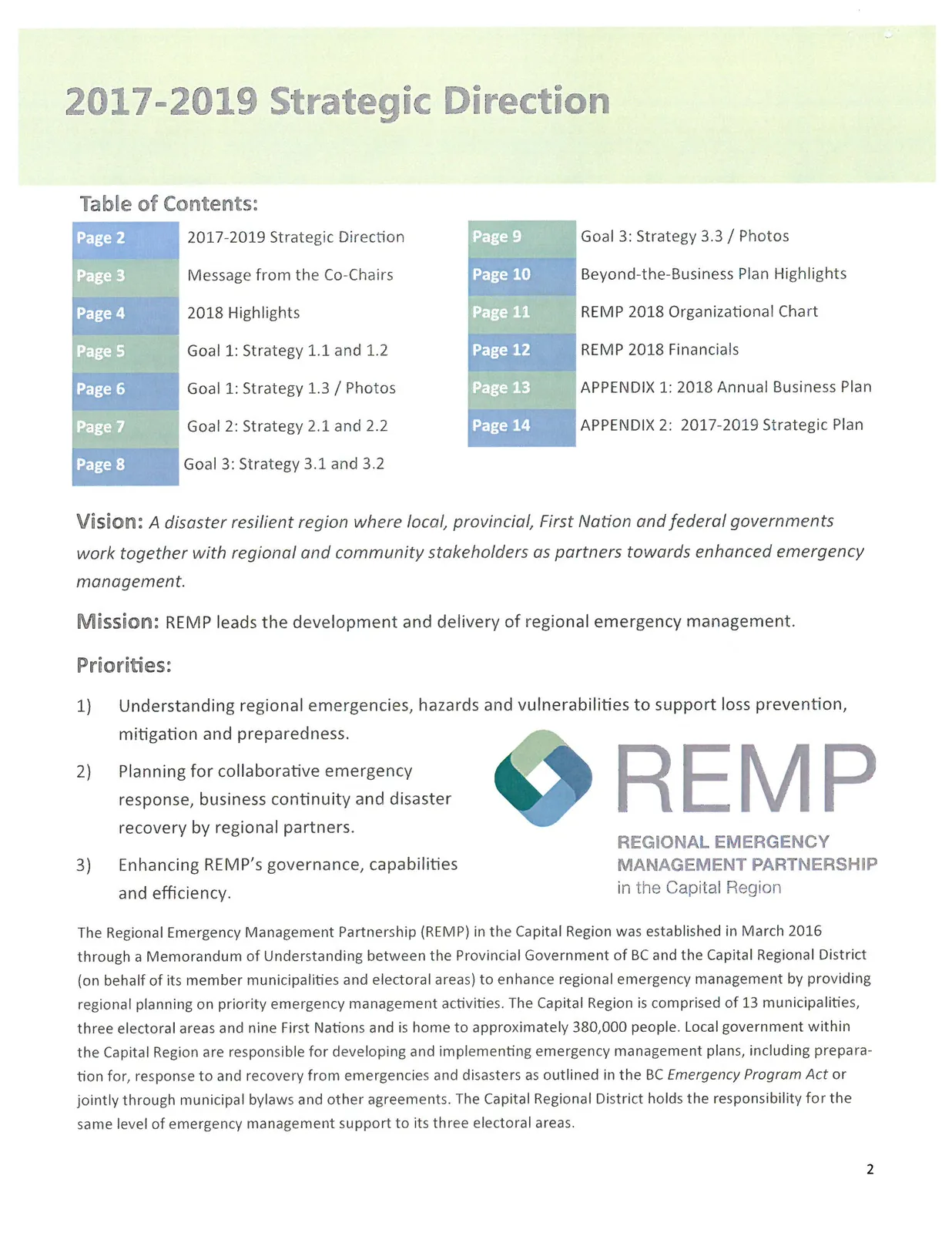
2017-2019 Strategic Direction
Table of Contents:
| Page | Section | Page | Section |
|---|---|---|---|
| Page 2 | 2017-2019 Strategic Direction | Page 9 | Goal 3: Strategy 3.3 / Photos |
| Page 3 | Message from the Co-Chairs | Page 10 | Beyond-the-Business Plan Highlights |
| Page 4 | 2018 Highlights | Page 11 | REMP 2018 Organizational Chart |
| Page 5 | Goal 1: Strategy 1.1 and 1.2 | Page 12 | REMP 2018 Financials |
| Page 6 | Goal 1: Strategy 1.3 / Photos | Page 13 | APPENDIX 1: 2018 Annual Business Plan |
| Page 7 | Goal 2: Strategy 2.1 and 2.2 | Page 14 | APPENDIX 2: 2017-2019 Strategic Plan |
| Page 8 | Goal 3: Strategy 3.1 and 3.2 |
Vision: A disaster resilient region where local, provincial, First Nation and federal governments work together with regional and community stakeholders as partners towards enhanced emergency management.
Mission: REMP leads the development and delivery of regional emergency management.
Priorities:
- Understanding regional emergencies, hazards and vulnerabilities to support loss prevention, mitigation and preparedness.
- Planning for collaborative emergency response, business continuity and disaster recovery by regional partners.
- Enhancing REMP's governance, capabilities and efficiency.
The Regional Emergency Management Partnership (REMP) in the Capital Region was established in March 2016 through a Memorandum of Understanding between the Provincial Government of BC and the Capital Regional District (on behalf of its member municipalities and electoral areas) to enhance regional emergency management by providing regional planning on priority emergency management activities. The Capital Region is comprised of 13 municipalities, three electoral areas and nine First Nations and is home to approximately 380,000 people. Local government within the Capital Region are responsible for developing and implementing emergency management plans, including preparation for, response to and recovery from emergencies and disasters as outlined in the BC Emergency Program Act or jointly through municipal bylaws and other agreements. The Capital Regional District holds the responsibility for the same level of emergency management support to its three electoral areas.
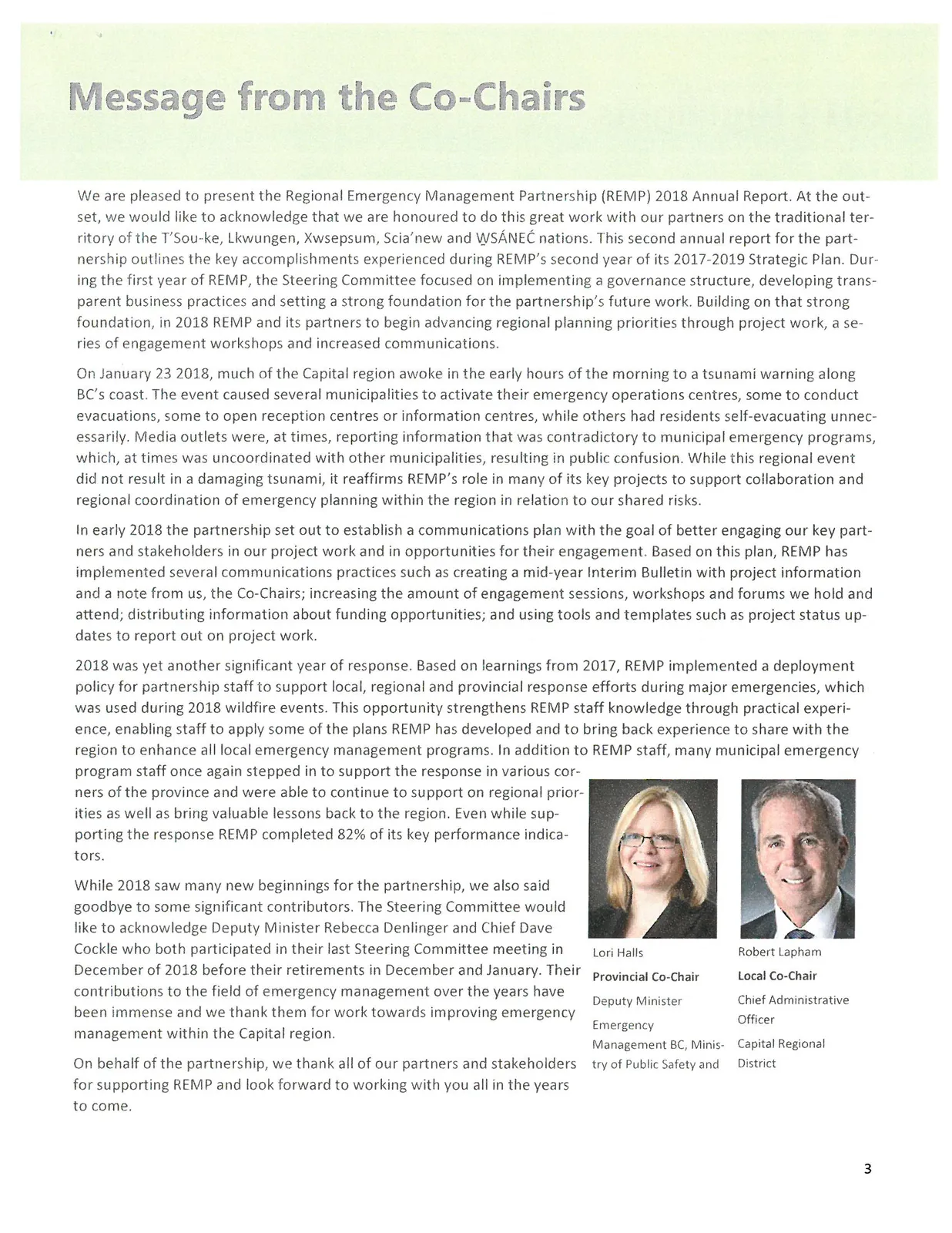
Message from the Co-Chairs
We are pleased to present the Regional Emergency Management Partnership (REMP) 2018 Annual Report. At the outset, we would like to acknowledge that we are honoured to do this great work with our partners on the traditional territory of the T'Sou-ke, Lkwungen, Xwsepsum, Scia'new and W̱SÁNEĆ nations. This second annual report for the partnership outlines the key accomplishments experienced during REMP's second year of its 2017-2019 Strategic Plan. During the first year of REMP, the Steering Committee focused on implementing a governance structure, developing transparent business practices and setting a strong foundation for the partnership's future work. Building on that strong foundation, in 2018 REMP and its partners to begin advancing regional planning priorities through project work, a series of engagement workshops and increased communications.
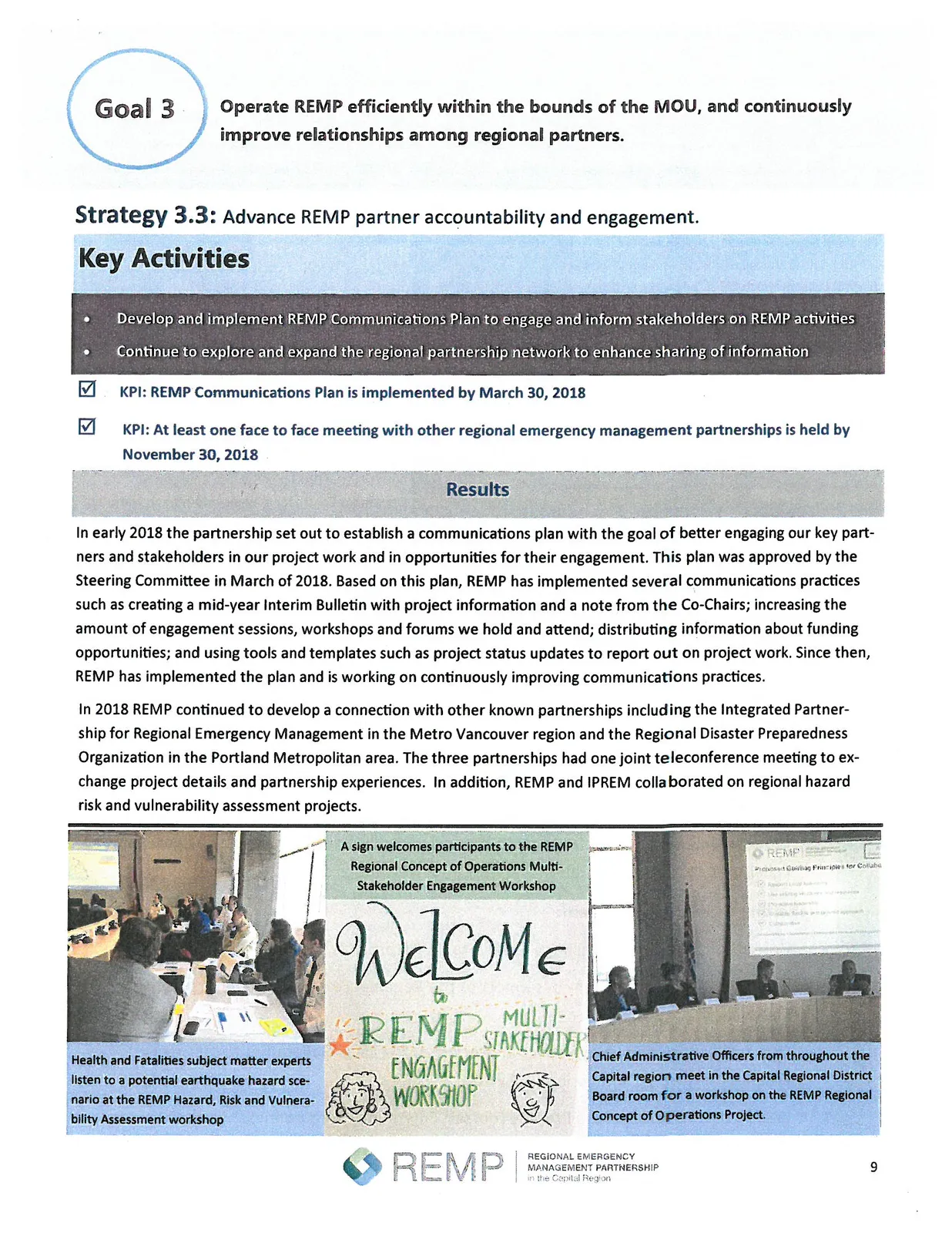
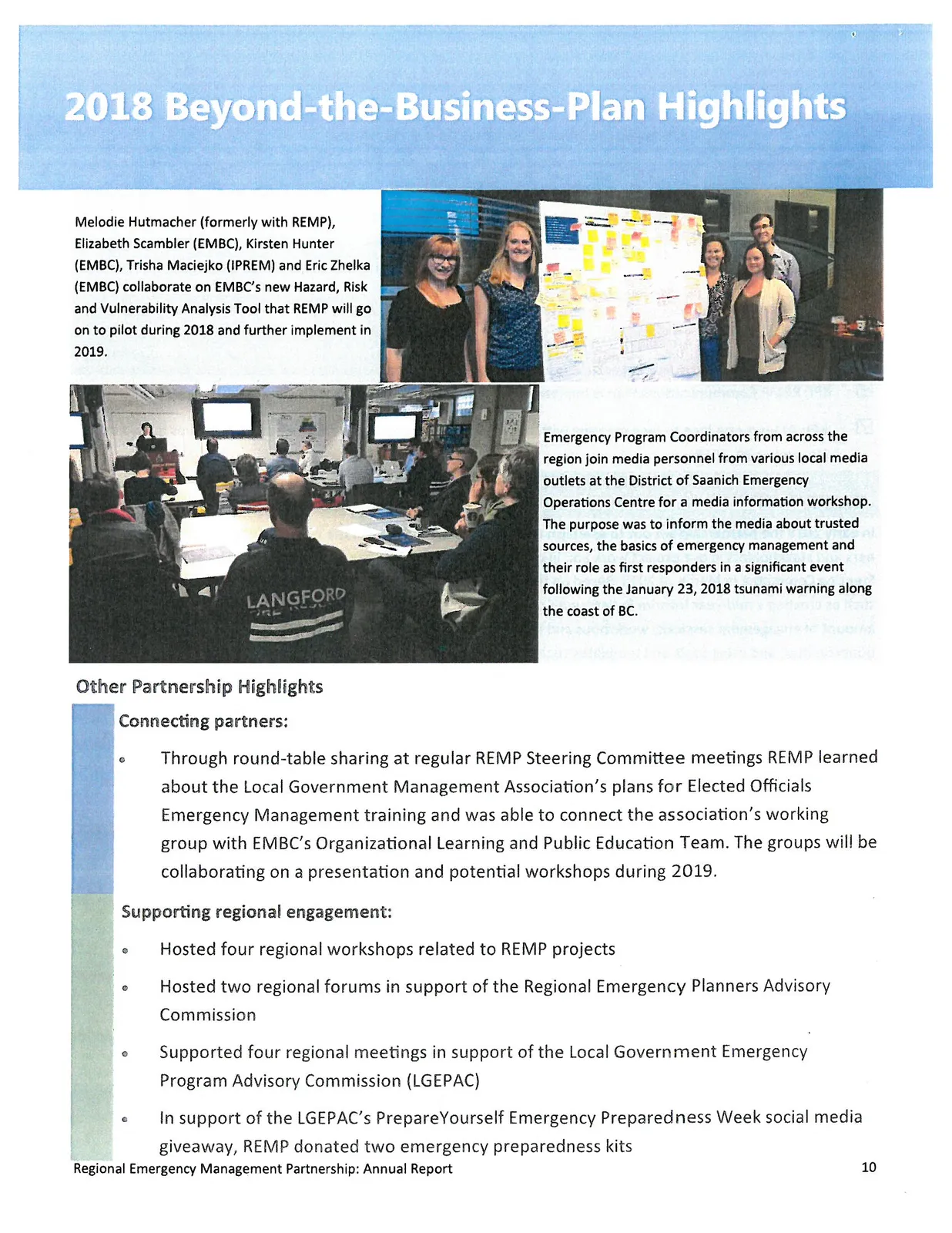
On January 23 2018, much of the Capital region awoke in the early hours of the morning to a tsunami warning along BC's coast. The event caused several municipalities to activate their emergency operations centres, some to conduct evacuations, some to open reception centres or information centres, while others had residents self-evacuating unnecessarily. Media outlets were, at times, reporting information that was contradictory to municipal emergency programs, which, at times was uncoordinated with other municipalities, resulting in public confusion. While this regional event did not result in a damaging tsunami, it reaffirms REMP's role in many of its key projects to support collaboration and regional coordination of emergency planning within the region in relation to our shared risks.
In early 2018 the partnership set out to establish a communications plan with the goal of better engaging our key partners and stakeholders in our project work and in opportunities for their engagement. Based on this plan, REMP has implemented several communications practices such as creating a mid-year Interim Bulletin with project information and a note from us, the Co-Chairs; increasing the amount of engagement sessions, workshops and forums we hold and attend; distributing information about funding opportunities; and using tools and templates such as project status updates to report out on project work.
2018 was yet another significant year of response. Based on learnings from 2017, REMP implemented a deployment policy for partnership staff to support local, regional and provincial response efforts during major emergencies, which was used during 2018 wildfire events. This opportunity strengthens REMP staff knowledge through practical experience, enabling staff to apply some of the plans REMP has developed and to bring back experience to share with the region to enhance all local emergency management programs. In addition to REMP staff, many municipal emergency program staff once again stepped in to support the response in various corners of the province and were able to continue to support on regional priorities as well as bring valuable lessons back to the region. Even while supporting the response REMP completed 82% of its key performance indicators.
While 2018 saw many new beginnings for the partnership, we also said goodbye to some significant contributors. The Steering Committee would like to acknowledge Deputy Minister Rebecca Denlinger and Chief Dave Cockle who both participated in their last Steering Committee meeting in December of 2018 before their retirements in December and January. Their contributions to the field of emergency management over the years have been immense and we thank them for work towards improving emergency management within the Capital region.
On behalf of the partnership, we thank all of our partners and stakeholders for supporting REMP and look forward to working with you all in the years to come.
2018 Highlights
- 82% of REMP's 2018 Key Performance Indicators were complete
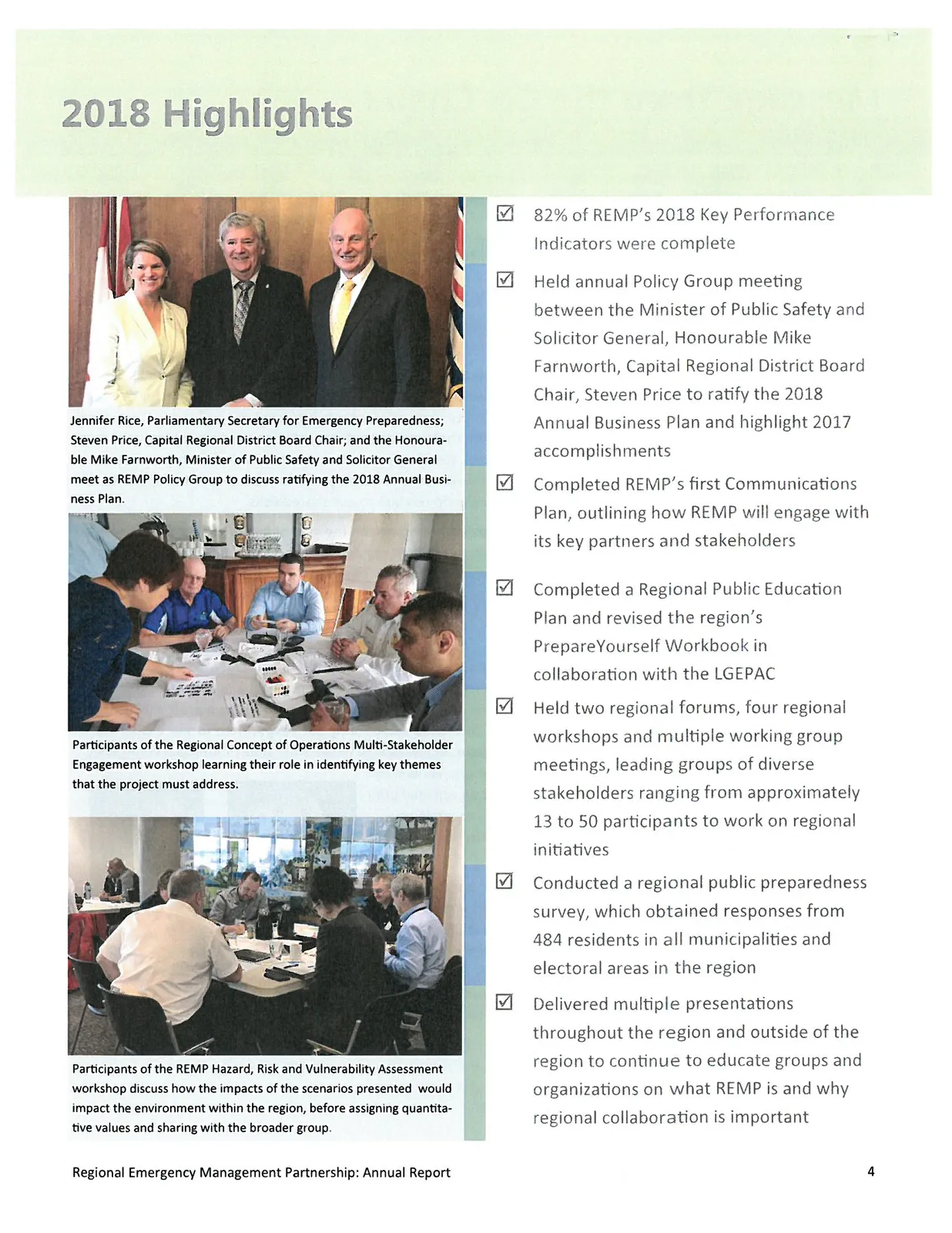
- Held annual Policy Group meeting between the Minister of Public Safety and Solicitor General, Honourable Mike Farnworth, Capital Regional District Board Chair, Steven Price to ratify the 2018 Annual Business Plan and highlight 2017 accomplishments
- Completed REMP's first Communications Plan, outlining how REMP will engage with its key partners and stakeholders
- Completed a Regional Public Education Plan and revised the region's PrepareYourself Workbook in collaboration with the LGEPAC
- Held two regional forums, four regional workshops and multiple working group meetings, leading groups of diverse stakeholders ranging from approximately 13 to 50 participants to work on regional initiatives
- Conducted a regional public preparedness survey, which obtained responses from 484 residents in all municipalities and electoral areas in the region
- Delivered multiple presentations throughout the region and outside of the region to continue to educate groups and organizations on what REMP is and why regional collaboration is important
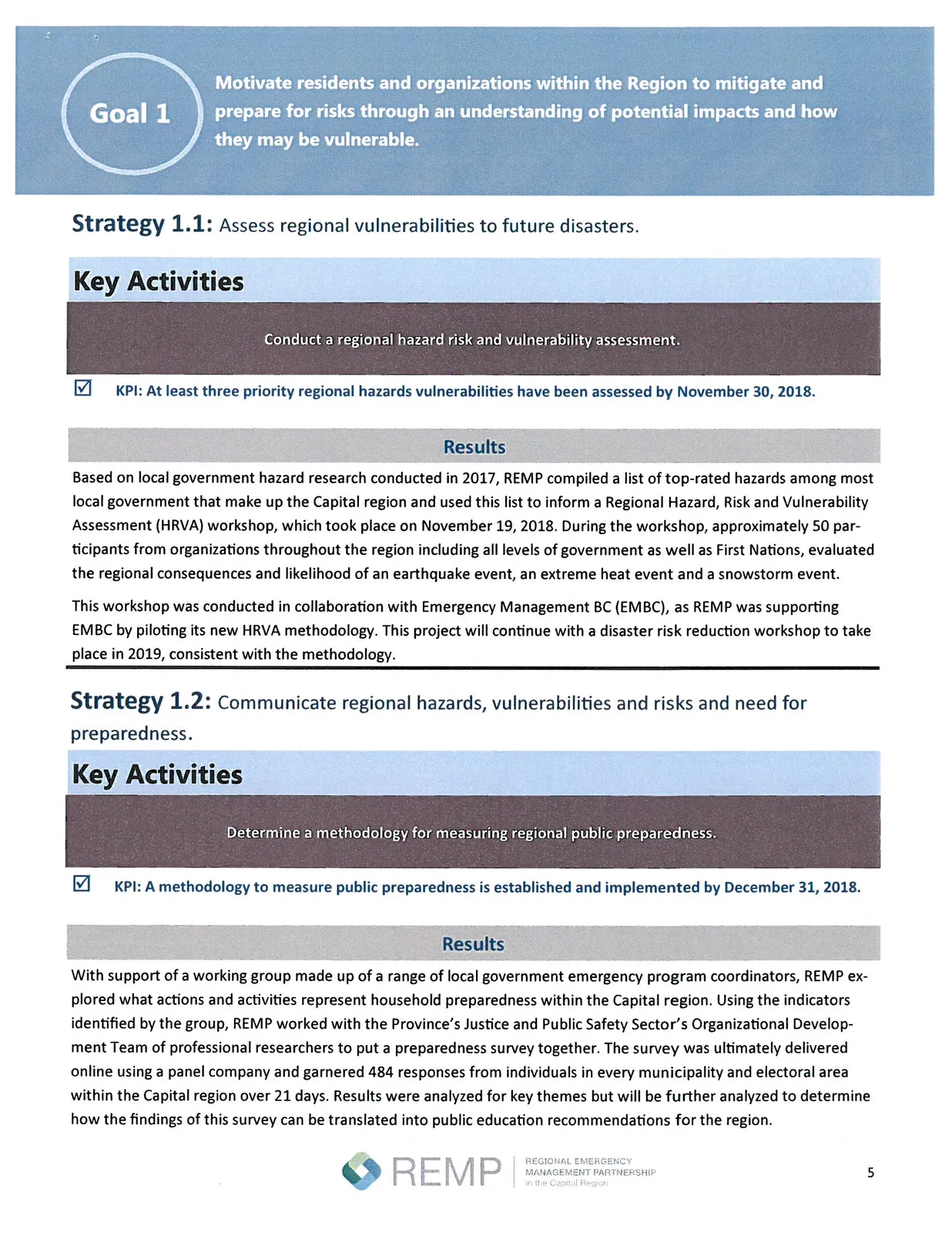
Goal 1: Motivate residents and organizations within the Region to mitigate and prepare for risks through an understanding of potential impacts and how they may be vulnerable.
Strategy 1.1: Assess regional vulnerabilities to future disasters.
Key Activities
- Conduct a regional hazard risk and vulnerability assessment.
KPI: At least three priority regional hazards vulnerabilities have been assessed by November 30, 2018. [Checked]
Results Based on local government hazard research conducted in 2017, REMP compiled a list of top-rated hazards among most local government that make up the Capital region and used this list to inform a Regional Hazard, Risk and Vulnerability Assessment (HRVA) workshop, which took place on November 19, 2018. During the workshop, approximately 50 participants from organizations throughout the region including all levels of government as well as First Nations, evaluated the regional consequences and likelihood of an earthquake event, an extreme heat event and a snowstorm event.
This workshop was conducted in collaboration with Emergency Management BC (EMBC), as REMP was supporting EMBC by piloting its new HRVA methodology. This project will continue with a disaster risk reduction workshop to take place in 2019, consistent with the methodology.
Strategy 1.2: Communicate regional hazards, vulnerabilities and risks and need for preparedness.
Key Activities
- Determine a methodology for measuring regional public preparedness.
KPI: A methodology to measure public preparedness is established and implemented by December 31, 2018. [Checked]
Results With support of a working group made up of a range of local government emergency program coordinators, REMP explored what actions and activities represent household preparedness within the Capital region. Using the indicators identified by the group, REMP worked with the Province's Justice and Public Safety Sector's Organizational Development Team of professional researchers to put a preparedness survey together. The survey was ultimately delivered online using a panel company and garnered 484 responses from individuals in every municipality and electoral area within the Capital region over 21 days. Results were analyzed for key themes but will be further analyzed to determine how the findings of this survey can be translated into public education recommendations for the region.
Strategy 1.3: Educate residents on mitigation options and benefits.
Key Activities
- Develop a regional public education plan to promote emergency preparedness activities
KPI: A regional public education plan is completed for implementation by municipalities by April 27, 2018. [Checked]
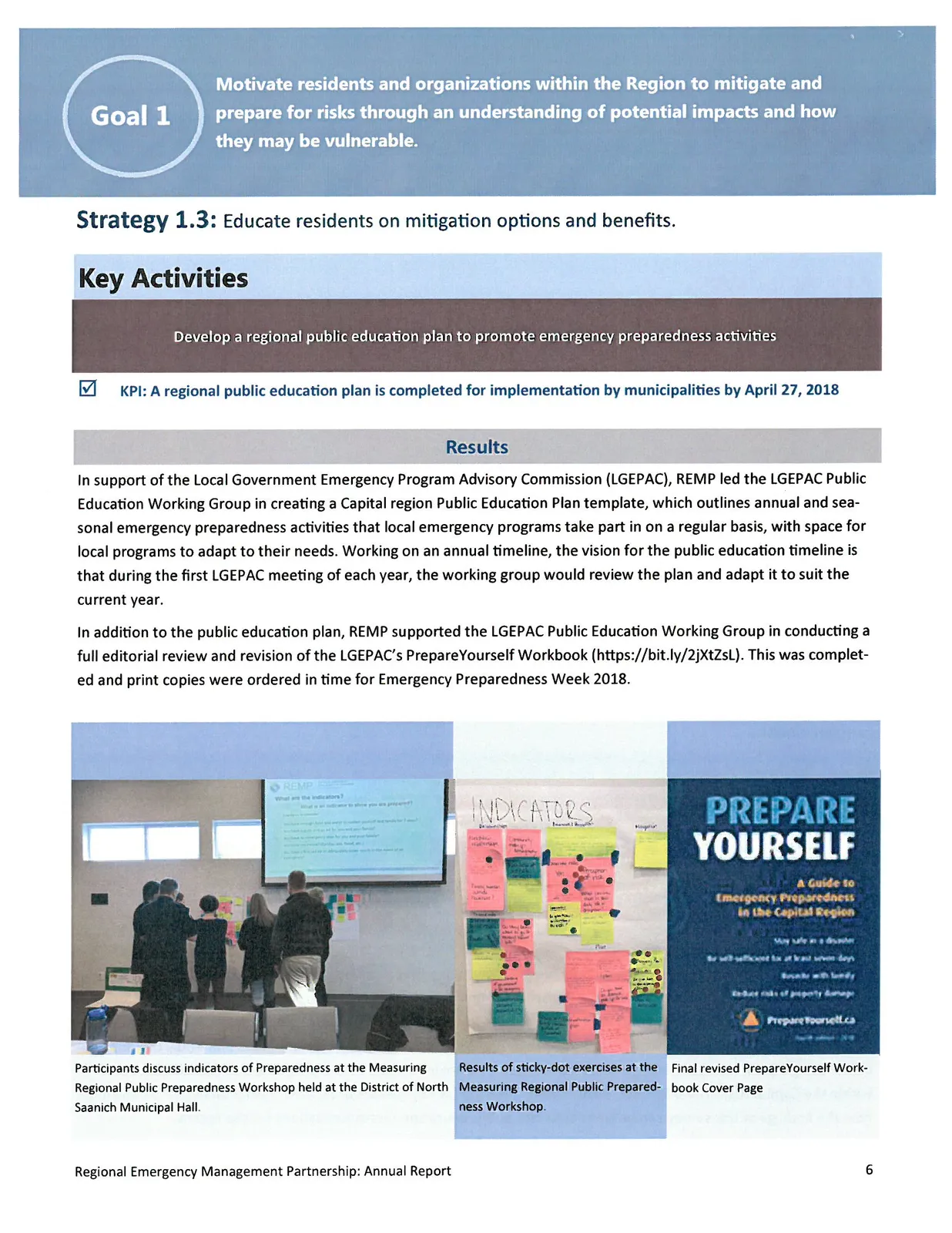
Results In support of the Local Government Emergency Program Advisory Commission (LGEPAC), REMP led the LGEPAC Public Education Working Group in creating a Capital region Public Education Plan template, which outlines annual and seasonal emergency preparedness activities that local emergency programs take part in on a regular basis, with space for local programs to adapt to their needs. Working on an annual timeline, the vision for the public education timeline is that during the first LGEPAC meeting of each year, the working group would review the plan and adapt it to suit the current year.
In addition to the public education plan, REMP supported the LGEPAC Public Education Working Group in conducting a full editorial review and revision of the LGEPAC's PrepareYourself Workbook (https://bit.ly/2jXtZsL). This was completed and print copies were ordered in time for Emergency Preparedness Week 2018.
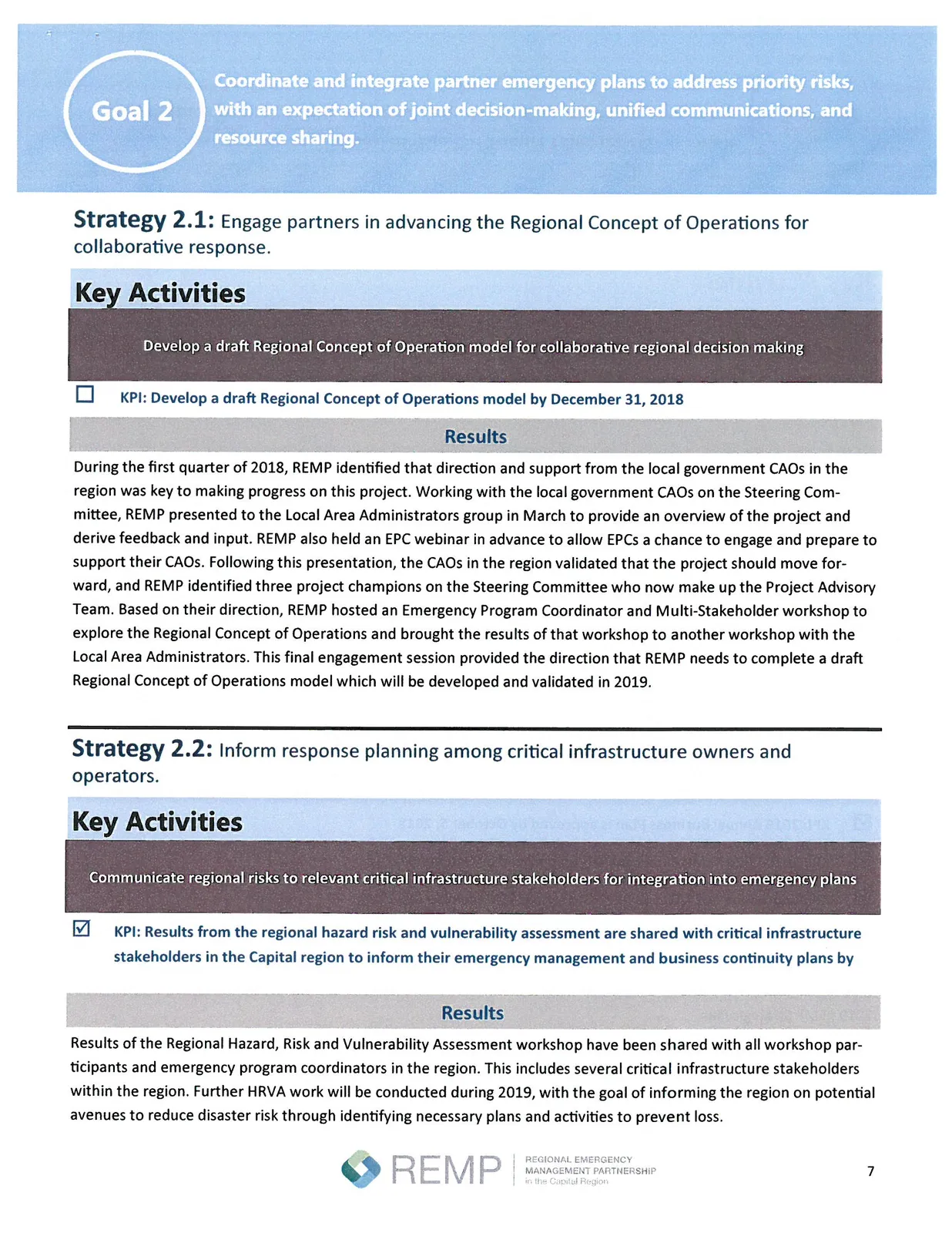
Goal 2: Coordinate and integrate partner emergency plans to address priority risks, with an expectation of joint decision-making, unified communications, and resource sharing.
Strategy 2.1: Engage partners in advancing the Regional Concept of Operations for collaborative response.
Key Activities
- Develop a draft Regional Concept of Operation model for collaborative regional decision making
KPI: Develop a draft Regional Concept of Operations model by December 31, 2018. [Unchecked]
Results During the first quarter of 2018, REMP identified that direction and support from the local government CAOs in the region was key to making progress on this project. Working with the local government CAOs on the Steering Committee, REMP presented to the Local Area Administrators group in March to provide an overview of the project and derive feedback and input. REMP also held an EPC webinar in advance to allow EPCs a chance to engage and prepare to support their CAOs. Following this presentation, the CAOs in the region validated that the project should move forward, and REMP identified three project champions on the Steering Committee who now make up the Project Advisory Team. Based on their direction, REMP hosted an Emergency Program Coordinator and Multi-Stakeholder workshop to explore the Regional Concept of Operations and brought the results of that workshop to another workshop with the Local Area Administrators. This final engagement session provided the direction that REMP needs to complete a draft Regional Concept of Operations model which will be developed and validated in 2019.
Strategy 2.2: Inform response planning among critical infrastructure owners and operators.
Key Activities
- Communicate regional risks to relevant critical infrastructure stakeholders for integration into emergency plans
KPI: Results from the regional hazard risk and vulnerability assessment are shared with critical infrastructure stakeholders in the Capital region to inform their emergency management and business continuity plans. [Checked]
Results Results of the Regional Hazard, Risk and Vulnerability Assessment workshop have been shared with all workshop participants and emergency program coordinators in the region. This includes several critical infrastructure stakeholders within the region. Further HRVA work will be conducted during 2019, with the goal of informing the region on potential avenues to reduce disaster risk through identifying necessary plans and activities to prevent loss.
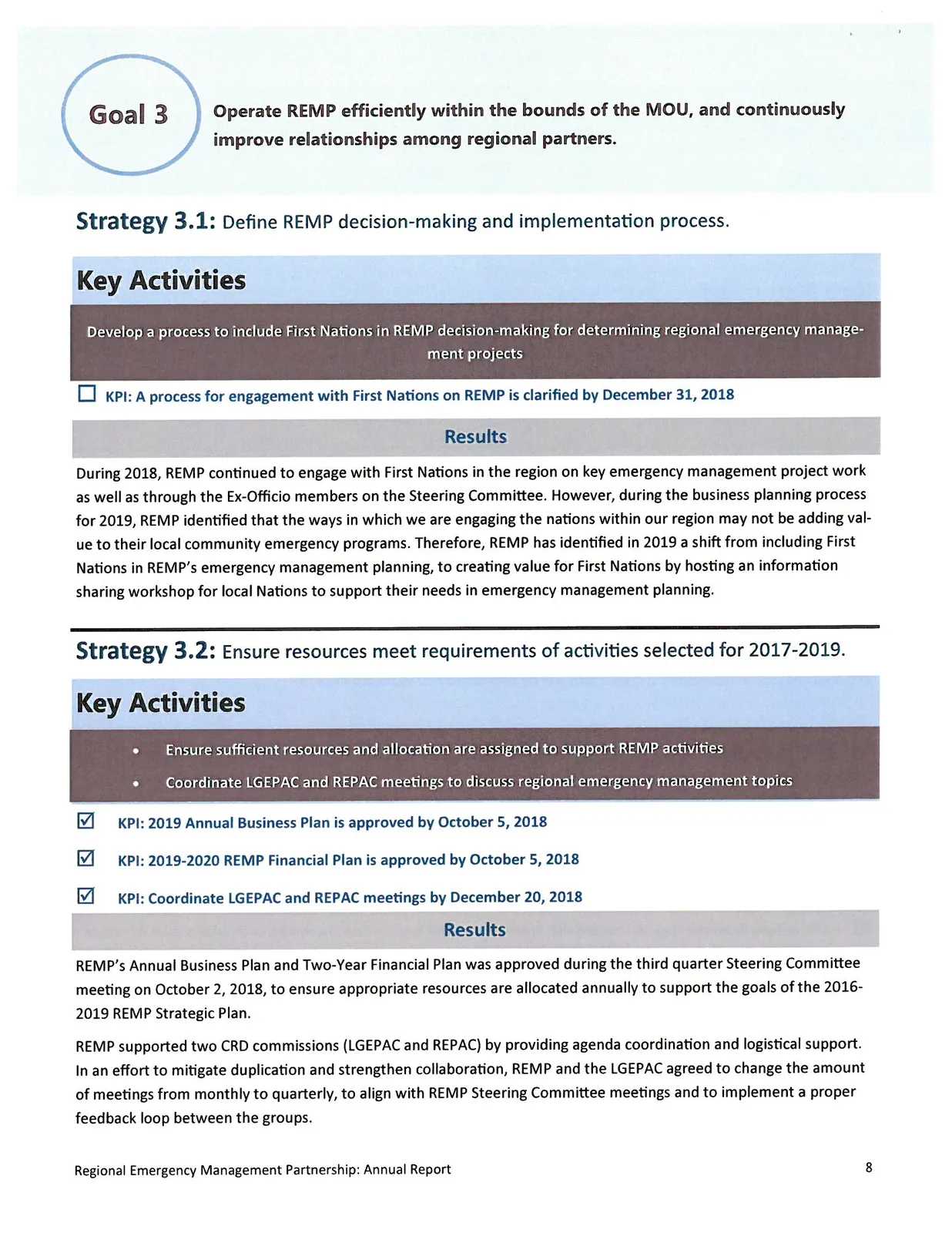
Goal 3: Operate REMP efficiently within the bounds of the MOU, and continuously improve relationships among regional partners.
Strategy 3.1: Define REMP decision-making and implementation process.
Key Activities
- Develop a process to include First Nations in REMP decision-making for determining regional emergency management projects
KPI: A process for engagement with First Nations on REMP is clarified by December 31, 2018. [Unchecked]
Results During 2018, REMP continued to engage with First Nations in the region on key emergency management project work as well as through the Ex-Officio members on the Steering Committee. However, during the business planning process for 2019, REMP identified that the ways in which we are engaging the nations within our region may not be adding value to their local community emergency programs. Therefore, REMP has identified in 2019 a shift from including First Nations in REMP's emergency management planning, to creating value for First Nations by hosting an information sharing workshop for local Nations to support their needs in emergency management planning.
Strategy 3.2: Ensure resources meet requirements of activities selected for 2017-2019.
Key Activities
- Ensure sufficient resources and allocation are assigned to support REMP activities
- Coordinate LGEPAC and REPAC meetings to discuss regional emergency management topics
KPI: 2019 Annual Business Plan is approved by October 5, 2018 [Checked] KPI: 2019-2020 REMP Financial Plan is approved by October 5, 2018 [Checked] KPI: Coordinate LGEPAC and REPAC meetings by December 20, 2018 [Checked]
Results REMP's Annual Business Plan and Two-Year Financial Plan was approved during the third quarter Steering Committee meeting on October 2, 2018, to ensure appropriate resources are allocated annually to support the goals of the 2016-2019 REMP Strategic Plan.
REMP supported two CRD commissions (LGEPAC and REPAC) by providing agenda coordination and logistical support. In an effort to mitigate duplication and strengthen collaboration, REMP and the LGEPAC agreed to change the amount of meetings from monthly to quarterly, to align with REMP Steering Committee meetings and to implement a proper feedback loop between the groups.
Strategy 3.3: Advance REMP partner accountability and engagement.
Key Activities
- Develop and implement REMP Communications Plan to engage and inform stakeholders on REMP activities
- Continue to explore and expand the regional partnership network to enhance sharing of information
KPI: REMP Communications Plan is implemented by March 30, 2018 [Checked] KPI: At least one face to face meeting with other regional emergency management partnerships is held by November 30, 2018 [Checked]
Results In early 2018 the partnership set out to establish a communications plan with the goal of better engaging our key partners and stakeholders in our project work and in opportunities for their engagement. This plan was approved by the Steering Committee in March of 2018. Based on this plan, REMP has implemented several communications practices such as creating a mid-year Interim Bulletin with project information and a note from the Co-Chairs; increasing the amount of engagement sessions, workshops and forums we hold and attend; distributing information about funding opportunities; and using tools and templates such as project status updates to report out on project work. Since then, REMP has implemented the plan and is working on continuously improving communications practices.
In 2018 REMP continued to develop a connection with other known partnerships including the Integrated Partnership for Regional Emergency Management in the Metro Vancouver region and the Regional Disaster Preparedness Organization in the Portland Metropolitan area. The three partnerships had one joint teleconference meeting to exchange project details and partnership experiences. In addition, REMP and IPREM collaborated on regional hazard risk and vulnerability assessment projects.
2018 Beyond-the-Business-Plan Highlights
Other Partnership Highlights
Connecting partners:
- Through round-table sharing at regular REMP Steering Committee meetings REMP learned about the Local Government Management Association's plans for Elected Officials Emergency Management training and was able to connect the association's working group with EMBC's Organizational Learning and Public Education Team. The groups will be collaborating on a presentation and potential workshops during 2019.
Supporting regional engagement:
- Hosted four regional workshops related to REMP projects
- Hosted two regional forums in support of the Regional Emergency Planners Advisory Commission
- Supported four regional meetings in support of the Local Government Emergency Program Advisory Commission (LGEPAC)
- In support of the LGEPAC's PrepareYourself Emergency Preparedness Week social media giveaway, REMP donated two emergency preparedness kits
2018 Organizational Chart
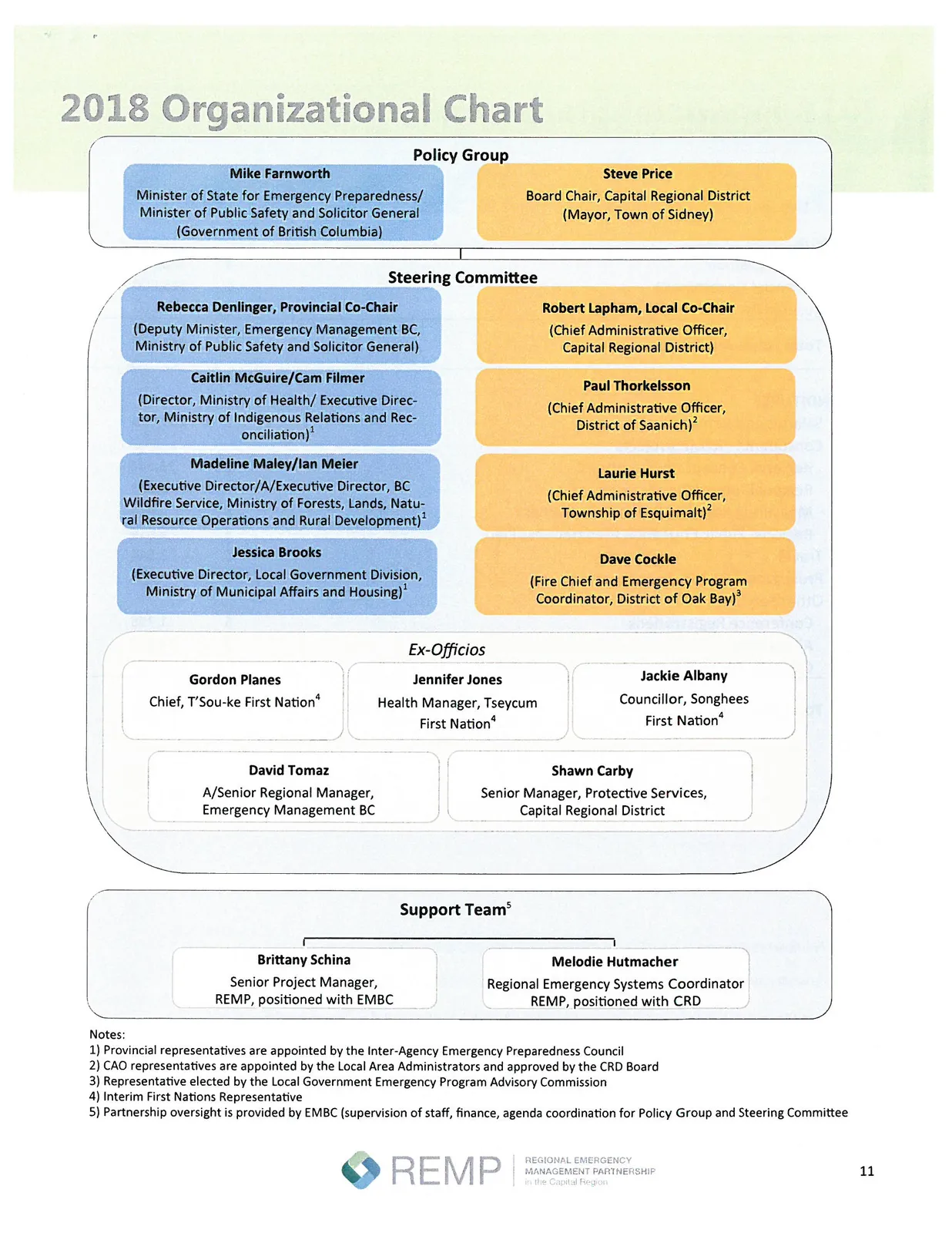
Policy Group
- Mike Farnworth, Minister of State for Emergency Preparedness / Minister of Public Safety and Solicitor General (Government of British Columbia)
- Steve Price, Board Chair, Capital Regional District (Mayor, Town of Sidney)
Steering Committee
- Rebecca Denlinger, Provincial Co-Chair (Deputy Minister, Emergency Management BC, Ministry of Public Safety and Solicitor General)
- Robert Lapham, Local Co-Chair (Chief Administrative Officer, Capital Regional District)
- Caitlin McGuire/Cam Filmer (Director, Ministry of Health / Executive Director, Ministry of Indigenous Relations and Reconciliation)¹
- Paul Thorkelsson (Chief Administrative Officer, District of Saanich)²
- Madeline Maley/Ian Meier (Executive Director/A/Executive Director, BC Wildfire Service, Ministry of Forests, Lands, Natural Resource Operations and Rural Development)¹
- Laurie Hurst (Chief Administrative Officer, Township of Esquimalt)²
- Jessica Brooks (Executive Director, Local Government Division, Ministry of Municipal Affairs and Housing)¹
- Dave Cockle (Fire Chief and Emergency Program Coordinator, District of Oak Bay)³
Ex-Officios
- Gordon Planes, Chief, T'Sou-ke First Nation⁴
- Jennifer Jones, Health Manager, Tseycum First Nation⁴
- Jackie Albany, Councillor, Songhees First Nation⁴
- David Tomaz, A/Senior Regional Manager, Emergency Management BC
- Shawn Carby, Senior Manager, Protective Services, Capital Regional District
Support Team⁵
- Brittany Schina, Senior Project Manager, REMP, positioned with EMBC
- Melodie Hutmacher, Regional Emergency Systems Coordinator, REMP, positioned with CRD
Notes:
- Provincial representatives are appointed by the Inter-Agency Emergency Preparedness Council
- CAO representatives are appointed by the Local Area Administrators and approved by the CRD Board
- Representative elected by the Local Government Emergency Program Advisory Commission
- Interim First Nations Representative
- Partnership oversight is provided by EMBC (supervision of staff, finance, agenda coordination for Policy Group and Steering Committee)
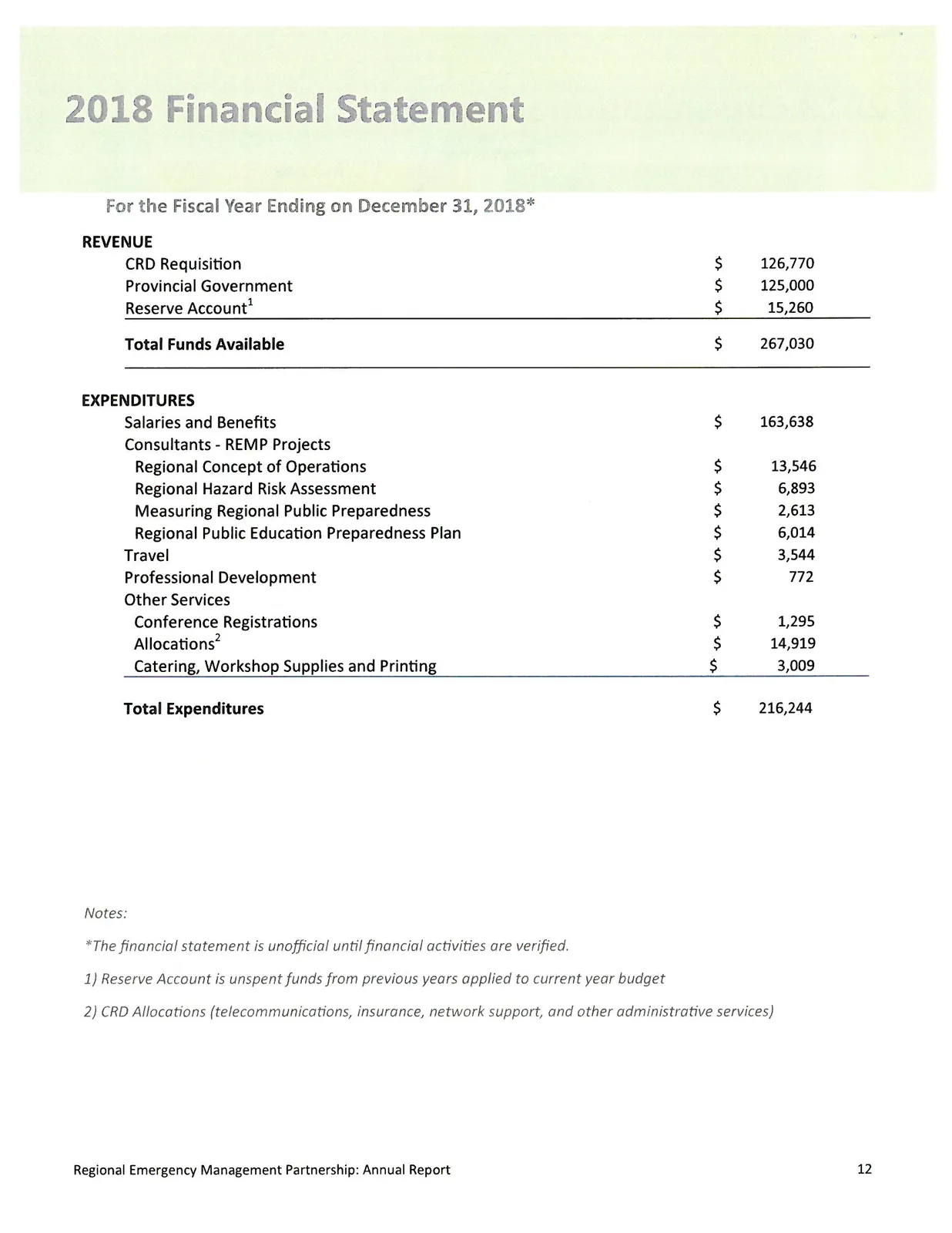
2018 Financial Statement
For the Fiscal Year Ending on December 31, 2018*
| REVENUE | |
|---|---|
| CRD Requisition | $ 126,770 |
| Provincial Government | $ 125,000 |
| Reserve Account¹ | $ 15,260 |
| Total Funds Available | $ 267,030 |
| EXPENDITURES | |
|---|---|
| Salaries and Benefits | $ 163,638 |
| Consultants - REMP Projects | |
| Regional Concept of Operations | $ 13,546 |
| Regional Hazard Risk Assessment | $ 6,893 |
| Measuring Regional Public Preparedness | $ 2,613 |
| Regional Public Education Preparedness Plan | $ 6,014 |
| Travel | $ 3,544 |
| Professional Development | $ 772 |
| Other Services | |
| Conference Registrations | $ 1,295 |
| Allocations² | $ 14,919 |
| Catering, Workshop Supplies and Printing | $ 3,009 |
| Total Expenditures | $ 216,244 |
Notes: *The financial statement is unofficial until financial activities are verified.
- Reserve Account is unspent funds from previous years applied to current year budget
- CRD Allocations (telecommunications, insurance, network support, and other administrative services)
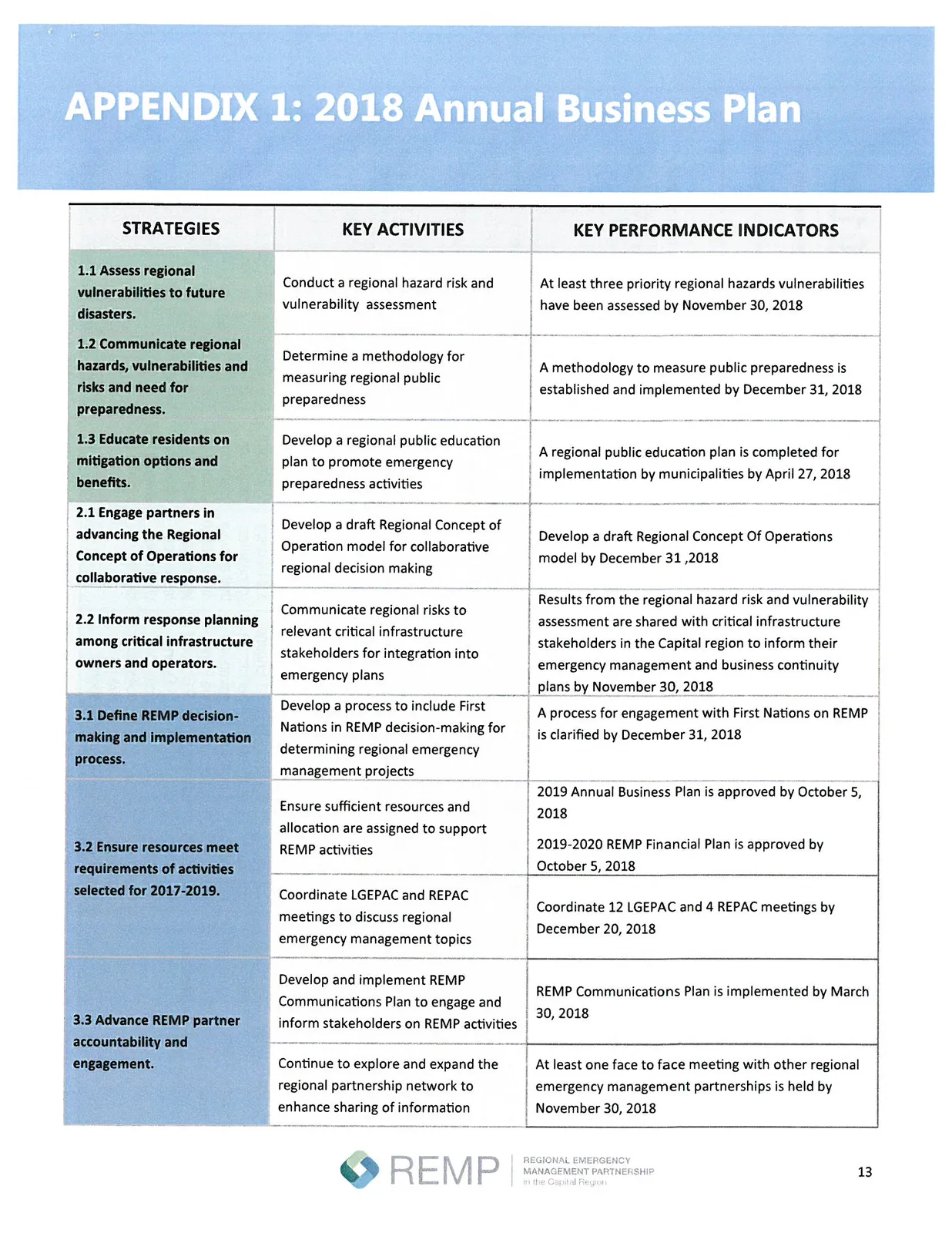
APPENDIX 1: 2018 Annual Business Plan
| STRATEGIES | KEY ACTIVITIES | KEY PERFORMANCE INDICATORS |
|---|---|---|
| 1.1 Assess regional vulnerabilities to future disasters. | Conduct a regional hazard risk and vulnerability assessment | At least three priority regional hazards vulnerabilities have been assessed by November 30, 2018 |
| 1.2 Communicate regional hazards, vulnerabilities and risks and need for preparedness. | Determine a methodology for measuring regional public preparedness | A methodology to measure public preparedness is established and implemented by December 31, 2018 |
| 1.3 Educate residents on mitigation options and benefits. | Develop a regional public education plan to promote emergency preparedness activities | A regional public education plan is completed for implementation by municipalities by April 27, 2018 |
| 2.1 Engage partners in advancing the Regional Concept of Operations for collaborative response. | Develop a draft Regional Concept of Operation model for collaborative regional decision making | Develop a draft Regional Concept Of Operations model by December 31, 2018 |
| 2.2 Inform response planning among critical infrastructure owners and operators. | Communicate regional risks to relevant critical infrastructure stakeholders for integration into emergency plans | Results from the regional hazard risk and vulnerability assessment are shared with critical infrastructure stakeholders in the Capital region to inform their emergency management and business continuity plans by November 30, 2018 |
| 3.1 Define REMP decision-making and implementation process. | Develop a process to include First Nations in REMP decision-making for determining regional emergency management projects | A process for engagement with First Nations on REMP is clarified by December 31, 2018 |
| 3.2 Ensure resources meet requirements of activities selected for 2017-2019. | Ensure sufficient resources and allocation are assigned to support REMP activities; Coordinate LGEPAC and REPAC meetings to discuss regional emergency management topics | 2019 Annual Business Plan is approved by October 5, 2018; 2019-2020 REMP Financial Plan is approved by October 5, 2018; Coordinate 12 LGEPAC and 4 REPAC meetings by December 20, 2018 |
| 3.3 Advance REMP partner accountability and engagement. | Develop and implement REMP Communications Plan to engage and inform stakeholders on REMP activities; Continue to explore and expand the regional partnership network to enhance sharing of information | REMP Communications Plan is implemented by March 30, 2018; At least one face to face meeting with other regional emergency management partnerships is held by November 30, 2018 |
APPENDIX 2: REMP Strategic Plan—2017-2019
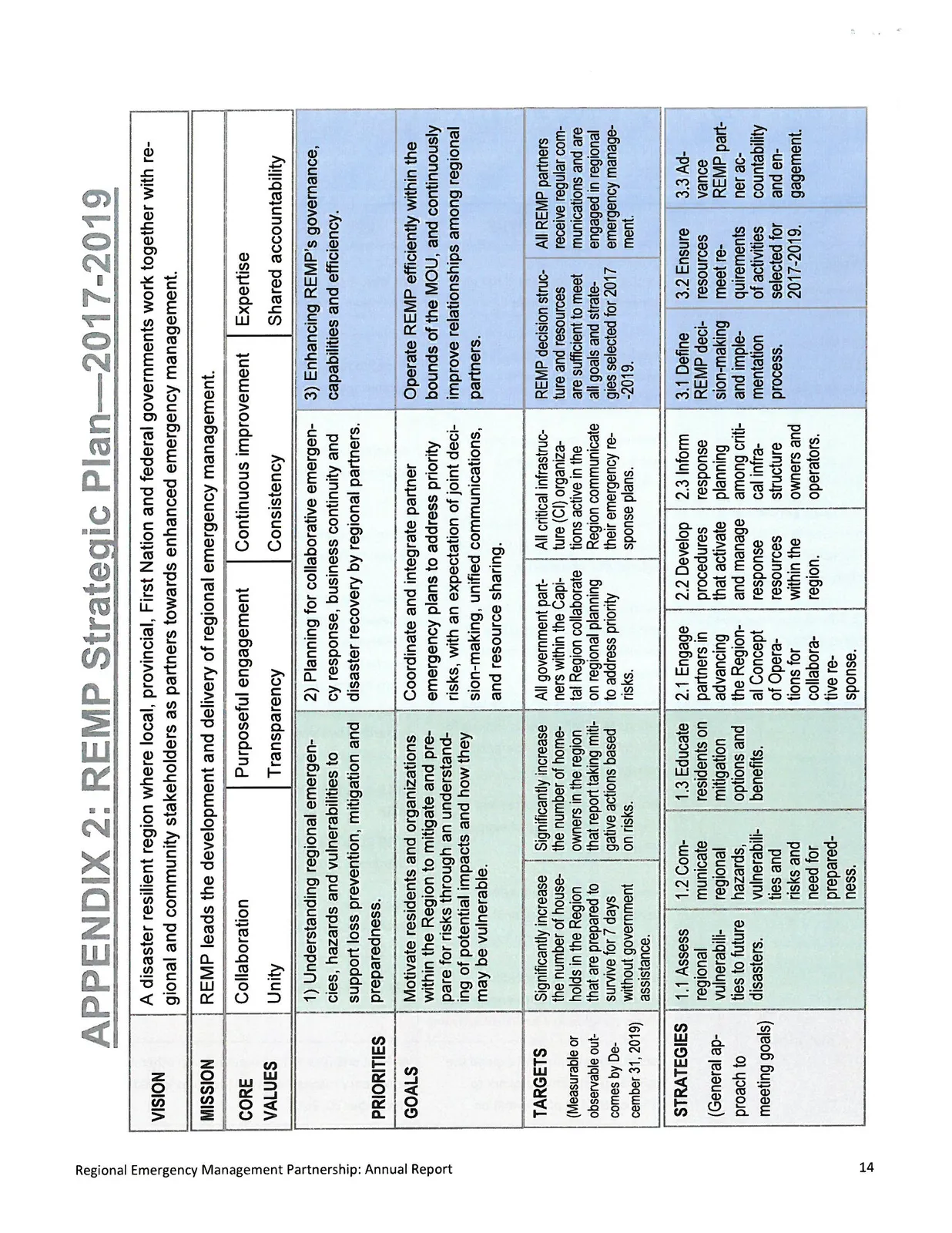
VISION: A disaster resilient region where local, provincial, First Nation and federal governments work together with regional and community stakeholders as partners towards enhanced emergency management.
MISSION: REMP leads the development and delivery of regional emergency management.
| CORE VALUES | Collaboration | Purposeful engagement | Continuous improvement | Expertise |
|---|---|---|---|---|
| Unity | Transparency | Consistency | Shared accountability |
PRIORITIES:
- Understanding regional emergencies, hazards and vulnerabilities to support loss prevention, mitigation and preparedness.
- Planning for collaborative emergency response, business continuity and disaster recovery by regional partners.
- Enhancing REMP's governance, capabilities and efficiency.
| GOALS | Motivate residents and organizations within the Region to mitigate and prepare for risks through an understanding of potential impacts and how they may be vulnerable. | Coordinate and integrate partner emergency plans to address priority risks, with an expectation of joint decision-making, unified communications, and resource sharing. | Operate REMP efficiently within the bounds of the MOU, and continuously improve relationships among regional partners. |
|---|---|---|---|
| TARGETS (Measurable outcomes by Dec 31, 2019) | Significantly increase the number of households in the Region that are prepared to survive for 7 days without government assistance. | Significantly increase the number of homeowners in the region that report taking mitigative actions based on risks. | All government partners within the Capital Region collaborate on regional planning to address priority risks. |
| STRATEGIES (General approach to meeting goals) | 1.1 Assess regional vulnerabilities to future disasters. | 1.2 Communicate regional hazards, vulnerabilities and risks and need for preparedness. | 1.3 Educate residents on mitigation options and benefits. |
Document Images
(7)