Memorandum of Understanding: Regional Concept of Operations for Emergency Response in the Capital Region
The draft MOU establishing the Regional Concept of Operations between the Province, municipalities, and First Nations.
Memorandum of Understanding
Regional Concept of Operations for Emergency Response in the Capital Region
BETWEEN:
- District of Central Saanich
- City of Colwood
- Township of Esquimalt
- District of Highlands
- City of Langford
- District of Metchosin
- District of North Saanich
- District of Oak Bay
- District of Saanich
- District of Sooke
- Town of Sidney
- City of Victoria
- Town of View Royal
- Capital Regional District on behalf of Juan De Fuca Electoral Area, Salt Spring Island Electoral Area and Southern Gulf Islands Electoral Area
AND:
- Esquimalt Nation
- Pacheedaht First Nation
- Pauquachin First Nation
- Scia'new First Nation
- Songhees Nation
- T'Sou-ke Nation
- Tsartlip First Nation
- Tsawout First Nation
- Tseycum First Nation
AND:
HER MAJESTY THE QUEEN IN RIGHT OF THE PROVINCE OF BRITISH COLUMBIA, as represented by the Minister of Public Safety and Solicitor General (herein referred to as the "Province")
WHEREAS:
a) Events of Regional Emergency Significance can occur that cross municipal, electoral area or First Nation boundaries or have impacts or demand for response beyond the capacity of one municipality, one electoral area or one First Nation to respond; b) Events of Regional Emergency Significance can occur that are cross-jurisdictional in nature or require a coordinated multi-jurisdictional, multi-agency response; c) The Parties each acknowledge that the interests of all persons living within their jurisdiction are best served by a coordinated response and regional collaboration during Events of Regional Emergency Significance; and d) The Parties wish to enter into this Memorandum of Understanding ("MOU") in order to build upon existing working relationships and to facilitate collaboration, decision making, and information-sharing between the Parties during Events of Regional Emergency Significance.
THEREFORE:
a) The Parties agree to establish a Regional Concept of Operations for Events of Regional Emergency Significance in the Capital Region; and b) The Parties agree to train and exercise the Regional Concept of Operations every two years, under the coordination of the Regional Emergency Management Partnership or any one of the Parties.
ARTICLE 1: INTERPRETATION
For the purposes of this MOU:
1.1 "Emergency" is a present or imminent event or circumstance that:
- is caused by accident, fire, explosion, technical failure or the forces of nature, and
- requires prompt coordination of action or special regulation of persons or property to protect the health, safety or welfare of a person, or persons, or to limit damage to property.
1.2 "Emergency Management" describes the systems and processes for preventing and mitigating, preparing for, and responding to, and recovery from emergencies and disasters.
1.3 "Event of Regional Emergency Significance" is a major event that has (or has the potential to have) an extraordinary level of risk to lives, property, environment, social and/or economic well being across jurisdictional boundaries in the region, which could require one or more of the following:
- Non-routine levels of coordination
- Sharing of situational awareness information
- Joint decision making
- Prioritizing resources
- Allocating of resources
- Response by multiple stakeholders (local government, First Nations, agencies etc)
1.4 "First Nations" means the Esquimalt Nation, Pacheedaht First Nation, Pauquachin First Nation, Scia'new First Nation, Songhees Nation, T'Sou-ke Nation, Tsartlip First Nation, Tsawout First Nation and Tseycum First Nation.
1.5 "Parties" means all parties to this MOU, and "Party" means one of them as the context may require.
1.6 "Regional Concept of Operations" is an emergency response framework to expedite decision making on regional issues, share information and cooperate during an event of regional significance, attached as Schedule 'A', as amended from time to time by mutual written agreement duly executed by the Parties to this Agreement.
1.7 "Regional Emergency Management Partnership" is the partnership established pursuant to the March 2016 memorandum of understanding between the Province of British Columbia and the Capital Regional District to lead and coordinate emergency management planning in the Capital Region.
1.8 "Capital Region" or "Regional" is the broad geographical area within the Capital Regional District and First Nations traditional territories that may be, but is not limited to, distinguished by physical characteristics, administrative boundaries, government, religion, language, or artificial features.
1.9 "Sub Region" is a subset of the Region that may be, but is not limited to, distinguished by physical characteristics, administrative boundaries, government, religion, language or artificial features.
ARTICLE 2: APPLICATION OF GOVERNING AGREEMENTS AND LEGISLATIONS
2.1 Nothing in this MOU shall be interpreted as limiting in any way the jurisdiction, authority and fulfillment of responsibilities of: a) The Minister and Ministry of Public Safety and Solicitor General in respect to Emergency management under the British Columbia Emergency Program Act, R.S.B.C. 1996, c. 111, and Regulations or any other Acts or Regulations; b) Municipalities and electoral areas in the Capital Regional District in respect to emergency management under British Columbia's Emergency Program Act, Local Government Act, R.S.B.C. 2015, c. 1, and Regulations or any other Acts or Regulations; or, c) First Nations in respect to emergency management under the Federal Emergency Management Act, S.C. 2007, c. 15.
ARTICLE 3: PURPOSE
3.1 The Parties wish to implement the Regional Concept of Operations to guide emergency response in the Capital Region.
3.2 The Parties recognize the value of and will seek opportunities for First Nations participation and input into the continuing development of the Regional Concept of Operations.
3.3 This MOU will guide the Parties in their efforts to collaborate during Events of Regional Emergency Significance based on the following principles:
- Respect local autonomy
- Local Authorities will remain the lead authority and maintain their autonomy with regards to emergencies within their jurisdictions
- Utilize existing structures
- The Regional Concept of Operations is based on the integration of existing agencies and authorities who play a role in planning, responding, and recovering from regional emergencies. The Regional Concept of Operations does not include the creation of any new regional emergency response function, organization, or facility.
- Utilize existing resources
- The Regional Concept of Operations utilizes existing resources and facilities to the greatest extent possible and recognizes that in regional emergencies additional resources may be required
- Pro-active leadership
- The Regional Concept of Operations is built on pro-active leadership aimed at identifying regional issues and clarifying roles, responsibilities and protocols prior to any regional emergency
- Scalable, flexible and layered approach
- The Regional Concept of Operations is scalable, flexible, and involves layers of authority and responsibility that reflect current structure (Note: The Regional Concept of Operations does not create new layers of authority)
- Collaborative decision making
- The Regional Concept of Operations uses collaborative decision making and is consensus based
3.4 The Parties agree to collaborate to achieve the following common objectives:
a) Engage senior level decision makers (e.g. local government Chief Administrative Officers) within the Capital Region in emergency management to enhance understanding and responsiveness in Events of Regional Emergency Significance. b) Utilize the Regional Concept of Operations during Events of Regional Emergency Significance to address: i. decision making on regional issues ii. enhance regional situation awareness iii. regional priority setting iv. expedite resource sharing v. joint public messaging c) Improve regional emergency management in the Capital Region through continued and increased regional cooperation during Events of Regional Emergency Significance while recognizing the benefits within and beyond the Capital Region.
3.5 This MOU: a) is not legally binding or enforceable; and b) does not affect any aboriginal right, title or interest of First Nations; and
ARTICLE 4: COMMUNICATION
4.1 External communications by the Parties with other levels of government, the media, and other entities, corporations or individuals will be consistent with protocols established by the Parties or their respective organizations.
4.2 The Parties agree to work together to develop public announcements and other messaging related to this MOU.
ARTICLE 5: EFFECT OF AGREEMENT
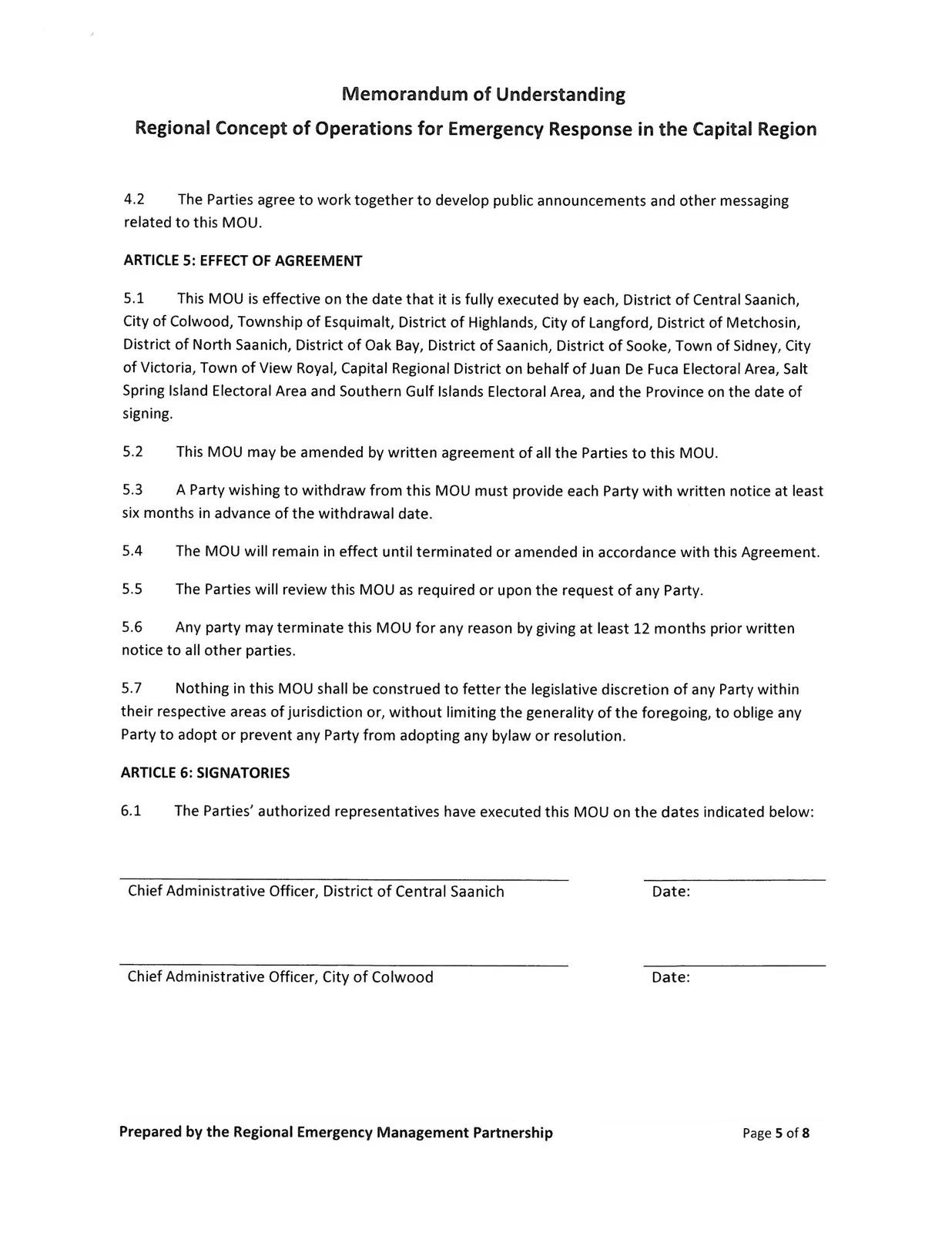
5.1 This MOU is effective on the date that it is fully executed by each, District of Central Saanich, City of Colwood, Township of Esquimalt, District of Highlands, City of Langford, District of Metchosin, District of North Saanich, District of Oak Bay, District of Saanich, District of Sooke, Town of Sidney, City of Victoria, Town of View Royal, Capital Regional District on behalf of Juan De Fuca Electoral Area, Salt Spring Island Electoral Area and Southern Gulf Islands Electoral Area, and the Province on the date of signing.
5.2 This MOU may be amended by written agreement of all the Parties to this MOU.
5.3 A Party wishing to withdraw from this MOU must provide each Party with written notice at least six months in advance of the withdrawal date.
5.4 The MOU will remain in effect until terminated or amended in accordance with this Agreement.
5.5 The Parties will review this MOU as required or upon the request of any Party.
5.6 Any party may terminate this MOU for any reason by giving at least 12 months prior written notice to all other parties.
5.7 Nothing in this MOU shall be construed to fetter the legislative discretion of any Party within their respective areas of jurisdiction or, without limiting the generality of the foregoing, to oblige any Party to adopt or prevent any Party from adopting any bylaw or resolution.
ARTICLE 6: SIGNATORIES
6.1 The Parties' authorized representatives have executed this MOU on the dates indicated below:
Chief Administrative Officer, District of Central Saanich Date: ________________________
Chief Administrative Officer, City of Colwood Date: ________________________
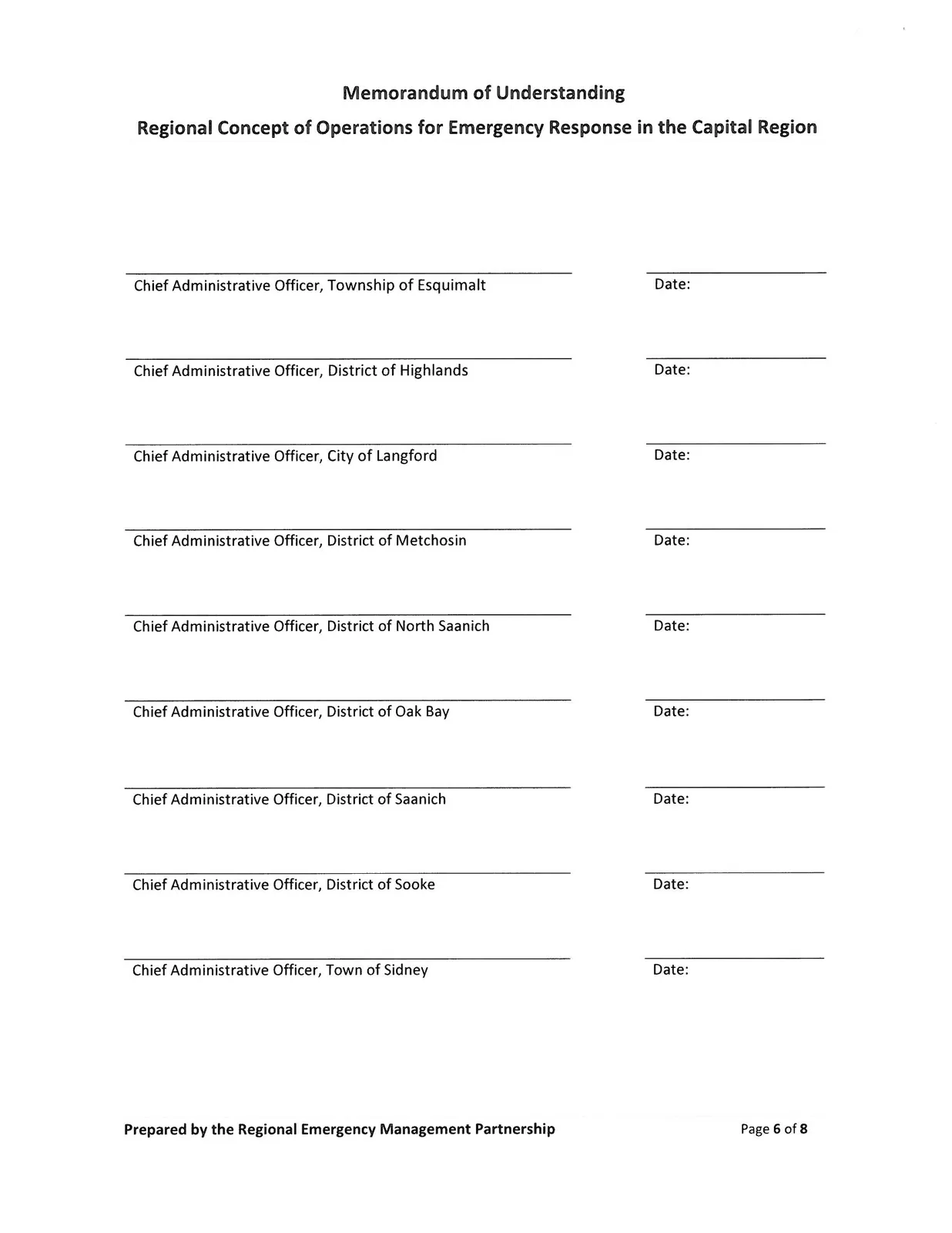
Chief Administrative Officer, Township of Esquimalt Date: ________________________
Chief Administrative Officer, District of Highlands Date: ________________________
Chief Administrative Officer, City of Langford Date: ________________________
Chief Administrative Officer, District of Metchosin Date: ________________________
Chief Administrative Officer, District of North Saanich Date: ________________________
Chief Administrative Officer, District of Oak Bay Date: ________________________
Chief Administrative Officer, District of Saanich Date: ________________________
Chief Administrative Officer, District of Sooke Date: ________________________
Chief Administrative Officer, Town of Sidney Date: ________________________
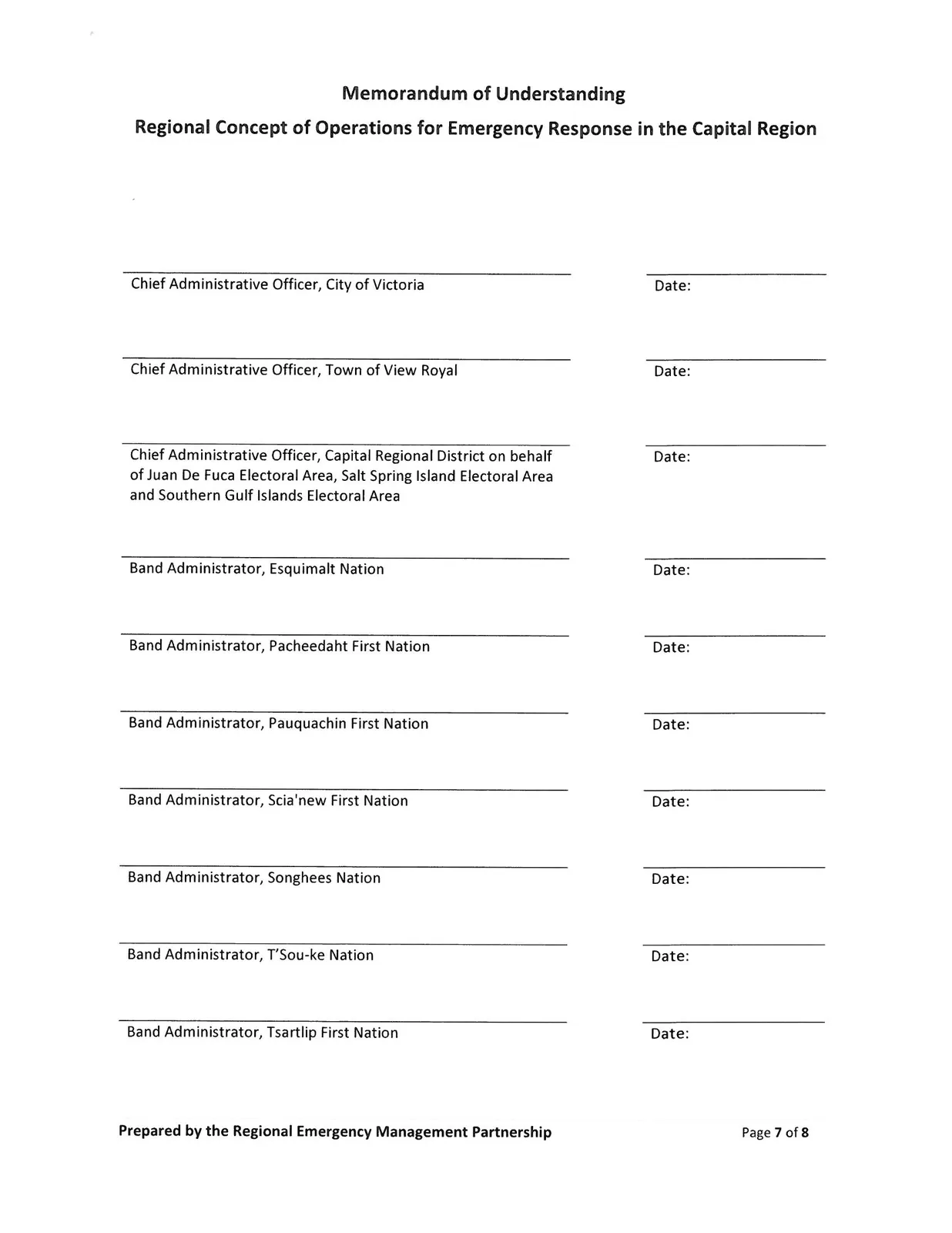
Chief Administrative Officer, City of Victoria Date: ________________________
Chief Administrative Officer, Town of View Royal Date: ________________________
Chief Administrative Officer, Capital Regional District on behalf of Juan De Fuca Electoral Area, Salt Spring Island Electoral Area and Southern Gulf Islands Electoral Area Date: ________________________
Band Administrator, Esquimalt Nation Date: ________________________
Band Administrator, Pacheedaht First Nation Date: ________________________
Band Administrator, Pauquachin First Nation Date: ________________________
Band Administrator, Scia'new First Nation Date: ________________________
Band Administrator, Songhees Nation Date: ________________________
Band Administrator, T'Sou-ke Nation Date: ________________________
Band Administrator, Tsartlip First Nation Date: ________________________
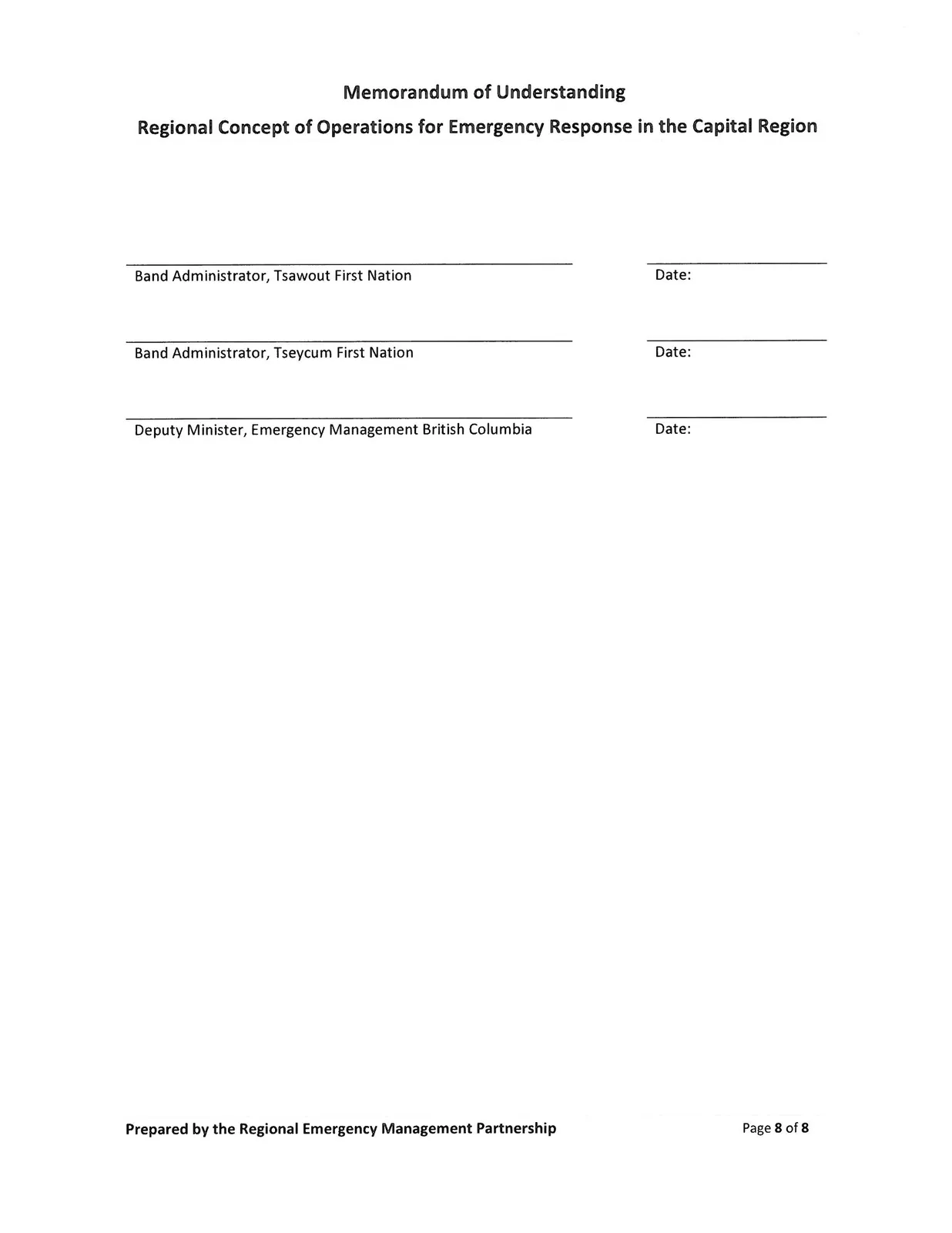
Band Administrator, Tsawout First Nation Date: ________________________
Band Administrator, Tseycum First Nation Date: ________________________
Deputy Minister, Emergency Management British Columbia Date: ________________________
Document Images
(8)