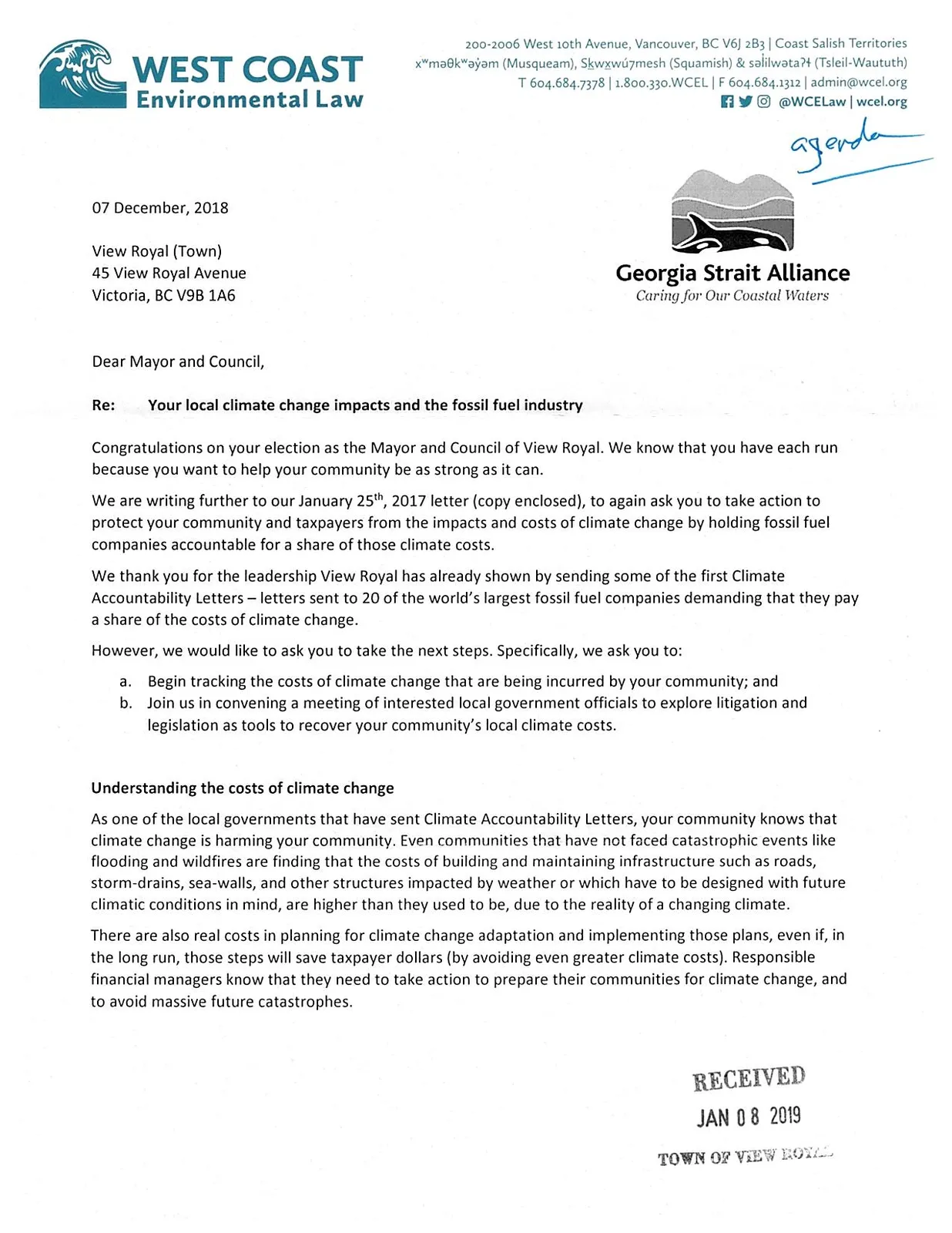
Letter from West Coast Environmental Law Re: Your local climate change impacts and the fossil fuel industry
A joint letter from WCEL and Georgia Strait Alliance asking the council to track climate change costs and explore legal tools to recover costs from fossil fuel companies.
07 December, 2018
View Royal (Town) 45 View Royal Avenue Victoria, BC V9B 1A6
Dear Mayor and Council,
Re: Your local climate change impacts and the fossil fuel industry
Congratulations on your election as the Mayor and Council of View Royal. We know that you have each run because you want to help your community be as strong as it can.
We are writing further to our January 25th, 2017 letter (copy enclosed), to again ask you to take action to protect your community and taxpayers from the impacts and costs of climate change by holding fossil fuel companies accountable for a share of those climate costs.
We thank you for the leadership View Royal has already shown by sending some of the first Climate Accountability Letters — letters sent to 20 of the world's largest fossil fuel companies demanding that they pay a share of the costs of climate change.
However, we would like to ask you to take the next steps. Specifically, we ask you to:
a. Begin tracking the costs of climate change that are being incurred by your community; and b. Join us in convening a meeting of interested local government officials to explore litigation and legislation as tools to recover your community's local climate costs.
Understanding the costs of climate change
As one of the local governments that have sent Climate Accountability Letters, your community knows that climate change is harming your community. Even communities that have not faced catastrophic events like flooding and wildfires are finding that the costs of building and maintaining infrastructure such as roads, storm-drains, sea-walls, and other structures impacted by weather or which have to be designed with future climatic conditions in mind, are higher than they used to be, due to the reality of a changing climate.
There are also real costs in planning for climate change adaptation and implementing those plans, even if, in the long run, those steps will save taxpayer dollars (by avoiding even greater climate costs). Responsible financial managers know that they need to take action to prepare their communities for climate change, and to avoid massive future catastrophes.
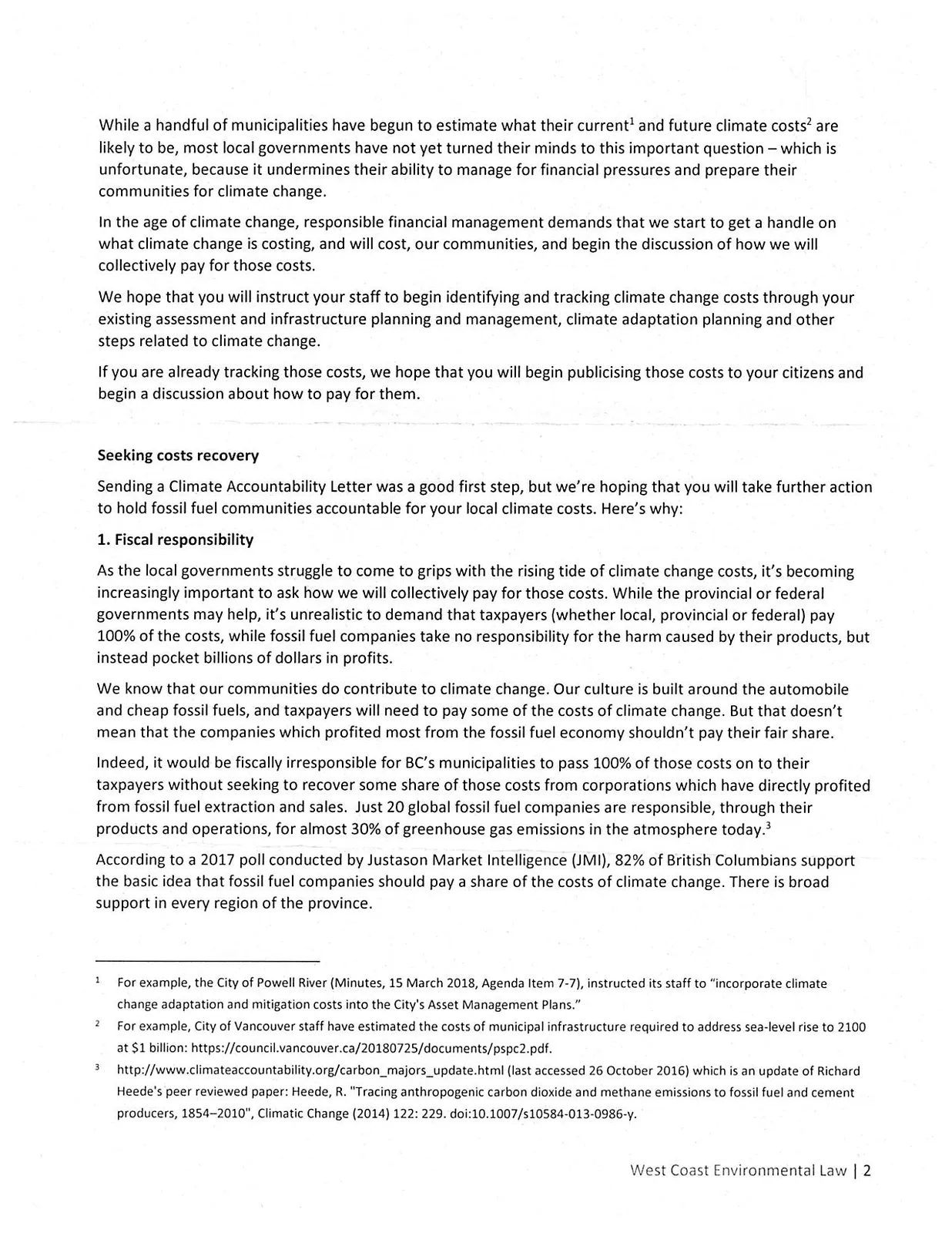
While a handful of municipalities have begun to estimate what their current¹ and future climate costs² are likely to be, most local governments have not yet turned their minds to this important question — which is unfortunate, because it undermines their ability to manage for financial pressures and prepare their communities for climate change.
In the age of climate change, responsible financial management demands that we start to get a handle on what climate change is costing, and will cost, our communities, and begin the discussion of how we will collectively pay for those costs.
We hope that you will instruct your staff to begin identifying and tracking climate change costs through your existing assessment and infrastructure planning and management, climate adaptation planning and other steps related to climate change.
If you are already tracking those costs, we hope that you will begin publicising those costs to your citizens and begin a discussion about how to pay for them.
Seeking costs recovery
Sending a Climate Accountability Letter was a good first step, but we're hoping that you will take further action to hold fossil fuel communities accountable for your local climate costs. Here's why:
1. Fiscal responsibility
As the local governments struggle to come to grips with the rising tide of climate change costs, it's becoming increasingly important to ask how we will collectively pay for those costs. While the provincial or federal governments may help, it's unrealistic to demand that taxpayers (whether local, provincial or federal) pay 100% of the costs, while fossil fuel companies take no responsibility for the harm caused by their products, but instead pocket billions of dollars in profits.
We know that our communities do contribute to climate change. Our culture is built around the automobile and cheap fossil fuels, and taxpayers will need to pay some of the costs of climate change. But that doesn't mean that the companies which profited most from the fossil fuel economy shouldn't pay their fair share.
Indeed, it would be fiscally irresponsible for BC's municipalities to pass 100% of those costs on to their taxpayers without seeking to recover some share of those costs from corporations which have directly profited from fossil fuel extraction and sales. Just 20 global fossil fuel companies are responsible, through their products and operations, for almost 30% of greenhouse gas emissions in the atmosphere today.³
According to a 2017 poll conducted by Justason Market Intelligence (JMI), 82% of British Columbians support the basic idea that fossil fuel companies should pay a share of the costs of climate change. There is broad support in every region of the province.
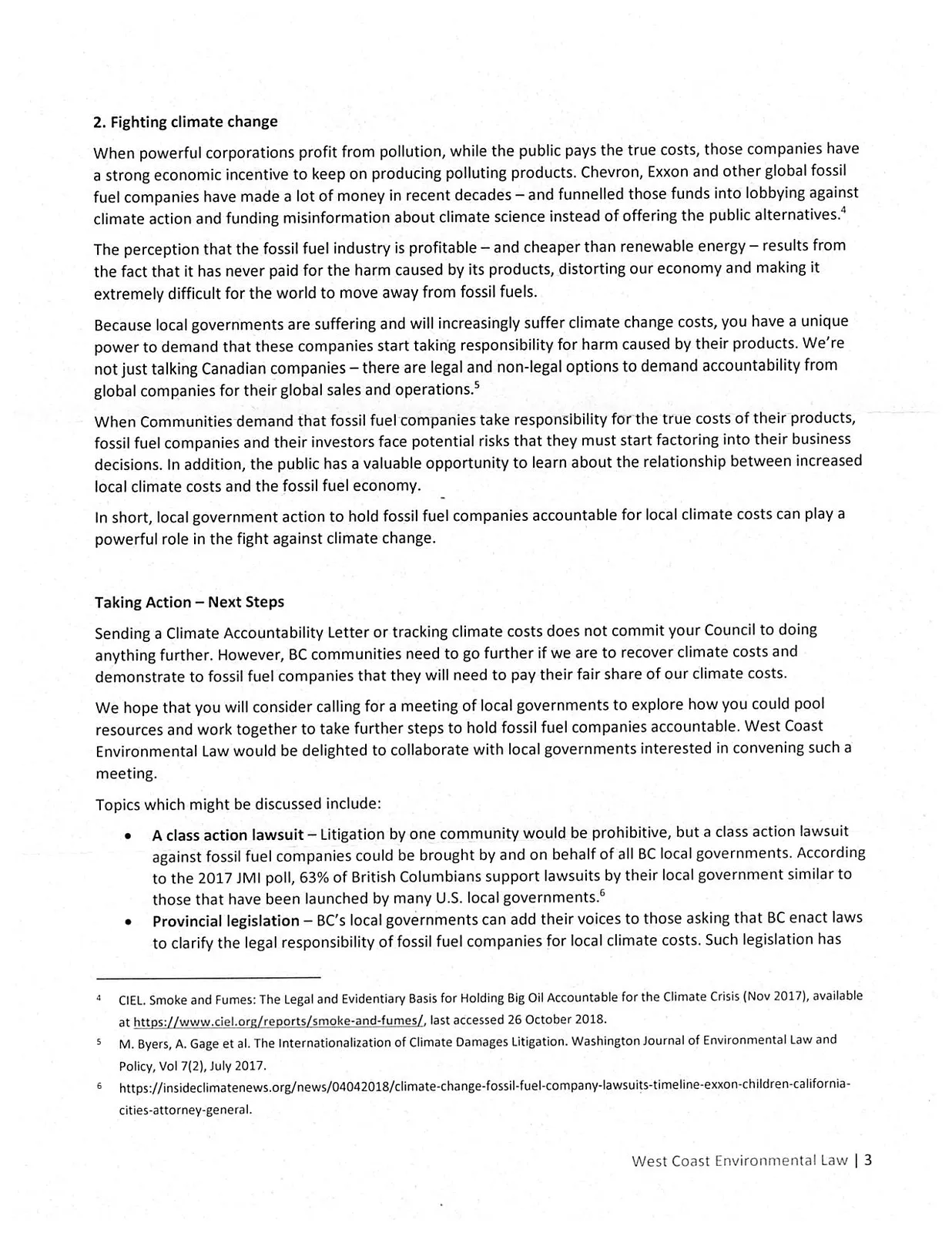
2. Fighting climate change
When powerful corporations profit from pollution, while the public pays the true costs, those companies have a strong economic incentive to keep on producing polluting products. Chevron, Exxon and other global fossil fuel companies have made a lot of money in recent decades — and funnelled those funds into lobbying against climate action and funding misinformation about climate science instead of offering the public alternatives.⁴
The perception that the fossil fuel industry is profitable — and cheaper than renewable energy — results from the fact that it has never paid for the harm caused by its products, distorting our economy and making it extremely difficult for the world to move away from fossil fuels.
Because local governments are suffering and will increasingly suffer climate change costs, you have a unique power to demand that these companies start taking responsibility for harm caused by their products. We're not just talking Canadian companies — there are legal and non-legal options to demand accountability from global companies for their global sales and operations.⁵
When Communities demand that fossil fuel companies take responsibility for the true costs of their products, fossil fuel companies and their investors face potential risks that they must start factoring into their business decisions. In addition, the public has a valuable opportunity to learn about the relationship between increased local climate costs and the fossil fuel economy.
In short, local government action to hold fossil fuel companies accountable for local climate costs can play a powerful role in the fight against climate change.
Taking Action — Next Steps
Sending a Climate Accountability Letter or tracking climate costs does not commit your Council to doing anything further. However, BC communities need to go further if we are to recover climate costs and demonstrate to fossil fuel companies that they will need to pay their fair share of our climate costs.
We hope that you will consider calling for a meeting of local governments to explore how you could pool resources and work together to take further steps to hold fossil fuel companies accountable. West Coast Environmental Law would be delighted to collaborate with local governments interested in convening such a meeting.
Topics which might be discussed include:
- A class action lawsuit — Litigation by one community would be prohibitive, but a class action lawsuit against fossil fuel companies could be brought by and on behalf of all BC local governments. According to the 2017 JMI poll, 63% of British Columbians support lawsuits by their local government similar to those that have been launched by many U.S. local governments.⁶
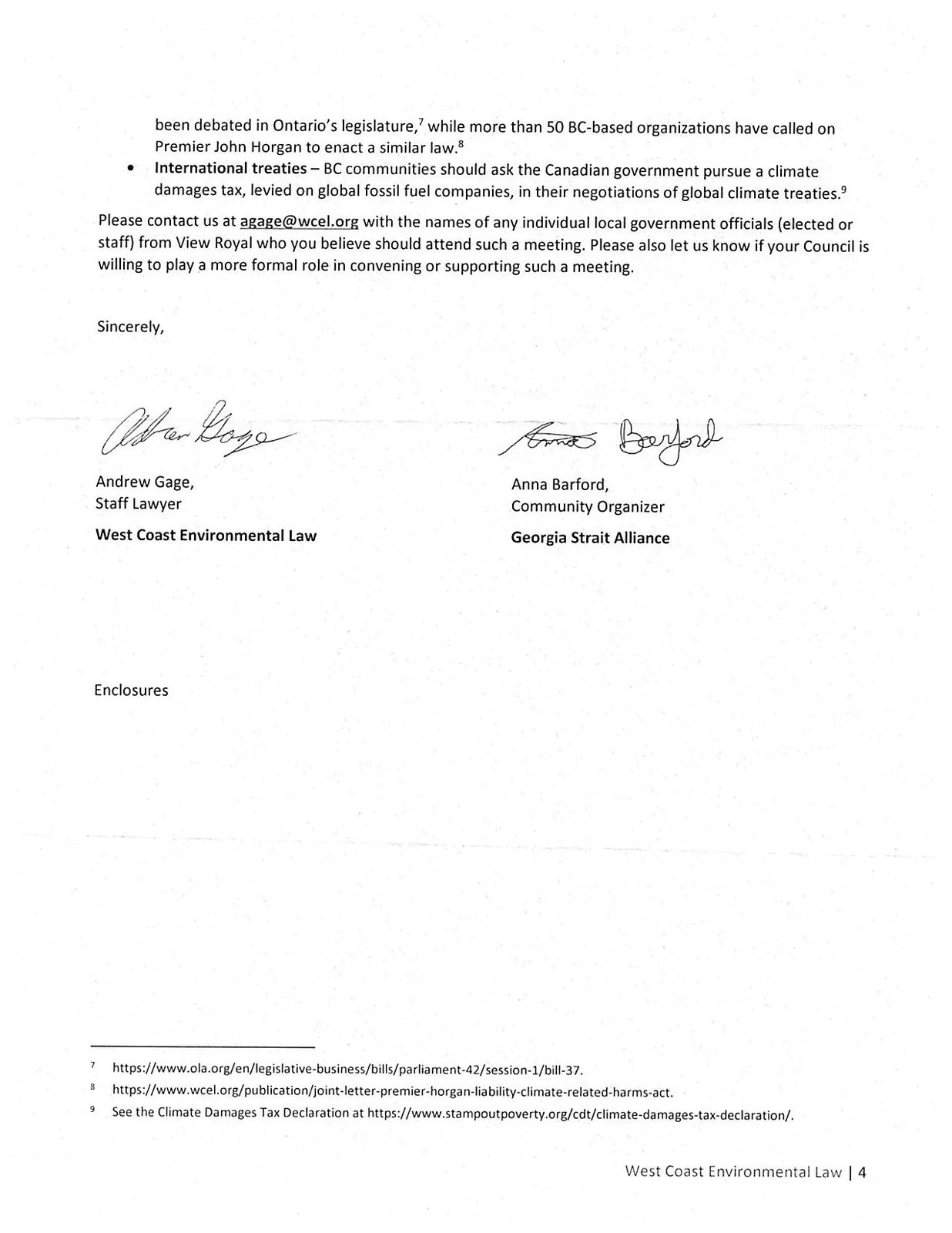
- Provincial legislation — BC's local governments can add their voices to those asking that BC enact laws to clarify the legal responsibility of fossil fuel companies for local climate costs. Such legislation has been debated in Ontario's legislature,⁷ while more than 50 BC-based organizations have called on Premier John Horgan to enact a similar law.⁸
- International treaties — BC communities should ask the Canadian government pursue a climate damages tax, levied on global fossil fuel companies, in their negotiations of global climate treaties.⁹
Please contact us at agage@wcel.org with the names of any individual local government officials (elected or staff) from View Royal who you believe should attend such a meeting. Please also let us know if your Council is willing to play a more formal role in convening or supporting such a meeting.
Sincerely,
Andrew Gage, Staff Lawyer West Coast Environmental Law
Anna Barford, Community Organizer Georgia Strait Alliance
Enclosures
¹ For example, the City of Powell River (Minutes, 15 March 2018, Agenda Item 7-7), instructed its staff to "incorporate climate change adaptation and mitigation costs into the City's Asset Management Plans."
² For example, City of Vancouver staff have estimated the costs of municipal infrastructure required to address sea-level rise to 2100 at $1 billion: https://council.vancouver.ca/20180725/documents/pspc2.pdf.
³ http://www.climateaccountability.org/carbon_majors_update.html (last accessed 26 October 2016) which is an update of Richard Heede's peer reviewed paper: Heede, R. "Tracing anthropogenic carbon dioxide and methane emissions to fossil fuel and cement producers, 1854-2010", Climatic Change (2014) 122: 229. doi:10.1007/s10584-013-0986-y.
⁴ CIEL. Smoke and Fumes: The Legal and Evidentiary Basis for Holding Big Oil Accountable for the Climate Crisis (Nov 2017), available at https://www.ciel.org/reports/smoke-and-fumes/, last accessed 26 October 2018.
⁵ M. Byers, A. Gage et al. The Internationalization of Climate Damages Litigation. Washington Journal of Environmental Law and Policy, Vol 7(2), July 2017.
⁷ https://www.ola.org/en/legislative-business/bills/parliament-42/session-1/bill-37.
⁸ https://www.wcel.org/publication/joint-letter-premier-horgan-liability-climate-related-harms-act.
⁹ See the Climate Damages Tax Declaration at https://www.stampoutpoverty.org/cdt/climate-damages-tax-declaration/.
Document Images
(4)