Town of View Royal Official Community Plan OCP Primer and Review Background
A staff report outlining the background and legislative requirements for updating the 2011 Official Community Plan, focusing on emerging issues like rapid population growth, climate emergency, and housing security.
TOWN OF VIEW ROYAL OFFICIAL COMMUNITY PLAN OCP PRIMER AND REVIEW BACKGROUND
Meeting Date: May 19, 2020
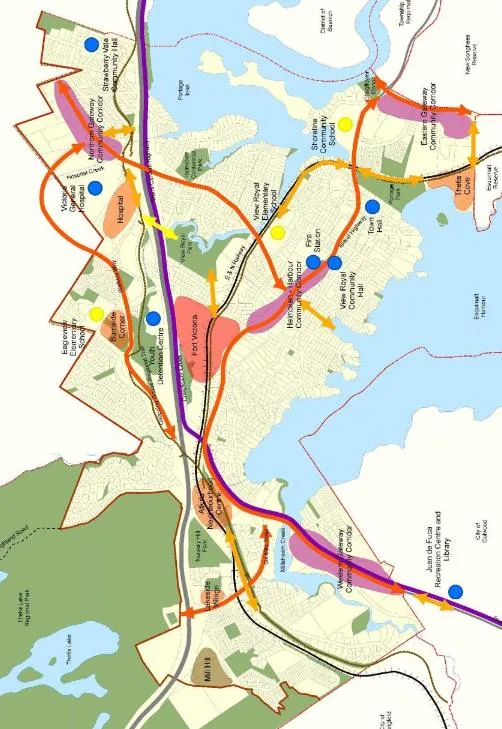
The challenge with growth is to place it where it makes sense, while mitigating the inherent land use conflicts that change inevitably provides.
While the current Community Development Framework and resulting Land Use Designations have been useful in providing broad guidance for growth in sensible areas in View Royal, the pace and demand for growth in the last several years has pushed the prescribed densities and land use transitions to their limits. Rezoning applications typically have the maximum prescribed density as a default, with the developer citing rising land and construction costs as reasons why densities need to come up for a development to be profitable.
Meanwhile, a pattern of neighbouring concern emerges with blocked views, jarring transitions from low density to apartment buildings, increased traffic, and parking concerns, and changing character of neighbourhoods. Wherever possible, aspects of the OCP such as storeys, density, etc. are used to illustrate the inappropriateness of the development for the site for those concerned or opposed for one reason or another.
What is often overlooked in these understandable concerns is how aspects of traffic, parking, density of development and land use patterns can work in concert to create a better built environment, an associated enhanced quality of life, a better economic outlook and environmental preservation for the community as a whole. This is all underpinned by the knowledge that buildings and transportation are the two main categories of greenhouse gas emissions and changes in this area will contribute significantly to mitigating climate change impacts. These positives may outweigh other ‘negative’ aspects of a development such as visual impact and local traffic concerns. As has been seen in cities such as Los Angeles, the objection to density has created vast, sprawling low-density neighbourhoods which have a significant negative social, economic, and environmental impact on its communities. Such compromise is inherent in every development and should be explicitly articulated in Town policy.
It would be of benefit for the Town to have tools to frame the impacts of development with a balanced message which weighs pros and cons in a more tangible manner:
- Increased density enables an increased quality of local services
- Increased density reduces urban sprawl and preserves natural open spaces
- Increasing density close to workplaces reduces regional traffic issues and the associated environmental issues
- Increased density reduces time and costs related to transportation for individuals
- Compact development produces housing security
- Compact development increases the efficiency and cost effectiveness of operating a living unit from both an individual point of view as well as a municipal (deep services, roads, transit etc) and third-party (shallow services like cable, power) servicing point of view.
There are some principles of planning and urban design that could be more focused in the review, adhering to the existing structure of the OCP:
Physical Environment
a. Land Use and Urban Design
The pattern of development from the corridors and traditional detached residential areas as illustrated within the Community Development Framework section of the OCP can often lead into hard transitions from established ‘traditional’ detached residential uses to apartment residential uses. What often remains is a choice between increasingly unaffordable detached residences, and a two-bedroom apartment in which many families feel very under-housed. Building on the discussion around housing security, these transitional areas should offer dedicated, long-term, secure rental options as well as strata ownership units in more compact housing forms such as row houses, townhouses, duplexes and similar.
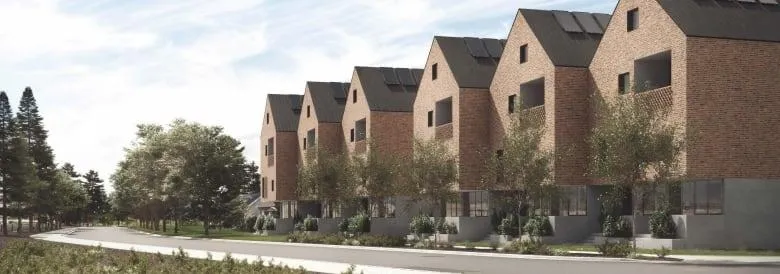
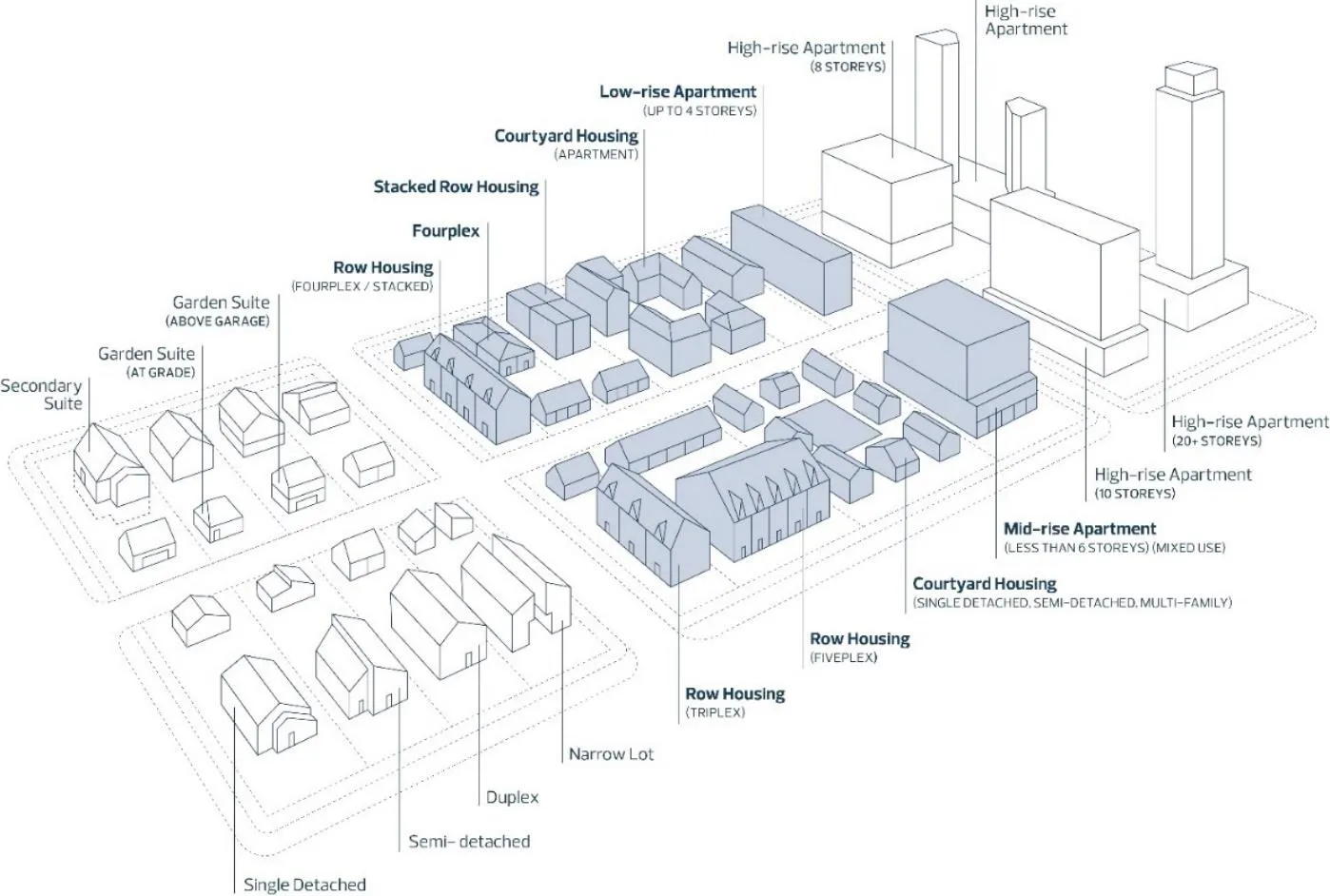
What follows from the discussion for a need for compact housing is the urban design principles and tools to accomplish a greater variety of housing choice while avoiding the abrupt land use transitions and associated conflicts that this causes. Above is an illustration showing a gradual transition from a single detached residential land use to the left all the way to high rise apartments characteristic of a major city core to the right. The dark grey buildings comprise the ‘missing middle’ housing discussed earlier; attached housing such as rowhouses, townhouses, stacked row housing, courtyard housing, and low and mid-rise apartments.
Frequently the land use conflicts that occur in View Royal (and elsewhere) ultimately boil down to perceived or genuinely harsh transitions in height, density, traffic between low density areas and new higher density, mid-to-high rise development. The inclusion of more options for gradual transitions from detached residential to other land uses softens the landscape and allows for density to be introduced to neighbourhoods in more sensitive ways.
b. Transportation and Mobility
With growth pressure throughout the region and the inevitability of a regional transit system bisecting View Royal, it makes sense to explore the concept and application of a Transit-Oriented Development (TOD) pattern within View Royal.
Potential amendments to the Land Use Designations to address TOD principles include identifying current and future transit nodes as growth nodes for residential and commercial development. TOD objectives are broadly two-fold:
- Encourage compact mixed-use development to encourage walkable and complete places to live, work and play.
- Development that increases transit ridership by locating residential and commercial locations near transit stations.
There continues to be significant advancement of technologies such as electric vehicles and electric bicycles, as well as the increased viability of sustainable energy technologies such as solar power which has not yet reached residential viability, but may do so in the coming decade. Electric bicycles and their increased use provide immense potential for the regional pathways (Galloping Goose and E&N) to support increased sustainable transportation options and capacity. Electric vehicles offer reduced emissions and noise pollution for neighbourhoods and will contribute to a reduction in greenhouse gas emissions. With these technologies come different needs for bicycle parking and charging and electric vehicle charging policies within the OCP and, correspondingly, the Zoning Bylaw regulations.
Land Use Designations can be tweaked to identify nodes of higher density in locations where transit and sustainable transportation is currently accessible or likely to occur in the future. While there remains a question as to whether the E&N corridor will be utilized for transit solutions in the future, the primary transportation corridors of the Island Highway, Trans Canada Highway, Galloping Goose and E&N corridor are established and will dictate land use patterns in the future.
c. Housing
Housing Security
Secondary suites have created some less-visible density in many detached residential neighbourhoods, and recent changes to the BC Building Code have made it less restrictive to place secondary suites into homes, including eliminating firewall requirements and expanding the range of dwellings in which secondary suites may be permitted. What is less frequently discussed, however, is the security of the various types of housing in the Town.
Housing security refers to the degree to which a resident is likely to be displaced from their residence due to a circumstance out of their control. It could be related to affordability, likeliness of rental agreement termination due to sale of a house containing a secondary suite, the redevelopment of a site, the legality of a living situation (such as permanent mobile home arrangements on lands not zoned for residential, or risk of displacement due to fire, flood, sea level rise, etc).
People living in rental situations are more vulnerable to housing security issues than people who own their residence. Renters of secondary suites or detached houses can be displaced quickly, sometimes with little notice, due to owner circumstance or redevelopment. In turn, those who are housed in illegal residences, or in transient situations (sleeping on a couch, in a car etc) are more vulnerable than those in legal rental situations.
The Town’s Housing Gaps and Needs study refers to a ‘housing continuum’. One might understand housing security as such, from most secure to least.
- Residential owner
- Attached residential renter
- Garden suite renter
- Legal secondary suite/detached residential renter
- Resident of a long-term illegal residential suite, mobile home, etc.
- Transient resident
- Homeless relying on short-term shelter
View Royal includes people in all these categories. The Town generally engages with the more marginalized and vulnerable portion of the population far less, and the Town could be actively looking for ways to increase that participation. Housing security affects other aspects of the Town’s function and security:
- Volunteer firefighters are often within the more vulnerable segments of the housed population due to affordability issues
- Service employees, health care workers, construction workers and similar groups are very vulnerable to housing insecurity, yet fulfill a vital societal role
- Aging individuals and people with health and mobility issues are particularly impacted by residential affordability and transience, and can provide great strain on social services should they lose access to stable housing
The Town of View Royal currently has only approximately 260 dedicated rental units in rental buildings, and approximately 400 registered secondary suites. There are very few secure rental units in View Royal.
Bolstering housing security in View Royal includes taking steps to increase the supply of housing that is secure and affordable for all existing and prospective View Royal residents, including affordable housing for young families, often transient employees such as construction workers, aging people, and low-income individuals (to name but a few). The supply of non-market and subsidized housing is also of priority when considering housing marginalized and vulnerable populations.
Policies which would assist housing insecurity in View Royal include:
- Expanding the types of properties which permit secondary suites, including reducing minimum lot sizes, reducing parking requirements, and permitting suites in selected attached properties
- Exploring rental zoning to increase the supply of secure rental housing
- Providing density bonusing for the provision of rental housing and/or below-market housing
- Increasing the intensity of uses and densities within the Land Use Designations, including the development of medium-density townhouses, row houses, narrow lot detached housing, and duplexes within traditionally detached residential areas
- Developing policies for non-market and subsidized housing generation through the rezoning process
- Exploring zoning for non-traditional housing alternatives such as cohousing
- Permitting garden suites
d. Natural Environment, Energy and Climate Change
The OCP will be informed by the Town’s Climate Action Strategy.
As a signatory to the BC Climate Action Charter since its 2007 inception and by joining nearly 1,500 jurisdictions around the world in declaring a climate emergency, the Town has committed to action on green house gas (GHG) reduction. The GHG reduction targets in the current OCP are out of date and the proposed update to the Town’s Climate Action Strategy would be a key tool to help recalibrate the targets, consider the CRD Regional Growth Strategy targets, and facilitate policies for sustainability in the Official Community Plan. View Royal embraces the concept of a triple-bottom line approach to sustainability, which balances social, economic and environmental issues. The challenge will be to have reliable, timely data to inform policies to guide the community over the long term.
e. Community Infrastructure and Services
The community infrastructure and services section can be reviewed and updated for an eye to servicing capacity for increasing the Town’s sustainable development and absorbing growth efficiently and reliably. Fire protection, emergency preparedness and response, efficient road and servicing infrastructure, and other aspects of the Town’s function can be reviewed to ensure that best practises and innovative approaches to the safe and efficient operation of the Town are included in the OCP implemented by the Town.
Social Environment
a. Parks and Recreation
The Town recently completed a new Parks Master Plan which identifies a hierarchy of parks and the recreation opportunities they present. Acquisition of small parks is not generally supported, as they do not easily facilitate neighbourhood recreation opportunities. Updated information and planning for signature parks (View Royal Park and Helmcken Centennial Park) is both underway and planned. Updating the OCP to reflect a stable parks system is needed. In addition, the OCP can speak to the long-standing relationship of the Town to West Shore Parks and Recreation as an important service provider for residents.
b. Community Facilities and Social Well-Being
Economic Environment
a. Economic Development
The Town is currently engaged in an economic analysis of selected precincts and results from this study will be available to inform the OCP. The critical questions that are being asked in this study are:
- What barriers to development/redevelopment exist in the Town?
- What tools are available and practical for a community of this size?
- Are the OCP and zoning densities, height and uses adequate to facilitate the development/redevelopment of strategic sites along major corridors?
- Does the zoning include the right mix of uses in the areas the Town has identified?
- What trends and projections are important for the Town to pay attention to?
- What strategies and options exist for View Royal within a competitive regional context?
The results of this study in particular will assist the OCP review on questions of land use and density. Our current vision is to be a complete community where people live, work and play. Additional attention to the economic generation potential of land within the Town is important to facilitate opportunities to access services and employment.
Development Permit Areas
a. Form and Character of Development
These sections could be revisited to be more comprehensive with all aspects of the design of attached residential, commercial, mixed use and industrial developments in the Town.
- Clarity and increased illustration and vision over desired architectural styles in the Town, and what those designs look like. Illustrations could be used.
- The addition of sign areas and sign design guidance to the form and character guidelines.
- The possible creation of design themes for gateway areas, change areas, individual neighbourhoods.
- The inclusion of guidance on Mixed Use (residential and commercial integration) form and character of development.
- Inclusion of guidelines for urban agriculture initiatives and other sustainable design features.
- Inclusion of statements on sustainable infrastructure such as bicycle parking and facilities, electric car charging stations, solar panels, wind power generators.
b. Environmental Protection and Natural Hazards
These sections of the OCP should be revisited to address issues which have come to sharper attention in the past decade include (but are not necessarily limited to):
- More detail and guidance for the mitigation of sea level rise and its impacts on low-lying areas within View Royal
- The integration of the Town’s Private Dock Development Guidelines into the Natural Watercourse and Shoreline Areas Development Permit Guidelines.
- Revisiting of the goals and objectives of shoreline preservation and more clarity with the vision for development within the Environmental DP areas (buildings, fences, retaining walls, etc).
- More robust guidance regarding fire protection and fire interface planning.
- The integration of archaeological records (mapping, inventory) provided by the BC Archaeology Branch (as per their desire to be more open and forthright about artifacts and the impact development has on them).
- Update on contemporary environmental and social design consideration around such issues as birdsafe design, sensitive archaeological site treatment and naturalized urban infrastructure.
NEXT STEPS
Staff is preparing a Terms of Reference document which provides a baseline document describing the Town’s requirements and standards for updating the OCP and will guide a Request for Proposal document for those components of the OCP which will be completed by a consultant team(s).
It is expected that the OCP updating process will begin in the fall of 2020 with a completion date in the latter half of 2020.
RECOMMENDATION
THAT Committee receive the report from the Community Planner entitled “TOWN OF VIEW ROYAL OFFICIAL COMMUNITY PLAN OCP PRIMER AND REVIEW PREPARATION BACKGROUND” dated May 13, 2020 for information.
Document Images
(1)