Staff Report: Energy Step Code Adoption
Report recommending the Town reconsider early adoption of Step 3 and instead follow the Provincial implementation timeline of 2022 to maintain a level playing field.
TOWN OF VIEW ROYAL Council Report
TO: Council DATE: April 21, 2020 FROM: Gary Faykes, Building Official MEETING: May 5, 2020
ENERGY STEP CODE ADOPTION
RECOMMENDATION:
THAT the Town of View Royal reconsider Step 3 of the Step Code and follow the Provincial guidelines for implementation by 2022;
AND THAT the Town’s Strategic Plan be amended to reflect this delay.
CHIEF ADMINISTRATIVE OFFICER’S COMMENTS:
I concur with the recommendation.
DIRECTOR OF PROTECTIVE SERVICE’S COMMENTS:
The Director of Protective Services recommends that the Town reconsider Step 3 of the Step Code and follow the Provincial guidelines on implementation by 2022. This approach will offer consistency not only within the majority of the CRD but will maintain an even playing field in the Westshore. All municipalities will be required, by 2022 to build at the same level. None of the Westshore Municipalities have adopted or entertained early adoption of the code. If View Royal chooses to adopt a more stringent level than proposed by the Province, inconsistent with other Westshore neighbors, this will likely create a scenario where an already minimal development portfolio is lessened. The industry has indicated strongly that additional costs to an already fragile market will result in a loss of development to View Royal.
It is evidenced that there are inconsistent applications and approaches to the Provincial Step code. The Province has set out a realistic guideline for adoption, based on many factors, which include access to materials, training and ability of the industry to deliver on the new requirements.
Further complicating the issue is COVID-19 which is anticipated to further diminish development proposals received by the Town. Requiring additional expenses and code requirements above the current BC Building Code could further reduce development.
Currently only 5 municipalities in the CRD have adopted the Step code at a higher level than recommended. Provincially, only 42 or the 162 municipalities have voluntarily adopted the Step Code.
PURPOSE OF REPORT:
To provide options to Council while considering adoption of the Energy Step Code.
BACKGROUND:
In April 2014, the Provincial Government identified a need for a change in construction standards to assist in reducing green house gases and meet climate-leadership commitments. A group was assembled with stakeholders of all levels.
By mid-2016, the group reached consensus on the core elements of what is today the BC Energy Step Code. In early 2017 the group was renamed the Energy Step Code Council. Since this date, individual Municipalities have had the option to adopt a bylaw that includes a level of step code that they feel would be a benefit to their community, with minimal impact to the building community. The goal is to be at the top of the Step program by 2032, to align with Climate Goals set by the Province.
In May of 2019 Council gave direction to staff to provide further information including costs and implications for both the Town and industry should the Step Code be adopted. Staff was also instructed to begin a consultation process toward adopting Step Code 3 by June 2020.
On October 25, 2019, Staff submitted the Notice of Consultation with the Province. The first step required to begin the initial consultation process with all the stakeholders.
A public workshop was held on November 26, with invitations sent to industry and the public. Staff provided some education and background on the Energy Step Code, as well as received feedback and questions from the attendees.
Some of the feedback and questions from the general public included:
- How are Energy Advisors certified? They are required to complete courses and an exam through the Home Builders Association, designed and approved by the Ministry of Natural Resources.
- What are the liabilities to the Town?
- How much will it cost?
Some of the feedback from the Builders, Developers and Associations included:
- The majority of business/builder/developers in attendance opposed the Step Code.
- The Victoria Residential Builders Association (VRBA) was in attendance and strongly opposed the Step Code.
- The opposition of the Step Code by all of these stakeholders was based on implicated increased costs to construction, creating an uneven building environment throughout the Municipalities by setting different standards and reasoning that the Province will regulate the system through the Building Code. It will make slow changes throughout this rendition of the code and introduce the first steps in the 2022 code change.
- The VRBA noted the National Code is already making changes that may affect the way the BC Building Code is applied.
- An implication was made that the Town will carry all liability if there is a failure as it was an adopted Bylaw, not a Code failure.
- The Town may have issues with liability and consumer protection as it is a voluntary and not required.
- Real estate agents have allegedly said purchasers of new homes are not interested in paying for energy efficiencies as they would rather have their money invested in "finishes".
- Developers indicated they may significantly reduce building in the "voluntary bylaw" municipalities.
- The belief among industry professionals is there is a greater gain in reducing greenhouse gases by capturing the existing building stock, as new construction already meets a higher standard.
- Considerable concern expressed from most on "energy consultants" that are required, and the lack of their responsibility given they will be dictating how things are built. Industry is not willing to trust them with their reputations / liability.
- Concerns were heard on making "affordable housing" unaffordable.
- The availability and certification of trained energy advisors. It is felt that at this time there has not been adequate time to produce the number of professionals that will be required to facilitate the need created by the initiative for the Province as a whole.
- Adequate training for building officials, builders, and designers. Proper training programs for stakeholders have been developing and are introduced as they become available. Costs for the courses are reasonable.
- Costs and cost increases. The Province has supplied estimates on what they believe will be incurred, however the two main organizations (CHBA – Canadian Home Builders Association and the VRBA – Victoria Residential Builders Association) that represent the building community have differing thoughts on these cost impacts.
- Availability of new products required to meet the higher steps. It is unknown if there has been adequate time to produce the required products for the higher steps and what impact that might have on construction timelines.
The Building Official attended a working group on February 18, 2020. The meeting was chaired by Niels Anthony, a leading Energy Advisor and Consultant. Questions around liability and certification were hot topics. It was concluded that while the Energy Advisor will be a strong influence in the designs and will be submitting documentation that the building department will need to accept if the minimum requirements are met. The Energy Advisor does not currently hold liability insurance when it comes to items such as building envelope as they are not experts in this field. Items like these are part of the design and the Town has some risk in accepting the design.
DISCUSSION:
What is the BC Energy Step Code?
The Province describes the Step Code as "a voluntary provincial standard enacted in April 2017 that provides an incremental and consistent approach to achieving more energy-efficient buildings that go beyond the requirements of the base BC Building Code. It does so by establishing a series of measurable, performance-based energy-efficiency requirements for construction that builders can choose to build to, and communities may voluntarily choose to adopt in bylaws and policies."
There are 5 steps in the Step Code. Step 1 is achievable with the current prescriptive building code design, good workmanship and adding on the requirement for energy modeling and conducting blower door testing on each new build. Step 5 is a "passive" building design that would see the build be net-zero ready.
Net-zero energy buildings and net-zero energy ready buildings are described as:
Net-zero energy buildings produce as much clean energy as they consume. They are up to 80 percent more energy efficient than a typical new building and use on-site (or near on-site) renewable energy systems to produce the remaining energy they need.
A Net-zero energy ready building is one that has been designed and built to a level of performance such that it could, with the addition of solar panels or other renewable energy technologies, achieve net-zero energy performance.
The steps towards this goal are:
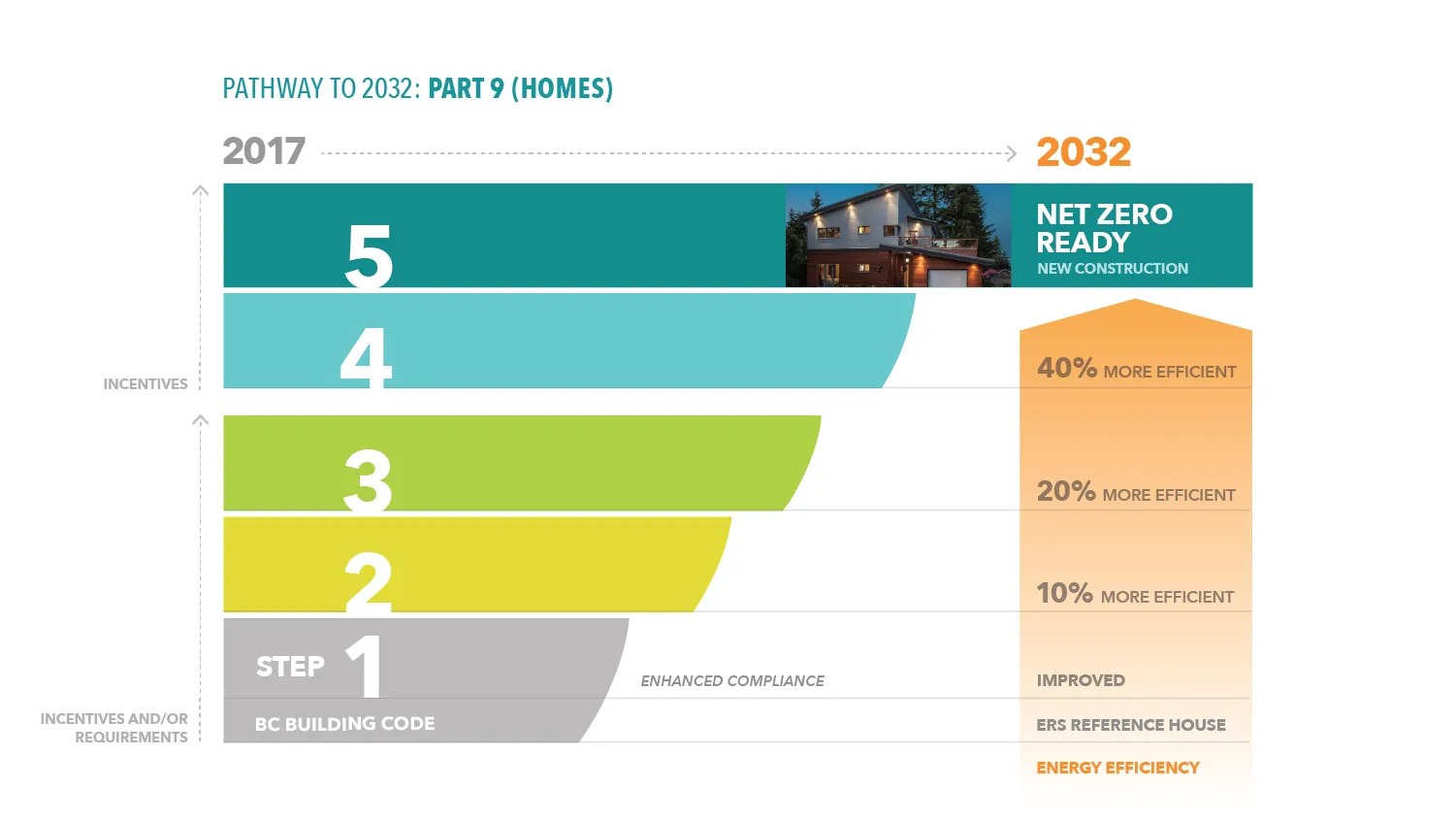
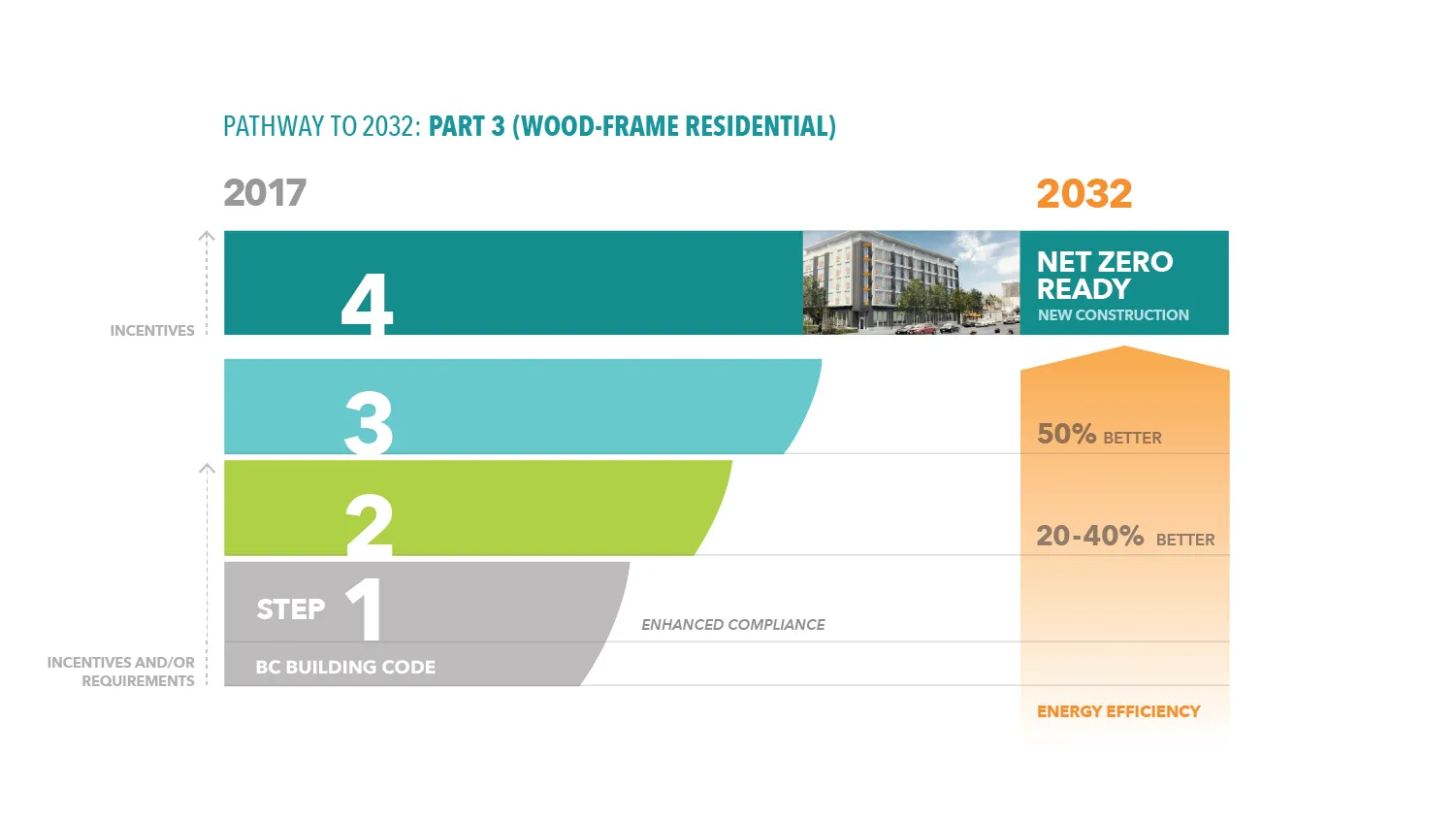
Builders have had the option of voluntarily selecting a step since April 2017. Local governments were able to establish individual bylaws since December of 2017.
Conversation with Building Safety and Standards representatives at various Building Official meetings have consistently shown the Provinces intent of implementing each step through building code updates in a timeline approximately:
- Part 9 buildings: Step 3 by 2022, Step 4 by 2027, Step 5 by 2032
- Part 3 buildings: Step 2 by 2022, Step 3 by 2027, Step 4 by 2032
Part 9 buildings consist of buildings 3 story’s or less in building height, having a building area not exceeding 600m2, and used for major occupancies classified as a) Group C, residential occupancies, b )Group D, business and personal services occupancies, c) Group E, mercantile occupancies, or d) Group F, Divisions 2 and 3, medium- and low-hazard industrial occupancies.
Part 3 buildings comprise of all remaining buildings except for farm related buildings.
Steps 1 and 2 in residential construction are often already met or are only missing items such as enrolling an energy auditor as part of the team. Several builders do use blower door testing as part of other energy efficiency programs they design to which is likely why the Province will go to Step 3 as of 2022 for Part 9 buildings.
What are the implications of the Step Code?
Implications of implementing the step code prior to adoption by the building code has been discussed at length between the municipal building officials and with the Building Safety and Standards representatives at numerous meetings since the inception. The higher the step adopted, the bigger the financial implication will be. Builders will show an increase to cost of construction with the need of a further consultant and possible materials. These increased costs for construction will ultimately be passed on to the purchaser.
Adopting part 9 buildings at step two should make an easier transition to step three in 2022 when the Province intends to implement it.
Regional response:
There have been 42 communities out of 162 provincially (see appendix A) that have implemented the step code since 2017. The following are the local communities have taken steps towards or adopted the Step Code:
- Victoria
- Saanich
- Oak Bay
- North Saanich
- Central Saanich
The remaining local governments have taken a “wait and see” type of approach. It has been discussed by the Building Officials that this should be a provincially driven approach in the interest of maintaining equal standards across communities.
Incentives used by other regions to gain buy in of the step code included reduced building permit fees, increased densities in subdivisions as well as other initiatives that would give back to the builder/developer in exchange for using the required step set by Council
BUDGET IMPLICATIONS:
Requiring step one or step two should have minimal impact on the Town.
Other costs that may need to be considered would be any incentive programs Council may offer to entice builders and designers to work within the Step Code. Incentives may include higher densities.
The full financial implication cannot be known until a program is put in place and further evaluation is undertaken.
OPTIONS:
OPTION 1. That the Town of View Royal reconsider Step 3 of the Step Code and follow the Provincial guidelines for implementation by 2022 and that the Strategic Plan be amended to reflect this delay.
OPTION 2. Adopt Step 3 recognizing that that this approach is inconsistent with the majority of local governments in British Columbia
Option 3. Receive the report for information only.
RECOMMENDATION:
THAT the Town of View Royal reconsider Step 3 of the Step Code and follow the Provincial guidelines for implementation by 2022;
AND THAT the Town’s Strategic Plan be amended to reflect this delay.
SUBMITTED BY: G. Faykes, Building Official
REVIEWED BY: P. Hurst, Director of Protective Services
Appendix A
Local Governments Consulting on the BC Energy Step Code
These local governments have submitted their initial notification, indicating they have started to consult on the BC Energy Step Code (listed by date of submission). The symbol * means the local government now references the BC Energy Step Code in a policy, program or bylaw.
- City of Richmond – June 16, 2017*
- City of North Vancouver – July 4, 2017 *
- City of Campbell River – July 10, 2017 *
- City of Duncan – August 24, 2017
- District of North Vancouver – September 1, 2017 *
- City of Victoria – September 27, 2017*
- District of Saanich – September 27, 2017
- Comox Valley Regional District – October 3, 2017 *
- District of North Saanich – October 4, 2017
- Resort Municipality of Whistler – October 5, 2017*
- District of West Vancouver – October 24, 2017 *
- Township of Langley – November 7, 2017*
- District of Squamish – November 9, 2017*
- City of New Westminster – November 28, 2017
- City of Surrey – December 7, 2017*
- City of Kelowna – January 22, 2018
- City of Penticton – January 27, 2018*
- City of Burnaby – March 1, 2018* (resubmitted April 10, 2019 to add Part 9 consultation)
- City of Kimberley – March 12, 2018 *
- City of Vernon – March 19, 2018
- Village of Belcarra – March 27, 2018
- District of Peachland – March 28, 2018
- District of Oak Bay – April 11, 2018
- City of West Kelowna – April 12, 2018
- District of Sparwood – April 23, 2018*
- District of Summerland – June 5, 2018
- District of Lake Country – June 7, 2018*
- City of Nanaimo – June 25, 2018
- City of Kamloops – July 17, 2018
- District of Central Saanich – July 17, 2018
- City of Port Moody – September 24, 2018
- City of Nelson – October 9, 2018
- Village of Anmore – October 22, 2018*
- District of Elkford – November 6, 2018
- City of Abbotsford – January 28, 2019
- City of Rossland – February 8, 2019
- Town of Creston – February 22, 2019
- Village of New Denver – February 28, 2019
- Bowen Island Municipality – March 4, 2019
- Regional District of East Kootenay – March 12, 2019
- Village of Kaslo – March 25, 2019
- City of Port Coquitlam – April 23, 2019
Document Images
(4)