Ministerial Order No. M192
The updated provincial order replacing M139, detailing requirements for municipalities to use best efforts to allow public attendance.
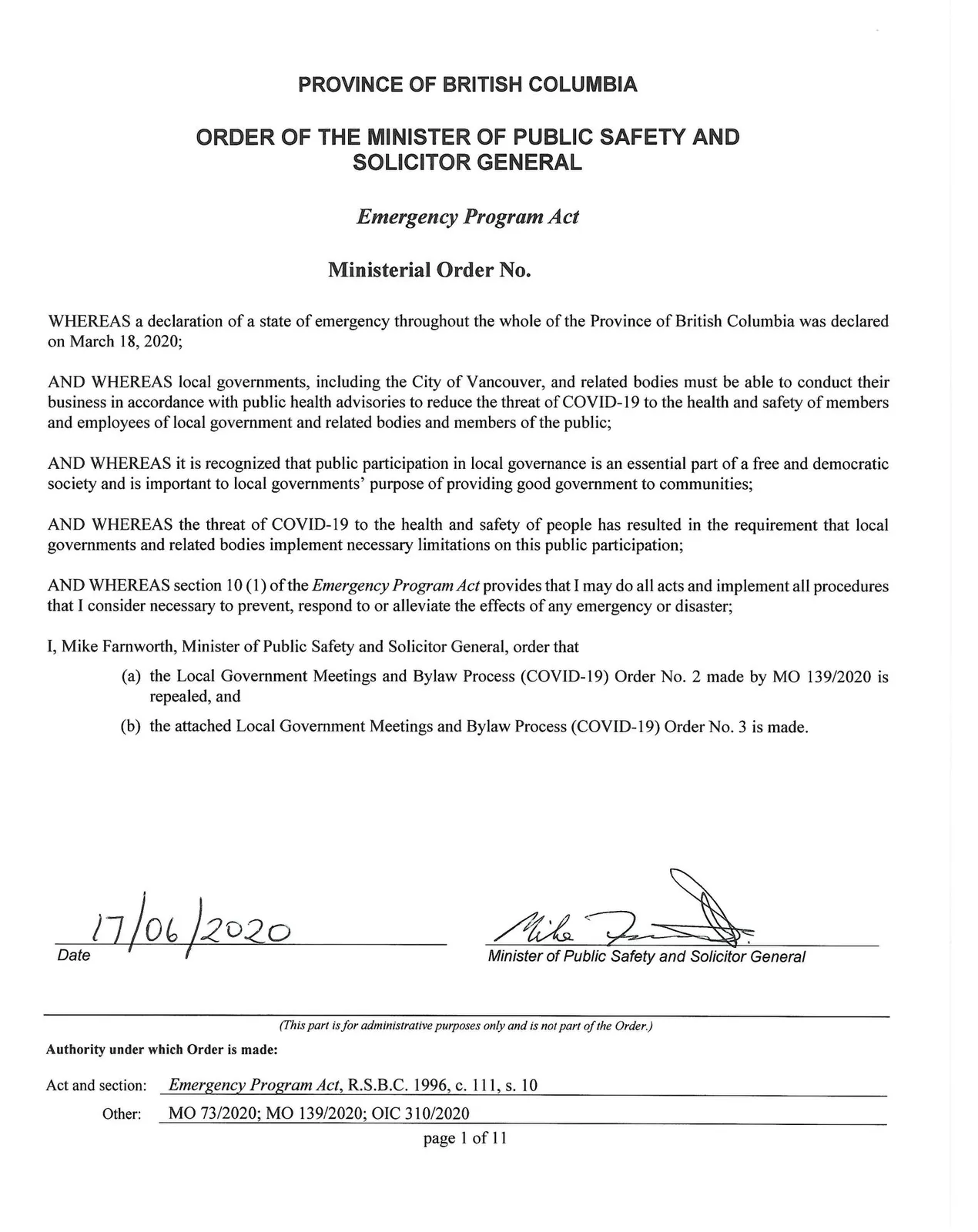
PROVINCE OF BRITISH COLUMBIA
ORDER OF THE MINISTER OF PUBLIC SAFETY AND SOLICITOR GENERAL
Emergency Program Act
Ministerial Order No. M192
WHEREAS a declaration of a state of emergency throughout the whole of the Province of British Columbia was declared on March 18, 2020;
AND WHEREAS local governments, including the City of Vancouver, and related bodies must be able to conduct their business in accordance with public health advisories to reduce the threat of COVID-19 to the health and safety of members and employees of local government and related bodies and members of the public;
AND WHEREAS it is recognized that public participation in local governance is an essential part of a free and democratic society and is important to local governments' purpose of providing good government to communities;
AND WHEREAS the threat of COVID-19 to the health and safety of people has resulted in the requirement that local governments and related bodies implement necessary limitations on this public participation;
AND WHEREAS section 10 (1) of the Emergency Program Act provides that I may do all acts and implement all procedures that I consider necessary to prevent, respond to or alleviate the effects of any emergency or disaster;
I, Mike Farnworth, Minister of Public Safety and Solicitor General, order that
(a) the Local Government Meetings and Bylaw Process (COVID-19) Order No. 2 made by MO 139/2020 is repealed, and
(b) the attached Local Government Meetings and Bylaw Process (COVID-19) Order No. 3 is made.
17/06/2020
Authority under which Order is made:
Act and section: Emergency Program Act, R.S.B.C. 1996, c. 111, s. 10 Other: MO 73/2020; MO 139/2020; OIC 310/2020
LOCAL GOVERNMENT MEETINGS AND BYLAW PROCESS (COVID-19) ORDER NO. 3
Division 1 – General
Definitions
1 In this order:
"board" has the same meaning as in the Schedule of the Local Government Act;
"council" has the same meaning as in the Schedule of the Community Charter;
"improvement district" has the same meaning as in the Schedule of the Local Government Act;
"local trust committee" has the same meaning as in section 1 of the Islands Trust Act;
"municipality" has the same meaning as in the Schedule of the Community Charter;
"municipality procedure bylaw" has the same meaning as "procedure bylaw" in the Schedule of the Community Charter;
"regional district" has the same meaning as in the Schedule of the Local Government Act;
"regional district procedure bylaw" means a procedure bylaw under section 225 of the Local Government Act;
"trust body" means
(a) the trust council, (b) the executive committee, (c) a local trust committee, or (d) the Islands Trust Conservancy,
as defined in the Islands Trust Act;
"Vancouver council" has the same meaning as "Council" in section 2 of the Vancouver Charter;
"Vancouver procedure bylaw" means a bylaw under section 165 [by-laws respecting Council proceedings and other administrative matters] of the Vancouver Charter.
Application
2 (1) This order only applies during the period that the declaration of a state of emergency made March 18, 2020 under section 9 (1) of the Emergency Program Act and any extension of the duration of that declaration is in effect.
(2) This order replaces the Local Government Meetings and Bylaw Process (COVID-19) Order No. 2 made by MO 139/2020.
Division 2 – Open Meetings
Open meetings – municipalities
3 (1) A council, or a body referred to in section 93 [application of rule to other bodies] of the Community Charter, must use best efforts to allow members of the public to attend an open meeting of the council or body in a manner that is consistent with any applicable requirements or recommendations made under the Public Health Act.
(2) A council or body is not required to allow members of the public to attend a meeting if, despite the best efforts of the council or body, the attendance of members of the public cannot be accommodated at a meeting that would otherwise be held in accordance with the applicable requirements or recommendations under the Public Health Act.
(3) If a council or body does not allow members of the public to attend a meeting, as contemplated in subsection (2) of this section,
(a) the council or body must state the following, by resolution: (i) the basis for holding the meeting without members of the public in attendance; (ii) the means by which the council or body is ensuring openness, transparency, accessibility and accountability in respect of the meeting, and (b) for the purposes of Division 3 [Open Meetings] of Part 4 [Public Participation and Council Accountability] of the Community Charter, the meeting is not to be considered closed to the public.
(4) The council or body may pass a resolution under subsection (3) (a) in reference to a specific meeting or, if the same circumstances apply, more than one meeting.
(5) This section applies despite (a) Division 3 [Open Meetings] of Part 4 [Public Participation and Council Accountability] of the Community Charter, and (b) any applicable requirements in a municipality procedure bylaw of a council.
Open meetings – regional districts
4 (1) A board, a board committee established under section 218 [appointment of select and standing committees] of the Local Government Act, or a body referred to in section 93 [application of rule to other bodies] of the Community Charter as that section applies under section 226 [board proceedings: application of Community Charter] of the Local Government Act, must use best efforts to allow members of the public to attend an open meeting of the board, board committee or body in a manner that is consistent with any applicable requirements or recommendations made under the Public Health Act.
(2) A board, board committee or body is not required to allow members of the public to attend a meeting if, despite the best efforts of the board, board committee or body, the attendance of members of the public cannot be accommodated at a meeting that would otherwise be held in accordance with the applicable requirements or recommendations under the Public Health Act.
(3) If a board, board committee or body does not allow members of the public to attend a meeting, as contemplated in subsection (2) of this section,
(a) the board, board committee or body must state the following, by resolution: (i) the basis for holding the meeting without members of the public in attendance; (ii) the means by which the board, board committee or body is ensuring openness, transparency, accessibility and accountability in respect of the meeting, and (b) for the purposes of Division 3 [Open Meetings] of Part 4 [Public Participation and Council Accountability] of the Community Charter as that Division applies to a regional district under section 226 of the Local Government Act, the meeting is not to be considered closed to the public.
(4) The board, board committee or body may pass a resolution under subsection (3) (a) in reference to a specific meeting or, if the same circumstances apply, more than one meeting.
(5) This section applies despite (a) Division 3 [Open Meetings] of Part 4 [Public Participation and Council Accountability] of the Community Charter, (b) section 226 [board proceedings: application of Community Charter] of the Local Government Act, and (c) any applicable requirements in a regional district procedure bylaw of a board.
Open meetings – Vancouver
5 (1) The Vancouver council, or a body referred to in section 165.7 [application to other city bodies] of the Vancouver Charter, must use best efforts to allow members of the public to attend an open meeting of the Vancouver council or the body in a manner that is consistent with any applicable requirements or recommendations made under the Public Health Act.
(2) The Vancouver council or a body is not required to allow members of the public to attend a meeting if, despite the best efforts of the Vancouver council or the body, the attendance of members of the public cannot be accommodated at a meeting that would otherwise be held in accordance with the applicable requirements or recommendations under the Public Health Act.
(3) If the Vancouver council or a body does not allow members of the public to attend a meeting, as contemplated in subsection (2) of this section,
(a) the Vancouver council or the body must state the following, by resolution: (i) the basis for holding the meeting without members of the public in attendance; (ii) the means by which the Vancouver council or the body is ensuring openness, transparency, accessibility and accountability in respect of the meeting, and (b) for the purposes of section 165.1 [general rule that meetings must be open to the public] of the Vancouver Charter, the meeting is not to be considered closed to the public.
(4) The Vancouver council or a body may pass a resolution under subsection (3) (a) in reference to a specific meeting or, if the same circumstances apply, more than one meeting.
(5) This section applies despite (a) section 165.1 of the Vancouver Charter, and (b) any applicable provision in the Vancouver procedure bylaw.
Open meetings – trust bodies
6 (1) A trust body, or a board of variance established by a local trust committee under section 29 (1) [land use and subdivision regulation] of the Islands Trust Act, must use best efforts to allow members of the public to attend an open meeting of the trust body or board of variance in a manner that is consistent with any applicable requirements or recommendations made under the Public Health Act.
(2) A trust body or board of variance is not required to allow members of the public to attend a meeting if, despite the best efforts of the trust body or board of variance, the attendance of members of the public cannot be accommodated at a meeting that would otherwise be held in accordance with the applicable requirements or recommendations under the Public Health Act.
(3) If a trust body or board of variance does not allow members of the public to attend a meeting, as contemplated in subsection (2) of this section,
(a) the trust body or board of variance must state the following, by resolution: (i) the basis for holding the meeting without members of the public in attendance; (ii) the means by which the trust body or board of variance is ensuring openness, transparency, accessibility and accountability in respect of the meeting, and (b) For the purposes of section 11 [procedures to be followed by local trust committees] of the Islands Trust Act, the meeting is not to be considered closed to the public.
(4) A trust body or board of variance may pass a resolution under subsection (3) (a) in reference to a specific meeting or, if the same circumstances apply, more than one meeting.
(5) This section applies despite (a) section 11 [application of Community Charter and Local Government Act to trust bodies] of the Islands Trust Regulation, B.C. Reg. 119/90, and (b) any applicable requirements in a procedure bylaw of a trust body.
Division 3 – Electronic Meetings
Electronic meetings – municipalities
7 (1) A council, or a body referred to in section 93 [application of rule to other bodies] of the Community Charter, may conduct all or part of a meeting of the council or body by means of electronic or other communication facilities.
(2) A member of a council or body who participates in a meeting by means of electronic or other communication facilities under this section is deemed to be present at the meeting.
(3) When conducting a meeting under subsection (1), a council or body must use best efforts to use electronic or other communication facilities that allow members of the public to hear, or watch and hear, the part of the meeting that is open to the public.
(4) If a council or body does not use electronic or other communication facilities as described in subsection (3), the council or body must state the following, by resolution:
(a) the basis for not using electronic or other communication facilities that allow members of the public to hear, or watch and hear, the part of the meeting that is open to the public; (b) the means by which the council or body is ensuring openness, transparency, accessibility and accountability in respect of the meeting.
(5) A council or body may pass a resolution under subsection (4) in reference to a specific meeting or, if the same circumstances apply, more than one meeting.
(6) Section 128 (2) (c) and (d) [electronic meetings and participation by members] of the Community Charter does not apply in respect of a meeting conducted by means of electronic or other communication facilities under this section unless a council or body proceeds as described in subsection (3) of this section, in which case those paragraphs apply.
(7) This section applies despite (a) section 128 of the Community Charter, and (b) any applicable requirements in a municipality procedure bylaw of a council.
Electronic meetings – regional districts
8 (1) A board, a board committee established under section 218 [appointment of select and standing committees] of the Local Government Act, or a body referred to in section 93 [application of rule to other bodies] of the Community Charter as that section applies under section 226 [board proceedings: application of Community Charter] of the Local Government Act, may conduct all or part of a meeting of the board, board committee or body by means of electronic or other communication facilities.
(2) A member of a board, board committee or body who participates in a meeting by means of electronic or other communication facilities under this section is deemed to be present at the meeting.
(3) When conducting a meeting under subsection (1), a board, board committee or body must use best efforts to use electronic or other communication facilities that allow members of the public to hear, or watch and hear, the part of the meeting that is open to the public.
(4) If a board, board committee or body does not use electronic or other communication facilities as described in subsection (3), the board, board committee or body must state the following, by resolution:
(a) the basis for not using electronic or other communication facilities that allow members of the public to hear, or watch and hear, the part of the meeting that is open to the public; (b) the means by which the board, board committee or body is ensuring openness, transparency, accessibility and accountability in respect of the meeting.
(5) A board, board committee or body may pass a resolution under subsection (4) in reference to a specific meeting or, if the same circumstances apply, more than one meeting.
(6) Section 2 (2) (d) and (e) [electronic meetings authorized] of the Regional District Electronic Meetings Regulation, B.C. Reg. 271/2005, does not apply in respect of a meeting conducted by means of electronic or other communication facilities under this section unless a board, board committee or body proceeds by using electronic or other communication facilities as described in subsection (3) of this section, in which case those paragraphs apply.
(7) This section applies despite (a) section 221 [electronic meetings and participation by members] of the Local Government Act, (b) the Regional District Electronic Meetings Regulation, and (c) any applicable requirements in a regional district procedure bylaw of a board.
Electronic meetings – Vancouver
9 (1) The Vancouver council, or a body referred to in section 165.7 [application to other city bodies] of the Vancouver Charter, may conduct all or part of a meeting of the Vancouver council or the body by means of electronic or other communication facilities.
(2) A member of the Vancouver council or of a body who participates in a meeting by means of electronic or other communication facilities under this section is deemed to be present at the meeting.
(3) When conducting a meeting under subsection (1), the Vancouver council or a body must use best efforts to use electronic or other communication facilities that allow members of the public to hear, or watch and hear, the part of the meeting that is open to the public.
(4) If the Vancouver council or a body does not use electronic or other communication facilities as described in subsection (3), the Vancouver council or the body must state the following, by resolution:
(a) the basis for not using electronic or other communication facilities that allow members of the public to hear, or watch and hear, the part of the meeting that is open to the public; (b) the means by which the Vancouver council or the body is ensuring openness, transparency, accessibility and accountability in respect of the meeting.
(5) The Vancouver council or a body may pass a resolution under subsection (4) in reference to a specific meeting or, if the same circumstances apply, more than one meeting.
(6) Section 2 (2) (c) and (d) [electronic meetings authorized] of the City of Vancouver Council Electronic Meetings Regulation, B.C. Reg. 42/2012, does not apply in respect of a meeting conducted by means of electronic or other communication facilities under this section unless the Vancouver council or a body proceeds by using electronic or other communication facilities as described in subsection (3) of this section, in which case those paragraphs apply.
(7) This section applies despite (a) section 164.1 [meeting procedures] of the Vancouver Charter, (b) the City of Vancouver Council Electronic Meetings Regulation, and (c) any applicable provision in the Vancouver procedure bylaw.
Electronic meetings – improvement districts
10 (1) An improvement district board, or a committee of an improvement district board appointed or established under section 689 [appointment of select and standing committees] of the Local Government Act, may conduct all or part of a meeting of the improvement district board or committee of an improvement district board, other than an annual general meeting, by means of electronic or other communication facilities.
(2) A member of an improvement district board or committee of an improvement district board who participates in a meeting by means of electronic or other communication facilities under this section is deemed to be present at the meeting.
(3) When conducting a meeting under subsection (1), an improvement district board or committee of an improvement district board must use best efforts to use electronic or other communication facilities that allow members of the public to hear, or watch and hear, the part of the meeting that is open to the public.
(4) If an improvement district board or committee of an improvement district board does not use electronic or other communication facilities as described in subsection (3), the improvement district board or committee of an improvement district board must state the following, by resolution:
(a) the basis for not using electronic or other communication facilities that allow members of the public to hear, or watch and hear, the part of the meeting that is open to the public; (b) the means by which the improvement district board or committee of an improvement district board is ensuring openness, transparency, accessibility and accountability in respect of the meeting.
(5) An improvement district board or committee of an improvement district board may pass a resolution under subsection (4) in reference to a specific meeting or, if the same circumstances apply, more than one meeting.
(6) This section applies despite (a) section 686 [meeting procedure – improvement district board] of the Local Government Act, and (b) any applicable requirements in a procedure bylaw of an improvement district board.
Electronic meetings – trust bodies
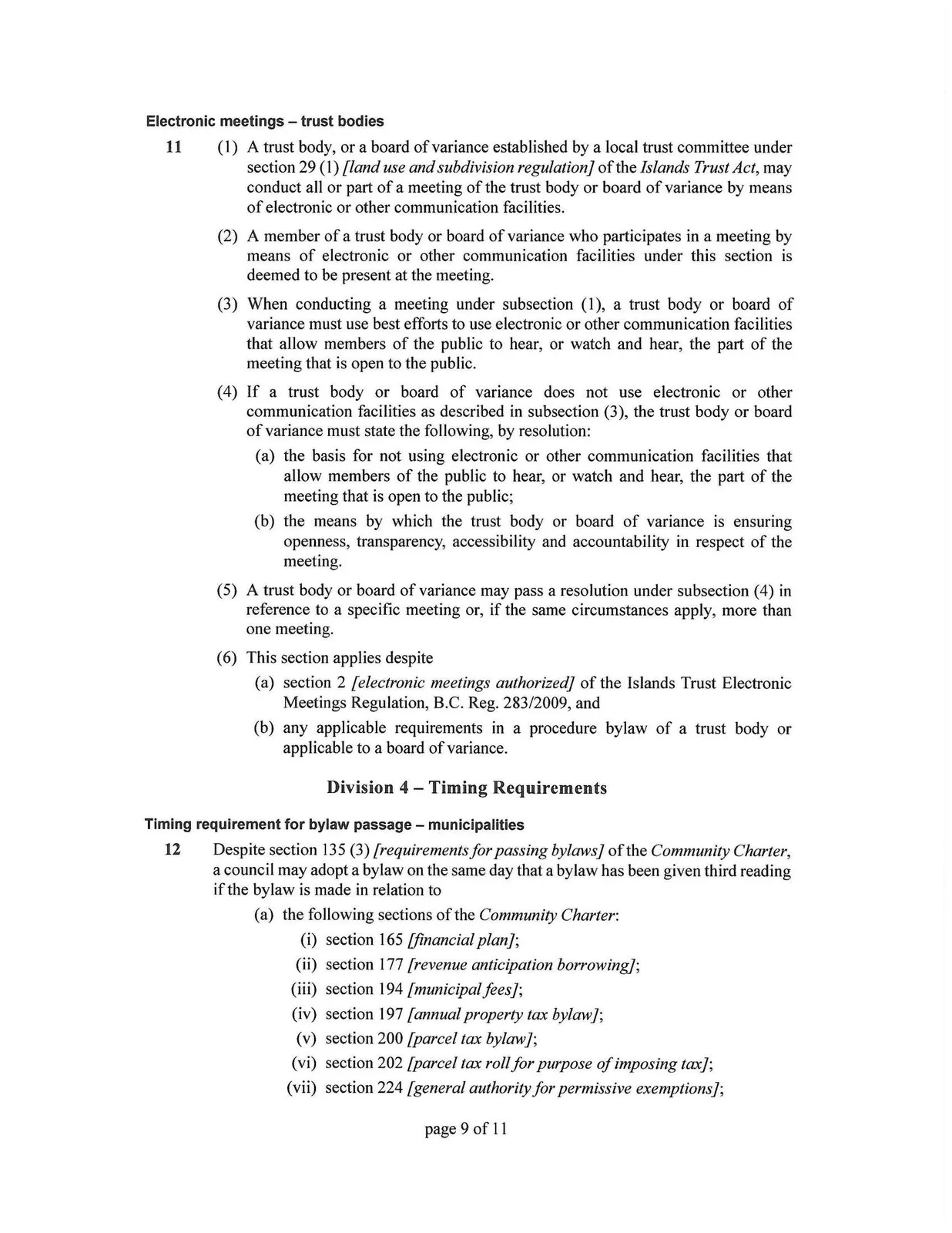
11 (1) A trust body, or a board of variance established by a local trust committee under section 29 (1) [land use and subdivision regulation] of the Islands Trust Act, may conduct all or part of a meeting of the trust body or board of variance by means of electronic or other communication facilities.
(2) A member of a trust body or board of variance who participates in a meeting by means of electronic or other communication facilities under this section is deemed to be present at the meeting.
(3) When conducting a meeting under subsection (1), a trust body or board of variance must use best efforts to use electronic or other communication facilities that allow members of the public to hear, or watch and hear, the part of the meeting that is open to the public.
(4) If a trust body or board of variance does not use electronic or other communication facilities as described in subsection (3), the trust body or board of variance must state the following, by resolution:
(a) the basis for not using electronic or other communication facilities that allow members of the public to hear, or watch and hear, the part of the meeting that is open to the public; (b) the means by which the trust body or board of variance is ensuring openness, transparency, accessibility and accountability in respect of the meeting.
(5) A trust body or board of variance may pass a resolution under subsection (4) in reference to a specific meeting or, if the same circumstances apply, more than one meeting.
(6) This section applies despite (a) section 2 [electronic meetings authorized] of the Islands Trust Electronic Meetings Regulation, B.C. Reg. 283/2009, and (b) any applicable requirements in a procedure bylaw of a trust body or applicable to a board of variance.
Division 4 – Timing Requirements
Timing requirement for bylaw passage – municipalities
12 Despite section 135 (3) [requirements for passing bylaws] of the Community Charter, a council may adopt a bylaw on the same day that a bylaw has been given third reading if the bylaw is made in relation to
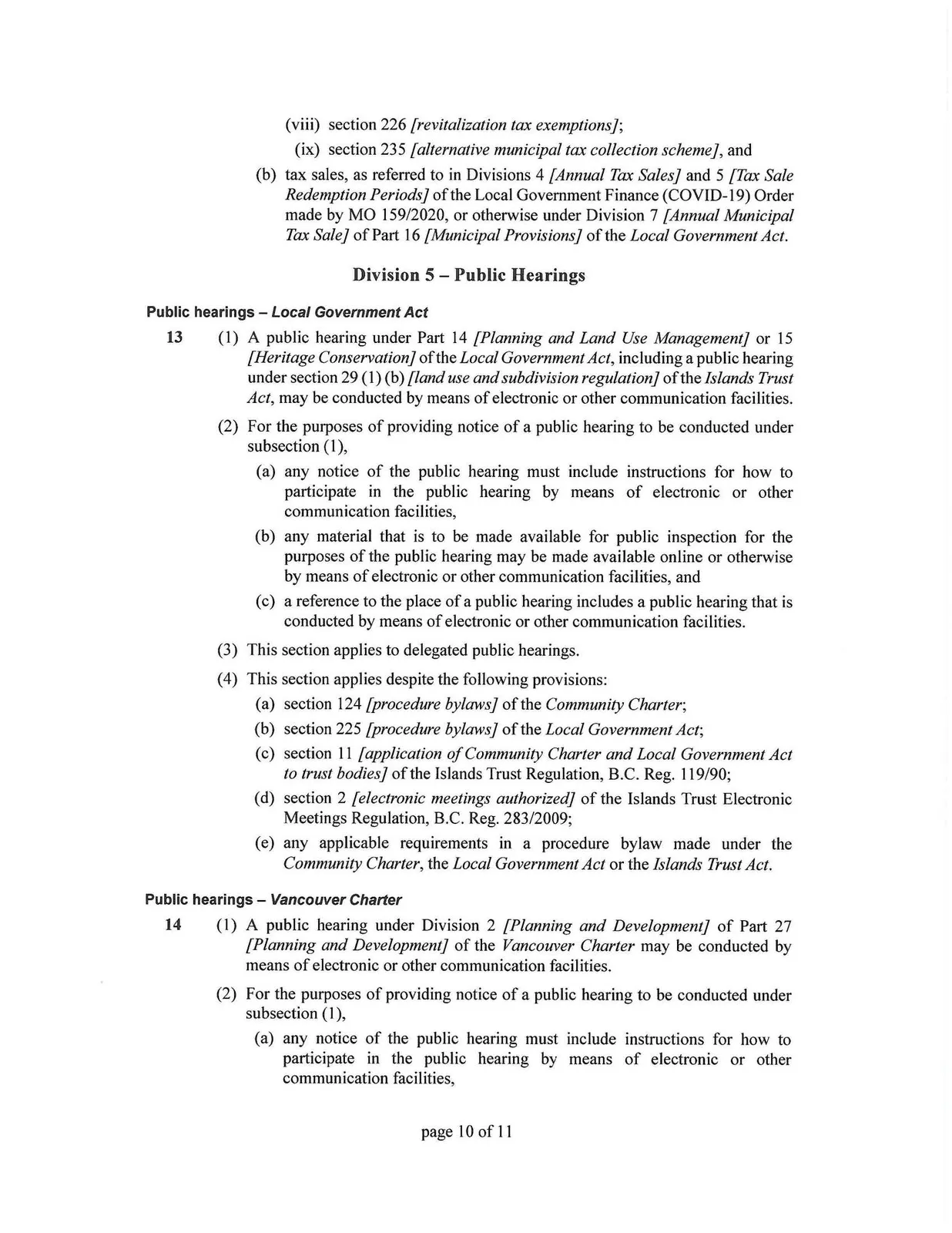
(a) the following sections of the Community Charter: (i) section 165 [financial plan]; (ii) section 177 [revenue anticipation borrowing]; (iii) section 194 [municipal fees]; (iv) section 197 [annual property tax bylaw]; (v) section 200 [parcel tax bylaw]; (vi) section 202 [parcel tax roll for purpose of imposing tax]; (vii) section 224 [general authority for permissive exemptions]; (viii) section 226 [revitalization tax exemptions]; (ix) section 235 [alternative municipal tax collection scheme], and (b) tax sales, as referred to in Divisions 4 [Annual Tax Sales] and 5 [Tax Sale Redemption Periods] of the Local Government Finance (COVID-19) Order made by MO 159/2020, or otherwise under Division 7 [Annual Municipal Tax Sale] of Part 16 [Municipal Provisions] of the Local Government Act.
Division 5 – Public Hearings
Public hearings – Local Government Act
13 (1) A public hearing under Part 14 [Planning and Land Use Management] or 15 [Heritage Conservation] of the Local Government Act, including a public hearing under section 29 (1) (b) [land use and subdivision regulation] of the Islands Trust Act, may be conducted by means of electronic or other communication facilities.
(2) For the purposes of providing notice of a public hearing to be conducted under subsection (1),
(a) any notice of the public hearing must include instructions for how to participate in the public hearing by means of electronic or other communication facilities, (b) any material that is to be made available for public inspection for the purposes of the public hearing may be made available online or otherwise by means of electronic or other communication facilities, and (c) a reference to the place of a public hearing includes a public hearing that is conducted by means of electronic or other communication facilities.
(3) This section applies to delegated public hearings.
(4) This section applies despite the following provisions: (a) section 124 [procedure bylaws] of the Community Charter; (b) section 225 [procedure bylaws] of the Local Government Act; (c) section 11 [application of Community Charter and Local Government Act to trust bodies] of the Islands Trust Regulation, B.C. Reg. 119/90; (d) section 2 [electronic meetings authorized] of the Islands Trust Electronic Meetings Regulation, B.C. Reg. 283/2009; (e) any applicable requirements in a procedure bylaw made under the Community Charter, the Local Government Act or the Islands Trust Act.
Public hearings – Vancouver Charter
14 (1) A public hearing under Division 2 [Planning and Development] of Part 27 [Planning and Development] of the Vancouver Charter may be conducted by means of electronic or other communication facilities.
(2) For the purposes of providing notice of a public hearing to be conducted under subsection (1),
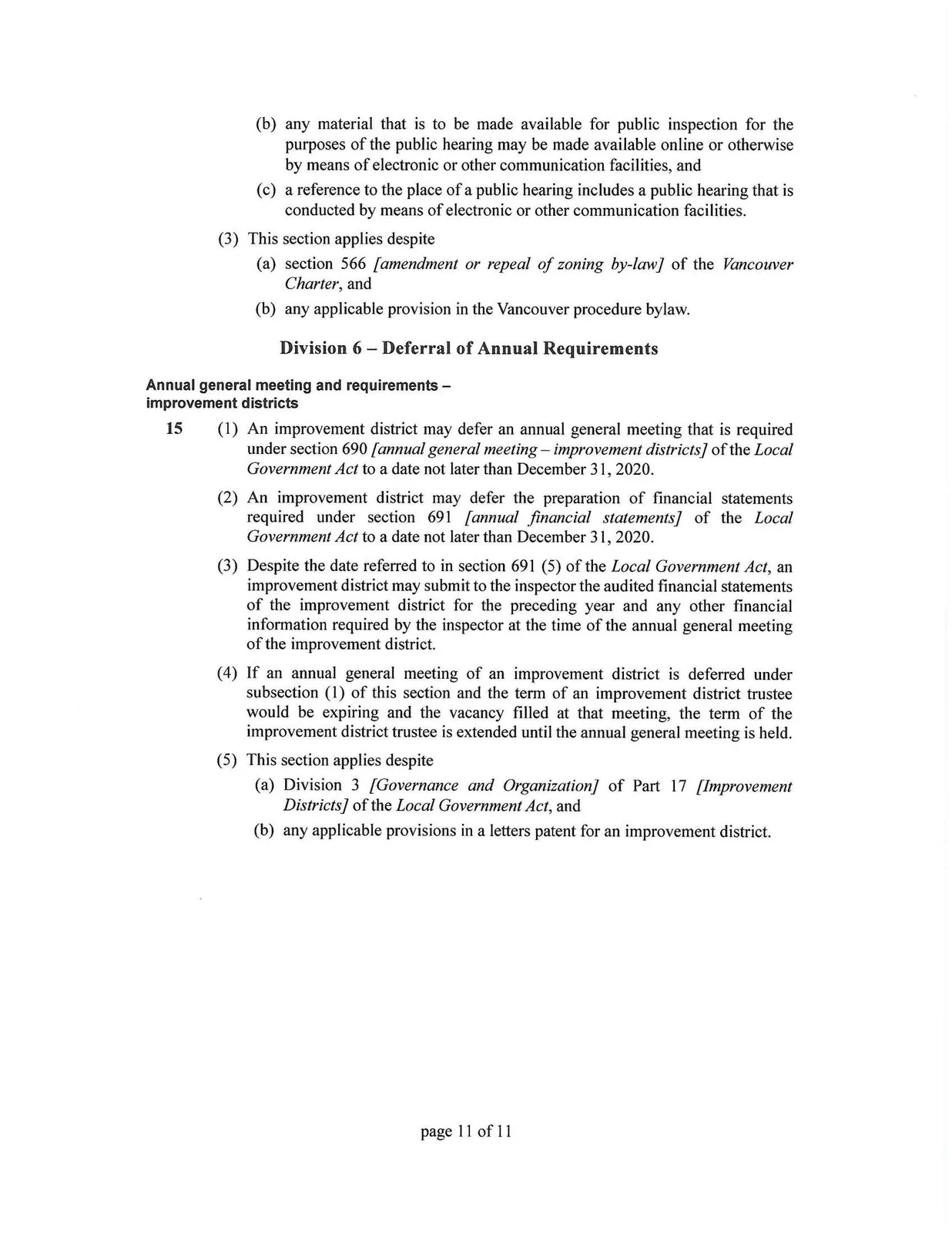
(a) any notice of the public hearing must include instructions for how to participate in the public hearing by means of electronic or other communication facilities, (b) any material that is to be made available for public inspection for the purposes of the public hearing may be made available online or otherwise by means of electronic or other communication facilities, and (c) a reference to the place of a public hearing includes a public hearing that is conducted by means of electronic or other communication facilities.
(3) This section applies despite (a) section 566 [amendment or repeal of zoning by-law] of the Vancouver Charter, and (b) any applicable provision in the Vancouver procedure bylaw.
Division 6 – Deferral of Annual Requirements
Annual general meeting and requirements – improvement districts
15 (1) An improvement district may defer an annual general meeting that is required under section 690 [annual general meeting – improvement districts] of the Local Government Act to a date not later than December 31, 2020.
(2) An improvement district may defer the preparation of financial statements required under section 691 [annual financial statements] of the Local Government Act to a date not later than December 31, 2020.
(3) Despite the date referred to in section 691 (5) of the Local Government Act, an improvement district may submit to the inspector the audited financial statements of the improvement district for the preceding year and any other financial information required by the inspector at the time of the annual general meeting of the improvement district.
(4) If an annual general meeting of an improvement district is deferred under subsection (1) of this section and the term of an improvement district trustee would be expiring and the vacancy filled at that meeting, the term of the improvement district trustee is extended until the annual general meeting is held.
(5) This section applies despite (a) Division 3 [Governance and Organization] of Part 17 [Improvement Districts] of the Local Government Act, and (b) any applicable provisions in a letters patent for an improvement district.
Document Images
(11)