BC Housing: Modular Supportive Housing Resident Outcomes Study
Research summary from BC Housing detailing the positive social and health outcomes of modular supportive housing residents.
BUILDING KNOWLEDGE
Modular Supportive Housing Resident Outcomes Study
SUMMARY REPORT - August 2019
An evaluation of the outcomes for modular supportive housing residents is underway across the province. This interim report highlights key outcomes for residents of the first seven modular supportive housing developments, six months after the buildings opened in 2018. These developments are located in Vancouver and Surrey, B.C.
People living in supportive housing are often some of the community’s most vulnerable. Many of them require a range of health care, mental health and addictions services.
Results for First Seven Modular Supportive Housing Developments
The Government of British Columbia announced the Rapid Response to Homelessness program in 2017 as an immediate response to homelessness across the province. The Province committed $291 million over two years to build 2,000 modular supportive housing units for people who are homeless or at risk of homelessness. In addition, $170 million was committed over three years to provide staffing and support services for residents. At the time of this report, 28 modular supportive housing developments, representing over 1,400 units, are operating across the province.
Results from the evaluation of the first seven modular supportive housing developments show improvements for residents in many areas of their lives, including: increased housing stability, improved quality of life, improved health, positive community relations, and reduced use of emergency health services.
“When survival is your daily life, future life goals are an impossibility because you are in a crisis mode. With modular supportive housing, we see stability. We see the capacity for food security and health.” – Modular supportive housing staff member
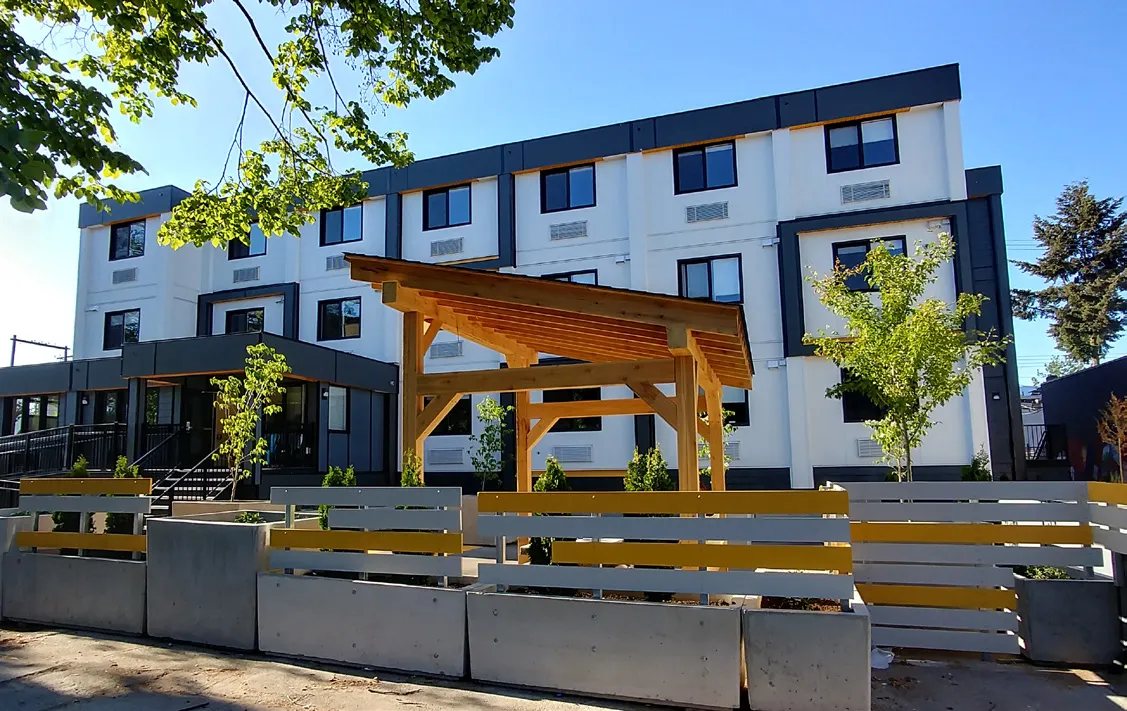
The seven sites included in this summary report are:
| Development Name | Municipality | # of Units |
|---|---|---|
| Reiderman Residence | Vancouver | 77 |
| Chartrand Place | Vancouver | 39 |
| Aneki Housing for Women | Vancouver | 39 |
| Sarah Ross House | Vancouver | 52 |
| Nancy Gerard Building | Surrey | 55 |
| Steve Cobon Building | Surrey | 60 |
| Nickerson Place | Surrey | 46 |
| Total | 368 |
Facts about the first seven modular supportive housing developments
- 33% Residents are seniors, age 55+
- 25% Residents identify as being of Indigenous descent
- 40% Residents are female
- 79% Residents were previously experiencing homelessness
- 77% Survey respondents reported a prior connection to the neighbourhood
“Modular supportive housing, with the supports we are able to provide, and the ability to create new housing within six months, is a phenomenal solution to homelessness.” – Modular supportive housing staff member
“Not having your entire life on your back has been amazing for people. Once people have a roof over their heads, it’s amazing what they can accomplish.” – Modular supportive housing staff member
Non-profit housing providers operate the modular supportive housing developments, providing on-site support 24 hours every day of the week and helping residents to:
- Maintain their units
- Participate in case planning and needs assessments
- Enhance their life skills, including learning to cook
- Access income assistance, pension benefits, disability benefits, and apply for a BC Identification Card
- Connect with education and employment opportunities and services
- Open a bank account
- Access community information, social and recreational programs
- Access food
- Connect with health care, mental health and addictions services, as required
- Connect with independent housing
Results Snapshot
- 94% Residents remained housed at their modular supportive housing building six months after moving into their units
- 84% Survey respondents reported improvements to overall well-being
- 54% Survey respondents reported better access to employment opportunities and employment support services
- 57% Survey respondents reported improvement in living skills
- 56% Survey respondents reported improvement in their physical health
- 82% Survey respondents reported experiencing positive interactions with neighbours
- 44% Survey respondents reported they had been admitted to the hospital less often¹
- 44% Survey respondents reported improvement to their mental health
- 39% Survey respondents reported improvements in addiction issues
Methodology
The data provided in this report was collected six months after each of the seven modular supportive housing developments opened. The outcomes are based on residents who moved into the buildings when they opened. Outcomes may change over time as the residents within the building change.
The following methodology was used in this study:
- A voluntary resident survey (41% response rate across the 7 developments)
- Interviews with non-profit housing providers (3 staff interviewed per development)
- Administrative data from BC Housing and City of Vancouver databases
This study is being undertaken at modular supportive housing developments across the province in collaboration with non-profit housing societies and other partners. In Vancouver, the Rapid Response to Homelessness program is delivered as Temporary Modular Housing (TMH).
Acknowledgment
We would like to sincerely thank all the residents who shared their perspectives through the resident survey as part of this study. BC Housing gratefully acknowledges each of the non-profit housing providers, City of Vancouver and City of Surrey for sharing their insights on the modular supportive housing buildings and for supporting this study. We also acknowledge the contribution of the City of Vancouver for assisting in the development of this research and providing data for this report.
To access the Modular Supportive Housing Resident Outcomes reports for each of these buildings, visit the BC Housing Research Centre at www.bchousing.org.
More Information
BC Housing’s Research Centre works in collaboration with housing sector partners to foster excellence in residential construction and find innovative solutions for affordable housing in British Columbia. Sharing leading-edge research, advances in building science, and new technologies encourages best practice. The Research Centre identifies and bridges research gaps to address homelessness, housing affordability, social housing challenges and the needs of distinct populations. Mobilizing knowledge and research expertise helps improve the quality of housing and leads to innovation and adoption of new construction techniques, Building Code changes, and enhanced education and training programs. Sign up to receive the latest news and updates from the BC Housing Research Centre at www.bchousing.org/subscribe.
Contact: Research Centre Email: research@bchousing.org Phone: 604-439-4135 For more infomation, visit our website at: www.bchousing.org
Document Images
(5)