COMMITTEE OF THE WHOLE REPORT - ELECTRIC VEHICLE CHARGING FACILITIES
Background research report from October 2020 comparing EV charging regulations across Saanich, Victoria, and other municipalities.
TOWN OF VIEW ROYAL COMMITTEE OF THE WHOLE REPORT
TO: Committee of the Whole DATE: October 8, 2020 FROM: J. Davison, MCIP RPP, Community Planner MEETING DATE: October 13, 2020
ELECTRIC VEHICLE CHARGING FACILITIES
RECOMMENDATION
THAT Council receive the report from the Community Planner entitled “ELECTRIC VEHICLE CHARGING FACILITIES” and dated October 8, 2020 for information.
CHIEF ADMINISTRATIVE OFFICER’S COMMENTS
I concur with the recommendation.
DIRECTOR OF DEVELOPMENT SERVICES’ COMMENTS
I concur with the recommendation.
PURPOSE OF REPORT
The purpose of the report is to provide information to Council regarding proposed minimum requirements for the provision of Electric Vehicle (EV) and electric bicycle charging facilities in new construction.
BACKGROUND
Electric vehicles are experiencing a period of exponential growth, driven by their convenience, ease of maintenance, reduced fuel costs, decreasing purchase price, and environmental benefit.
On July 28, 2020 the Vancouver Sun reported that, according to ICBC figures, there were 29,385 electric vehicles on the road on March 31, 2020, compared to 13,727 licensed EVs April 1, 2019. As of March 2020, there were 5,635 licensed EVs on Vancouver Island and the South Gulf Islands, compared to 2,842 on April 1, 2019. On Vancouver Island, the municipality with the most EVs was Saanich at 1,291, followed by Oak Bay with 460. Salt Spring Island had the highest ratio of EVs at 21 per 1,000 residents.
Charging infrastructure is evolving rapidly. For reference, there are three levels of charging for EVs. Below is information provided by BC Hydro for each level. Level 2 chargers are the most common dedicated chargers for residential use.
Levels of Charging
Level 1 chargers
- Uses a connection to a standard 120-volt outlet
- Charges 8 km per hour
- Takes 12 to 20 hours to fully charge a battery EV (6 to 12 hours for a plug-in hybrid)
- Used mostly in homes
Level 2 chargers
- Uses a connection to a 240-volt outlet, like those used by ovens and clothes dryers
- Charges 30 km per hour
- Takes 6 to 14 hours to fully charge a battery EV (4 to 8 hours for a plug-in hybrid)
- Used in homes, businesses, and common areas
Fast Chargers (also known as Level 3)
- Uses a direct current connection to an electrical system
- Charges 100 km per 30 minutes or 80% charge at 50 kW (varies by vehicle type)
- Takes 1 to 4 hours to fully charge a battery EV (15 minutes to 3 hours for a plug-in hybrid)
- Used mostly in businesses and common areas
Source: BC Hydro https://electricvehicles.bchydro.com/charge/choosing-a-home-EV-charger
PROJECT INFORMATION
Requiring EV charging facilities will address the Town’s strategic goals towards reducing GHG emissions, as well as serving to respond to the Town’s recent declaration of a Climate Emergency on March 5, 2019.
OCP Policy NE4.1 Reduction of Greenhouse Gas Emissions (GHG) Work with other municipalities and levels of government, public agencies and organizations to reduce GHG emissions through land use, energy and transportation planning; infrastructure design; building retrofits; water and energy conservation; solid waste management; and green procurements.
Other Municipalities
Currently Saanich and Victoria have EV parking facility regulations within their bylaws. Esquimalt, Oak Bay, Colwood and Langford do not.
Saanich has a very robust, prescriptive and detailed set of regulations and are laid out as such (as an example):
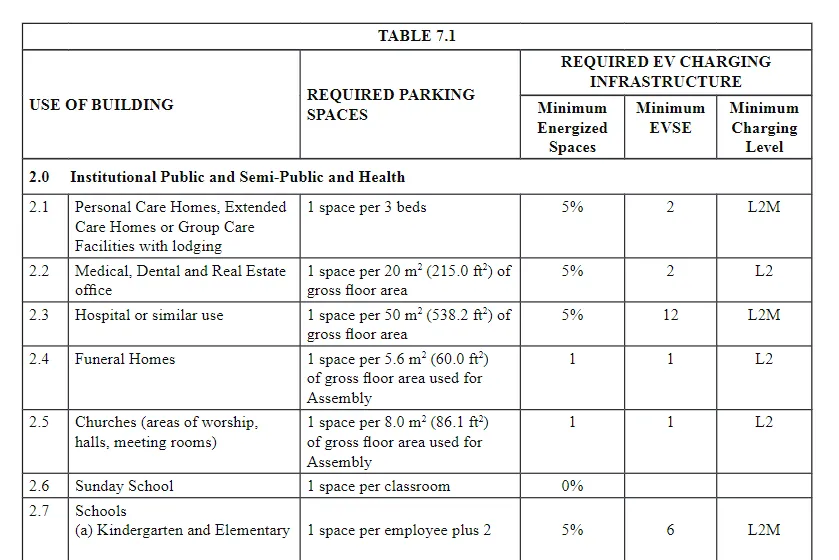
| USE OF BUILDING | REQUIRED PARKING SPACES | REQUIRED EV CHARGING INFRASTRUCTURE: Minimum Energized Spaces | REQUIRED EV CHARGING INFRASTRUCTURE: Minimum EVSE | REQUIRED EV CHARGING INFRASTRUCTURE: Minimum Charging Level |
|---|---|---|---|---|
| 2.0 Institutional Public and Semi-Public and Health | ||||
| 2.1 Personal Care Homes, Extended Care Homes or Group Care Facilities with lodging | 1 space per 3 beds | 5% | 2 | L2M |
| 2.2 Medical, Dental and Real Estate office | 1 space per 20 m² (215.0 ft²) of gross floor area | 5% | 2 | L2 |
| 2.3 Hospital or similar use | 1 space per 50 m² (538.2 ft²) of gross floor area | 5% | 12 | L2M |
| 2.4 Funeral Homes | 1 space per 5.6 m² (60.0 ft²) of gross floor area used for Assembly | 1 | 1 | L2 |
| 2.5 Churches (areas of worship, halls, meeting rooms) | 1 space per 8.0 m² (86.1 ft²) of gross floor area used for Assembly | 1 | 1 | L2 |
| 2.6 Sunday School | 1 space per classroom | 0% | ||
| 2.7 Schools (a) Kindergarten and Elementary | 1 space per employee plus 2 | 5% | 6 | L2M |
Victoria’s set of regulations is simpler, with one energized electric vehicle outlet (Level 2) required for each required parking space (suites not included) and a very simple Commercial, Institutional and Industrial requirement where less than 10 required spaces does not require an energized electric vehicle outlet, 10-14 requires 1 outlet (total, not per space) and more than 15 requires 2 outlets or 5% of the total number of required spaces (whichever is greater).
ANALYSIS AND DISCUSSION
Staff believes the Victoria approach is easier and better, for the following reasons:
- EV charging is in a transitional stage, with an uncertain future regarding common methods of charging. Keeping things simple for now will ensure pre-wiring for residential buildings but will not provide complex and likely unnecessary regulation for commercial, institutional and industrial uses.
- Retrofitting residential buildings for EV outlets is very expensive; requiring it at time of construction is far cheaper. Residential locations are where EV owners are currently most likely to charge their vehicles, and perhaps even more so in the future. With battery technology improving at a very rapid rate, it is possible that charging at work or at a public charger will not be common in the future; home charging or dedicated charging facilities for long road trips is likely to be the future model, or a supplemental system that will be deemed very useful, if not outright necessary.
The other issue is charging facilities for electric bicycles. Staff recommends that there be a 120V power outlet (Level 1 charging connection) provided per Class 1 bicycle parking space (meaning “a secure, weather-protected bicycle parking facility used to accommodate long-term parking, such as for residents or employees, usually within a building or covered, fenced area”). This means that a standard household dual-outlet service per two spaces would be required.
It should be noted that existing buildings will not be required to retrofit to meet the EV charging requirements; only new buildings will be required to have these facilities.
CONCLUSION
Staff recommends that the Town amend Zoning Bylaw No. 900 2014:
- to require one Level 2 EV charging outlet per required parking space (excepting suites) for all new residential construction;
- to ensure that Commercial, Institutional and Industrial requirement where less than 10 required spaces do not require an energized electric vehicle outlet, 10-14 required spaces require one Level 2 outlet (total, not per space) and more than 15 required spaces requires 2 Level 2 outlets or 5% of the total number of required spaces (whichever is greater).
- to require one 120V (Level 1) outlet per required bicycle parking space.
RECOMMENDATION
THAT Council receive the report from the Community Planner entitled “ELECTRIC VEHICLE CHARGING FACILITIES” and dated October 8, 2020 for information.
SUBMITTED BY: J. Davison MCIP RPP, Community Planner REVIEWED BY: for L. Chase MCIP RPP, Director of Development Services
Document Images
(4)