Council Report - Environmental Development Permit with Variances No. 2017/10 - 4 Governor’s Point
Staff report regarding a development permit with variances to authorize the completion of a partially-constructed retaining wall within the 15m shoreline setback.
TOWN OF VIEW ROYAL COUNCIL REPORT
TO: Council DATE: June 27, 2018 FROM: J. Davison, MCIP RPP, Planner MEETING DATE: July 3, 2018 FILE NO.: 3060-20-2017-10
ENVIRONMENTAL DEVELOPMENT PERMIT WITH VARIANCES 4 GOVERNOR’S POINT
RECOMMENDATION
THAT Council approve Development Permit 2017/10;
AND THAT Development Permit include the following variances to Zoning Bylaw No. 900, 2014:
- Variance to the height of a retaining wall from 1.2m to 2.3m – Zoning Bylaw Section 4.8.9
- Variance to a retaining wall constructed within 15m of the natural boundary to the sea - Zoning Bylaw Section 3.8.2.a
AND THAT the English Ivy at the base of the wall be removed;
AND THAT plantings at the base of the wall be native to the region.
CHIEF ADMINISTRATIVE OFFICER’S COMMENTS
I concur with the recommendation.
DIRECTOR OF DEVELOPMENT SERVICES’ COMMENTS
I concur with the recommendation.
PURPOSE OF REPORT
The purpose of this report is to present an application for an Environmental Development Permit with variance to permit the completion of a partially-constructed retaining wall.
BACKGROUND
In February of 2017 it was brought to the Town’s attention that a retaining wall was being constructed at 4 Governor’s Point Dr, within the 15m special setback and 15m Natural Watercourse and Shoreline Environmental Development Permit Area. It also appeared to be over the 1.2m maximum height as permitted by the Town’s Zoning Bylaw.
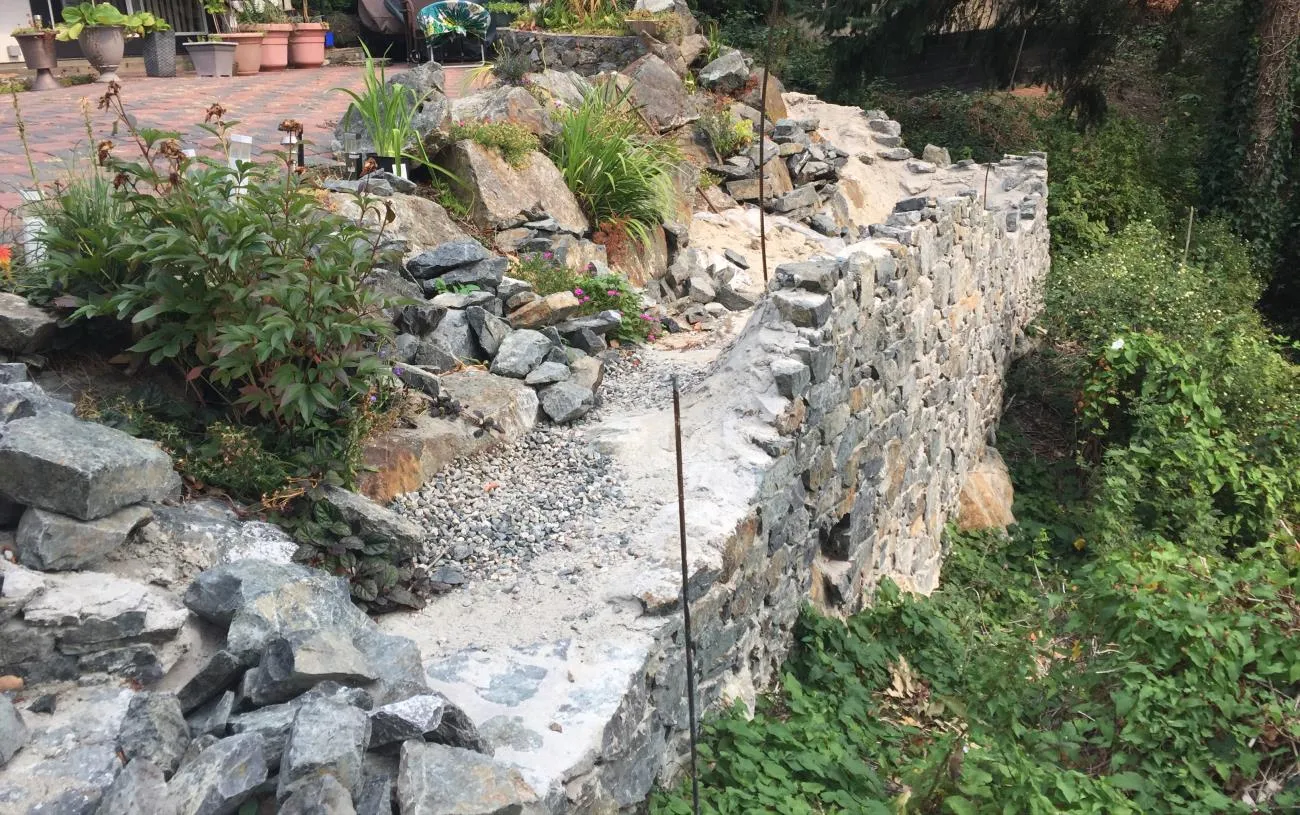
The applicant stopped working on the wall and over the course of the year assembled various application requirements before submitting a complete application in February of 2018. A photo of the partially finished wall is provided below.
Update to May 8 Committee of the Whole Report:
As requested by Committee, the applicant obtained a survey showing the location, existing and final height of the wall.
The height of the wall when finished will be 2.3m from base to top (the May COW report had the height at 2.4m). The wall is 5.1m from the present natural boundary.
PROJECT INFORMATION
The existing patio and stacked boulder wall was built with the house in 2003. No Development Permit is on record for the property. While there was an Environmental Development Permit requirement for shoreline development under OCP Bylaw No. 361, 1999, it was much less prescriptive than the current regulations and the lot in question is not identified as a specific area of concern. As best as staff can determine, no Development Permit was required under the previous regulations.
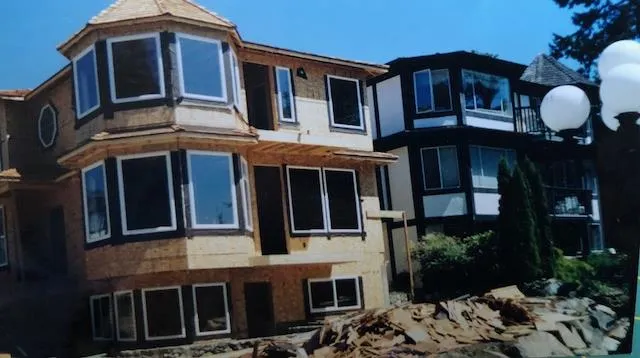
The applicant has supplied the following photo (below) as evidence that the patio was constructed with the house. While it is by no means conclusive, it does show what appears to be stacked rock in the bottom right-hand corner, as well as a significantly disturbed and levelled patio area.
The applicant has built a wall which is to have a height of 2.3m at completion, compared to the permitted height of 1.2m for a retaining wall under Zoning Bylaw No. 900, 2014. The wall is also within the 15m special setback to the natural boundary to the sea, which is not permitted by the Zoning Bylaw. It is also within the 15m Natural Watercourse and Shoreline Development Permit Area.
The subject property is subject to a requirement to obtain a Development Permit according to the Natural Watercourse and Shoreline Development Permit Area (DPA). This DPA focuses on the protection of environmentally sensitive areas.
The applicant has submitted the following information in support of their application:
- Applicant’s Statement – undated
- Site Plan and Elevation – Matthew Bergink – February 8, 2018
- BCLS Survey – Peter Broeren – June 1, 2018
- Environmental Assessment – Swell Environmental – April 14, 2017
- Geotechnical Statement – Ryzuk Environmental – October 9, 2017
The application requires variances:
- Variance to the height of a retaining wall from 1.2m to 2.3m – Zoning Bylaw Section 4.8.9
- Variance to a retaining wall constructed within 15m of the natural boundary to the sea - Zoning Bylaw Section 3.8.2.a
The base of the partially-constructed wall is 5.1m from the surveyed natural boundary, but not in a significantly different location from the stacked boulder wall previously in place.
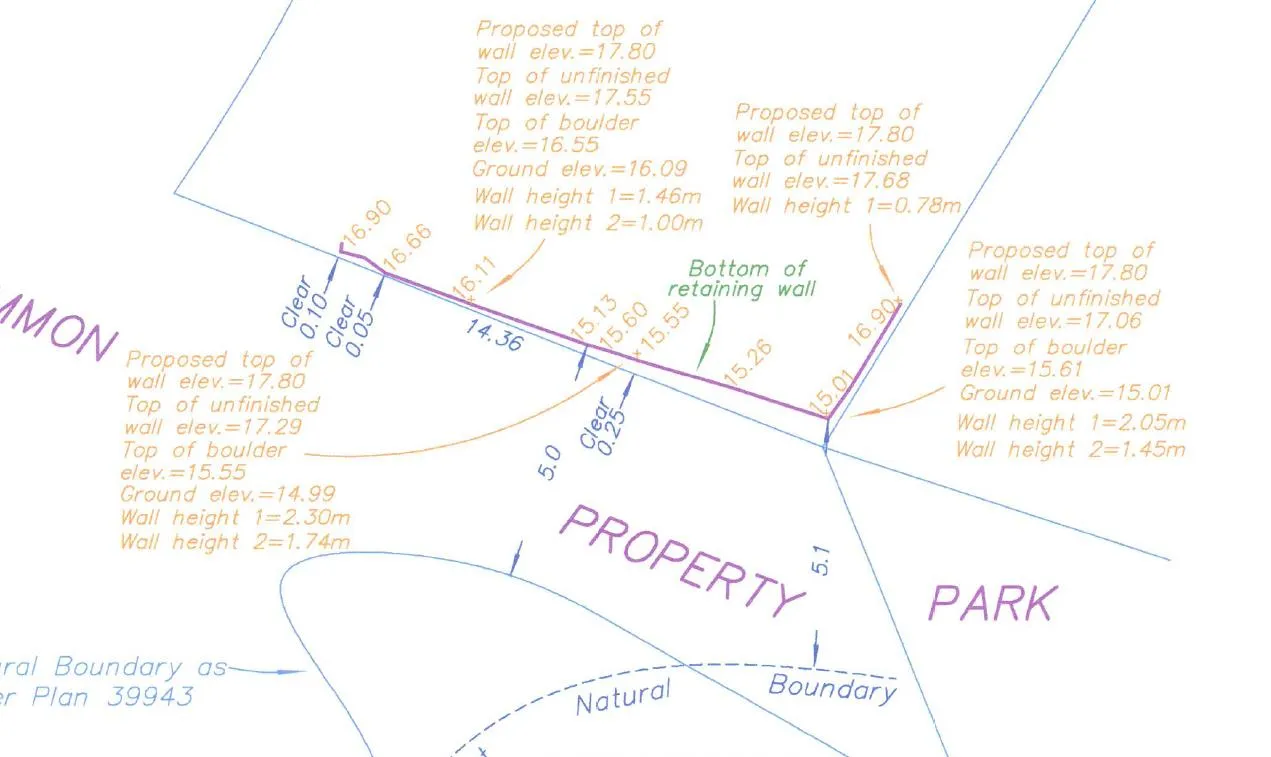
The setback distance is not itself a variance as the retaining wall is not considered to be a structure within the Zoning Bylaw. Retaining walls are simply not permitted in the special setback so the variance is to permit it in the setback.
The retaining wall height and location must be consistent with the submitted and approved Development Permit drawings upon completion; it must be constructed to the same height and in the same location as on the plans submitted in the Development Permit application.
ISSUES AND ANALYSIS
The applicant cites several reasons for the construction of the wall:
- Prevention of future erosion
- Eliminating rodent issues in the former boulder wall
- Improving aesthetics for neighbours
- Earthquake damage mitigation
There are two issues here for Committee (and then Council) to consider:
- The impact of the retaining wall and associated patio structure on the environment
- The impact of the variance on the use and enjoyment of adjacent properties
Impact on Environment
The Swell Environmental report has the following conclusion:
Based on the observed site conditions there is no evidence of environmental impact from the current wall modifications.
The report recommends following General Best Management Practices for construction based on the proposed work:
- Schedule construction activities during dry weather
- Ensure concrete wastes are contained: wet concrete is not deposited into surrounding aquatic ecosystems, remove excess concrete, and do not allow water from equipment and tool cleaning to enter the aquatic environment; and
- Remove all wastes associated with construction.
Additionally the report notes the prevalence of invasive English Ivy at the base of the wall and notes that its removal and replacement with various recommended native plants would serve the location well.
Geotechnical Engineering
The attached report indicates that the wall is being constructed to a sufficient standard. Staff will recommend that a final inspection be made when the wall is completed.
Impact of Variances
The visual impact of the wall at 2.4m, and the proximity of it to the stairway and beach, is a significant consideration for Council. The base of the wall measures approximately 4m from the natural boundary.
POLICY
Generally speaking the Official Community Plan Natural Watercourse and Shoreline guidelines around shoreline development encourage ‘soft engineering’ rather than the hard, vertical wall proposed by the applicant.
viii. In the design of new developments or re‐development, the use of soft engineered and innovative alternatives to stabilizing shorelines and preventing erosion, such as bioengineering rather than traditional hard engineered measures should be used. In general, the harder the construction measure, the greater the impact on shoreline process, including sediment transport, geomorphology and biological functions. Hard" measures refer to those with solid, hard surfaces, such as concrete bulkheads, while "soft" structural measures rely on less rigid materials, such as biotechnical vegetation measures or beach enhancement. There is a range of measures varying from soft to hard that include:
- Vegetation enhancement.
- Upland drainage control.
- Biotechnical measures.
- Beach enhancement.
- Anchor trees.
- Gravel placement.
- Rock (rip rap) revetments.
- Gabions.
- Concrete groins.
- Retaining walls or bulkheads.
ix. Where hard measures can conclusively be shown to be the only means of effectively preventing erosion, they should be designed in consultation with a registered professional biologist, qualified environmental professionals and professional engineers, as appropriate.
In this case, the space available to soft-engineer a retaining wall is minimal if there is to be a retention or increase of patio space available, but if this wall was designed from the start in consultation with professionals it may look somewhat different than the current partially built structure, with more naturalized features.
CONCLUSION
The concern of the Development Permit is environmental impact; the biologists’ report has indicated that there is no negative impact from the proposed wall. Conversely, however, there is potentially not as much enhancement as if the wall were designed with all the Development Permit guidelines in mind.
The question before Council is whether the proposed design adds value to the property while not adversely affecting the use and enjoyment of adjacent properties.
RECOMMENDATION
THAT Council approve Development Permit 2017/10;
AND THAT Development Permit include the following variances to Zoning Bylaw No. 900, 2014:
- Variance to the height of a retaining wall from 1.2m to 2.3m – Zoning Bylaw Section 4.8.9
- Variance to a retaining wall constructed within 15m of the natural boundary to the sea - Zoning Bylaw Section 3.8.2.a
AND THAT the English Ivy at the base of the wall be removed;
AND THAT any plantings at the base of the wall be native to the region.
SUBMITTED BY: J. Davison, MCIP RPP, Planner
REVIEWED BY: L. Chase, MCIP RPP, Director of Development Services
ATTACHMENTS:
- Applicant’s Statement – undated
- Site Plan and Elevation – Matthew Bergink – February 8, 2018
- BCLS Survey – Peter Broeren – June 1, 2018
- Environmental Assessment – Swell Environmental – April 14, 2017
- Geotechnical Statement – Ryzuk Environmental – October 9, 2017
Document Images
(3)