Disaster Proofing Canada – Earthquake Resiliency Information
Informational brochures regarding earthquake risk in BC and the financial impact of potential disasters.
Disaster Proofing Canada – Earthquake Resiliency
Canada is not prepared for a major earthquake – despite its high risk
It's not a question of if but when...
- Southwestern British Columbia is overdue for a large earthquake.
- Such a major disaster would cost lives and destroy communities, infrastructure, and supply lines.
- It would have a huge impact on individual British Columbians and on Canada’s economic performance as a whole.
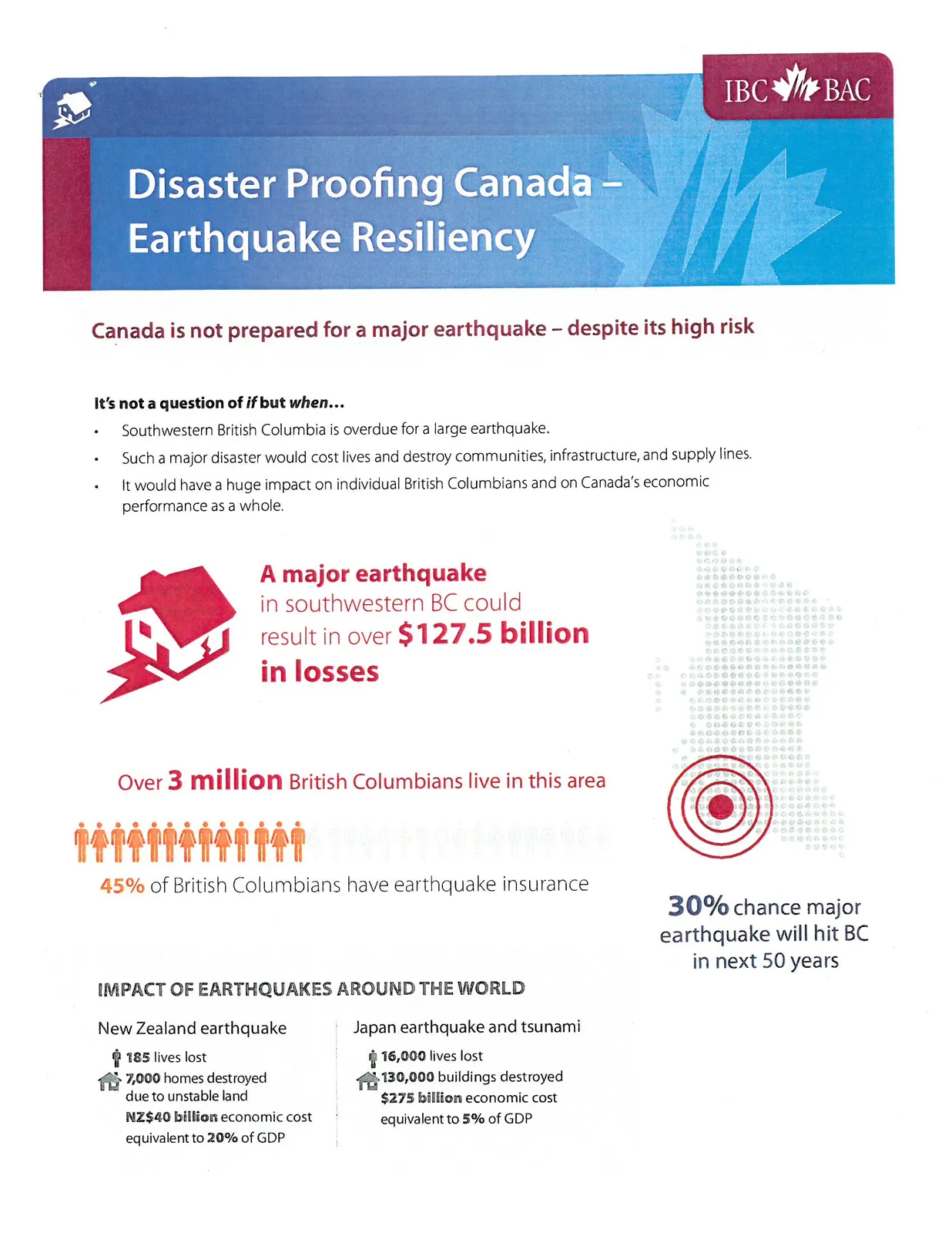
IMPACT OF EARTHQUAKES AROUND THE WORLD
| New Zealand earthquake | Japan earthquake and tsunami |
|---|---|
| 185 lives lost | 16,000 lives lost |
| 7,000 homes destroyed due to unstable land | 130,000 buildings destroyed |
| NZ$40 billion economic cost equivalent to 20% of GDP | $275 billion economic cost equivalent to 5% of GDP |
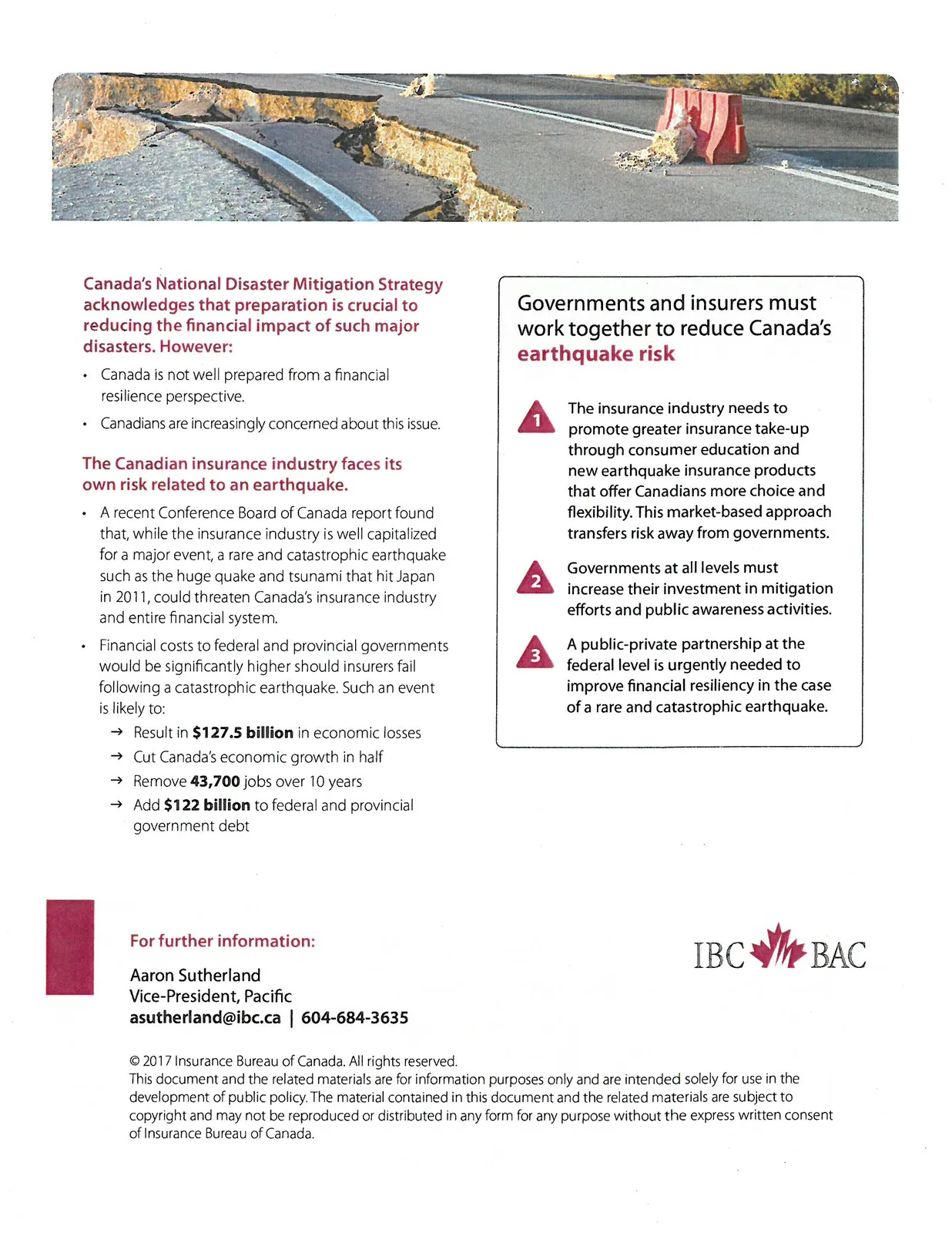
Canada’s National Disaster Mitigation Strategy acknowledges that preparation is crucial to reducing the financial impact of such major disasters. However:
- Canada is not well prepared from a financial resilience perspective.
- Canadians are increasingly concerned about this issue.
The Canadian insurance industry faces its own risk related to an earthquake.
- A recent Conference Board of Canada report found that, while the insurance industry is well capitalized for a major event, a rare and catastrophic earthquake such as the huge quake and tsunami that hit Japan in 2011, could threaten Canada’s insurance industry and entire financial system.
- Financial costs to federal and provincial governments would be significantly higher should insurers fail following a catastrophic earthquake. Such an event is likely to:
- Result in $127.5 billion in economic losses
- Cut Canada’s economic growth in half
- Remove 43,700 jobs over 10 years
- Add $122 billion to federal and provincial government debt
Governments and insurers must work together to reduce Canada’s earthquake risk
- The insurance industry needs to promote greater insurance take-up through consumer education and new earthquake insurance products that offer Canadians more choice and flexibility. This market-based approach transfers risk away from governments.
- Governments at all levels must increase their investment in mitigation efforts and public awareness activities.
- A public-private partnership at the federal level is urgently needed to improve financial resiliency in the case of a rare and catastrophic earthquake.
For further information:
Aaron Sutherland Vice-President, Pacific asutherland@ibc.ca | 604-684-3635
© 2017 Insurance Bureau of Canada. All rights reserved.
This document and the related materials are for information purposes only and are intended solely for use in the development of public policy. The material contained in this document and the related materials are subject to copyright and may not be reproduced or distributed in any form for any purpose without the express written consent of Insurance Bureau of Canada.
Disaster Proofing Canada – Earthquake Resiliency
Canada is not prepared for a major earthquake – despite its high risk
It's not a question of if but when...
- Southwestern British Columbia is overdue for a large earthquake.
- Such a major disaster would cost lives and destroy communities, infrastructure, and supply lines.
- It would have a huge impact on individual British Columbians and on Canada’s economic performance as a whole.
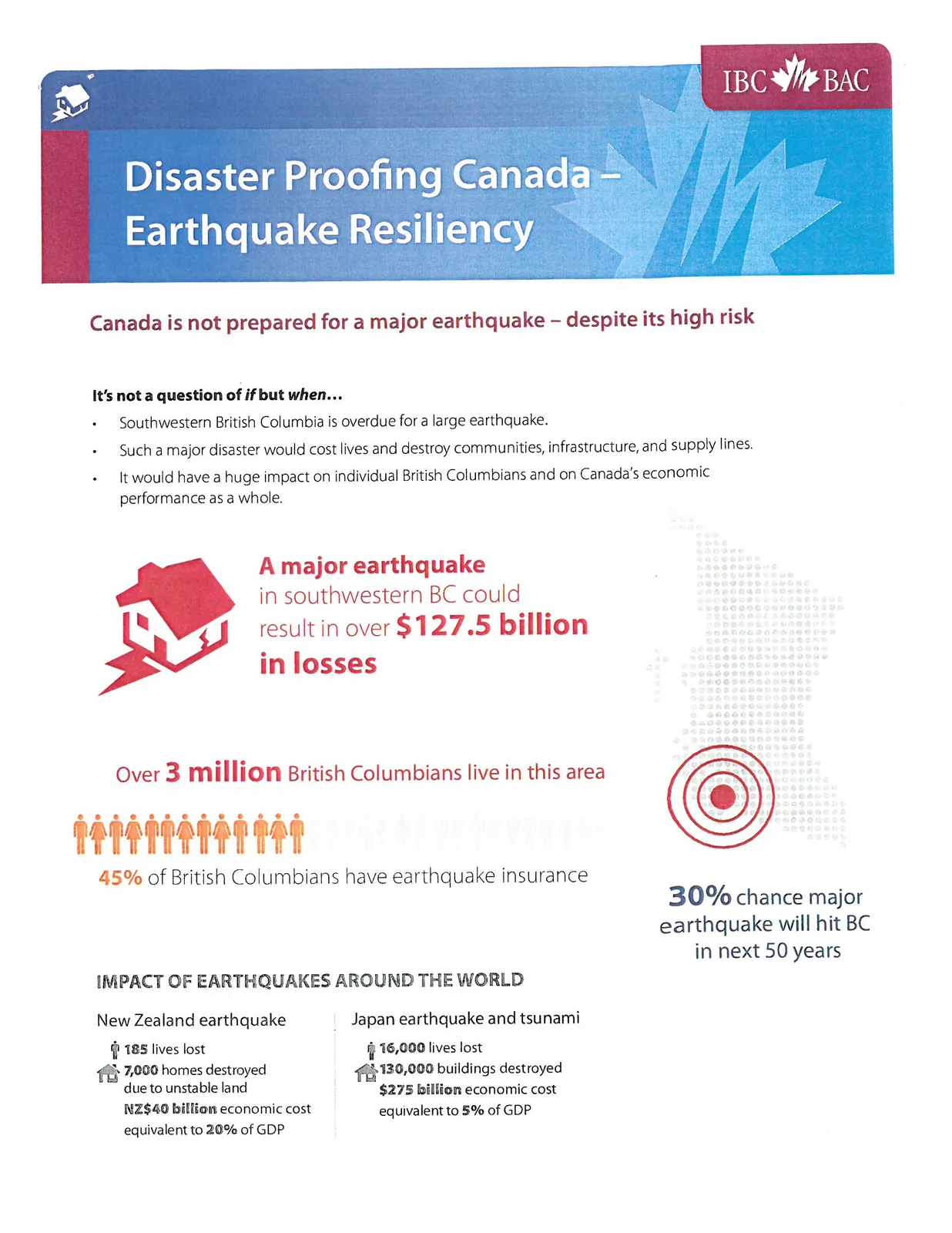
IMPACT OF EARTHQUAKES AROUND THE WORLD
| New Zealand earthquake | Japan earthquake and tsunami |
|---|---|
| 185 lives lost | 16,000 lives lost |
| 7,000 homes destroyed due to unstable land | 130,000 buildings destroyed |
| NZ$40 billion economic cost equivalent to 20% of GDP | $275 billion economic cost equivalent to 5% of GDP |
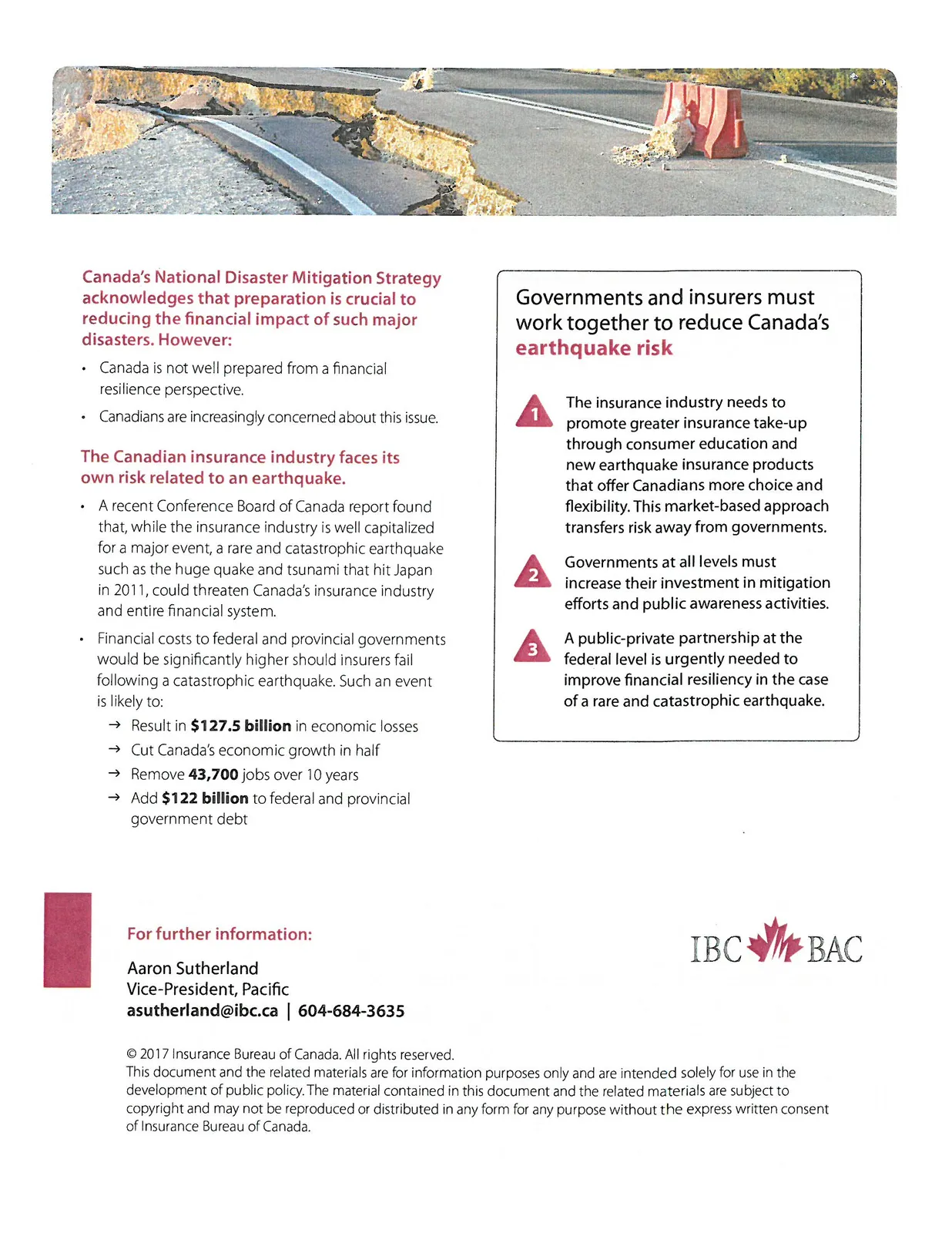
Canada’s National Disaster Mitigation Strategy acknowledges that preparation is crucial to reducing the financial impact of such major disasters. However:
- Canada is not well prepared from a financial resilience perspective.
- Canadians are increasingly concerned about this issue.
The Canadian insurance industry faces its own risk related to an earthquake.
- A recent Conference Board of Canada report found that, while the insurance industry is well capitalized for a major event, a rare and catastrophic earthquake such as the huge quake and tsunami that hit Japan in 2011, could threaten Canada’s insurance industry and entire financial system.
- Financial costs to federal and provincial governments would be significantly higher should insurers fail following a catastrophic earthquake. Such an event is likely to:
- Result in $127.5 billion in economic losses
- Cut Canada’s economic growth in half
- Remove 43,700 jobs over 10 years
- Add $122 billion to federal and provincial government debt
Governments and insurers must work together to reduce Canada’s earthquake risk
- The insurance industry needs to promote greater insurance take-up through consumer education and new earthquake insurance products that offer Canadians more choice and flexibility. This market-based approach transfers risk away from governments.
- Governments at all levels must increase their investment in mitigation efforts and public awareness activities.
- A public-private partnership at the federal level is urgently needed to improve financial resiliency in the case of a rare and catastrophic earthquake.
For further information:
Aaron Sutherland Vice-President, Pacific asutherland@ibc.ca | 604-684-3635
© 2017 Insurance Bureau of Canada. All rights reserved.
This document and the related materials are for information purposes only and are intended solely for use in the development of public policy. The material contained in this document and the related materials are subject to copyright and may not be reproduced or distributed in any form for any purpose without the express written consent of Insurance Bureau of Canada.