Schedule 2 - Proposed DP 2017/06 Drawings
Architectural drawings including overall site plans and level 1 floor plans for the casino expansion.
Context
A regional growth strategy is a framework, developed by municipalities and the regional district in partnership, for identifying social, economic and environmental objectives. Its purpose, under Part 13 of the Local Government Act, is to “… promote human settlement that is socially, economically, and environmentally healthy and that makes efficient use of public facilities and services, land and other resources.” A regional growth strategy expresses how communities will work together to enhance regional quality of life and social well-being. As of 2008, regional growth strategies must also include policies, actions and targets for the reduction of greenhouse gas emissions.
The Capital Regional District adopted a Regional Growth Strategy bylaw in 2003. In 2011, the Capital Regional District Board in partnership with local municipalities initiated the required five year review of the Regional Growth Strategy (2003). The 2016-2018 update to the Regional Growth Strategy follows considerable public and intergovernmental discussion and consultation. Map 1 shows the Regional Growth Management Planning Area. At the present time, the Capital Region’s ten First Nations are not partners in the regional growth strategy, nor does it apply to the Salt Spring Island and the Southern Gulf Islands Electoral Areas, which fall under the planning jurisdiction of the Islands Trust (see Map 1).
Citizens, local governments, First Nations, school district boards, stakeholders, and provincial and federal agencies have been involved in the Strategy’s update through a regional sustainability planning process. This process determined that many of the policies of the Regional Growth Strategy (2003) are achieving desired objectives, notably, increasing compact and complete communities, acquiring green space, and substantially completing the regional trail network. Further, key complementary planning documents identified as actions to implement the Regional Growth Strategy (2003) are complete, including:
- 2007 Regional Housing Affordability Strategy; and
- Regional Transportation Strategy (completed as the 2014 Regional Transportation Plan and the 2011 Pedestrian and Cycling Master Plan).
Input and feedback have affirmed the desire for a strong growth management framework rooted in the 2003 Regional Growth Strategy objectives and emphasized the importance of mitigating and adapting to the effects of climate change. Updates integrate recommendations from completed planning documents and address the requirements for policies, actions and targets for greenhouse gas reductions.
MAP 1: GROWTH MANAGEMENT PLANNING AREA
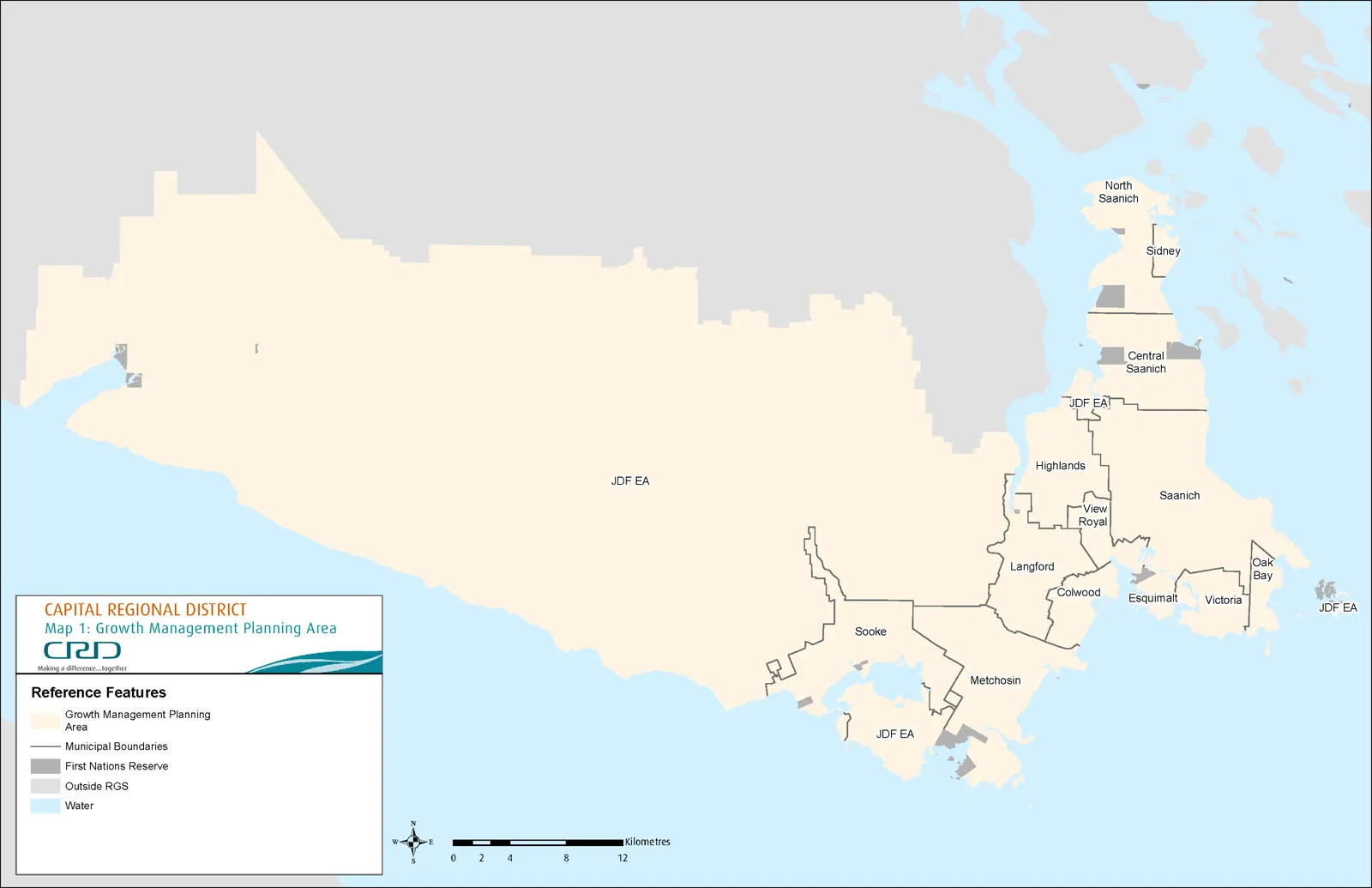
The Capital Region is located at the southern-most end of Vancouver Island, in the Cascadia/Salish Sea bio-region (see Map 2). The bio-region runs north-south along a coastal corridor stretching from Campbell River south to Olympia, Washington and east to Hope. The Capital Region’s present settlement pattern is characterized by a diverse mix of urban and rural communities, with a concentration of population in the Core Area located along key transportation corridors. The West Shore and Saanich Peninsula feature smaller urban centres, with forestry lands to the west throughout the Juan de Fuca Electoral Area. Agricultural lands are concentrated on the Saanich Peninsula, with some slightly more dispersed lands on the West Shore.
In this context, modest population growth is forecast for the Capital Region. Table 1 highlights existing and forecasted-projected population, dwelling units and employment.