Letter re: Border implications of Bill C-45 - Hon. Mobina Jaffer
Information package from Senator Jaffer regarding the risks of permanent US border barring for Canadians following cannabis legalization.
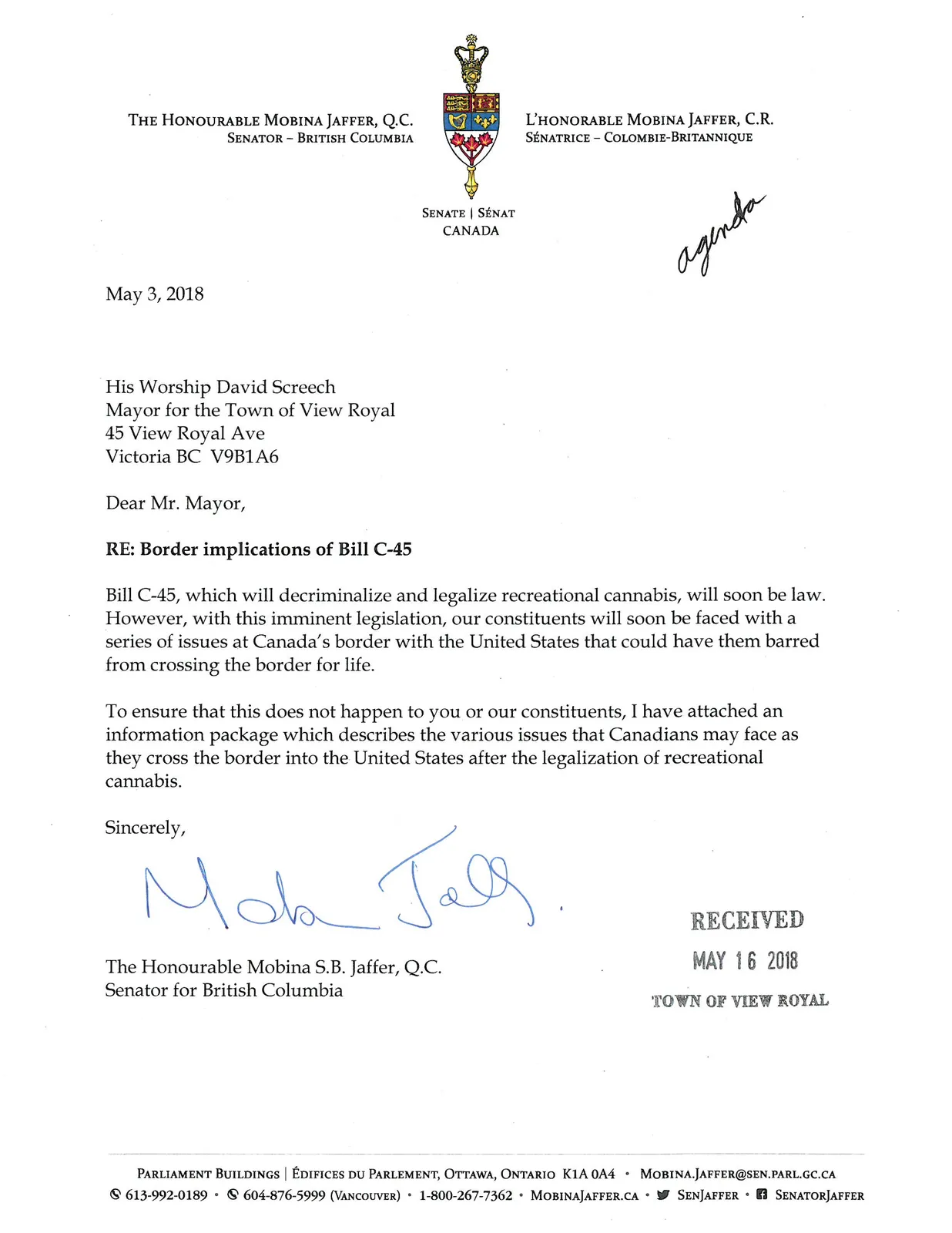
May 3, 2018
His Worship David Screech Mayor for the Town of View Royal 45 View Royal Ave Victoria BC V9B 1A6
Dear Mr. Mayor,
RE: Border implications of Bill C-45
Bill C-45, which will decriminalize and legalize recreational cannabis, will soon be law. However, with this imminent legislation, our constituents will soon be faced with a series of issues at Canada's border with the United States that could have them barred from crossing the border for life.
To ensure that this does not happen to you or our constituents, I have attached an information package which describes the various issues that Canadians may face as they cross the border into the United States after the legalization of recreational cannabis.
Sincerely,
The Honourable Mobina S.B. Jaffer, Q.C. Senator for British Columbia
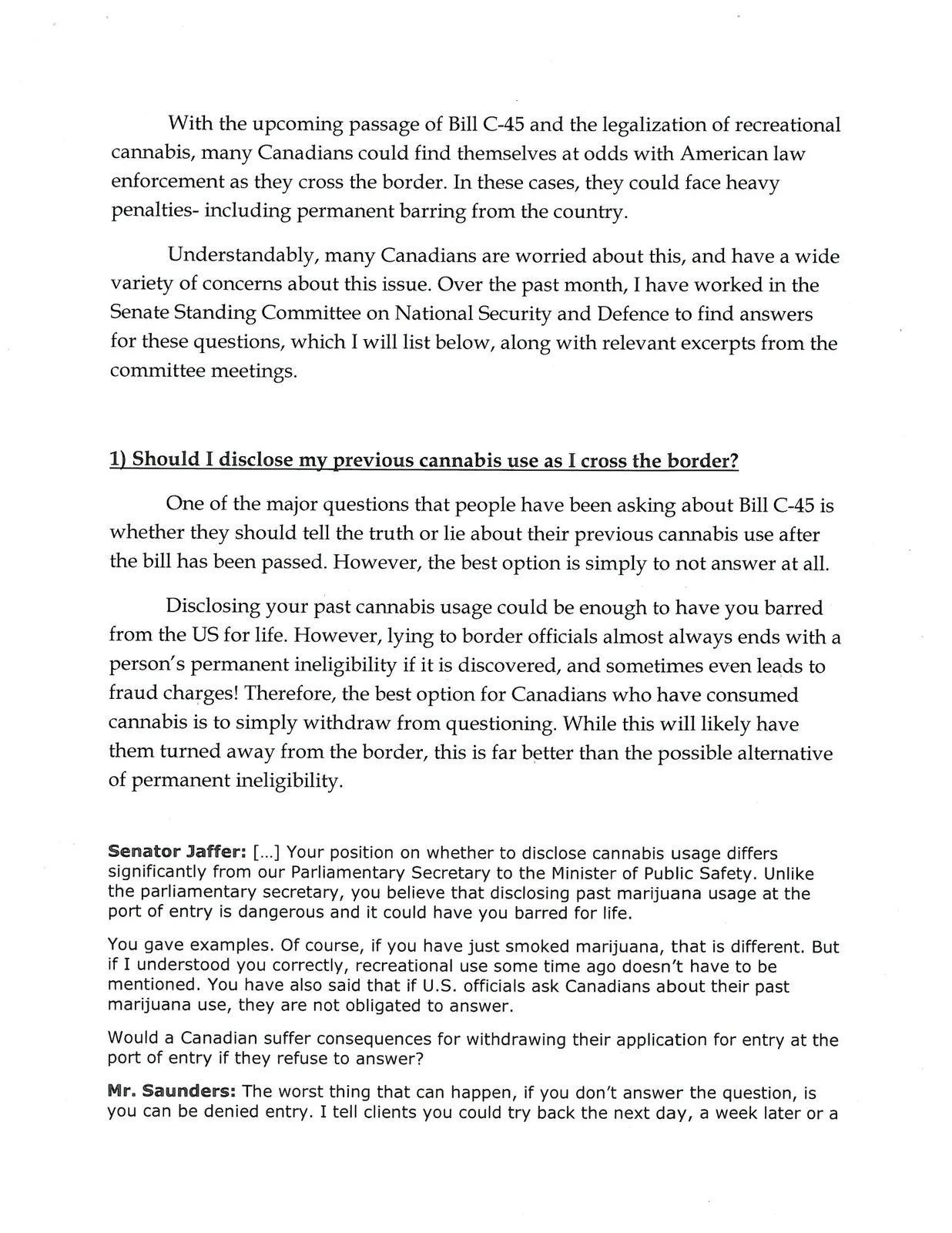
With the upcoming passage of Bill C-45 and the legalization of recreational cannabis, many Canadians could find themselves at odds with American law enforcement as they cross the border. In these cases, they could face heavy penalties—including permanent barring from the country.
Understandably, many Canadians are worried about this, and have a wide variety of concerns about this issue. Over the past month, I have worked in the Senate Standing Committee on National Security and Defence to find answers for these questions, which I will list below, along with relevant excerpts from the committee meetings.
1) Should I disclose my previous cannabis use as I cross the border?
One of the major questions that people have been asking about Bill C-45 is whether they should tell the truth or lie about their previous cannabis use after the bill has been passed. However, the best option is simply to not answer at all.
Disclosing your past cannabis usage could be enough to have you barred from the US for life. However, lying to border officials almost always ends with a person's permanent ineligibility if it is discovered, and sometimes even leads to fraud charges! Therefore, the best option for Canadians who have consumed cannabis is to simply withdraw from questioning. While this will likely have them turned away from the border, this is far better than the possible alternative of permanent ineligibility.
Senator Jaffer: [...] Your position on whether to disclose cannabis usage differs significantly from our Parliamentary Secretary to the Minister of Public Safety. Unlike the parliamentary secretary, you believe that disclosing past marijuana usage at the port of entry is dangerous and it could have you barred for life.
You gave examples. Of course, if you have just smoked marijuana, that is different. But if I understood you correctly, recreational use some time ago doesn't have to be mentioned. You have also said that if U.S. officials ask Canadians about their past marijuana use, they are not obligated to answer.
Would a Canadian suffer consequences for withdrawing their application for entry at the port of entry if they refuse to answer?
Mr. Saunders: The worst thing that can happen, if you don't answer the question, is you can be denied entry. I tell clients you could try back the next day, a week later or a month later. Chances are you will probably get a different officer who won't ask the same question.
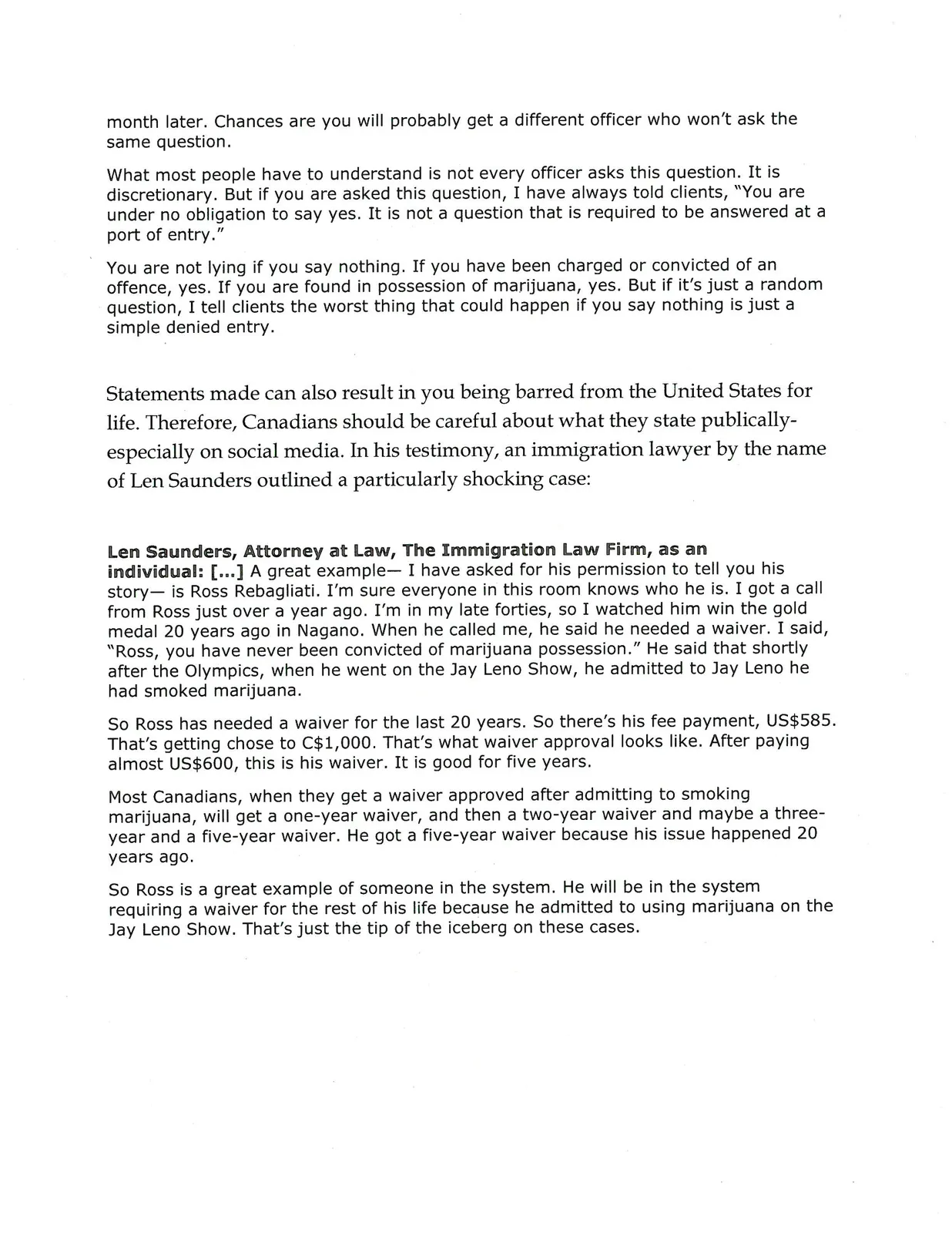
What most people have to understand is not every officer asks this question. It is discretionary. But if you are asked this question, I have always told clients, "You are under no obligation to say yes. It is not a question that is required to be answered at a port of entry."
You are not lying if you say nothing. If you have been charged or convicted of an offence, yes. If you are found in possession of marijuana, yes. But if it's just a random question, I tell clients the worst thing that could happen if you say nothing is just a simple denied entry.
Statements made can also result in you being barred from the United States for life. Therefore, Canadians should be careful about what they state publically—especially on social media. In his testimony, an immigration lawyer by the name of Len Saunders outlined a particularly shocking case:
Len Saunders, Attorney at Law, The Immigration Law Firm, as an individual: [...] A great example—I have asked for his permission to tell you his story—is Ross Rebagliati. I'm sure everyone in this room knows who he is. I got a call from Ross just over a year ago. I'm in my late forties, so I watched him win the gold medal 20 years ago in Nagano. When he called me, he said he needed a waiver. I said, "Ross, you have never been convicted of marijuana possession." He said that shortly after the Olympics, when he went on the Jay Leno Show, he admitted to Jay Leno he had smoked marijuana.
So Ross has needed a waiver for the last 20 years. So there's his fee payment, US$585. That's getting close to C$1,000. That's what waiver approval looks like. After paying almost US$600, this is his waiver. It is good for five years.
Most Canadians, when they get a waiver approved after admitting to smoking marijuana, will get a one-year waiver, and then a two-year waiver and maybe a three-year and a five-year waiver. He got a five-year waiver because his issue happened 20 years ago.
So Ross is a great example of someone in the system. He will be in the system requiring a waiver for the rest of his life because he admitted to using marijuana on the Jay Leno Show. That's just the tip of the iceberg on these cases.
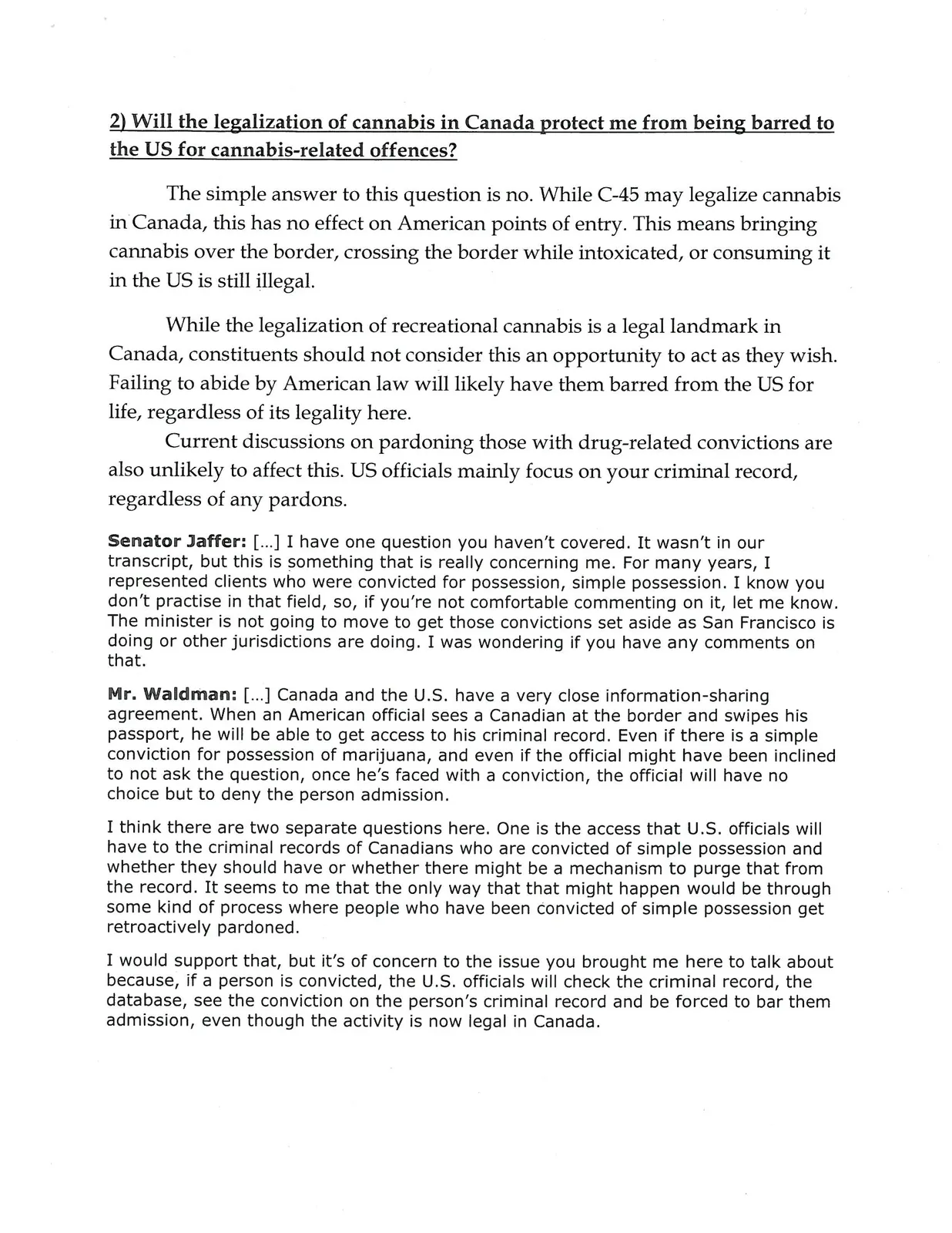
2) Will the legalization of cannabis in Canada protect me from being barred to the US for cannabis-related offences?
The simple answer to this question is no. While C-45 may legalize cannabis in Canada, this has no effect on American points of entry. This means bringing cannabis over the border, crossing the border while intoxicated, or consuming it in the US is still illegal.
While the legalization of recreational cannabis is a legal landmark in Canada, constituents should not consider this an opportunity to act as they wish. Failing to abide by American law will likely have them barred from the US for life, regardless of its legality here.
Current discussions on pardoning those with drug-related convictions are also unlikely to affect this. US officials mainly focus on your criminal record, regardless of any pardons.
Senator Jaffer: [...] I have one question you haven't covered. It wasn't in our transcript, but this is something that is really concerning me. For many years, I represented clients who were convicted for possession, simple possession. I know you don't practise in that field, so, if you're not comfortable commenting on it, let me know. The minister is not going to move to get those convictions set aside as San Francisco is doing or other jurisdictions are doing. I was wondering if you have any comments on that.
Mr. Waldman: [...] Canada and the U.S. have a very close information-sharing agreement. When an American official sees a Canadian at the border and swipes his passport, he will be able to get access to his criminal record. Even if there is a simple conviction for possession of marijuana, and even if the official might have been inclined to not ask the question, once he's faced with a conviction, the official will have no choice but to deny the person admission.
I think there are two separate questions here. One is the access that U.S. officials will have to the criminal records of Canadians who are convicted of simple possession and whether they should have or whether there might be a mechanism to purge that from the record. It seems to me that the only way that that might happen would be through some kind of process where people who have been convicted of simple possession get retroactively pardoned.
I would support that, but it's of concern to the issue you brought me here to talk about because, if a person is convicted, the U.S. officials will check the criminal record, the database, see the conviction on the person's criminal record and be forced to bar them admission, even though the activity is now legal in Canada.
There is also little indication that this is about to change. Canada still has yet to enter meaningful discussions with the US to solve this issue.
Senator Jaffer: Mr. Waldman, you always make your remarks thoughtfully, saying that our government has to talk to the Americans. As you've set it out, I won't repeat about the monies we spend in the U.S. The challenge that the committee here faces is that when I pushed the official about this, I got a lecture about how we can't tell another country what to do. So what you said, I felt like it was a fait accompli. That's what they said. As you read in the transcript, it said the American government will not change its position, and our officials told me it's not their position to tell another country what to do.
I hear what you say, and obviously the minister is appearing after you, and we will urge him regarding what you are telling us, but that's the challenge we face.
Mr. Waldman: I think it's important to distinguish we're not telling the Americans what to do. We're giving the Americans our official governmental position and asking the Americans to take that into account when they deal with Canadian citizens who are seeking to cross the border within the context of Canadians who spend tens of billions of dollars of tourism money in the United States.
We're saying to the Americans, "It's your call what to do, but possession is going to be legal in Canada on this date, and after that we would ask, as a government, that you take into account that it's legal when you deal with Canadians crossing the border." That's all we can do.
3) Am I putting myself at risk by going through preclearance?
Last year, Canada's preclearance policy was updated in a way that could potentially jeopardize travelers. In this new system, travellers have to truthfully answer any question that is asked by a preclearance officer—including questions about cannabis usage.
If they disclose their past use, they put themselves at risk of being barred from the United States for life. However, lying during preclearance can be considered "resisting or willfully obstructing a preclearance officer" which can result in up to two years of imprisonment.
Given that Canadians are left with few options in preclearance proceedings, constituents who have consumed cannabis may wish to go through normal points of entry.
Senator Jaffer: My second question has to do with the Preclearance Act. I'm personally very unhappy with what has happened with the Preclearance Act because, under Bill C-23, travellers must truthfully answer any question that is asked by the preclearance officer. That means that Canadians will have to answer truthfully about their cannabis use, despite the fact that they do not have to disclose it at the normal port of entry, meaning if they drive across. But they have to if they go by the airport.
The other part of this, which you are very much aware of, is that it's on our soil, but our RCMP may not be there if there is extensive questioning. I wanted to know how you feel, especially with people who are permanent residents.
Mr. Waldman: It will apply also to Canadian citizens. Obviously, I wanted to testify, but I missed the opportunity to testify on the Preclearance Act. I have a lot of concerns about that and precisely about those types of matters because people will now be compellable.
The advice that the immigration officer said — "You don't have to answer the question; you can just turn around and go away" — won't apply at Canadian airports, pursuant to this legislation. They will be compellable, and they will have to answer questions. So it's a bit strange that a Canadian on Canadian soil will be in a weaker position than a Canadian who drives across the border and is on U.S. soil if you travel by car.
So it's a matter for concern. I don't think that, at the time the bill was passed, the drafters of the legislation really contemplated these types of situations. I think it's a big problem, and it exposes some Canadians to a vulnerable position, for sure.
4) Can I consume cannabis in states where it is legalized?
While many states have legalized the recreational consumption of cannabis, the drug still remains illegal on a federal level under the Controlled Substances Act. In fact, the Act categorizes cannabis as a Schedule 1 drug, the highest possible category in the American legal system.
In other words, consuming cannabis in states where it is legalized can and will get you barred from crossing the border.
Senator Jaffer: And the challenge gets even worse, because I live in B.C. When this law goes through, it will be legal in British Columbia. It's legal in Washington state. So for a British Columbian, they think that they are not doing anything wrong. They're going to a state where a certain amount of cannabis is legal, and yet federally it isn't. It's not that easy. People will be confused as to what's happening. I think that there's a lot of work that our government needs to do to protect Canadians.
Mr. Waldman: You know, in the same way that there's been a lot of effort about educating people about not taking large amounts of currency across the border, I think the same thing has to happen with Canadians not taking drugs across the border. Even though it's legal in Canada, it's not legal in most contexts to transport marijuana between Canada and the United States after legalization in Canada. Canadians have to be educated about that, and it has to be made perfectly clear to them that legalization in Canada does not allow you to cross the border.
Maybe it makes sense to put signs up near the border crossings warning Canadians about that. I'm not sure. But there has to be a concerted effort to educate Canadians about what is and is not legal.
5) Is the government ensuring that Canadians are informed of these issues?
Unfortunately, there is little that is currently being done to ensure that Canadians are being informed of these issues, despite the fact that many people could be banned from the United States for life. For now, all that the government has announced is a small information campaign in 2019—a whole year after the bill's passage. Other institutions may have to take up that task.
Senator Jaffer: [...] I have not received answers from you on my first question about protecting Canadians. We are going to make it legal to use cannabis here, but we are not telling Canadians that if you cross the border they will have issues. You did say, Mr. Hill, by 2019 you'll have this and by 2019 you'll have that, but this will be law before that. But I don't think you can answer this. We'll just have to get the minister here to answer that. [...]
Mr. Hill: Thank you, senator. I'd like to try to explain the communication strategy that is being developed and implemented. With respect to your question, it will be made clear, if it's not clear to date, for Canadians who wish to import any cannabis into the United States, that that is a criminal offence. So entrepreneurs in Canada who are going to be investing and working in the cannabis industry in Canada will understand the domestic legal framework that is being put in place, and they will also understand the implications with respect to the movement of cannabis goods or goods with cannabis in them across the border. It will be made very clear to them that that continues to be criminally prohibited. It continues to be a serious criminal offence to take any amount of cannabis across into the U.S. unless an exception is provided clearly by law.
So we will be doing our utmost to ensure that Canadians understand that so that they do not inadvertently or because of a lack of awareness fall into this unfortunate situation. That is our commitment. That is our objective. We're working in partnership with Transport Canada, Health Canada, Global Affairs, the RCMP, the Public Safety portfolio, to ensure that that communication is comprehensive and timely, so that the information is available before the legislation comes into force. So that is the work we are undertaking.
Senator Jaffer: I really appreciate that, and what you are saying gives me some satisfaction, but you're not telling me what you're going to do. I understand you're going to do a campaign. I understand you're going to tell citizens, but by when? We are being pushed to pass this legislation right now. By when are you going to tell Canadians all of that? What is your exact plan?
Mr. Hill: We are already communicating to Canadians through, for example, the travel advisory that Global Affairs has on its website. We are already communicating to Canadians through the Canada Border Services Agency website and our interactions with stakeholders and industry and in the not-for-profit sector. So we are already communicating with our stakeholders and partners, and you will see a much more visible communications campaign in the short term, in advance of the legislation coming into force, if it does get Royal Assent.
6) How will the emerging cannabis industry be affected by the legalization of cannabis?
Canadian cannabis businesses—which are currently valued at 37 billion dollars—will likely want to work with their American counterparts in the days to come, and there are a variety of legal ways for it to happen, such as the sale of accessories or pipes. However, due to the strict and vague nature of American law, this could still be considered "association with drug trafficking" which would put employees at risk of permanent barring from the United States.
Given that legal cannabis dispensaries are considered drug traffickers under federal American law, this could also put the families of people working for their Canadian counterparts at risk too. Without serious discussions with the United States, many Canadians working for this burgeoning multi-billion dollar industry could find themselves at risk.
Senator Jaffer: [...] I have a question for you, Mr. Railton. In your article that you mentioned, "Marijuana and Immigration," you state:
Providing a government officer with a "reason to believe" that a noncitizen is associated with drug trafficking, which could include a normal association with state-legal marijuana businesses, is enough to make the noncitizen and even his or her family members inadmissible.
This worries me very much. It's not just the person; the family could be prohibited from entering the United States. It's like being guilty by association.
Did I understand your article correctly?
Mr. Railton: Thank you. First of all, immigration law is a very complicated area of law. May I just say that in trying to sum up the law of marijuana and immigration in my opening comments, I tried to tap on some of the highlights of different issues. But the article referenced working in a state legal operation. Washington State, for instance, has legalized recreational marijuana. We see folks working at stores, working in the production and working in professional positions associated with the businesses engaged in cannabis. The industry itself is growing in scale, so there is a lot of money and business to be done.
The state governments and the people in the states are subject to federal law, but in the United States, the Department of Justice has somewhat kept a hands-off approach to businesses in the states, such as Colorado, Washington and others that have legalized, while this industry develops. The question here is around somebody working in a Canadian legalized operation where, under the federal law of Canada, marijuana is legalized. That circumstance is a little different than where somebody is working for a state legal operation where there's a conflict of laws with the U.S. federal Controlled Substances Act. In Canada, where cannabis is legalized, I don't think working for a Canadian operation would create a basis for inadmissibility if it were strictly in Canada under a legalized regime. But this is one of the places where there are questions.
Now, if a Canadian business wants to do transboundary business with the United States, that is a problem, and we've seen a variety of situations with it over the last few years, where you have folks in Canada who would like to invest in state legal operations or otherwise get involved in them. When those persons are identified, they run a risk for immigration and inadmissibility. And, yes, the family would be involved in such situations.
Document Images
(9)