Proposal for a Voluntary Conservation Tax Incentive Program (CTIP): Background Paper
In-depth background paper on the proposed program, including detailed enrollment data and comparison with programs in other jurisdictions.
Proposal for a Voluntary Conservation Tax Incentive Program (CTIP): Background Paper
January 2016
1. Natural Areas Protection Tax Exemption Program
1.1 History
In the early 1990's property values and assessments rose dramatically in B.C.'s Gulf Islands, triggering an increase in subdivisions and logging. Due to concerns about the impact of development on important ecological areas, locally elected trustees advocated for provincial legislation which would allow local governments to provide an incentive for landowners to voluntarily leave their properties in a natural state rather than developing or logging them to pay property taxes.
At the time the policy of the Islands Trust (a federation of local Gulf Islands governments) supported the use of property tax incentives to promote natural area conservation. As the concept of a conservation tax incentive program progressed it was felt that legislative changes allowing such incentives in the Islands Trust area only would be simpler than province-wide adoption.
The Natural Areas Protection Tax Exemption Program (NAPTEP) was instituted through amendments to the Islands Trust Act in 2000 and the Act’s regulations in 2002. Launched initially in the Islands Trust areas overlapping with the Capital and Sunshine Coast Regional Districts, NAPTEP expanded between 2008 and 2015 to include the Islands Trust areas of the Nanaimo, Cowichan Valley, Comox Valley and Powell River regional districts and the Municipality of Bowen Island.
1.2 Features of NAPTEP
NAPTEP is a fully voluntary program offered by the Island Trust and Island Trust Fund (ITF – a conservation land trust for the Gulf Islands) – voluntary in terms of both regional district and municipal participation and in terms of landowner enrolment. All NAPTEP covenants are held by the ITF Board.
NAPTEP offers 65% tax exemption on land which is protected by a conservation covenant. Qualifying land must have special features such as undisturbed natural areas that are good examples of important ecosystems, habitat for rare native plants or plant communities, critical habitat for native animal species or special geological features.
NAPTEP covenants apply to natural areas and generally are not placed on developed portions of a parcel, such as homes, other buildings and roads. NAPTEP reduces only the land portion of property taxes, not parcel taxes or tax on improvements. Since NAPTEP covenants apply only to non-developed land and apply only to land taxes, the actual reduction in total property taxes is usually lower than 65%. The average reduction in total taxes payable per property for all NAPTEP covenants in 2015 was only 36% and for some properties it was as low as 10%.
Land with a NAPTEP covenant receives a Natural Area Exemption Certificate which is forwarded to BC Assessment and reduces annual taxes payable. NAPTEP covenants do not entail a requirement for public access to the protected land. There is no minimum or maximum size for conservation covenants. However it is unlikely that owners of small parcels or land with low assessed value will apply to NAPTEP since the potential tax reduction benefits may not outweigh the costs of entering the program. Typically, landowners would be seeking to recover application costs within a few years.
Land approved under the NAPTEP program is classed as residential (BC Assessment class 1). However placement of a covenant on a parcel may lower the assessed value of land which could otherwise be developed since those development opportunities are foregone. Lands subject to other tax exemptions, such as Private Managed Forest Land (BC Assessment class 7) and agricultural land (class 9), are not eligible for NAPTEP. Land enrolled under NAPTEP may qualify for the federal Ecological Gifts (EcoGift) program and charitable gift receipt. The EcoGift program gives private land owners a non-refundable income tax credit and an exemption from capital gains tax.
Landowners applying for NAPTEP tax reduction are responsible for payment of covenant initiation costs, which include a $450 ITF application fee and the cost of registration of the covenant with BC Land Titles and may include a legal land survey, baseline ecological survey and legal and tax advice. Total initiation costs are estimated to range from $2500 to $12,000, a significant cost for any landowner considering a covenant as permanent protection for their property. In some cases supplementary funding can be arranged to assist landowners with these initiation costs. The ITF is responsible for ongoing costs of monitoring and enforcement of the covenant.
Conservation covenants are permanent, remaining with the land title even if the land is sold. NAPTEP benefits are also permanent and will therefore help to balance the lowered development potential of the land for the initial and future owners of the land. However, if a landowner breaches the conditions of the covenant, the NAPTEP certificate may be revoked and past tax reduction benefits may be fully recovered. It should be noted that other, more equitable exit provisions could be adopted. For example, the Private Managed Forest Land program uses a full benefit recovery approach (similar to NAPTEP) for land which has been enrolled for up to five years. After five years the exit fee is reduced and after fifteen years the land is no longer subject to an exit fee.
NAPTEP Stories
A landowner family in the southern Gulf Islands was motivated by a strong desire to protect 1.2 acres of Garry Oak meadow on their 4.2 acre property. The covenant, established in 2011, is held by the Islands Trust Fund and the local island conservancy. The cost of developing the covenant included the ITF fee, land survey, ecological assessment and registration with Land Titles, with a total cost of about $3400. In this case, a local endowment fund was available to offset approximately 75% of the covenant initiation costs, leaving them with only a little over $800 in out of pocket expense. The NAPTEP tax exemption saving is close to $350 per year or a little more than a 10% reduction in taxes payable. This small tax saving would not, by itself, be sufficient to justify the full cost of the covenant on a strictly financial basis. However with the offsetting endowment funds the payback period was shortened to just over 2 years. The landowners' motivation for establishing a conservation covenant was their love of the natural character of their property and the availability of the local endowment fund.
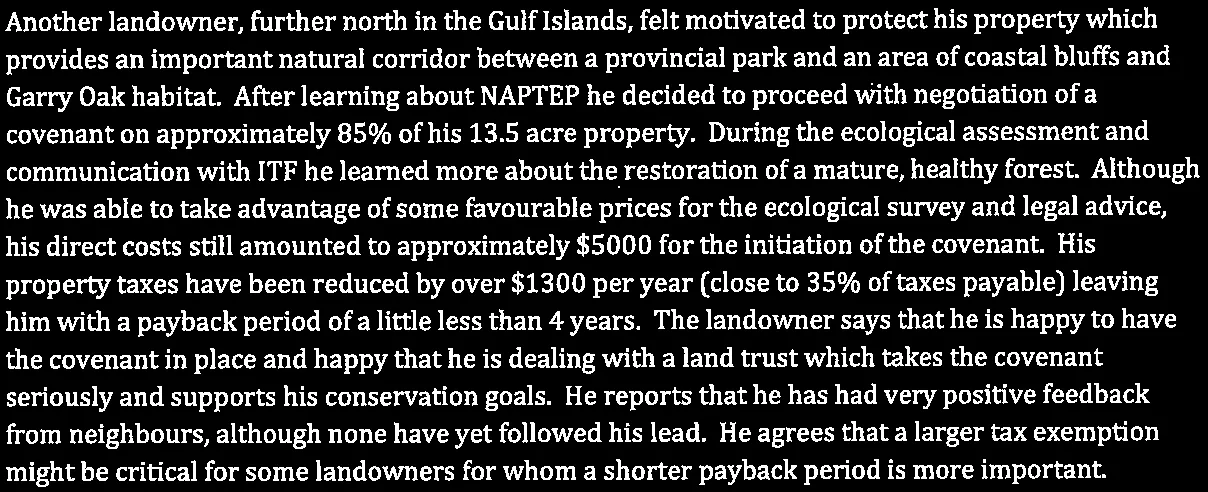
Another landowner, further north in the Gulf Islands, felt motivated to protect his property which provides an important natural corridor between a provincial park and an area of coastal bluffs and Garry Oak habitat. After learning about NAPTEP he decided to proceed with negotiation of a covenant on approximately 85% of his 13.5 acre property. During the ecological assessment and communication with ITF he learned more about the restoration of a mature, healthy forest. Although he was able to take advantage of some favourable prices for the ecological survey and legal advice, his direct costs still amounted to approximately $5000 for the initiation of the covenant. His property taxes have been reduced by over $1300 per year (close to 35% of taxes payable) leaving him with a payback period of a little less than 4 years. The landowner says that he is happy to have the covenant in place and happy that he is dealing with a land trust which takes the covenant seriously and supports his conservation goals. He reports that he has had very positive feedback from neighbours, although none have yet followed his lead. He agrees that a larger tax exemption might be critical for some landowners for whom a shorter payback period is more important.
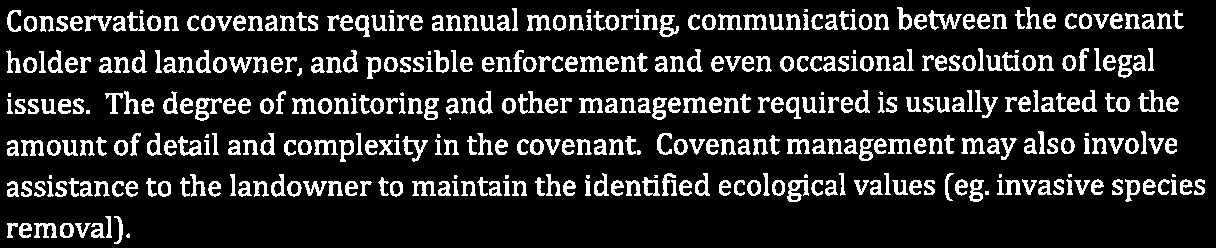
Conservation covenants require annual monitoring, communication between the covenant holder and landowner, and possible enforcement and even occasional resolution of legal issues. The degree of monitoring and other management required is usually related to the amount of detail and complexity in the covenant. Covenant management may also involve assistance to the landowner to maintain the identified ecological values (eg. invasive species removal).
Monitoring and management of covenants is the responsibility of the covenant holder, usually a conservation organization. In some cases endowment funds are set aside to offset the annual monitoring and management costs. In other cases landowners are required to pay an annual amount to cover, at least partially, these annual costs.
While these considerations apply regardless of whether or not a tax exemption program is in place, they have a considerable impact on the readiness of land owners and land trusts or others to put conservation covenants in place and, thus, the level of demand for a tax exemption program.
1.3 NAPTEP Enrolment
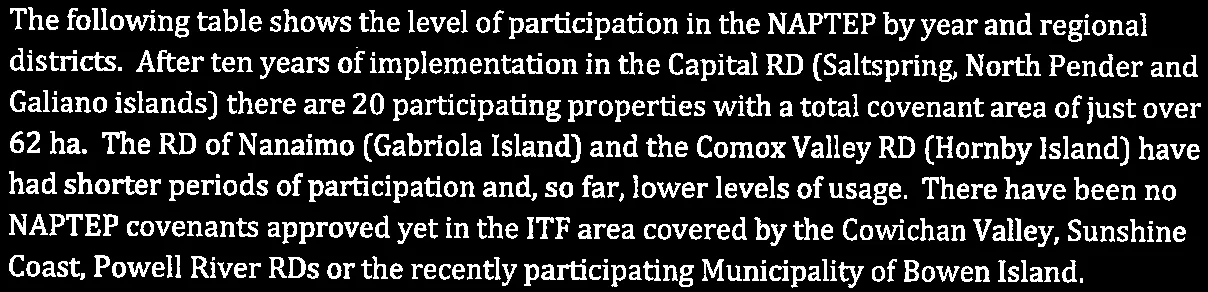
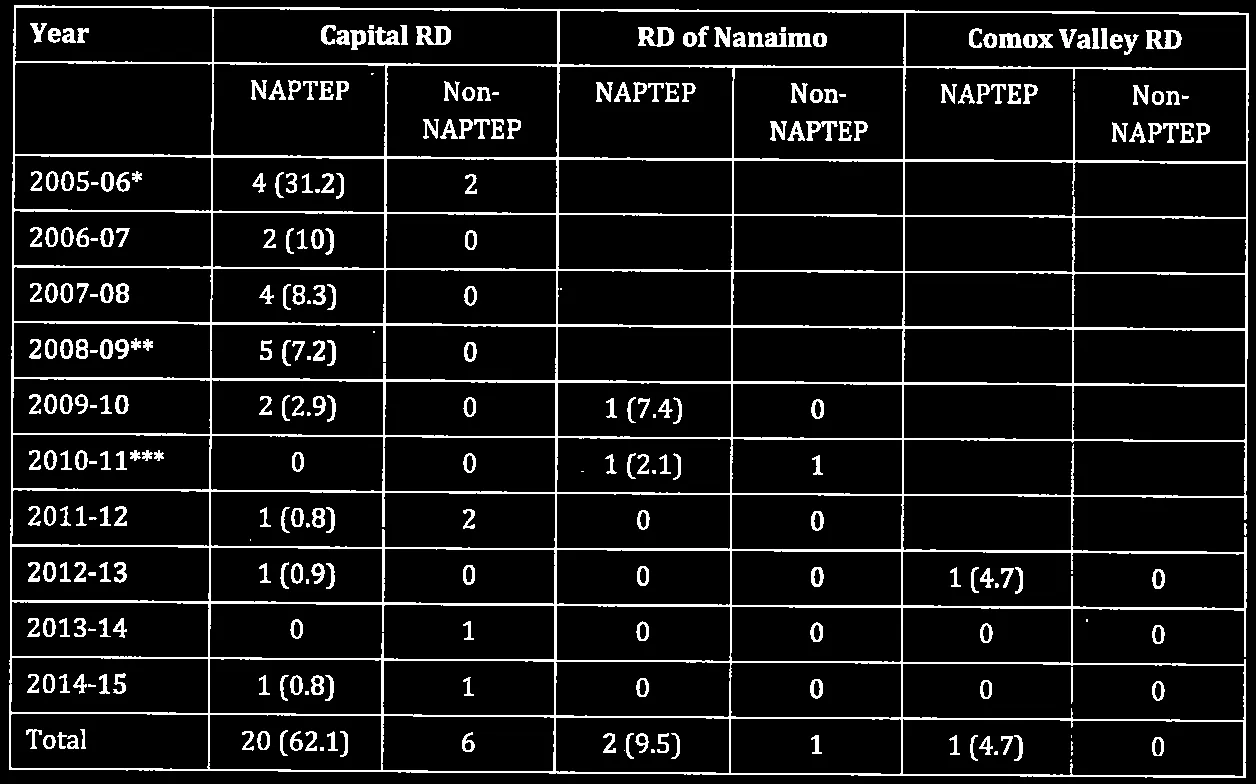
The following table shows the level of participation in the NAPTEP by year and regional districts. After ten years of implementation in the Capital RD (Saltspring, North Pender and Galiano islands) there are 20 participating properties with a total covenant area of just over 62 ha. The RD of Nanaimo (Gabriola Island) and the Comox Valley RD (Hornby Island) have had shorter periods of participation and, so far, lower levels of usage. There have been no NAPTEP covenants approved yet in the ITF area covered by the Cowichan Valley, Sunshine Coast, Powell River RDs or the recently participating Municipality of Bowen Island.
Land Enrolled in the ITF Natural Area Protection Tax Exemption Program No. of parcels and (ha.)
| Year | Capital RD | RD of Nanaimo | Comox Valley RD | |||
|---|---|---|---|---|---|---|
| NAPTEP | Non-NAPTEP | NAPTEP | Non-NAPTEP | NAPTEP | Non-NAPTEP | |
| 2005-06* | 4 (31.2) | 2 | ||||
| 2006-07 | 2 (10) | 0 | ||||
| 2007-08 | 4 (8.3) | 0 | ||||
| 2008-09** | 5 (7.2) | 0 | ||||
| 2009-10 | 2 (2.9) | 0 | 1 (7.4) | 0 | ||
| 2010-11*** | 0 | 0 | 1 (2.1) | 1 | ||
| 2011-12 | 1 (0.8) | 2 | 0 | 0 | ||
| 2012-13 | 1 (0.9) | 0 | 0 | 0 | 1 (4.7) | 0 |
| 2013-14 | 0 | 1 | 0 | 0 | 0 | 0 |
| 2014-15 | 1 (0.8) | 1 | 0 | 0 | 0 | 0 |
| Total | 20 (62.1) | 6 | 2 (9.5) | 1 | 1 (4.7) | 0 |
* 2005 – NAPTEP launched in Capital RD ** 2008 – NAPTEP launched in RD of Nanaimo *** 2010 – NAPTEP launched in Comox Valley RD
Older ITF covenants can also transition into the NAPTEP if they meet all eligibility criteria. To date only one such transition of an older covenant into the program has taken place although there have been a few other indications of interest.
The level of enrolment in the NAPTEP is holding relatively constant in the ITF area at 2 – 3 covenants per year. It appears that for large properties which can potentially realize a greater benefit from a NAPTEP tax saving, there may often be offsetting subdivision or other development potential which reduces landowners interest in participation. For small properties the tax saving potential is also small and may not be enough to outweigh the covenant initiation costs, some of which are fixed regardless of parcel size. Covenants are most likely where landowners have a clear conservation orientation or where there are supplementary sources of funding.
Expansion of a conservation tax incentive program to other areas of the province will be determined by the willingness of regional districts and municipalities to participate in the program. However, the voluntary NAPTEP participation of essentially all local governments in the IT area would suggest that local government participation in a province-wide program could also be strong.
The capacity of land trusts or local governments to initiate and manage conservation covenants is also likely to be an important factor for land enrolment in a province-wide tax exemption program. Many land trusts operate with limited human and financial resources and are therefore likely, at least initially, to be able to handle only a small number of covenants each year. These land trusts should be supported and their capacity increased since they are helping to achieve public conservation goals for valuable species and ecosystems.
It can therefore be expected that a NAPTEP-like, province wide conservation tax exemption program will have a positive, although initially modest, impact on the rate of natural area protection through conservation covenants. Landowners who are positively inclined to place their land under permanent protection will be more likely to proceed if the costs and benefits can be shifted somewhat in their favour. However the NAPTEP experience has shown that a conservation tax incentive program is not going to result in a large influx of properties nor in issues regarding tax revenue nor fairness in tax burden between landowners.
1.4 NAPTEP Financing
Two facts stand out with respect to the financing of NAPTEP tax exemptions. First, there is no loss of provincial or local tax income and no requirement for the province to compensate local governments for reduced tax. Instead, the NAPTEP program involves a tax shift from a small number of participating landowners to a large number of non-participating properties. And, second, the amount of tax shifting is very small.
In simple terms, property taxes are based on assessed values (the tax base) and tax (or mill) rates. Actual taxes payable are subject to year-to-year changes in the tax base and changes in revenue requirements for such things as schools, hospitals and local services. From a government revenue perspective, the 65% NAPTEP tax exemption is offset by both land development and other changes in assessments elsewhere and by shifting a small amount of tax to others in the same tax pool. This is the same as the effect of the agricultural, heritage property and other tax exemptions. It should also be noted that the cost of administering the NAPTEP program is minimal. BC Assessment enters the tax exemption certificate into its records and shows the exemption on the landowner's annual assessment notice.
Calculation of actual tax shifting is rather complex and has only been done on a hypothetical basis for regional districts and areas considering participation with ITF in NAPTEP. Within these areas different tax categories are pooled differently. For example, the effect of a tax exemption on school, police and provincial rural taxes affects the provincial tax pool for these taxes and would be imperceptible. The effect of a tax exemption on regional hospital, parks and recreation, fire protection and other regional and local services would be slightly larger but would not affect taxpayers in other parts of the province. Also, mill rates vary by taxing authority and property classification.
The level of participation in NAPTEP was discussed above. The ITF calculated tax shifts for landowners in one island local trust.¹ Based on a 1% participation rate in NAPTEP, the resulting tax shift, or additional tax payable by non-NAPTEP properties, was estimated to be $0.03 per year per landowner in the Cowichan Valley Regional district and $0.04 per non-NAPTEP landowner in the local island trust areas. If the participation rate was 5%, these tax shift values would rise to $0.14 and $0.22 per landowner respectively. Another calculation of the tax shift impacts on provincial, regional district and IT area landowners ranged from $0.01 to $0.45 per year per non-NAPTEP taxpayer, based on a 1% participation rate in the NAPTEP program and $0.07 to $2.25 with a 5% participation rate.² The total tax exemption for the 23 NAPTEP properties in 2015 was a little more than $34,000, a very small figure in comparison to total property taxes paid.
It appears that, in comparison to land acquisition costs, a voluntary tax exemption program such as NAPTEP offers a highly cost-effective means of protecting some of the most valuable, privately-owned natural areas in areas where such protection is often critical. Tax shifting to non-participating landowners is very small, likely to be offset by many other changes affecting tax rates, and very reasonable in comparison to the increased amenity values and positive impact on other property values which will result from conservation of natural areas. From a local government and provincial perspective, such a tax exemption program has no direct cost and minimal administrative requirements.
¹ Islands Trust Fund, “Hypothetical Tax Shift Due to Implementation of the Natural Area Protection Tax Exemption Program (NAPTEP) in the Thetis Island Local Trust Area (Cowichan Valley Regional District),” August 2008, unpublished. ² Islands Trust Fund, “Technical Report: Hypothetical Tax Shift Due to the Implementation of the Natural Area Protection Tax Exemption Program (NAPTEP),” May 2005, unpublished.
2. Conservation Incentive Programs in Other Jurisdictions
2.1 Nova Scotia
Nova Scotia promotes the conservation of natural areas on private land through a Conservation Property Tax Exemption Program (CPTEP) which began in 2009. The province has made a commitment to protect 12% of its land by 2015. However 75% of Nova Scotia land and 95% of its coast is privately owned, so protection of privately owned land is very important.
The CPTEP exempts landowners from 100% of property tax on qualifying conservation properties and it provides a grant from the province to municipalities in lieu of taxes on those properties. The program also eliminates “change of use” taxes which can be levied as a result of property becoming protected.
Qualifying conservation properties are those which are subject to a conservation easement (covenant) that is primarily dedicated to the protection of native biodiversity and natural processes. Industrial and commercial use is prohibited on conservation properties, including forestry, agriculture and quarrying. Qualifying conservation properties also include land held for the protection of native biodiversity and natural processes by an eligible body such as a land trust, municipality or provincial or federal government agency.
No application process is required for the CPTEP; government agencies and land trusts identify qualifying land. Once identified the tax exemption is provided year after year unless a change of use occurs. However if a change of use takes place a change of use tax of 20% of the fair market value of the property is charged.
2.2 Ontario
The Province of Ontario recognizes that many of its most significant natural areas are privately owned and that it is important to encourage responsible stewardship of these lands and the protection of their outstanding natural heritage features. The Ontario Conservation Land Tax Incentive Program (CLTIP) replaced an earlier tax reduction (rebate) program in 1998. CLTIP is a voluntary program which provides an incentive for landowners to protect conservation lands by offering 100% property tax exemption.
Eligible conservation land include provincially significant wetlands, provincially significant areas of natural and scientific interest, habitat of a regulated species, or designated parts of the Niagara Escarpment. In 2004 the Ontario government added a Community Conservation Land category, consisting of land owned by charitable conservation organizations and conservation authorities, where these meet eligibility criteria and are maintained to preserve natural heritage and biodiversity objectives. Eligible land parcels must be ½ acre or larger.
Eligibility for CLTIP is not dependent on land being covered by a conservation covenant / easement. Continued participation in the CLTIP requires annual applications. The Ontario Ministry of Natural Resources is responsible decisions on qualification for CLTIP and for ongoing land use monitoring. Land use activities which are detrimental to the values for which CLTIP eligibility was granted can result in loss of tax exemption.
Like B.C., Ontario has a Managed Forest Tax Incentive Program and a Farm Property Class Tax Rate Program which promote preservation and sound management of forest and agricultural land. In contract, the CLTIP is for land which is preserved in a natural state and forest and agricultural products are not produced.
Although the provincial government does not directly compensate municipalities for revenue losses resulting from tax-exempt conservation lands, when calculating transfer payments to municipalities to assist with social costs, it takes into account that CLTIP properties do not directly generate municipal revenues.
2.3 United States
U.S. federal legislation allows donors of conservation easements to deduct a portion of the value of the easement from their income tax. In 2006 the income tax deduction limit was raised from 30% to 50% of the easement’s appraised value, with a limit of 100% for qualifying farmers and ranchers. That program was not extended in 2014 but work is continuing to seek extension of the enhanced program in 2015. A number of states also have programs allowing personal and corporate income tax deduction for conservation easement donation.
In addition some states have property tax reduction programs. For example, in 2008 Florida, which does not have state income tax, exempted land under permanent conservation easement from state property tax. Minimum parcel limits and qualifying land feature criteria apply and there is a re-capture mechanism for back taxes when the land is taken out of conservation. Maryland has a program under which a landowner pays no property tax for 15 years on land that is subject to a donated environmental trust easement. The tax credit does not apply to any residential improvements, or to a minimum of one acre around these improvements. At the end of the 15-year period unimproved land under donated easement will be assessed at the highest agricultural rate.
An “open space” tax program in San Juan County in Washington State was taken into account in developing B.C.’s NAPTEP in the late 1990’s. The Open Space Taxation Act, enacted in 1970, allows property owners to have their open space, farm and agricultural, and timberlands valued at their current use rather than their “highest and best use” value. The program does not distinguish between preserved natural areas and those producing forest and agricultural products.
3. Complementary Activities and Support
BC has protected over 14 million ha., or 14% of the provincial land base, in a network of parks, conservancies, ecological reserves, recreational and other protected areas. In March 2015 an additional 1500 ha. was added to provincial parks, increasing recreational opportunities and protection natural areas. More than half this land was added through acquisition of private land.
While private land makes up only about five percent of the land base in the province, much of this private land is concentrated in scarce, ecologically important and heavily developed zones. Non-government organizations play an important part in the conservation of privately owned natural areas. As of 2013, BC non-government organizations held a total of close to 300,000 ha. in various forms of ownership and land interest, including close to 20,000 ha. in conservation covenants and other registered interests. These non-government land conservation efforts are a valuable and cost effective complement to the provincial government's protected areas program.
Regional districts and municipalities support the protection of ecologically important natural areas and corridors and the watershed, habitat, climate change mitigation and other benefits which they provide. Official documents such as regional growth strategies and official community plans invariably recognize the vital importance of natural area protection and often refer to the need for innovative tools and incentives in order to meet their objectives.
While many private land owners are conservation-minded and want to practice good land stewardship, financial pressures from rising land values and assessments create incentives toward development, disturbance, fragmentation and exploitation of local resources. Many of the benefits of natural area conservation are “public” in nature and do not result in direct financial pay-back for landowners. Property tax reduction may be an important tool to correct this “conservation disincentive.”
B.C. Government
The B.C. Government’s “Protecting Vulnerable Species: Five-Year Plan for Species at Risk in British Columbia” states that:
“A high proportion of B.C.’s species at risk occur in naturally productive areas that are also attractive for human settlement and consist primarily of private lands. Individuals and conservation groups whose efforts are primarily focused on private lands make a big contribution to voluntary protection and recovery of species at risk. Tools such as incentives and funding inspire, encourage and reward voluntary efforts to protect and manage species at risk. If local governments, conservation partners, First Nations, private landowners and industry have these tools, they will be able to contribute more fully to species-at-risk conservation.”
The report also makes the recommendation to “Explore and recommend new ways (including incentives and possible project funding) to promote voluntary protection of species at risk (by 2015).”³
Discussions are underway among several B.C. ministries concerning how a conservation tax incentive program can be developed.
Union of B.C. Municipalities (UBCM) and Local Governments
In 2011 the Sunshine Coast Regional District brought to the UBCM meeting a resolution, also endorsed by the Association of Vancouver Island and Coastal Communities, calling on the Ministry of Community, Sport and Cultural Development to grant local governments the authority to implement natural area protection tax exemption programs. That resolution was passed unanimously. The Provincial Government responded that this was the first time that such a request had been made but that the province would be willing to work with regional districts to consider the matter.
In 2015 the Comox Valley Regional District forwarded a similar resolution to the UBCM convention:
WHEREAS the Islands Trust has successfully implemented a Natural Area Protection Tax Exemption Program (NAPTEP) which provides 65% property tax relief for landowners who enter into a conservation covenant to protect important natural features on their property;
AND WHEREAS the NAPTEP complements provincial and local programs and policies and does not result in any loss of tax revenue nor any significant additional costs;
AND WHEREAS regional districts and municipalities may wish to support and encourage landowners to preserve natural areas for current and future environmental benefits;
THEREFORE BE IT RESOLVED that the Ministry of Community, Sport and Cultural Development be requested to grant local governments the authority to implement a conservation tax incentive program modeled on the NAPTEP.
Once again, this resolution was passed unanimously by the UBCM convention.
³ Government of British Columbia, “Protecting Vulnerable Species: Five-Year Plan for Species at Risk in British Columbia,” 2014, p. 30-31
In addition to local government support for this resolution through UBCM, a number of regional districts have, over the past 10 years, agreed to participate in the NAPTEP. As noted above, the Capital RD and Sunshine Coast RD joined the program in 2005, RD of Nanaimo and Cowichan Valley RD joined in 2008, Comox Valley RD in 2010, Powell River RD in 2011 and the Municipality of Bowen Island in 2015.
Federation of B.C. Naturalists (BC Nature)
Also in 2011 BC Nature passed the following resolution:
BE IT RESOLVED that BC Nature urge the Union of BC Municipalities, municipalities and the Provincial Government to enact legislation to provide property tax incentives to those private land owners who wish to protect their land and its features by covenant from future development.
4. Recommendations
Provincial Tax Incentive Program
Based on the 10-year experience which ITF has had in implementation of NAPTEP, it is recommended that a BC-wide property tax exemption program should be enabled through amendment of the necessary provincial legislation. The main features of the program would be:
- the program should be titled a “Conservation Tax Incentive Program” (CTIP) to distinguish it from the existing NAPTEP
- fully voluntary participation by local governments, landowners and land trusts in the same manner as NAPTEP
Also, based on the model of Nova Scotia and Ontario and considering the low tax shift impacts of NAPTEP and the need to create active participation in the program, the CTIP should include:
- 100% annual property tax exemption for land with a qualifying conservation covenant
Further:
- Exit fees for land withdrawn from a CTIP should be defined on a basis similar to the Private Managed Forest Land Program: full recovery of tax exemption benefits up to 5 years, then a declining recovery rate and no recovery after 15 years.
It is also proposed that if a CTIP program is adopted on a province-wide basis it should fully replace the NAPTEP in the ITF area.
Implementation Considerations
There will be a number of important implementation considerations for a provincial CTIP, such as:
- Will all land trusts be able to participate in the CTIP? Will the provincial or local governments provide some oversight of the program to ensure that covenants are being well managed and ongoing tax reductions justified?
- Should there be some kind of provincial support to build the capacity of land trusts to implement and manage conservation covenants since these are helping to achieve provincial conservation goals?
- How will eligible natural areas be defined and will these be based on regional conservation priorities? Will a standard covenant template be required or will some flexibility in covenant details be allowed?
- Which provincial ministry / agency will be responsible for the CTIP? Will there be a defined program review point to ensure that the CTIP is effective and that lessons are being incorporated?
These and other implementation considerations will need to be defined through a provincial policy development process. Local governments and land trusts should be consulted during this process.
Process Leading to Adoption and Beyond
The Land Trust Alliance of BC and partner organizations recognize the efforts of BC ministries to promote the development of a conservation tax incentive program as an outcome of the five-year species at risk plan. As a complement to those efforts, the land trust community is seeking to build awareness and support for the necessary amendment of provincial legislation.
The following steps have been taken or are planned, leading to provincial adoption of a CTIP:
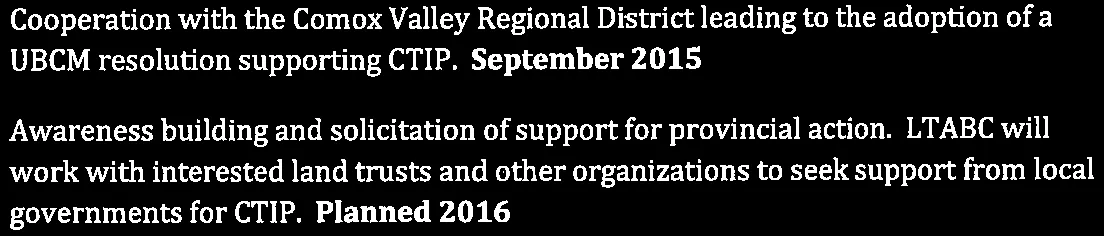
- Cooperation with the Comox Valley Regional District leading to the adoption of a UBCM resolution supporting CTIP. September 2015
- Awareness building and solicitation of support for provincial action. LTABC will work with interested land trusts and other organizations to seek support from local governments for CTIP. Planned 2016
- Meetings with government officials and organizations to promote the necessary legislative amendments and policy development. Planned 2016
- It is hoped that the necessary provincial legislative amendments can take place in 2017.
Further steps will be needed to continue to build awareness, carry out training for land trusts and, likely, step-by-step implementation in regional districts and municipalities which have taken the necessary actions to adopt the program in their areas.
Document Images
(50)