MARY LAKE PARK Brochure
Full informational brochure for Mary Lake Park, detailing its ecology, First Nations significance, and recreational potential.
MARY LAKE PARK
Connecting Trails, Communities and Nature
GREATER VICTORIA GREENBELT SOCIETY
Goals:
- Create the First Park with Lake Access in the West Highlands
- Protect Watershed and Wildlife Habitat containing Endangered Species
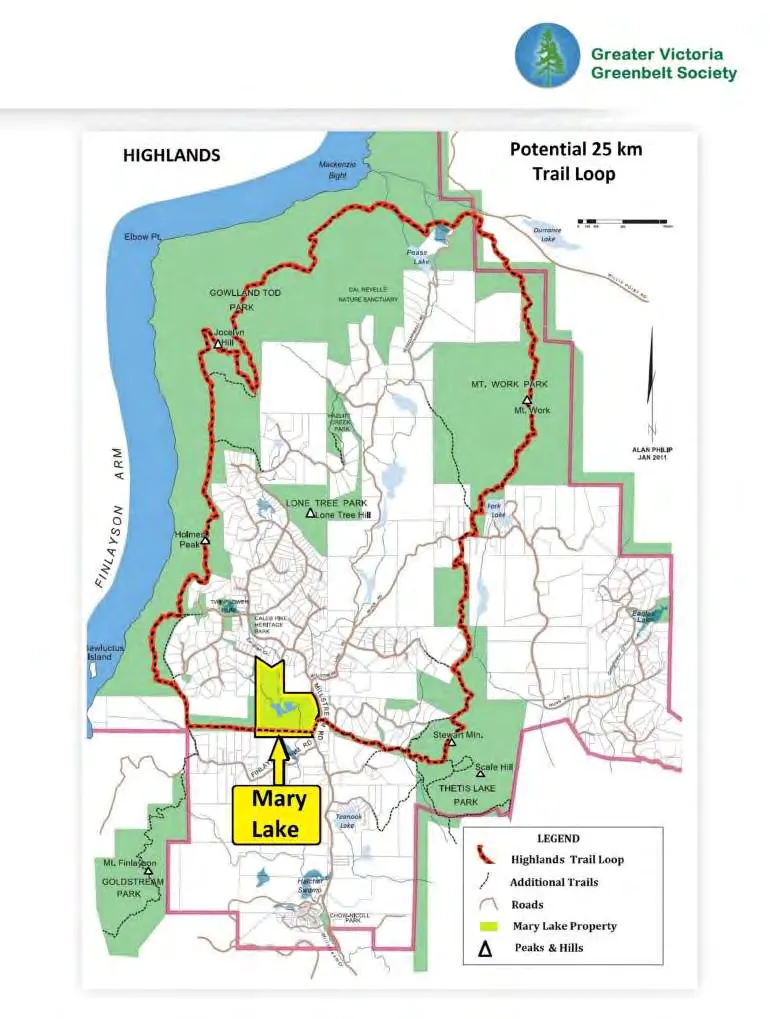
- Complete 25 km Gowlland Tod/ Mount Work/ Thetis Lake Trail Loop
- Honour the First Nations Traditional History and Culture
The acquisition of the Mary Lake property will create 67 acres of Public Park which includes the 7 acre lake, creeks, wetlands and surrounding natural forest land.
The Greater Victoria Greenbelt Society proposes that the Mary Lake Park be administered by the District of Highlands, with the long distance trail link being incorporated into the Capital Regional District park system.
Many Benefits:
- Provide a natural carbon sink, and maintain an important wildlife corridor which will protect diverse habitats of many plant and animal species several of which are endangered.
- Protect an excellent example of the Dry Coastal Douglas Fir ecosystem, so little of which remains intact.
- Safeguard a part of the Millstream Creek watershed and ground water aquifers.
- Will fill in the missing link of a 25km hiking trail that is just 25 minutes from the city of Victoria.
- Increase opportunities for experiencing natural environments for local families.
- Serve as a location for a wide range of educational activities from simple observation and nature interpretation to the teaching of complex ecological processes.
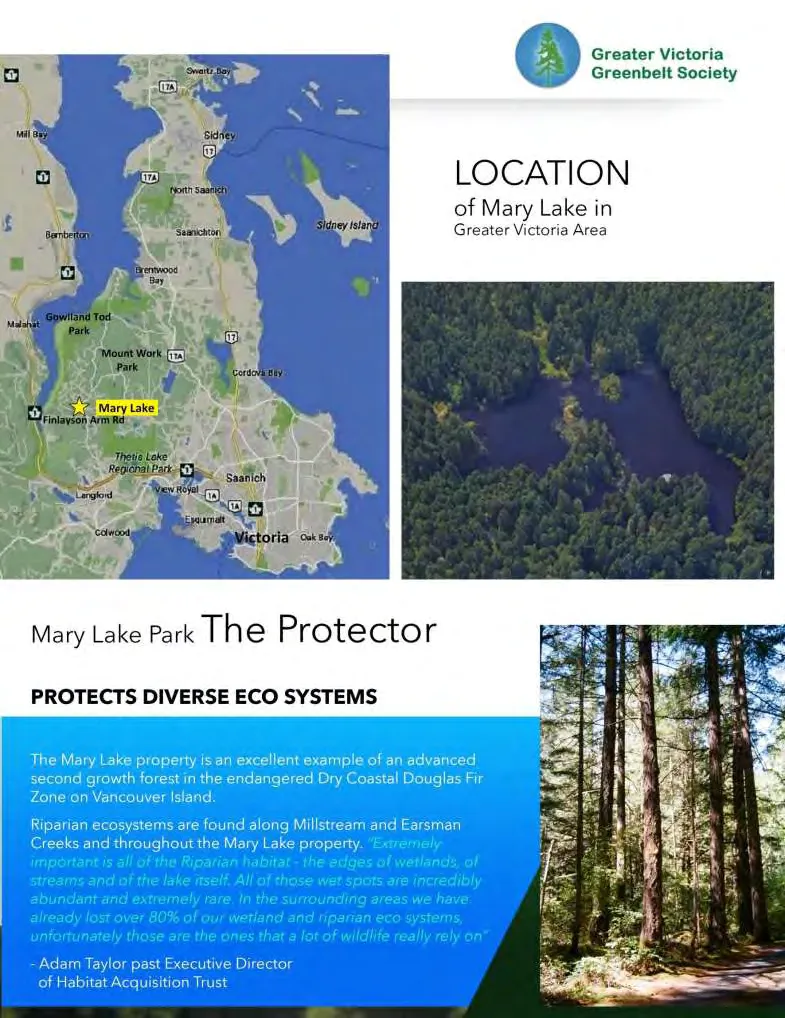
LOCATION of Mary Lake in Greater Victoria Area
Mary Lake Park The Protector
PROTECTS DIVERSE ECO SYSTEMS
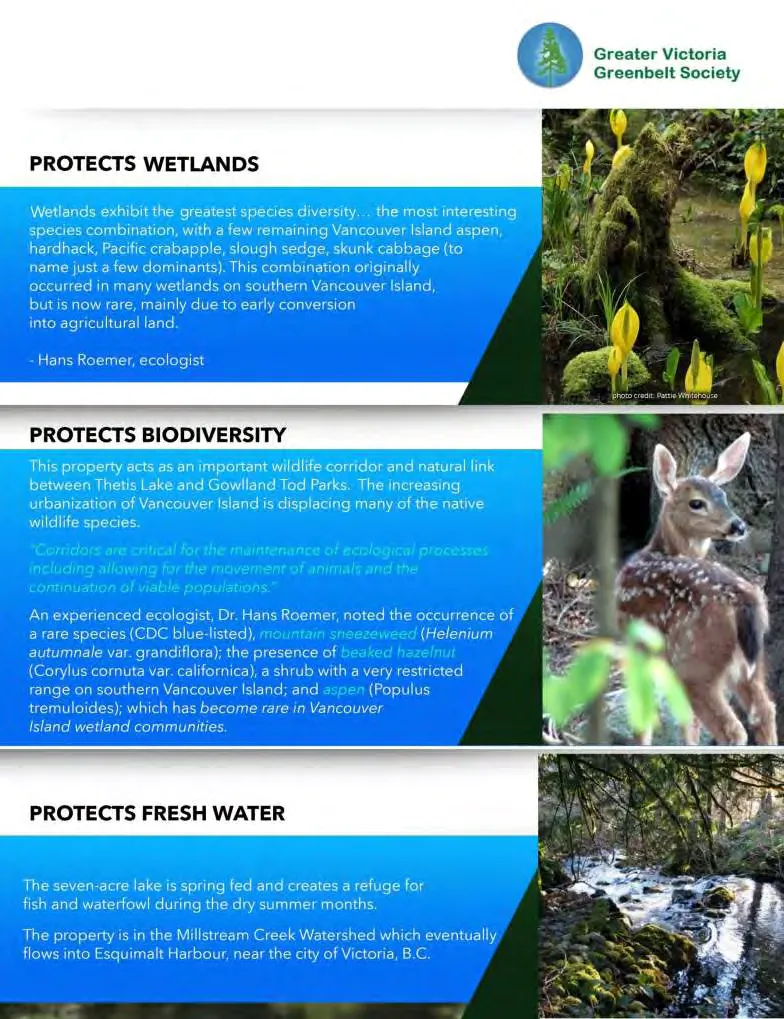
The Mary Lake property is an excellent example of an advanced second growth forest in the endangered Dry Coastal Douglas Fir Zone on Vancouver Island.
Riparian ecosystems are found along Millstream and Earsman Creeks and throughout the Mary Lake property. “Extremely important is all of the Riparian habitat - the edges of wetlands, of streams and of the lake itself. All of those wet spots are incredibly abundant and extremely rare. In the surrounding areas we have already lost over 80% of our wetland and riparian eco systems, unfortunately those are the ones that a lot of wildlife really rely on”
- Adam Taylor past Executive Director of Habitat Acquisition Trust
PROTECTS WETLANDS
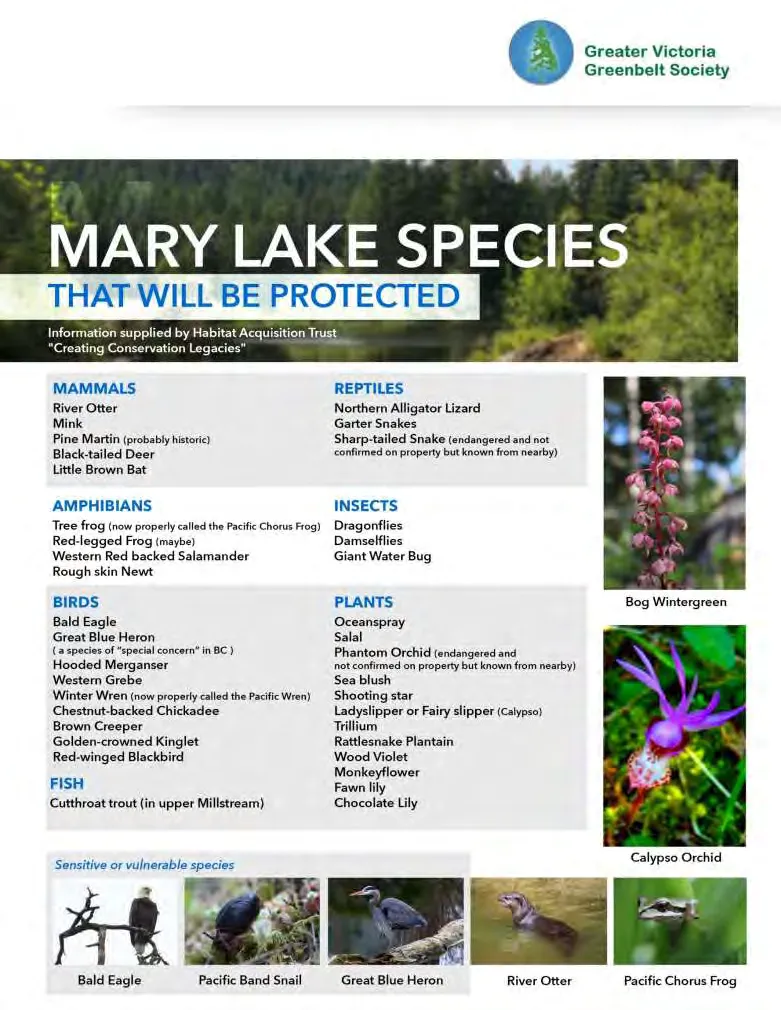
Wetlands exhibit the greatest species diversity... the most interesting species combination, with a few remaining Vancouver Island aspen, hardhack, Pacific crabapple, slough sedge, skunk cabbage (to name just a few dominants). This combination originally occurred in many wetlands on southern Vancouver Island, but is now rare, mainly due to early conversion into agricultural land.
- Hans Roemer, ecologist
PROTECTS BIODIVERSITY
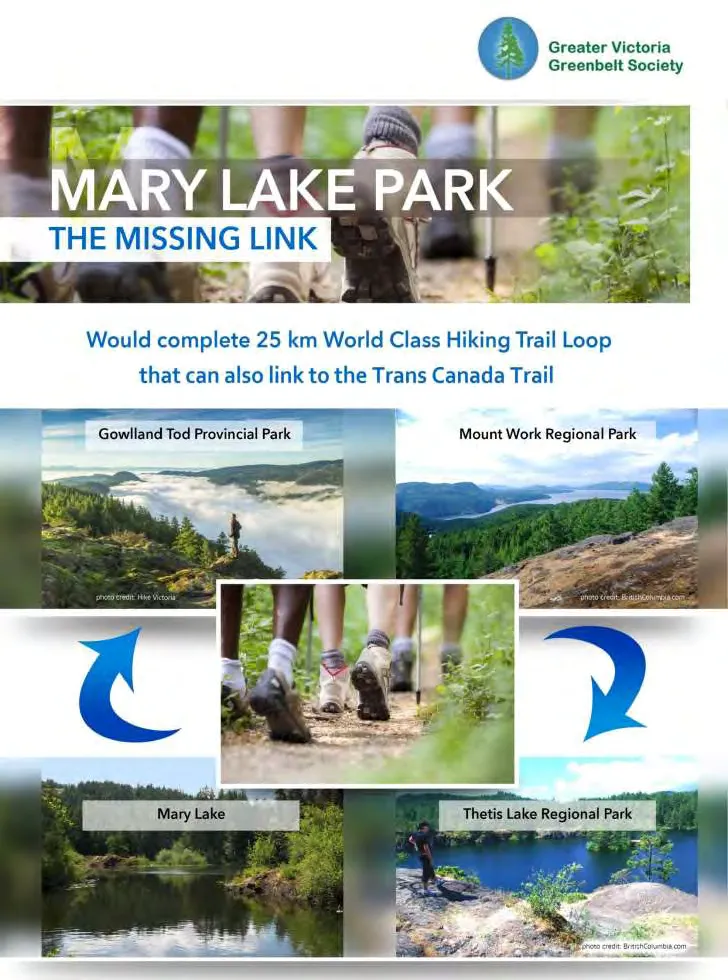
This property acts as an important wildlife corridor and natural link between Thetis Lake and Gowlland Tod Parks. The increasing urbanization of Vancouver Island is displacing many of the native wildlife species.
“Corridors are critical for the maintenance of ecological processes including allowing for the movement of animals and the continuation of viable populations.”
An experienced ecologist, Dr. Hans Roemer, noted the occurrence of a rare species (CDC blue-listed), mountain sneezeweed (Helenium autumnale var. grandiflora); the presence of beaked hazelnut (Corylus cornuta var. californica), a shrub with a very restricted range on southern Vancouver Island; and aspen (Populus tremuloides); which has become rare in Vancouver Island wetland communities.
PROTECTS FRESH WATER
The seven-acre lake is spring fed and creates a refuge for fish and waterfowl during the dry summer months.
The property is in the Millstream Creek Watershed which eventually flows into Esquimalt Harbour, near the city of Victoria, B.C.
MARY LAKE SPECIES THAT WILL BE PROTECTED
Information supplied by Habitat Acquisition Trust “Creating Conservation Legacies”
| MAMMALS | REPTILES |
|---|---|
| River Otter | Northern Alligator Lizard |
| Mink | Garter Snakes |
| Pine Martin (probably historic) | Sharp-tailed Snake (endangered and not confirmed on property but known from nearby) |
| Black-tailed Deer | |
| Little Brown Bat |
| AMPHIBIANS | INSECTS |
|---|---|
| Tree frog (now properly called the Pacific Chorus Frog) | Dragonflies |
| Red-legged Frog (maybe) | Damselflies |
| Western Red backed Salamander | Giant Water Bug |
| Rough skin Newt |
| BIRDS | PLANTS |
|---|---|
| Bald Eagle | Oceanspray |
| Great Blue Heron (a species of “special concern” in BC) | Salal |
| Hooded Merganser | Phantom Orchid (endangered and not confirmed on property but known from nearby) |
| Western Grebe | Sea blush |
| Winter Wren (now properly called the Pacific Wren) | Shooting star |
| Chestnut-backed Chickadee | Ladyslipper or Fairy slipper (Calypso) |
| Brown Creeper | Trillium |
| Golden-crowned Kinglet | Rattlesnake Plantain |
| Red-winged Blackbird | Wood Violet |
| Monkeyflower | |
| FISH | Fawn lily |
| Cutthroat trout (in upper Millstream) | Chocolate Lily |
Sensitive or vulnerable species
MARY LAKE PARK THE MISSING LINK
Would complete 25 km World Class Hiking Trail Loop that can also link to the Trans Canada Trail
HIGHLANDS Potential 25 km Trail Loop
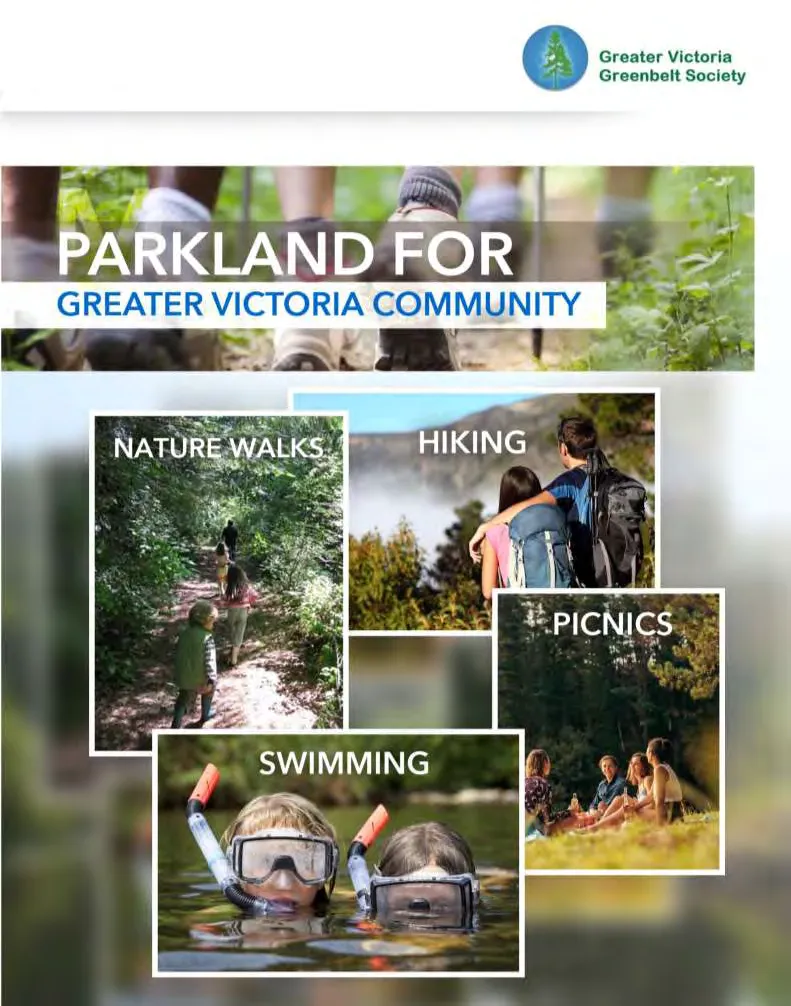
PARKLAND FOR GREATER VICTORIA COMMUNITY
NATURE WALKS
HIKING
PICNICS
SWIMMING
FIRST NATIONS CULTURAL SIGNIFICANCE
Mary Lake lies within the traditional territories of the WSÁNEC (Saanich) Coast Salish Peoples.
We recognize the integral role the ancestors of the WSÁNEC Coast Salish Peoples have played as past stewards of the Mary Lake and Highland lands.
The teachings of the WSÁNEC (Saanich) peoples speak of the land, the water and the people as equal members of a complex system, an integrated entity connected through cultural traditions.
Today, the WSÁNEC people are divided into four groups located along the Saanich Peninsula: Tsartlip, Tsawout, Pauquachin, and Tseycum.
“We need to protect our land. That is what the Ancestors said. We need to keep the land clean, our streams clean. We need to be giving back to our land.” ~ John Elliot Sr., Tsartlip Elder
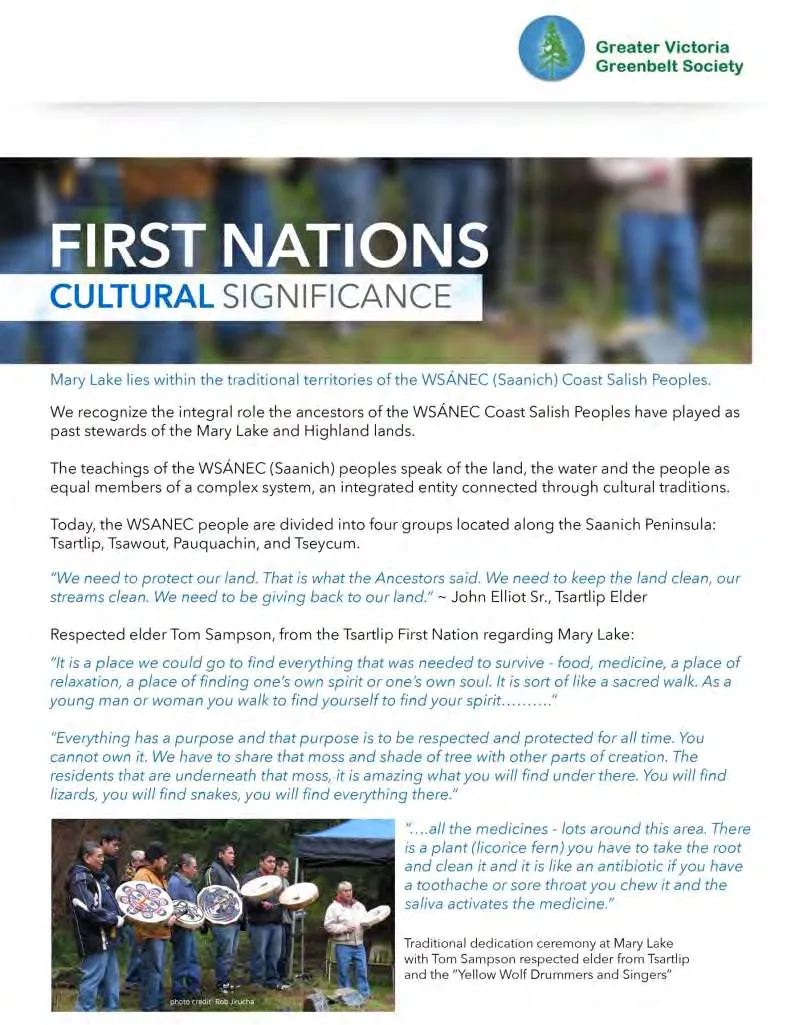
Respected elder Tom Sampson, from the Tsartlip First Nation regarding Mary Lake: “It is a place we could go to find everything that was needed to survive - food, medicine, a place of relaxation, a place of finding one’s own spirit or one’s own soul. It is sort of like a sacred walk. As a young man or woman you walk to find yourself to find your spirit.........”
“Everything has a purpose and that purpose is to be respected and protected for all time. You cannot own it. We have to share that moss and shade of tree with other parts of creation. The residents that are underneath that moss, it is amazing what you will find under there. You will find lizards, you will find snakes, you will find everything there.”
“....all the medicines - lots around this area. There is a plant (licorice fern) you have to take the root and clean it and it is like an antibiotic if you have a toothache or sore throat you chew it and the saliva activates the medicine.”
Traditional dedication ceremony at Mary Lake with Tom Sampson respected elder from Tsartlip and the “Yellow Wolf Drummers and Singers”
MARY LAKE PARK FUTURE VISIONS
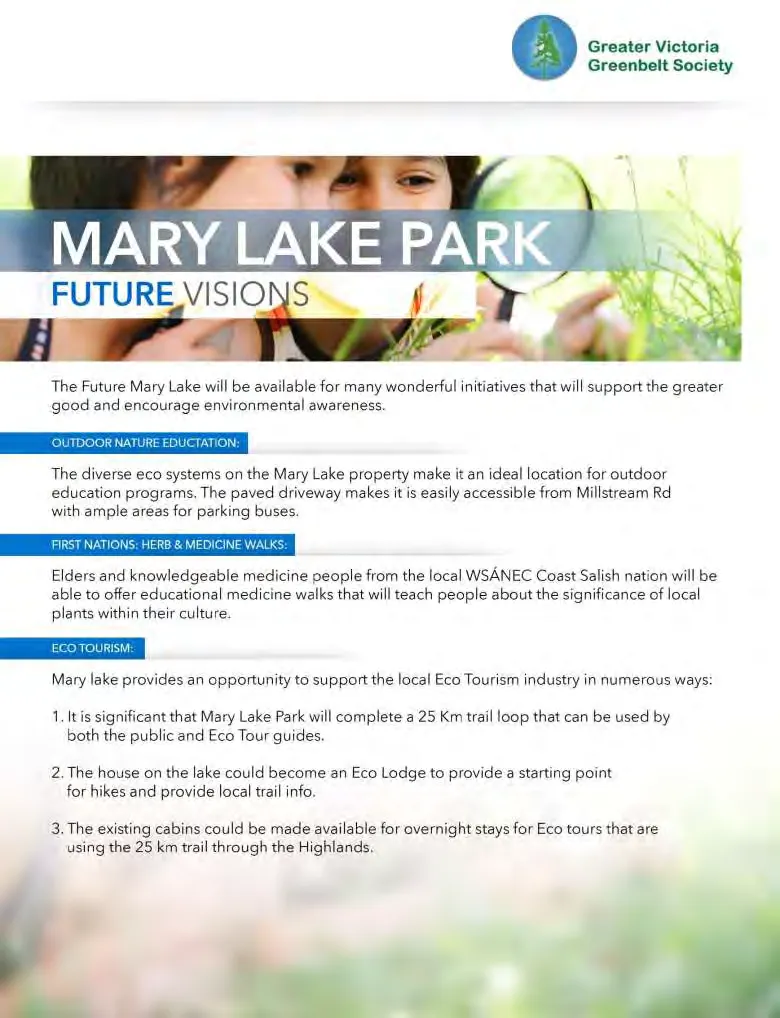
The Future Mary Lake will be available for many wonderful initiatives that will support the greater good and encourage environmental awareness.
OUTDOOR NATURE EDUCATION:
The diverse eco systems on the Mary Lake property make it an ideal location for outdoor education programs. The paved driveway makes it is easily accessible from Millstream Rd with ample areas for parking buses.
FIRST NATIONS: HERB & MEDICINE WALKS:
Elders and knowledgeable medicine people from the local WSÁNEC Coast Salish nation will be able to offer educational medicine walks that will teach people about the significance of local plants within their culture.
ECO TOURISM:
Mary lake provides an opportunity to support the local Eco Tourism industry in numerous ways:
- It is significant that Mary Lake Park will complete a 25 Km trail loop that can be used by both the public and Eco Tour guides.
- The house on the lake could become an Eco Lodge to provide a starting point for hikes and provide local trail info.
- The existing cabins could be made available for overnight stays for Eco tours that are using the 25 km trail through the Highlands.
GREATER VICTORIA GREENBELT SOCIETY HISTORY
The Greater Victoria Greenbelt Society (GVGS) worked with the Highlands Stewardship Foundation (HSF) in 2010-11 to conserve and establish the Mary Lake property as a public park. In July 2016, GVGS secured another option to acquire the property and is again seeking funds and public support to conserve and create a public recreation site.
Greater Victoria Greenbelt Society (GVGS): 1979 - to present
Mission: “To promote the reservation, acquisition and protection, and where necessary the purchase of greenbelt lands, potential parklands and outstanding examples of our natural and cultural heritage for the benefit of all citizens of the Greater Victoria metropolitan area.”
- 1980-87 developed detailed Trail Plans for the Saanich Peninsula and Western Communities and proposed Trail Construction Guidelines.
- The Capital Regional District used these “linear park” plans as the basis for the Regional Trail System.
Highlands Stewardship Foundation (HSF): 2003 - to present
Mission: “To promote the care and protection of land, water and air in the District of Highlands through community involvement and public education.”
HSF originated from the amalgamation of the Gowlland Foundation and the Friends of Fork Lake in 2003.
- 2004: the Foundation received the Capital Regional District's “Eco Star” Award for its grass-roots conservation activities, including collaboration with the Langford Lake Protection Society and B.C. Water & Waste Association.
- 2009-12: Initiated the District of Highlands Groundwater Monitoring Task Force that completed a 3 Phase Groundwater Protection Study.
- Liaises and collaborates with various organizations including the District of Highlands, Highlands District Community Association, B.C. Lake Stewardship Society, BC. Ministry of Environment, Capital Regional District, Royal Roads University and the University of Victoria in conservation initiatives.
- Gowlland Foundation (1989-2003): was formed to protect the Gowlland Range, the magnificent high ground overlooking the Saanich Inlet. The Foundation's efforts met with success in 2004 when the Government of BC and the Nature Conservancy of Canada collaborated to create the 1400 ac Gowlland Tod Provincial Park, the first of the Commonwealth Legacy Parks. Sixteen miles of trails provides access to glorious views and conserves over 150 species protecting the Capital Region's biodiversity.
- The Friends of Fork Lake (1996-2003): a stewardship group formed to protect water quality in Fork Lake. With support from the B.C. Ministry of Water, Land and Air Protection implemented a volunteer water monitoring program which expanded to include Teanook, Third, Pease, Eagles and Mitchell Lakes in the District of Highlands.
Bob McMinn, GVGS Chair, leading the effort to create the Mary Lake Park, has been awarded the Queen’s Diamond Jubilee and Canada 125 Medals, and the Highlands District’s Freedom of the Municipality in recognition of many years’ service to the Highlands and the Greater Victoria community. He has sat on the Board of Directors of the Gowlland Foundation, Thetis Lake Sanctuary Association, Swan Lake-Christmas Hill Nature Sanctuary, Highland Stewardship Foundation, Capital Region Open Space Advisory Committee, Langford Electoral Area Advisory Planning Commission and many District of Highlands Select Committees and Community organizations.
Greater Victoria Greenbelt Society Our Growing List of Supporters
Environmental Community
Tourism Community
Business Community
Hiking Community
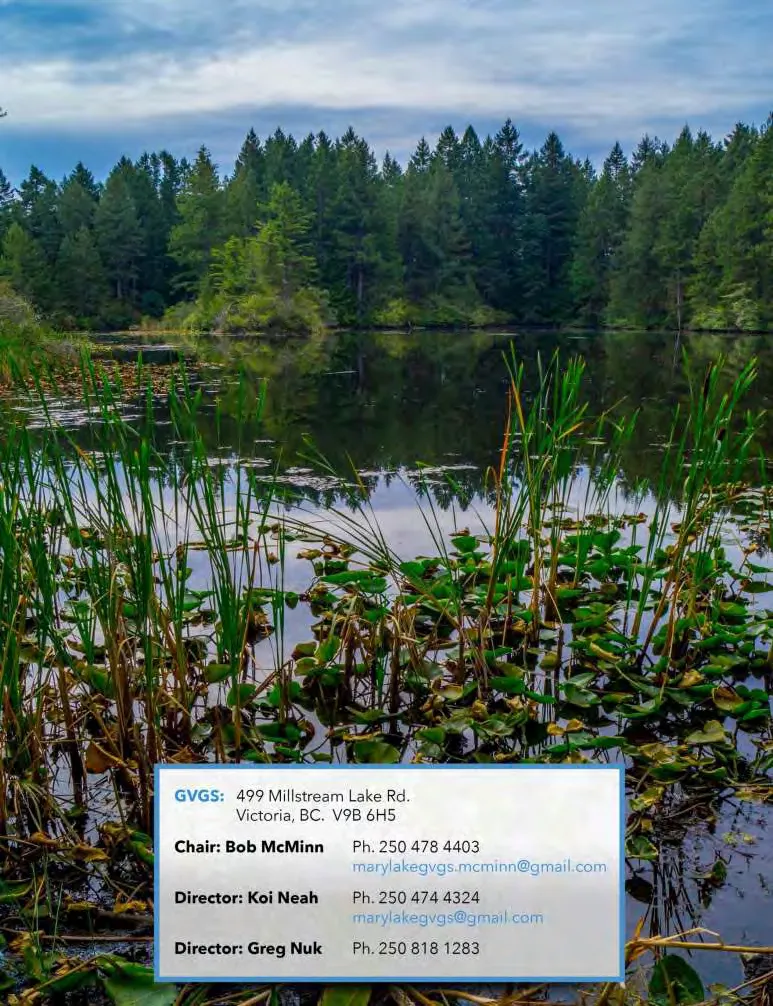
GVGS: 499 Millstream Lake Rd. Victoria, BC. V9B 6H5
Chair: Bob McMinn Ph. 250 478 4403 marylakegvgs.mcminn@gmail.com
Director: Koi Neah Ph. 250 474 4324 marylakegvgs@gmail.com
Director: Greg Nuk Ph. 250 818 1283
Document Images
(22)
Pacific Band Snail
Great Blue Heron

River Otter swimming

Pacific Chorus Frog

View from Gowlland Tod Provincial Park

View from Mount Work Regional Park

Close-up of hikers' feet on a trail

View of Mary Lake

View of Thetis Lake Regional Park
Map of the Highlands showing the Highlands Trail Loop, additional trails, roads, Mary Lake Property, and various peaks and hills

Children walking on a forest trail

Two hikers looking out over a valley

A group of people having a picnic in a park
Two children in snorkeling gear in water

Traditional dedication ceremony at Mary Lake with First Nations drummers and singers

Children using a magnifying glass outdoors

A panoramic view of trees and hills