Arborists Report: Eagle Creek Village – Phase 2 (Attachment 30)
Professional arborist's assessment of the tree resource on the development site with preservation recommendations.
December 15, 2015
Omicron Developments Inc. Fifth floor, Three Bentall Centre 595 Burrard Street, PO Box 49369 Vancouver, BC V7X 1L4
Attention: Jessica Ng
Re: Eagle Creek Village – Phase 2
Assignment
To visually examine the tree resource on the portion of property identified as Eagle Creek village Phase 2 in the plans provided and identify those trees that are suitable to be retained given the proposed impacts. Provide recommendations for mitigating any impacts the proposed construction activity may have on the trees deemed suitable to be retained.
Observations
The majority of the trees that were on the site had been removed by the time of our most recent site visit. The Park area along the North and West boundaries has been isolated by the construction activity by chain link barrier fencing. Given the proposed construction plans and proposed grade changes there was no opportunity for retaining any of the existing trees within the center of the Phase 2 site and retaining trees along the periphery will be challenging. Of the trees that remain, there are a group of Douglas fir trees numbered: 24 – 30 along the East eastern property line, a group of Douglas fir trees in the North corner and a group of Garry oak trees along the Western boundary that were not tagged. The two groups of trees that are not tagged will not be possible to be retained as they are within building and road footprints.
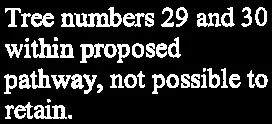
Douglas firs numbers 24 and 25 are showing health stress symptoms and are located within the proposed parking area and will not be possible to retain. Douglas fir number 26 is showing decline symptoms, will be impacted by the proposed parking area and is not suitable to retain. Douglas fir trees numbered 27and 28 are located along the property line and there is a cut of approximately 1 meter in depth proposed within 2 meters from the tree trunks. At the time of our site visit there was fill soils placed over a portion of their critical root zones but no indications that there had been any excavation in that area. We anticipate that the excavation for the proposed pathway will necessitate their removal. Douglas fir trees number 29 and 30 are shown as being within the proposed gravel pathway and will not be able to be retained in the current design.
Trees on the neighbouring properties and within the park area have a good opportunity for retention providing their critical root zones can be adequately protected during the construction process.
Recommendations:
- Barrier fencing: The areas, surrounding the trees to be retained, should be isolated from the construction activity by erecting protective barrier fencing. Where possible, the fencing should be erected at the perimeter of the critical root zones as defined in our Tree Resource Spreadsheet. The barrier fencing to be erected must be a minimum of 4 feet in height, of solid frame construction that is attached to wooden or metal posts. A solid board or rail must run between the posts at the top and the bottom of the fencing. This solid frame can then be covered with plywood, or flexible snow fencing (see attached diagram). The fencing must be erected prior to the start of any construction activity on site (i.e. site clearing, excavation, blasting, construction), and remain in place through completion of the project. Signs must be posted around the protection zone to declare it off limits to all construction related activity. The project arborist must be consulted before this fencing is removed or moved for any purpose. Solid hording material may also be required to protect the trunks of trees from mechanical injury if vehicles or machinery are permitted close to tree trunks and where blasting is required.
- Blasting and rock removal – We anticipate that blasting will be required adjacent to the trees that are to be retained. When areas of bedrock are encountered near trees to be retained, the blasting to level these rock areas should be sensitive to the root zones located at the edge of the rock. Care must be taken to assure that the area of blasting does not extend into the critical root zones beyond the building and road footprints. The use of small low-concussion charges, and multiple small charges designed to pre-shear the rock face, will reduce fracturing, ground vibration, and reduce the impact on the surrounding environment. Only explosives of low phytotoxicity, and techniques that minimize tree damage, are to be used. Provisions must be made to store blast rock, and other construction materials and debris, away from critical tree root zones.
- Douglas fir along East property line (numbers 27 - 30) – If any of the Douglas fir trees along this property line are going to be retained, any excavation within their critical root zones must be supervised by the project arborist. At that time it can be determined whether they can be retained or not. If structural roots must be severed or the project arborist feels that the impacts have destabilized the trees or impacted the trees to a point where they will not survive, it will be recommended that they be removed.
Please do not hesitate to call us at 250-479-8733 should you have any further questions. Thank you.
Yours truly, Talbot Mackenzie & Associates
Graham Mackenzie & Tom Talbot ISA Certified, & Consulting Arborists
Enclosures: 1-page site plan, 1-page barrier fencing specifications, 1-page pictures
Disclosure Statement
Arborists are professionals who examine trees and use their training, knowledge and experience to recommend techniques and procedures that will improve the health and structure of individual trees or group of trees, or to mitigate associated risks.
Trees are living organisms, whose health and structure change, and are influenced by age, continued growth, climate, weather conditions, and insect and disease pathogens. Indicators of structural weakness and disease are often hidden within the tree structure or beneath the ground. It is not possible for an arborist to identify every flaw or condition that could result in failure nor can he/she guarantee that the tree will remain healthy and free of risk.
Remedial care and mitigation measures recommended are based on the visible and detectable indicators present at the time of the examination and cannot be guaranteed to alleviate all symptoms or to mitigate all risk posed.
Pictures
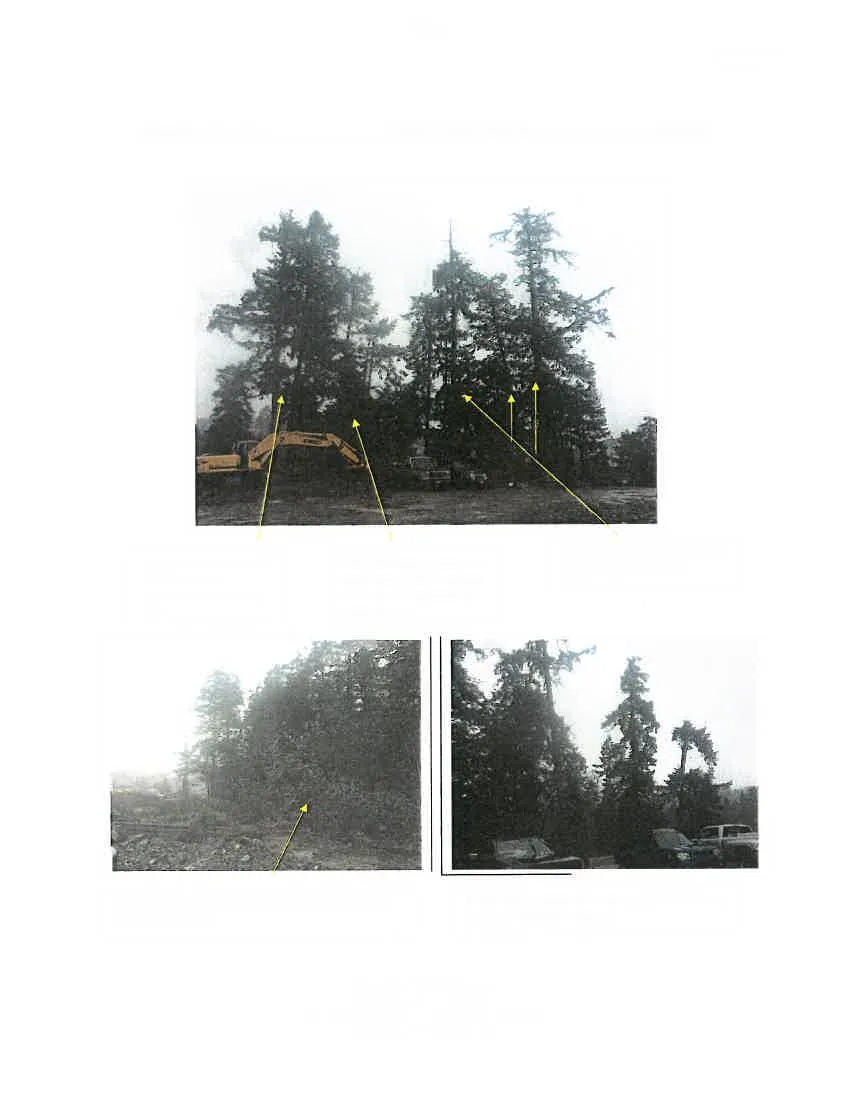
Annotated Photographs Content:
- Tree numbers 27 and 28, 1 meter cut within 2 meters of trunks. Designated for removal.
- Declining tree numbers: 24, 25, 26, not suitable to retain.
- Remaining Garry oak trees in Phase 2 that are in the proposed roadway.
- Remaining Douglas fir trees in phase 2 that are in proposed building footprint.
Tree Removal Plan
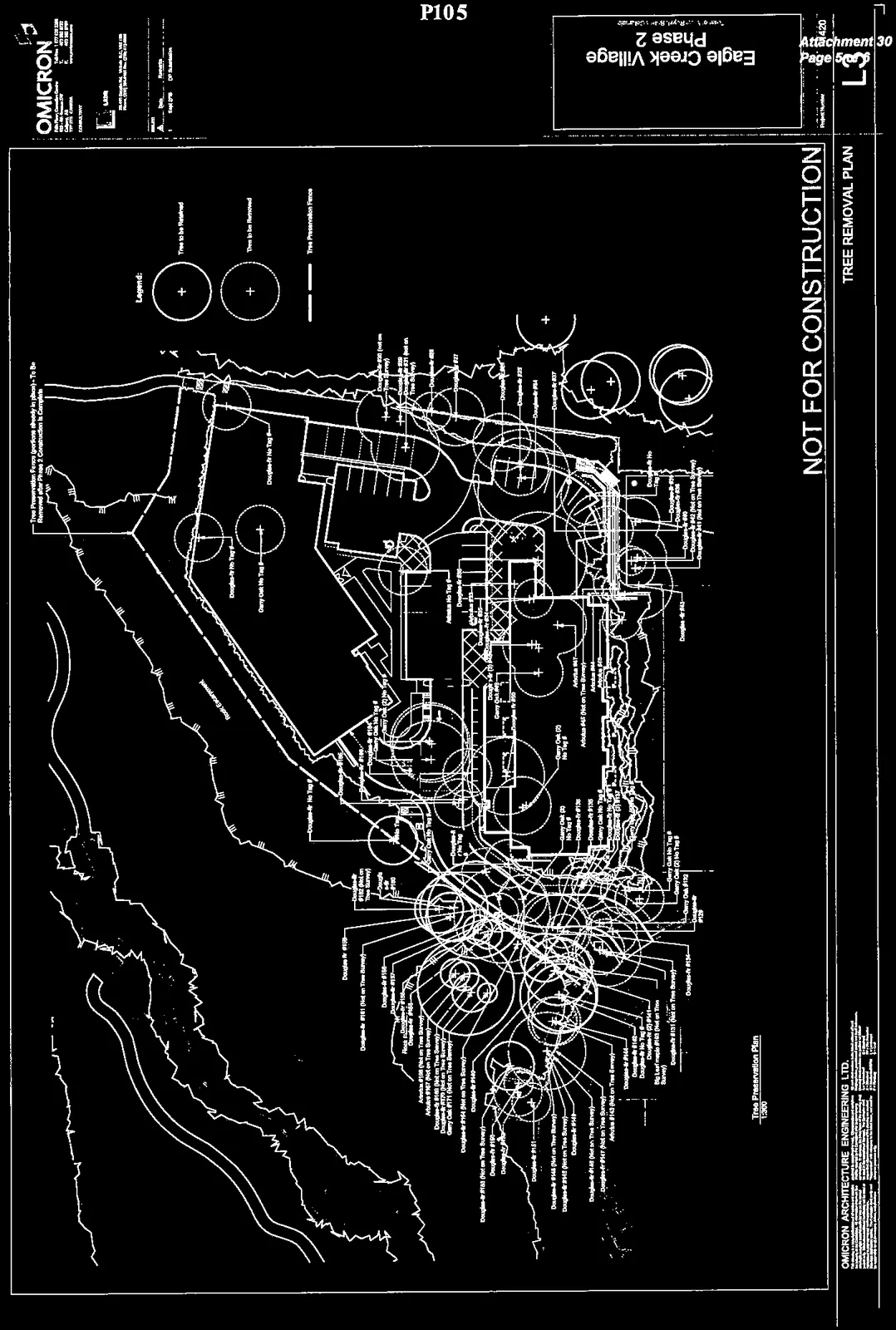
Status: NOT FOR CONSTRUCTION
| Legend Symbol | Description |
|---|---|
| Circle with plus (+) | Tree to be Retained |
| Circle with X | Tree to be Removed |
| Dashed line | Tree Preservation Fence |
Tree Protection Fencing
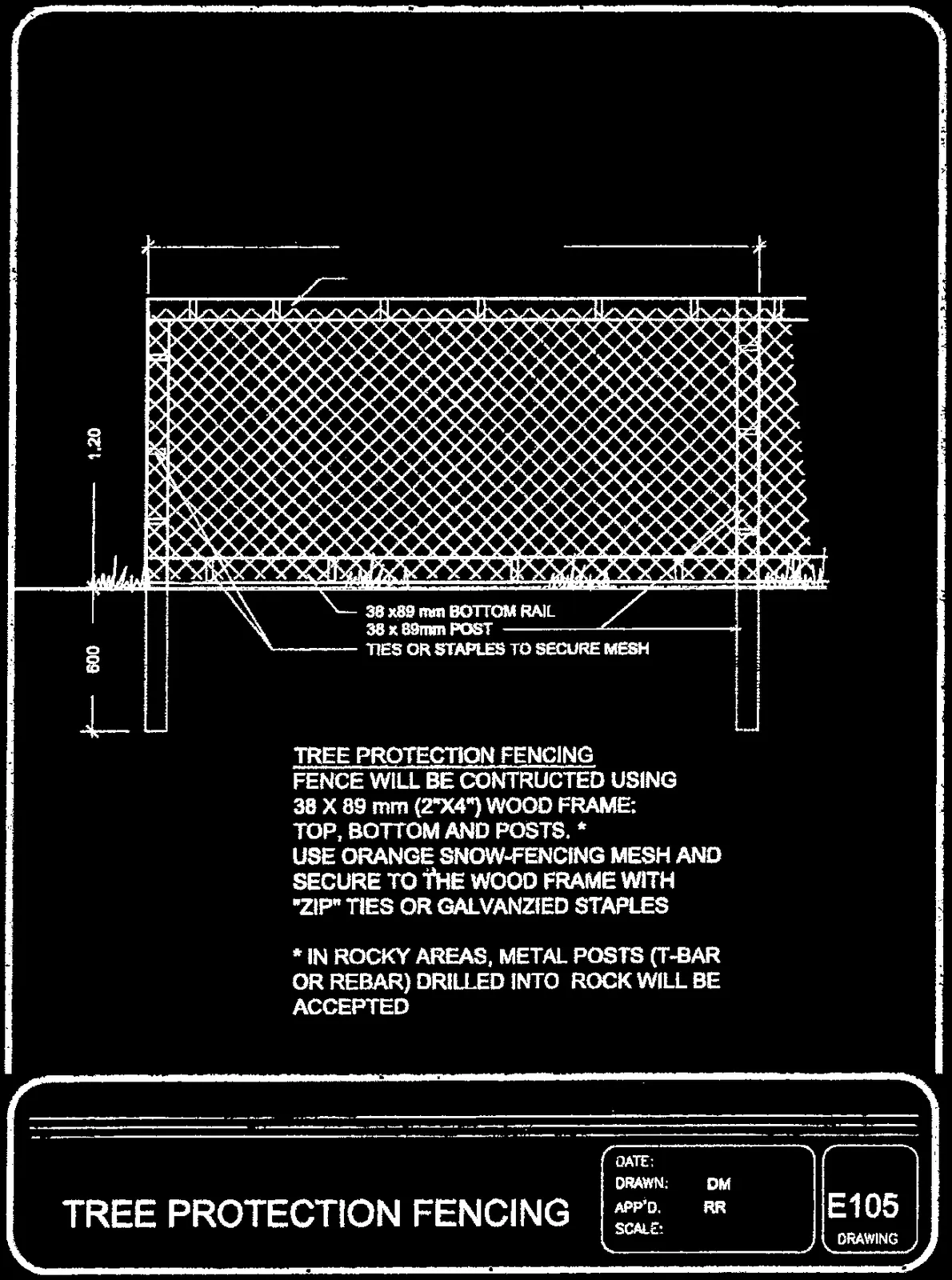
TREE PROTECTION FENCING SPECIFICATIONS
FENCE WILL BE CONSTRUCTED USING 38 X 89 mm (2"X4") WOOD FRAME: TOP, BOTTOM AND POSTS. * USE ORANGE SNOW-FENCING MESH AND SECURE TO THE WOOD FRAME WITH "ZIP" TIES OR GALVANIZED STAPLES
- IN ROCKY AREAS, METAL POSTS (T-BAR OR REBAR) DRILLED INTO ROCK WILL BE ACCEPTED
Diagram Details:
- Drawing Name: TREE PROTECTION FENCING
- Date: Oct 30/07
- Drawing Number: E105
- Scale: N.T.S.
- Technical Dimensions:
- Maximum Span: 2.4m
- Mesh Height: 1.20m
- Post Depth: 600mm
- Lumber: 38 x 89 mm top rail, bottom rail, and posts