Appendix
Development Permit Area Guidelines Review - 1950 Watkiss Way
July 19, 2016Pages 106–1122 sections
A detailed staff review assessing the project's compliance with municipal design guidelines for the Neighbourhood Mixed Use area.
July 11, 2016Neighbourhood Mixed Use DPA
DEVELOPMENT PERMIT AREA GUIDELINES - REVIEW
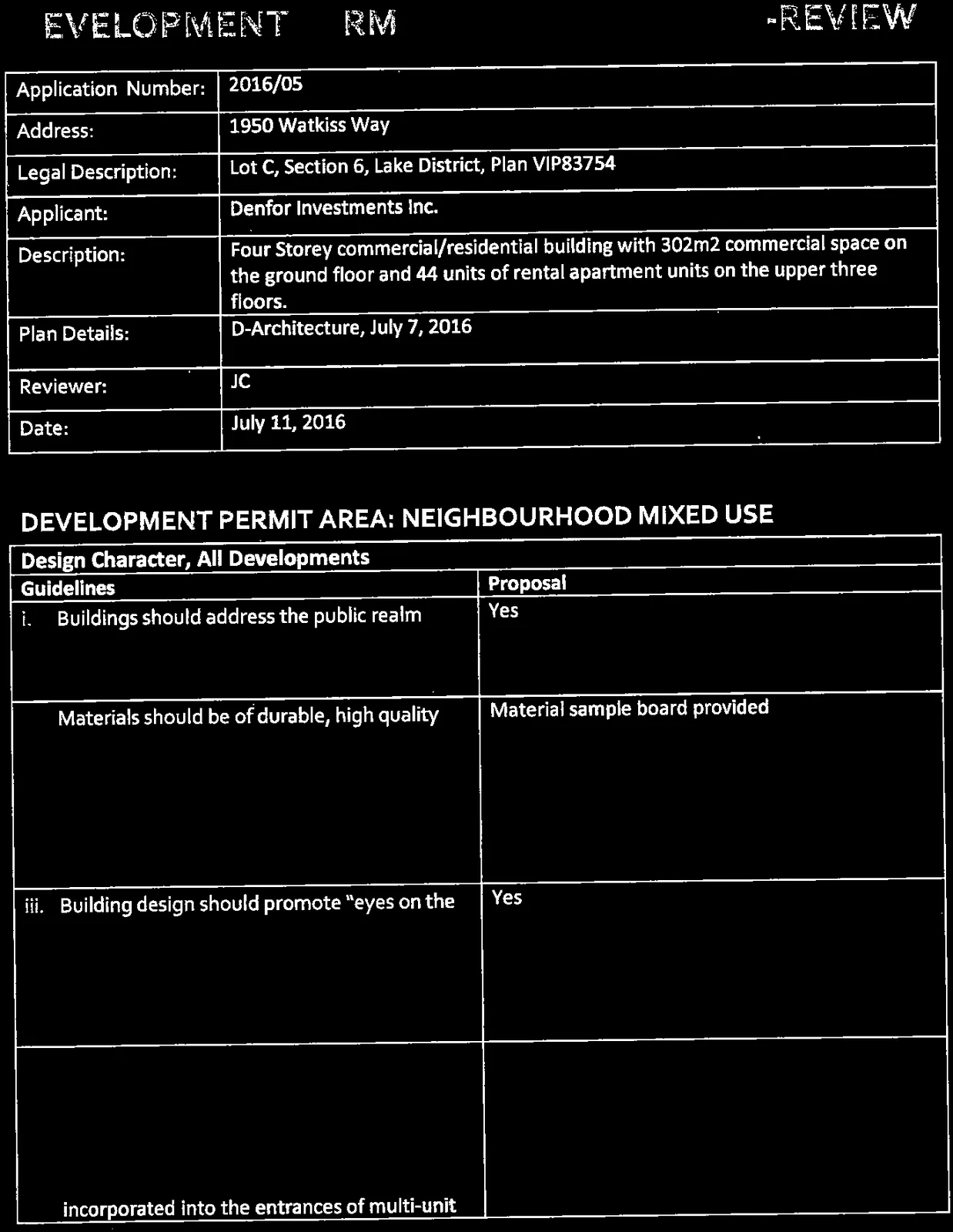
| Application Number: | 2016/05 |
| Address: | 1950 Watkiss Way |
| Legal Description: | Lot C, Section 6, Lake District, Plan VIP83754 |
| Applicant: | Denfor Investments Inc. |
| Description: | Four Storey commercial/residential building with 302m2 commercial space on the ground floor and 44 units of rental apartment units on the upper three floors. |
| Plan Details: | D-Architecture, July 7, 2016 |
| Reviewer: | JC |
| Date: | July 11, 2016 |
DEVELOPMENT PERMIT AREA: NEIGHBOURHOOD MIXED USE
Design Character, All Developments
| Guidelines | Proposal |
|---|---|
| i. Buildings should address the public realm and contribute to a safe and comfortable pedestrian-friendly streetscape. | Yes |
ii. Materials should be of durable, high quality material and should reflect the natural surroundings of View Royal and a “West Coast” design character; bringing in elements of wood, stone and a natural colour palette. Natural materials are preferred.  |
Material sample board provided |
iii. Building design should promote “eyes on the street” for natural surveillance of the public realm through the provision of entrances, windows, patios, porches and decks facing public streets and spaces. 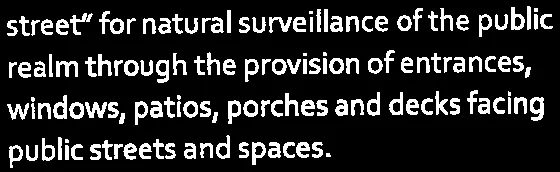 |
Yes |
iv. Main entrances should be clearly identified in the streetscape. Entrances may be emphasized with lighting, architectural detailing, colour, special paving, landscaping or other defining features. Weather protection should be incorporated into the entrances of multi-unit buildings. 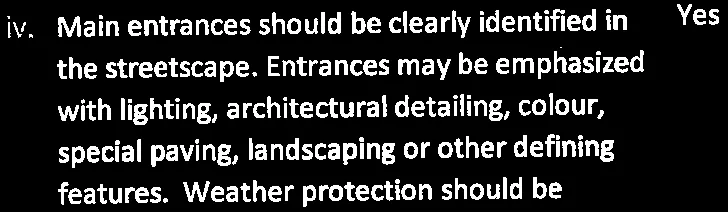 |
Yes |
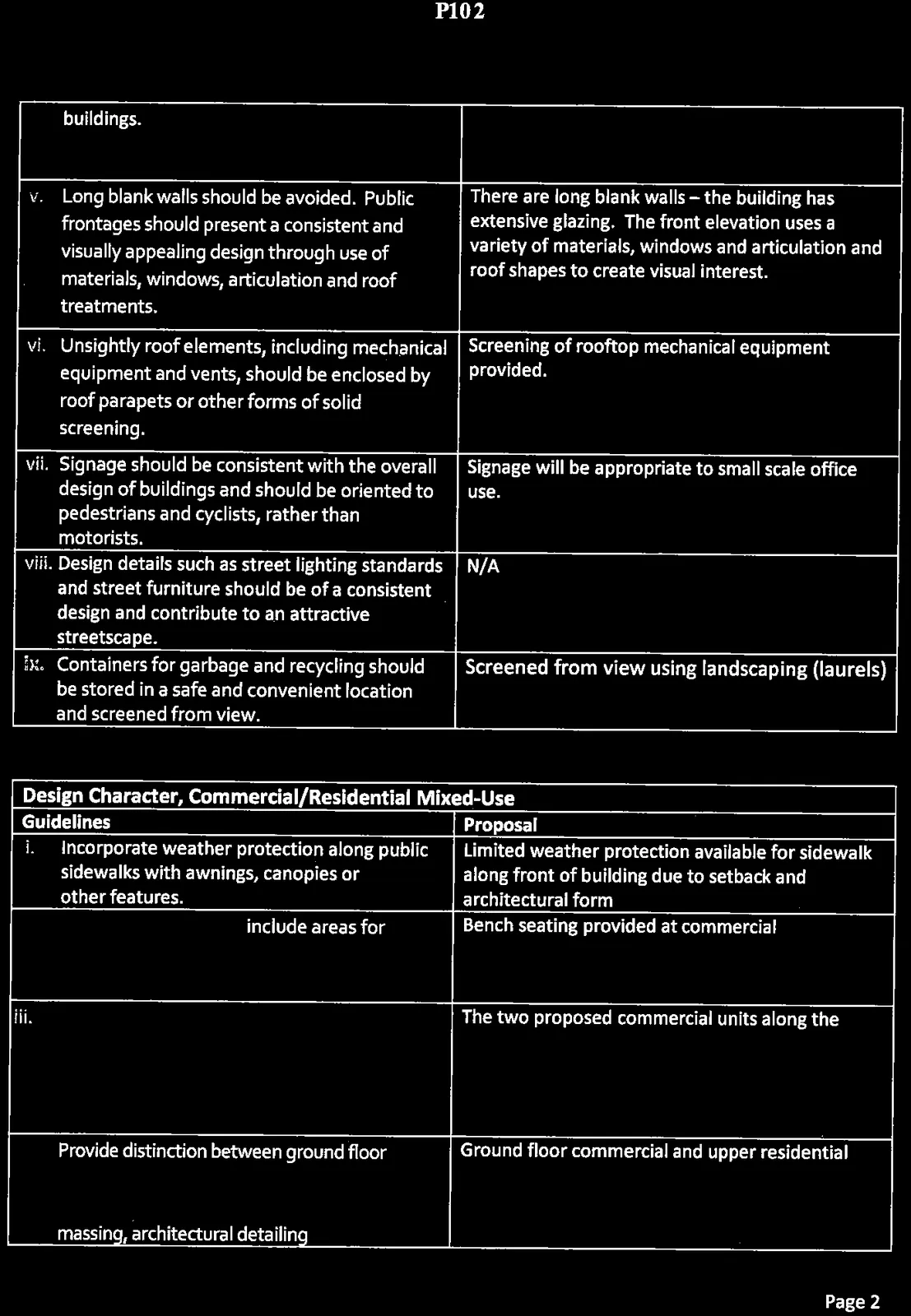
| Guidelines | Proposal |
|---|---|
| v. Long blank walls should be avoided. Public frontages should present a consistent and visually appealing design through use of materials, windows, articulation and roof treatments. | There are long blank walls – the building has extensive glazing. The front elevation uses a variety of materials, windows and articulation and roof shapes to create visual interest. |
| vi. Unsightly roof elements, including mechanical equipment and vents, should be enclosed by roof parapets or other forms of solid screening. | Screening of rooftop mechanical equipment provided. |
| vii. Signage should be consistent with the overall design of buildings and should be oriented to pedestrians and cyclists, rather than motorists. | Signage will be appropriate to small scale office use. |
| viii. Design details such as street lighting standards and street furniture should be of a consistent design and contribute to an attractive streetscape. | N/A |
| ix. Containers for garbage and recycling should be stored in a safe and convenient location and screened from view. | Screened from view using landscaping (laurels) |
Design Character, Commercial/Residential Mixed-Use
| Guidelines | Proposal |
|---|---|
| i. Incorporate weather protection along public sidewalks with awnings, canopies or other features. | Limited weather protection available for sidewalk along front of building due to setback and architectural form |
| ii. Developments should include areas for outdoor seating. | Bench seating provided at commercial entrance. |
| iii. Small, distinctive commercial units are preferred to long, uninterrupted commercial façades. | The two proposed commercial units along the ground floor street frontage are appropriate to the scale of the building. |
| iv. Provide distinction between ground floor commercial and upper levels of residential development through variation in materials, massing, architectural detailing or other elements. | Ground floor commercial and upper residential levels are visually distinct |
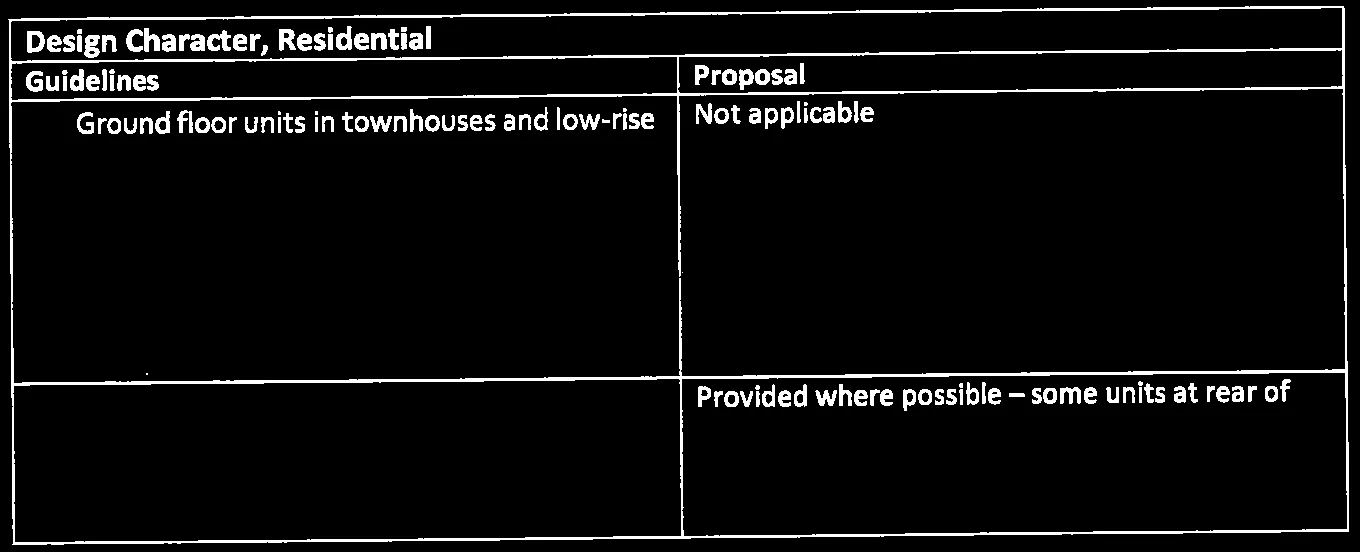
Design Character, Residential
| Guidelines | Proposal |
|---|---|
i. Ground floor units in townhouses and low-rise apartments should have individual front doors that are directly accessible and visible from the street. Ground floor units may be raised up to 0.6 metres (two feet) above grade to provide privacy for dwelling units. 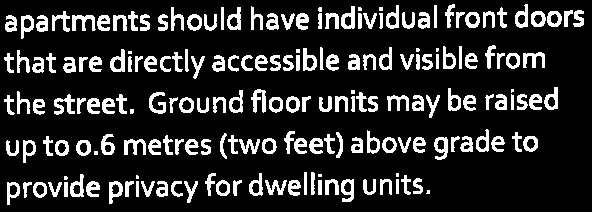 |
Not applicable |
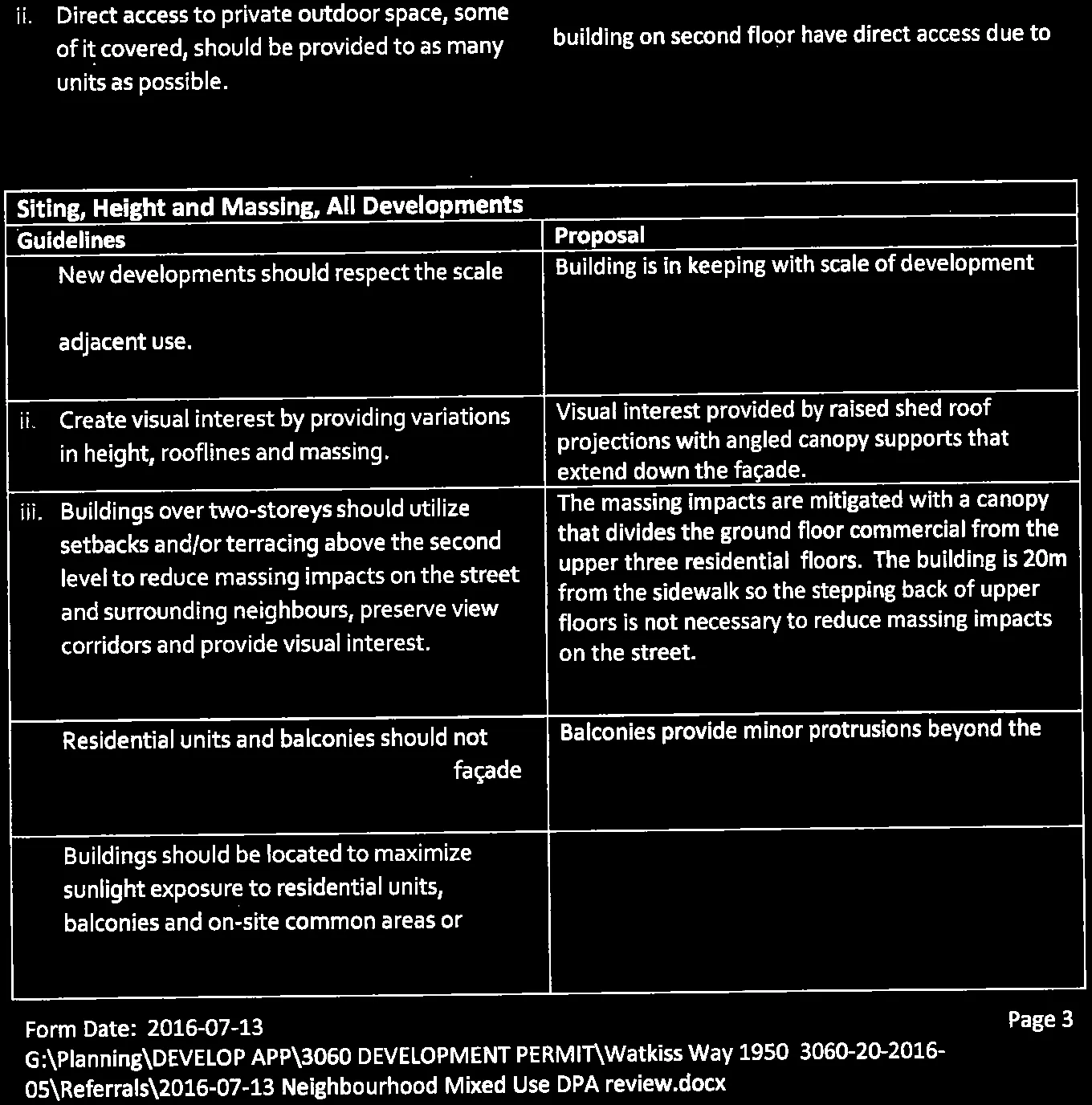
| ii. Direct access to private outdoor space, some of it covered, should be provided to as many units as possible. | Provided where possible – some units at rear of building on second floor have direct access due to slope |
Siting, Height and Massing, All Developments
| Guidelines | Proposal |
|---|---|
| i. New developments should respect the scale and general development pattern of the adjacent use. | Building is in keeping with scale of development on adjacent property |
| ii. Create visual interest by providing variations in height, rooflines and massing. | Visual interest provided by raised shed roof projections with angled canopy supports that extend down the façade. |
| iii. Buildings over two-storeys should utilize setbacks and/or terracing above the second level to reduce massing impacts on the street and surrounding neighbours, preserve view corridors and provide visual interest. | The massing impacts are mitigated with a canopy that divides the ground floor commercial from the upper three residential floors. The building is 20m from the sidewalk so the stepping back of upper floors is not necessary to reduce massing impacts on the street. |
| iv. Residential units and balconies should not protrude further than the commercial façade below. | Balconies provide minor protrusions beyond the commercial façade to provide articulation and visual interest |
| v. Buildings should be located to maximize sunlight exposure to residential units, balconies and on-site common areas or outdoor seating areas. | Yes |
| vi. Building siting and placement of balconies, decks and windows should limit overlook and shadowing impact on neighbours. | The building is configured to maximize privacy with the adjacent property. |
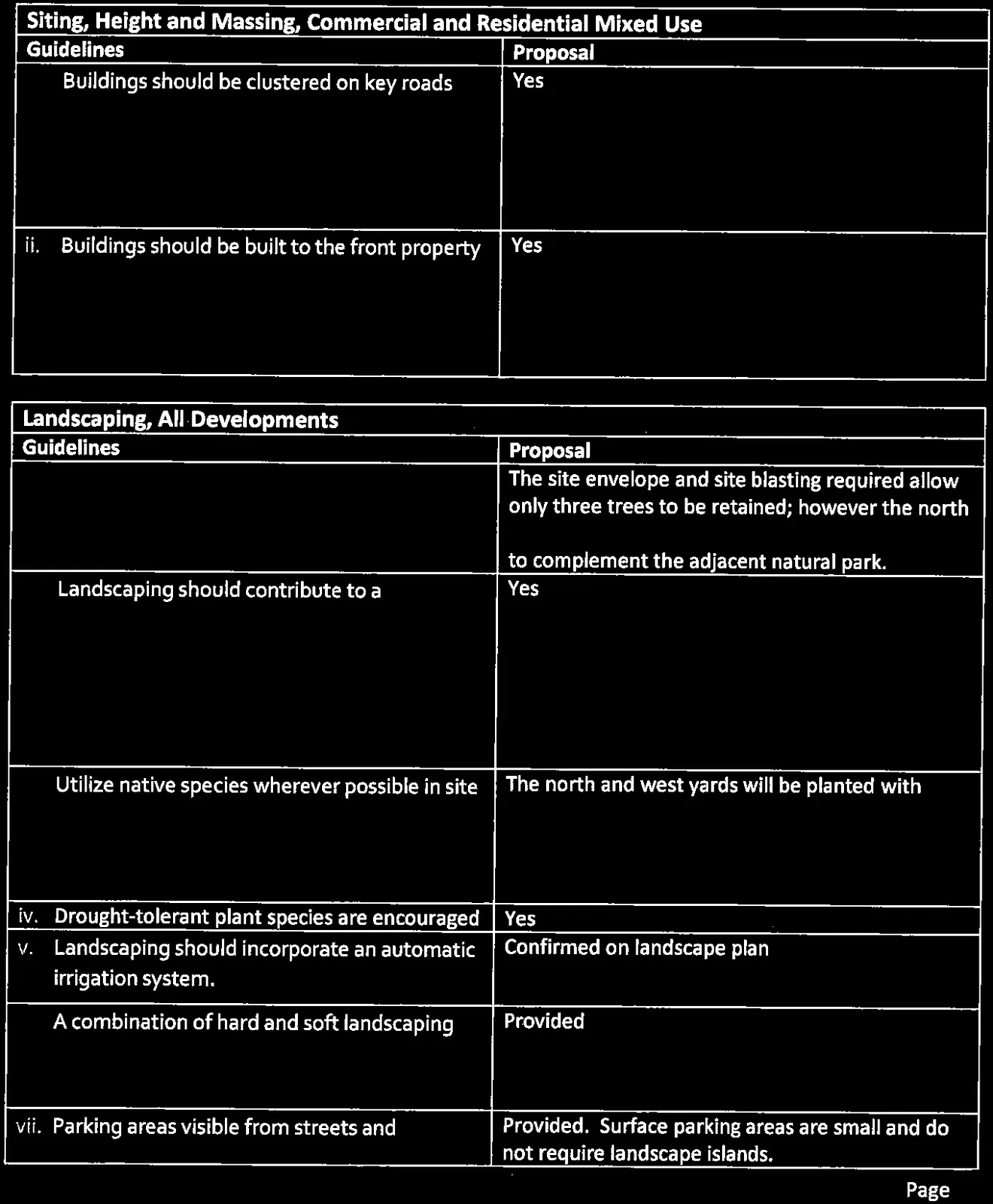
Siting, Height and Massing, Commercial and Residential Mixed Use
| Guidelines | Proposal |
|---|---|
i. Buildings should be clustered on key roads and intersections to create a hub of residential density and services that is pedestrian-oriented and in keeping with the scale of the neighbourhood. 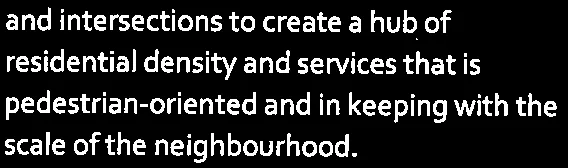 |
Yes |
| ii. Buildings should be built to the front property line, articulated with generous areas of clear glass windows and doorway entrances set back into retail units. | Yes |
Landscaping, All Developments
Page 106–112
| Guidelines | Proposal |
|---|---|
| i. Retain mature trees, vegetation and natural features wherever possible. | The site envelope and site blasting required allow only three trees to be retained; however the north and west yards will be planted with native species to complement the adjacent natural park. |
ii. Landscaping should contribute to a pedestrian-friendly streetscape and may include street trees, planters, decorative paving, seating, and use of other materials or furniture to add interest and define the pedestrian realm.  |
Yes |
| iii. Utilize native species wherever possible in site landscaping. Plants should be chosen for seasonal interest and compatibility with the local climate. | The north and west yards will be planted with native species to complement the adjacent natural park. |
| iv. Drought-tolerant plant species are encouraged | Yes |
| v. Landscaping should incorporate an automatic irrigation system. | Confirmed on landscape plan |
| vi. A combination of hard and soft landscaping elements should be used to define the transition between public and private space. | Provided |
vii. Parking areas visible from streets and adjacent residential buildings should be screened with substantial landscaping. Surface parking areas should incorporate trees in planting islands to increase permeability, provide shade and improve the visual appearance of parking areas. 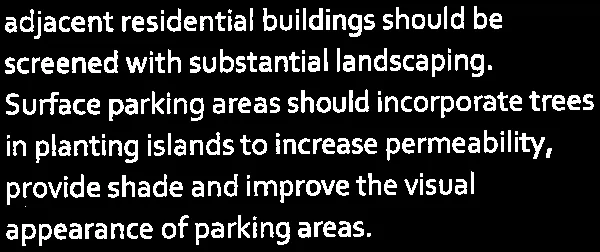 |
Provided. Surface parking areas are small and do not require landscape islands. |
viii. Landscape design strategies should be incorporated that minimize stormwater runoff, and promotes the natural infiltration and cleaning of runoff. 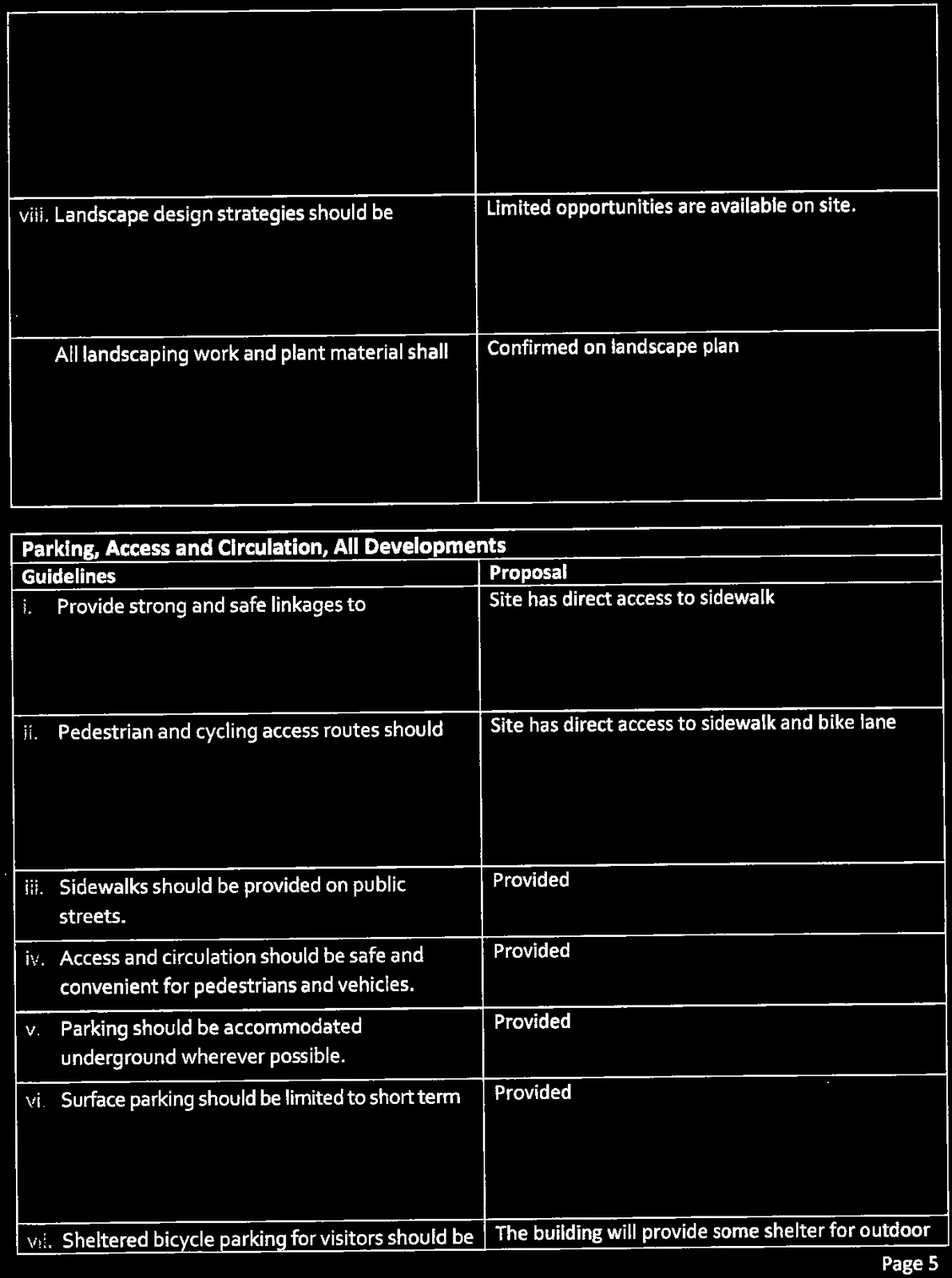 |
Limited opportunities are available on site.  |
ix. All landscaping work and plant material shall conform to the most recent edition of the British Columbia Landscape Standard published by the British Columbia Society of Landscape Architects. 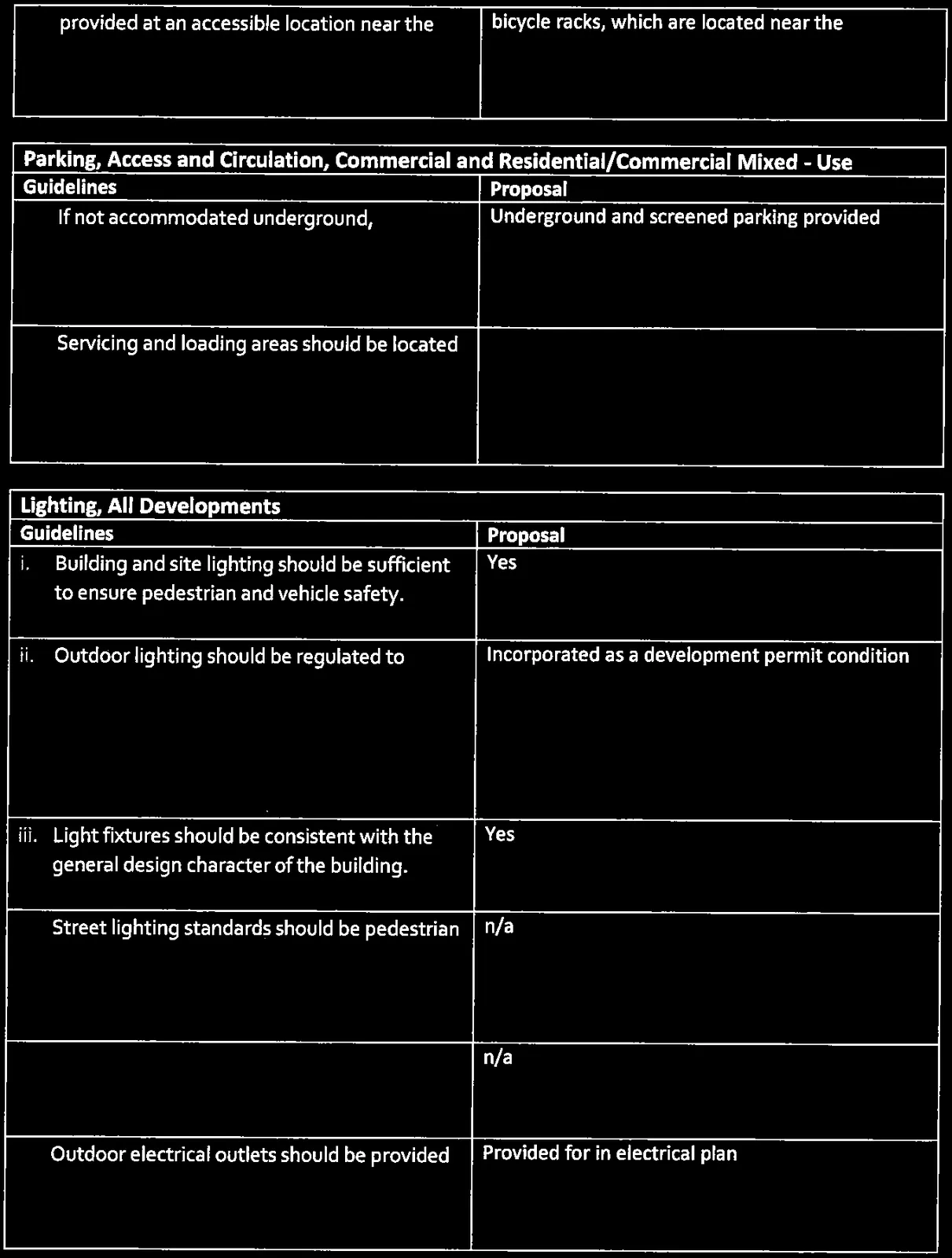 |
Confirmed on landscape plan |
Parking, Access and Circulation, All Developments
| Guidelines | Proposal |
|---|---|
| i. Provide strong and safe linkages to surrounding parks, trails, schools and other neighbourhood destinations. | Site has direct access to sidewalk |
ii. Pedestrian and cycling access routes should designed to provide easy and convenient access to transit services, cycling routes, trails and sidewalks. 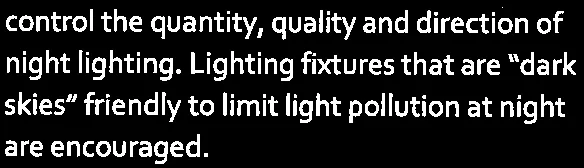 |
Site has direct access to sidewalk and bike lane |
| iii. Sidewalks should be provided on public streets. | Provided |
| iv. Access and circulation should be safe and convenient for pedestrians and vehicles. | Provided |
| v. Parking should be accommodated underground wherever possible. | Provided |
vi. Surface parking should be limited to short term commercial or residential visitor parking and should be suitably landscaped to screen parking areas from public roads and pedestrian routes. 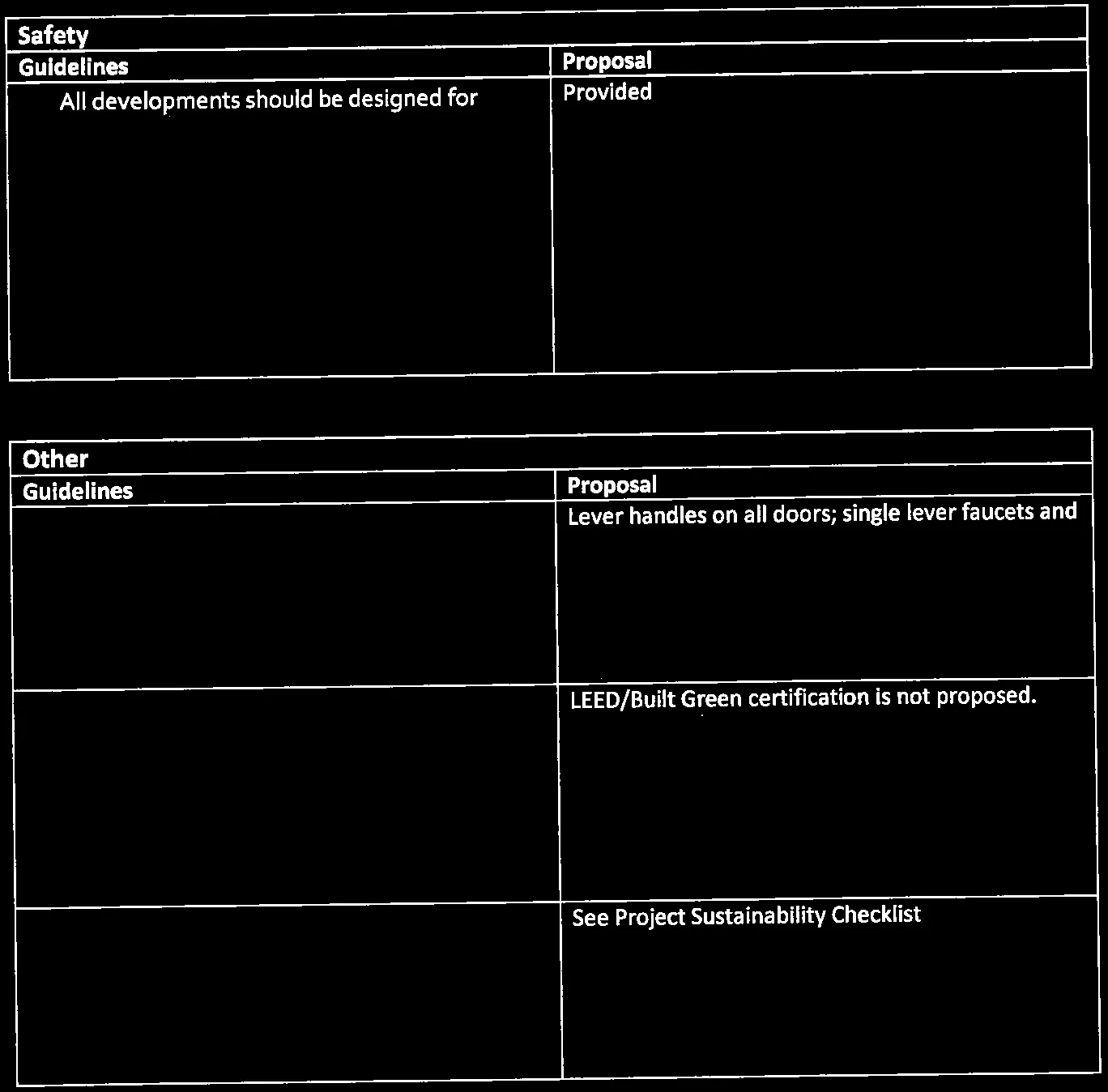 |
Provided |
| vii. Sheltered bicycle parking for visitors should be provided at an accessible location near the primary entrance and located so as to ensure passive surveillance. | The building will provide some shelter for outdoor bicycle racks, which are located near the apartment entrance for passive surveillance. |
Parking, Access and Circulation, Commercial and Residential/Commercial Mixed - Use
| Guidelines | Proposal |
|---|---|
| i. If not accommodated underground, commercial parking should be located behind buildings, wherever possible. | Underground and screened parking provided |
| ii. Servicing and loading areas should be located in a manner that does not negatively impact the pedestrian realm. |
Lighting, All Developments
| Guidelines | Proposal |
|---|---|
| i. Building and site lighting should be sufficient to ensure pedestrian and vehicle safety. | Yes |
ii. Outdoor lighting should be regulated to control the quantity, quality and direction of night lighting. Lighting fixtures that are “dark skies” friendly to limit light pollution at night are encouraged. 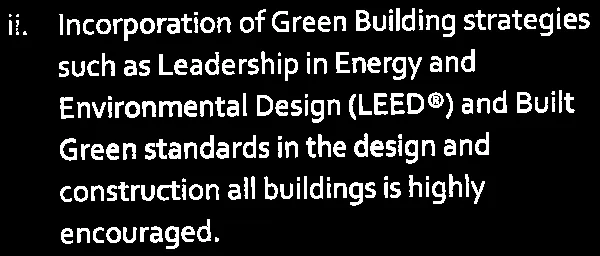 |
Incorporated as a development permit condition |
| iii. Light fixtures should be consistent with the general design character of the building. | Yes |
| iv. Street lighting standards should be pedestrian scale, while providing sufficient light for automobile traffic. | n/a |
| v. Street light standards should be consistent with street furniture and garbage/recycling receptacles. | n/a |
| vi. Outdoor electrical outlets should be provided at regular intervals to facilitate the installation of seasonal/decorative outdoor lighting. | Provided for in electrical plan |
| vii. Where pole mounted lighting is necessary, light standard luminaries should be no more than 40,000 lumens and mounted on poles no more than 5 metres high. | Incorporated as a development permit condition |
Safety
| Guidelines | Proposal |
|---|---|
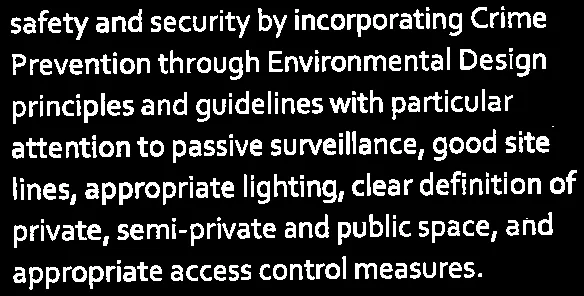
| i. All developments should be designed for safety and security by incorporating Crime Prevention through Environmental Design principles and guidelines with particular attention to passive surveillance, good site lines, appropriate lighting, clear definition of private, semi-private and public space, and appropriate access control measures. | Provided |
Other
| Guidelines | Proposal |
|---|---|
| i. Implementation of “adaptable design standards” in residential development is encouraged to accommodate individuals with mobility challenges, and to facilitate “aging in place”. | Lever handles on all doors; single lever faucets and walk-in showers for some units. |
| ii. Incorporation of Green Building strategies such as Leadership in Energy and Environmental Design (LEED®) and Built Green standards in the design and construction all buildings is highly encouraged. | LEED/Built Green certification is not proposed. |
| iii. Incorporation of resource and energy efficiency into the siting, design, construction and maintenance of buildings and structures is highly encouraged. | See Project Sustainability Checklist |
Page 106–112
Document Images
(11)









Extracted from: 2016 07 19 Council Agenda - Pdf