Schedule B - Supplementary Design Guidelines
Technical guidelines and standards for water, sewer, roads, and landscape design in new subdivisions.
SCHEDULE B - SUPPLEMENTARY DESIGN GUIDELINES
SUPPLEMENTARY DESIGN GUIDELINE GENERAL USE DESCRIPTION
This schedule contains supplementary design guidelines to be applied in conjunction with the Design Guideline Manual of the Master Municipal Construction Documents, dated 2014, both of which shall apply to all Works and Services constructed within the Town of View Royal.
Supplementary Design Guidelines contained within this Schedule supplement or supersede the Master Municipal Construction Document (MMCD). Where the Town of View Royal Supplementary Design Guidelines are in conflict with the MMCD, the Town of View Royal Design Guidelines shall take precedence.
Section number and clause numbers in the Town of View Royal Supplementary Design Guidelines coincide with the MMCD numbering protocol.
Table of Contents
| Section | Description |
|---|---|
| Section 1.0 | General Design Considerations |
| 1.7 | Decommissioning |
| Section 2.0 | Water Distribution |
| Section 3.0 | Sanitary Sewers |
| Section 4.0 | Storm Drainage |
| 4.3.1 | The Minor System |
| 4.3.2 | The Major System |
| 4.4 | Runoff Analysis |
| 4.11 | Runoff Controls |
| 4.11.10 | Performance Targets |
| Section 5.0 | Roads |
| 5.3 | Cross-Section Elements |
| 5.11.1 | Sidewalk |
| 5.13 | Transit Facilities |
| 5.17.3 | Pavement Alternatives |
| Section 12.0 | Landscape Requirements |
| 12.1 | Plans |
| 12.2 | Boulevard Trees |
| 12.3 | Tree Retention |
Section 1.0 - General Design Considerations
Add the following:
1.7 - Decommissioning
A. Existing Pipe Utilities
Unless otherwise approved, all abandoned pipes within public rights-of-way shall be removed and disposed of off-site as per applicable environmental requirements. Trench backfilling shall be performed in accordance with trench backfilling procedures required for new pipe installation. All disturbed surfaces shall be restored to equal or better conditions.
B. Existing Sanitary Lift Stations
The preferred method of decommissioning abandoned sanitary lift stations includes total removal of the pump tank (wet well) and all associated works within the tank, electrical and instrumentation components, and abandoning and permanently sealing off all pipes connecting to the tank. If a concern exists that the removal of the below ground tank may cause soil instability and disturbance to the existing nearby structures, the tank may be abandoned in place after the following procedure is followed:
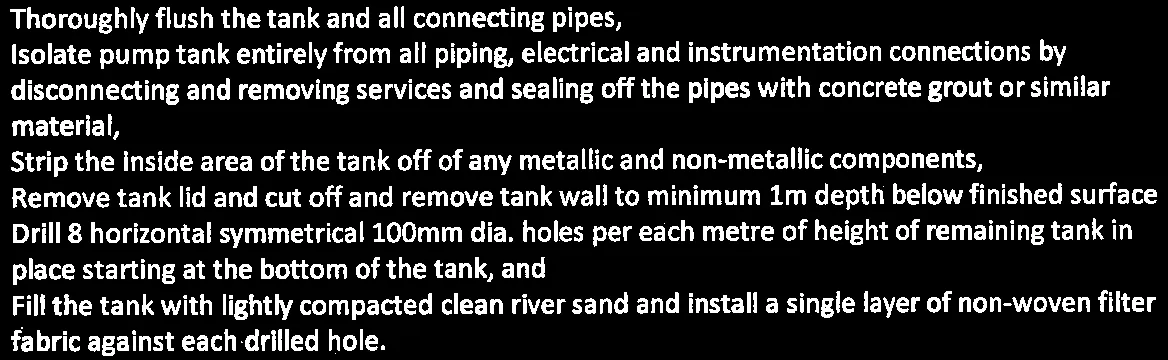
- Thoroughly flush the tank and all connecting pipes,
- Isolate pump tank entirely from all piping, electrical and instrumentation connections by disconnecting and removing services and sealing off the pipes with concrete grout or similar material,
- Strip the inside area of the tank off of any metallic and non-metallic components,
- Remove tank lid and cut off and remove tank wall to minimum 1m depth below finished surface,
- Drill 8 horizontal symmetrical 100mm dia. holes per each metre of height of remaining tank in place starting at the bottom of the tank, and
- Fill the tank with lightly compacted clean river sand and install a single layer of non-woven filter fabric against each drilled hole.
Section 2.0 - Water Distribution
All Water Distribution requirements shall be confirmed with the Capital Regional District who is the water distribution system provider in the Town of View Royal. For all developments that include non-single family properties fire flow calculations must be submitted in accordance with the latest Fire Underwriters Survey with confirmation provided by the Capital Regional District that sufficient fire flow exists to protect the proposed development.
Section 3.0 - Sanitary Sewers
As per MMCD.
Section 4.0 - Storm Drainage
4.3.1 - The Minor System
Replace this section with the following:
Consists of pipe, gutters, catch basins, driveway culverts, open channels, watercourses, rain gardens, oil interceptors and other stormwater management BMPs designed to capture, convey, treat, or modify flows up to a 10-year return frequency.
All minor system components are to be sized to ensure that the hydraulic grade line of 10-year frequency flows remain below ground surface, and the flood protection elevation of dwellings, or within bank limits in the case of open channels and bio-swales.
4.3.2 - The Major System
Replace this section with the following:
Consists of surface flood paths, roadways, roadway culverts, watercourses and stormwater management facilities designed to capture, convey, treat, or modify larger flows up to a 100-year return frequency.
4.4 - Runoff Analysis
Replace this section with the following:
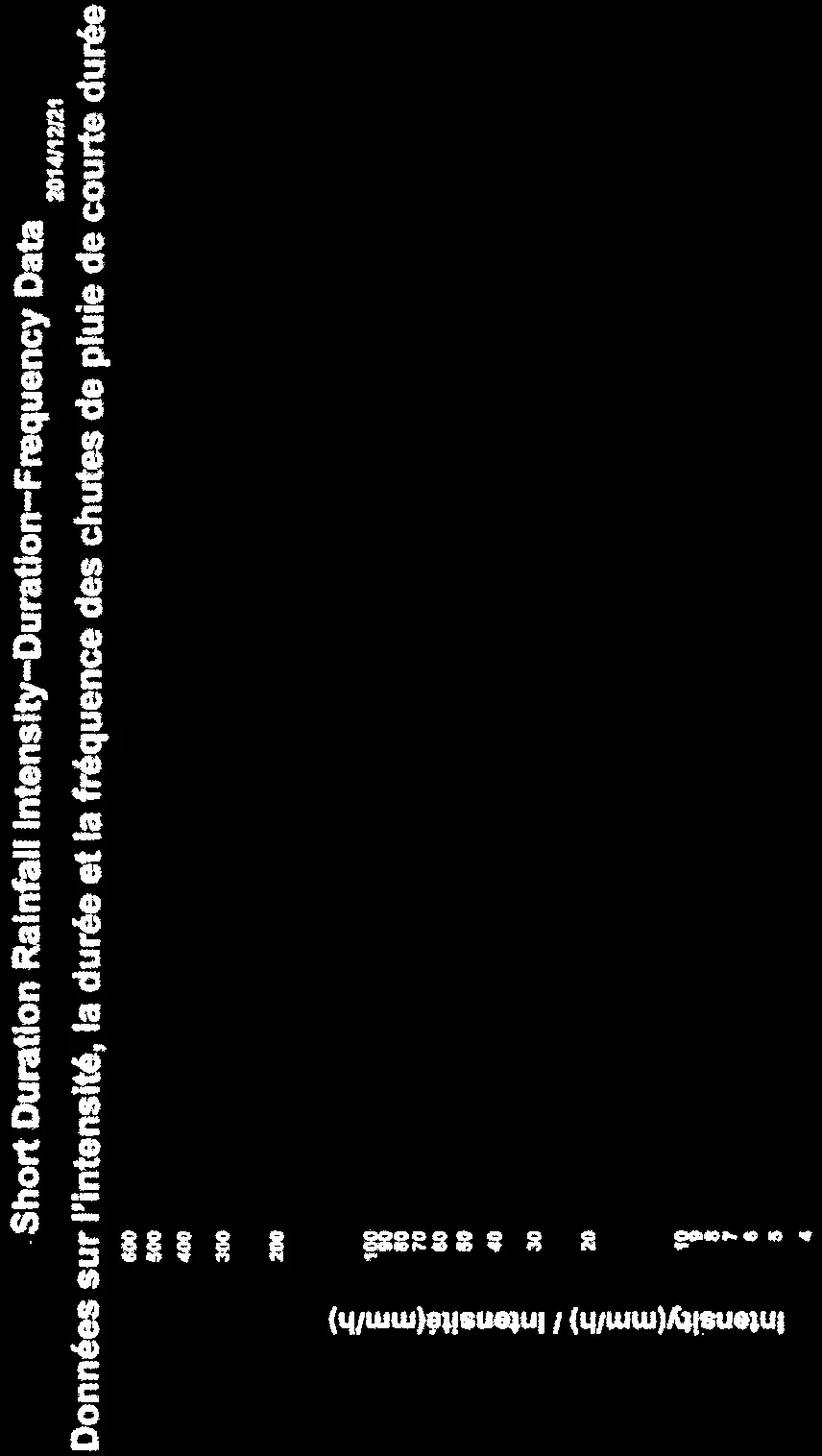
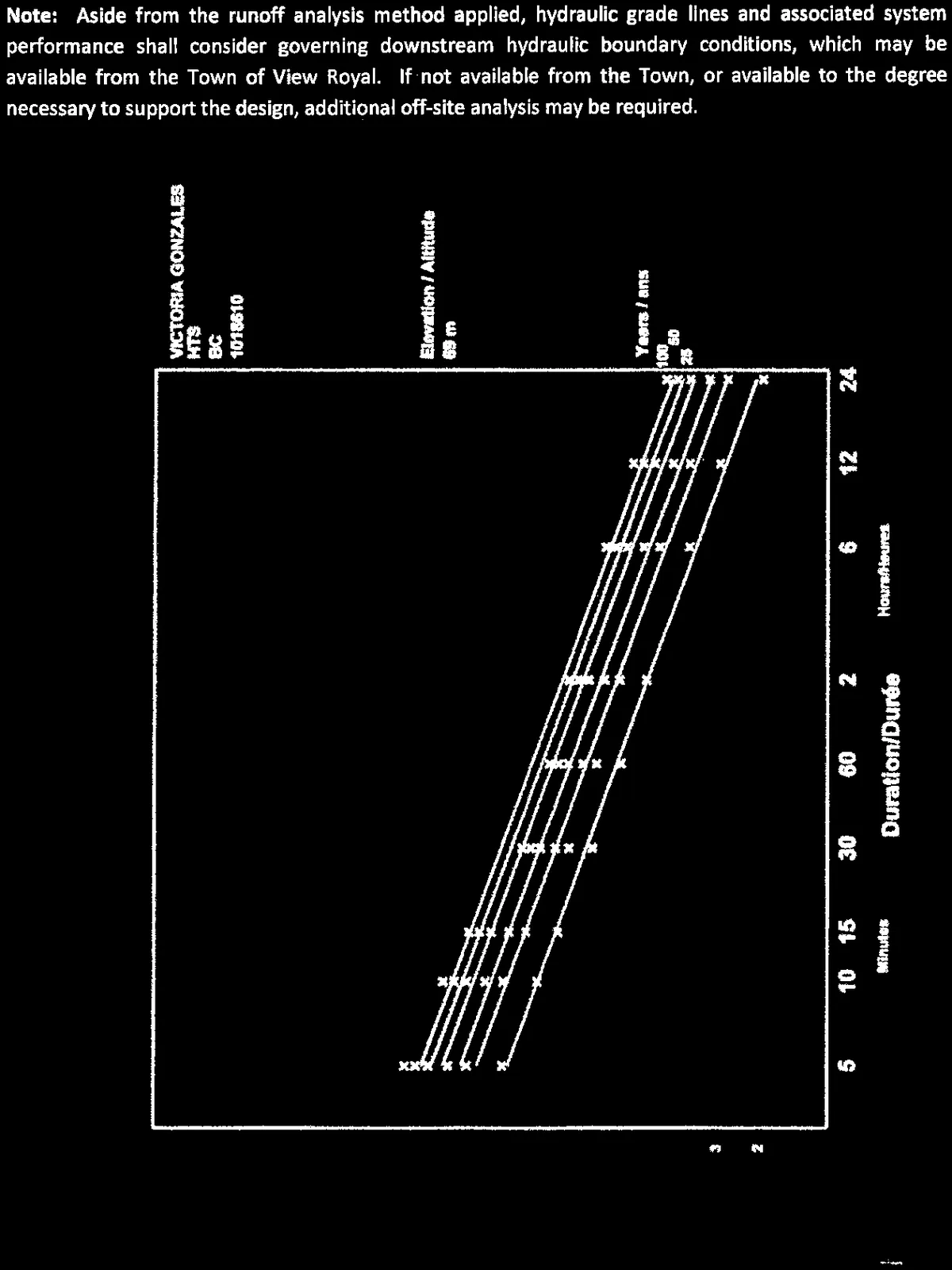
Rainwater management design should be carried out using one or more of the following methods as indicated below. Calculations are to be submitted with designs. The Rainfall Intensity Duration curve is provided for reference in the figure below.
- Rational Method: Applicable in most cases for the purposes of conveyance design only and for areas less than 10 hectares in size.
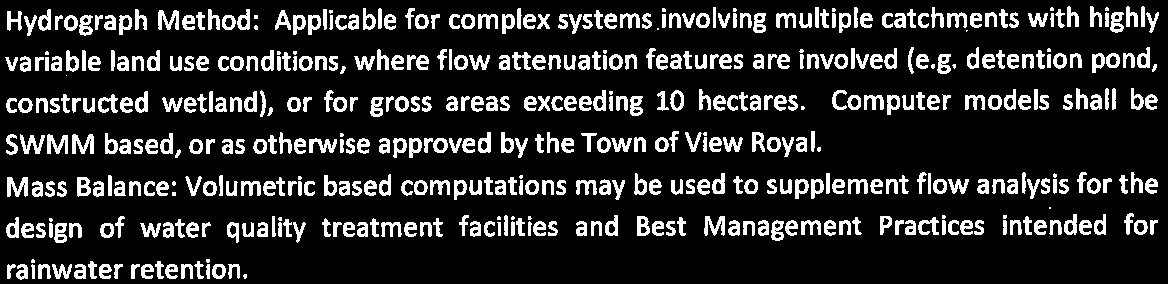
- Hydrograph Method: Applicable for complex systems involving multiple catchments with highly variable land use conditions, where flow attenuation features are involved (e.g. detention pond, constructed wetland), or for gross areas exceeding 10 hectares. Computer models shall be SWMM based, or as otherwise approved by the Town of View Royal.
- Mass Balance: Volumetric based computations may be used to supplement flow analysis for the design of water quality treatment facilities and Best Management Practices intended for rainwater retention.
Note: Aside from the runoff analysis method applied, hydraulic grade lines and associated system performance shall consider governing downstream hydraulic boundary conditions, which may be available from the Town of View Royal. If not available from the Town, or available to the degree necessary to support the design, additional off-site analysis may be required.
4.11 - Runoff Controls
Add the following to the end of this section:
4.11.10 - Performance Targets
All developments must incorporate water quality treatment provisions into the design, to meet the performance targets specified in the Town of View Royal Storm Water Regulation Bylaw No. 902, 2015.
Section 5.0 - Roads
5.3 - Cross-Section Elements
Replace this section with the following:
Recommended road cross sections elements are shown on the typical sections in the Town of View Royal Supplementary Detail Drawings (Schedule D).
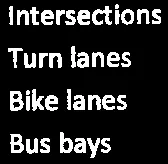
Right-of-way and pavement widths shown in the Town of View Royal Supplementary Design Guidelines (Schedule B) and the Town of View Royal Supplementary Detail Drawings (Schedule D) are subject to increases to accommodate the following:

- Intersections
- Turn lanes
- Bike lanes
- Bus bays
Unless noted otherwise in Town of View Royal Supplementary Design Guidelines and Town of View Royal Supplementary Detail Drawings, or by condition of the Servicing Agreement, topsoil with sod and trees is required on medians and boulevards. Where the width is insufficient for maintenance of vegetation or ability to accommodate trees, concrete surfaces will be required.
Note: Table 5.1, 5.2 and 5.3 have been omitted in lieu of the Town of View Royal Supplementary Detail Drawings.
5.11.1 - Sidewalk
Replace this section with the following:
The requirement for sidewalks is as shown in the Town of View Royal Supplementary Detail Drawings.
In the absence of specific local requirements, sidewalk details should be as follows:
- Minimum width: 1.5 m (excluding adjacent curb)
- Cross-slope: 2%, except at driveways and wheelchair ramps
- Drainage: Towards gutter
5.13 - Transit Facilities
Replace this section with the following:
The requirement for transit facilities will be established by the Town of View Royal, in consultation with BC Transit.
Bus bay locations should be established in cooperation with BC Transit. Bus bay details should be in accordance with the Pullouts section of the TAC Geometric Design Guidelines. It is assumed that local residential roads shall be serviced by community shuttle vehicles, while collector and arterial roads shall be serviced by full-sized City buses.
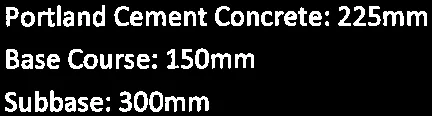
Bus bays must be constructed as per the BC Transit Infrastructure Design Guidelines and include the following Portland cement pavement structure:

- Portland Cement Concrete: 225mm
- Base Course: 150mm
- Subbase: 300mm
Transit signs should be in accordance with the Manual on Uniform Traffic Control Devices (MUTCD).
Additional guidelines are included in BC Transit, Infrastructure Design Guidelines and Canadian Urban Transit Association, Canadian Transit Handbook.
5.17.3 - Pavement Alternatives
Add the following to the end of this section:
The pavement alternatives are minimum standards only. Subgrade soil conditions must be verified by a qualified geotechnical engineer and the subgrade stiffness must be verified by proof roll prior to implementing the minimum standards. Alternatively, site-specific road structures should be designed by a qualified geotechnical engineer.
Section 12.0 - Landscape Requirements
12.1 - Plans
Designs and drawings shall be prepared and sealed by a Landscape Architect currently registered in British Columbia. Plans shall clearly show all survey, existing and proposed soft and hard landscape features and all existing and proposed roads and above ground services.
Plans shall be at minimum 1:200 [1/16" = 1'-0"] scale and shall include cross-sections and sight clearance.
Landscape plans must clearly show:
- Materials and character of the surface treatment at entire site.
- Planting plan and a plant list. Planting plan shall indicate the general planted size and spacing of plants. Plant list shall document quantity, scientific and common name, and scheduled size of plants at the time of planting.
- Existing trees to be retained / removed. Tree protection strategy during construction shall be noted. Refer to section 8.3 of this document for further information regarding existing tree retention.
- Hard landscape features, e.g., paving, walls, lighting, fencing, furniture, signage, trellis, water feature, drainage, etc. Materials for such hard landscape features shall be clearly indicated.
- Grading at entire site, including location and elevation of all area drains in hard landscape, storm drainage swales, lawn basins in soft landscape areas.
12.2 - Boulevard Trees
Tree selection, handling, planting and maintenance must meet the current editions of BCSLA/BCLNA Landscape Standards and the CNTA Nursery Stock Standard, be in good health and condition without wounds, have normal form, and be free of diseases and pests.
All tree root balls and pots to be free of noxious weeds.
All trees of excurrent genera to have single leaders (no trees with co-dominant stems permitted).
All trees to have encircling/girdling roots removed at the time of planting.
All tree species are to be approved by the Director of Engineering, or designate, and be a minimum of 6cm caliper, branched at or above 1.3m if deciduous, or 3m in height if coniferous. No pruning of the scaffold branches or leader should be undertaken; only broken branches should be pruned.
Protect tree from danger during planting. Ensure root ball is protected from sun, frost or desiccation.
Planting
Planting holes must be free draining to the extent that rainwater and/or supplemental water does not accumulate and drown the roots. If necessary, the subgrade must be graded with positive slope and/or drainage services such as but not limited to percolation holes, french drains or drain pipes must be installed to suit.
Watering of the root ball must be undertaken immediately after planting and then for the first growing season so that the root ball is thoroughly wetted once per week (minimum).
The tree should be pruned to ANSI A3000 standards after establishment and from time to time to train it for structure to conform to the form of the species and to respond to growing site constraints. All pruning must be undertaken by or performed under the direction of a qualified arborist certified by the International Society of Arboriculture and who demonstrates proficiency in pruning.
The mulched root zone should be refreshed annually to replace the mulch. This area must be weeded by hand to avoid trunk and root damage from string trimmers or mowers.
In situations where designed boulevard area does not provide adequate rooting volume, structural soil and/or Silva Cells may be utilized to provide further soil volume. Silva Cells are considered an experimental product at the time of publication of this manual. The use of Silva Cells must be approved by the Town of View Royal prior to installation on public property. Design and installation techniques are to be provided by Silva Cell suppliers and approved by the Town of View Royal.
Root barriers must be installed at the time of planting whenever a tree is installed within 2 metres of a sidewalk or other hardscape features, excluding roads; or where specified on approved drawings. Barriers must be made commercially, produced for the purpose of deflecting roots downward, and be of a specification approved by the Town of View Royal. Placement of root barriers must be as per manufacturer's instructions.
Tree Spacing
Boulevard trees are to be spaced at 8-10m [26'-33'] on centre.
Clearances
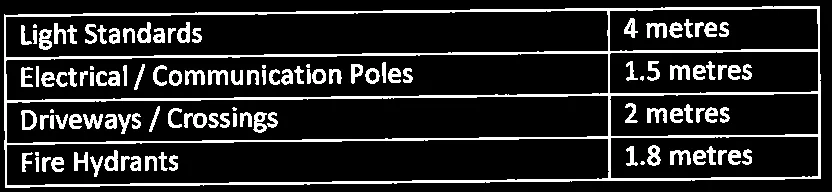
The following table is the guidelines for minimum clearances for all of boulevard trees. Clearances shall be measured from the closest edge of the listed items to the centre of tree:
| Item | Minimum Clearance |
|---|---|
| Light Standards | 4 metres |
| Electrical / Communication Poles | 1.5 metres |
| Driveways / Crossings | 2 metres |
| Fire Hydrants | 1.8 metres |
| Corner Clearance (from extended property line) | 3 metres |
| Stop Signs | 6 metres |
| Manholes, Valve Boxes, Service Kiosks | 1.5 metres |
12.3 - Tree Retention
All of the existing trees that are 20cm DBH (Diameter Breast Height) or more must be surveyed and assessed by certified Arborists. Landscape plans shall clearly indicate whether such trees are to be retained or removed. Tree protection zones during construction shall be consulted with certified Arborists and shown on plans.
Retention of existing trees is encouraged in park lands and in areas that do not require major re-grading.