Appendix
Attachment 11: Development Permit Area Guidelines Review (Staff Review)
September 20, 2016Pages 107–1132 sections
Staff's technical evaluation of how the dock proposal meets Environmental Protection & Natural Hazard guidelines.
Reviewer: James DavisonCompleted: Sept 8, 2016
DEVELOPMENT PERMIT AREA GUIDELINES - REVIEW
| Field | Details |
|---|---|
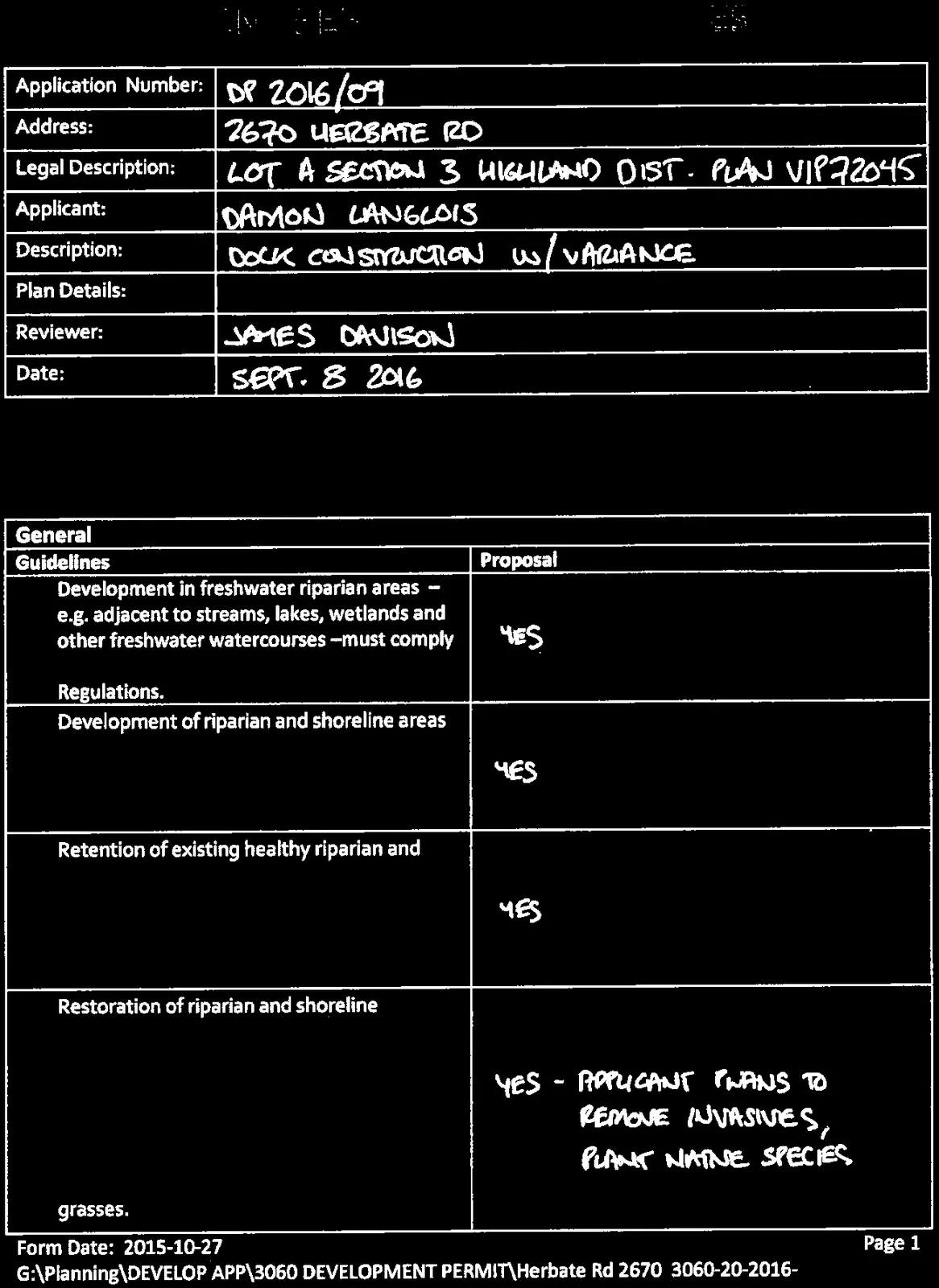
| Application Number: | DP 2016/09 |
| Address: | 2670 HERBATE RD |
| Legal Description: | LOT A SECTION 3 HIGHLAND DIST. PLAN VIP72045 |
| Applicant: | DAMON LANGLOIS |
| Description: | DOCK CONSTRUCTION W/ VARIANCE |
| Plan Details: | |
| Reviewer: | JAMES DAVISON |
| Date: | SEPT. 8 2016 |
DEVELOPMENT PERMIT AREA: ENVIRONMENTAL PROTECTION & NATURAL HAZARD
General
| Guidelines | Proposal |
|---|---|
| Development in freshwater riparian areas — e.g. adjacent to streams, lakes, wetlands and other freshwater watercourses — must comply with the requirements of the Riparian Area Regulations. | YES |
| Development of riparian and shoreline areas should be limited and not negatively impact the ecological health of the immediate area or impede public access. | YES |
| Retention of existing healthy riparian and shoreline vegetation should be maximized with any paths, structures or other constructed areas sited to minimize impact on trees and sensitive areas. | YES |
| Restoration of riparian and shoreline vegetation and habitat, including removal of invasive species, is encouraged for all properties within this Development Permit Area. Development should result in a net increase in native vegetation in almost all circumstances including trees, shrubs and grasses. | YES - APPLICANT PLANS TO REMOVE INVASIVES, PLANT NATIVE SPECIES. |
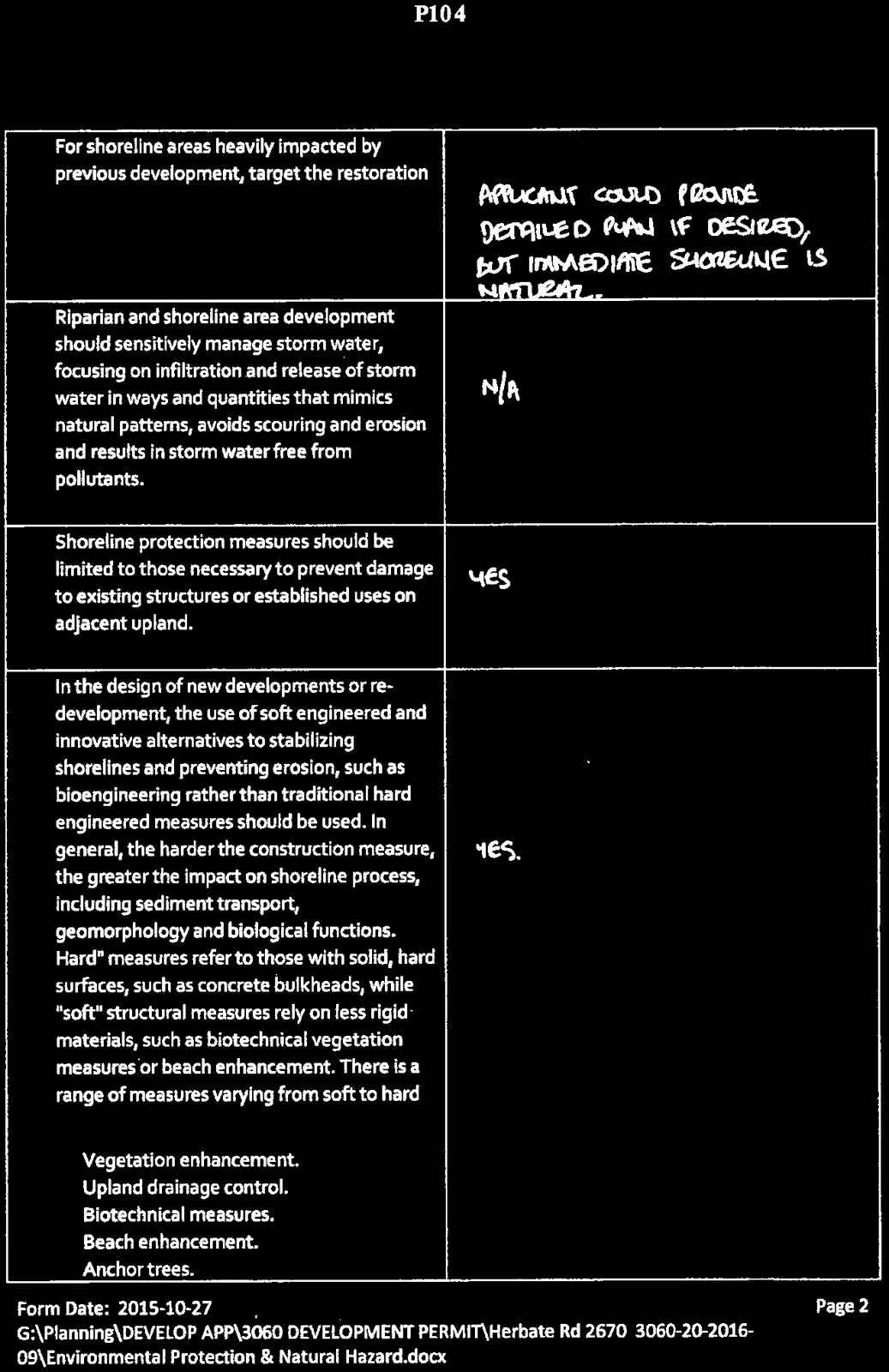
| For shoreline areas heavily impacted by previous development, target the restoration of ecologically appropriate vegetation for an average 15m wide (minimum 5 m) shoreline zone over 50% of the shore length. | APPLICANT COULD PROVIDE DETAILED PLAN IF DESIRED, BUT IMMEDIATE SHORELINE IS NATURAL. |
| Riparian and shoreline area development should sensitively manage storm water, focusing on infiltration and release of storm water in ways and quantities that mimics natural patterns, avoids scouring and erosion and results in storm water free from pollutants. | N/A |
| Shoreline protection measures should be limited to those necessary to prevent damage to existing structures or established uses on adjacent upland. | YES |
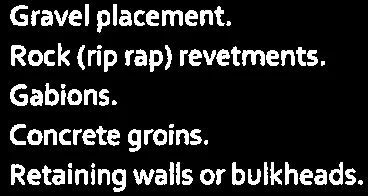
In the design of new developments or redevelopment, the use of soft engineered and innovative alternatives to stabilizing shorelines and preventing erosion, such as bioengineering rather than traditional hard engineered measures should be used. In general, the harder the construction measure, the greater the impact on shoreline process, including sediment transport, geomorphology and biological functions. "Hard" measures refer to those with solid, hard surfaces, such as concrete bulkheads, while "soft" structural measures rely on less rigid materials, such as biotechnical vegetation measures or beach enhancement. There is a range of measures varying from soft to hard:
|
YES. |
|
YES |
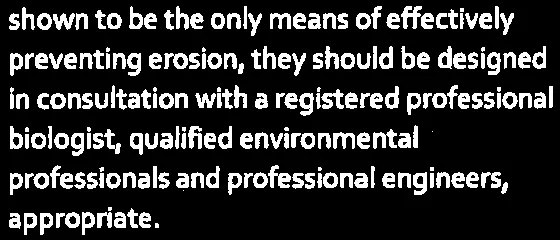
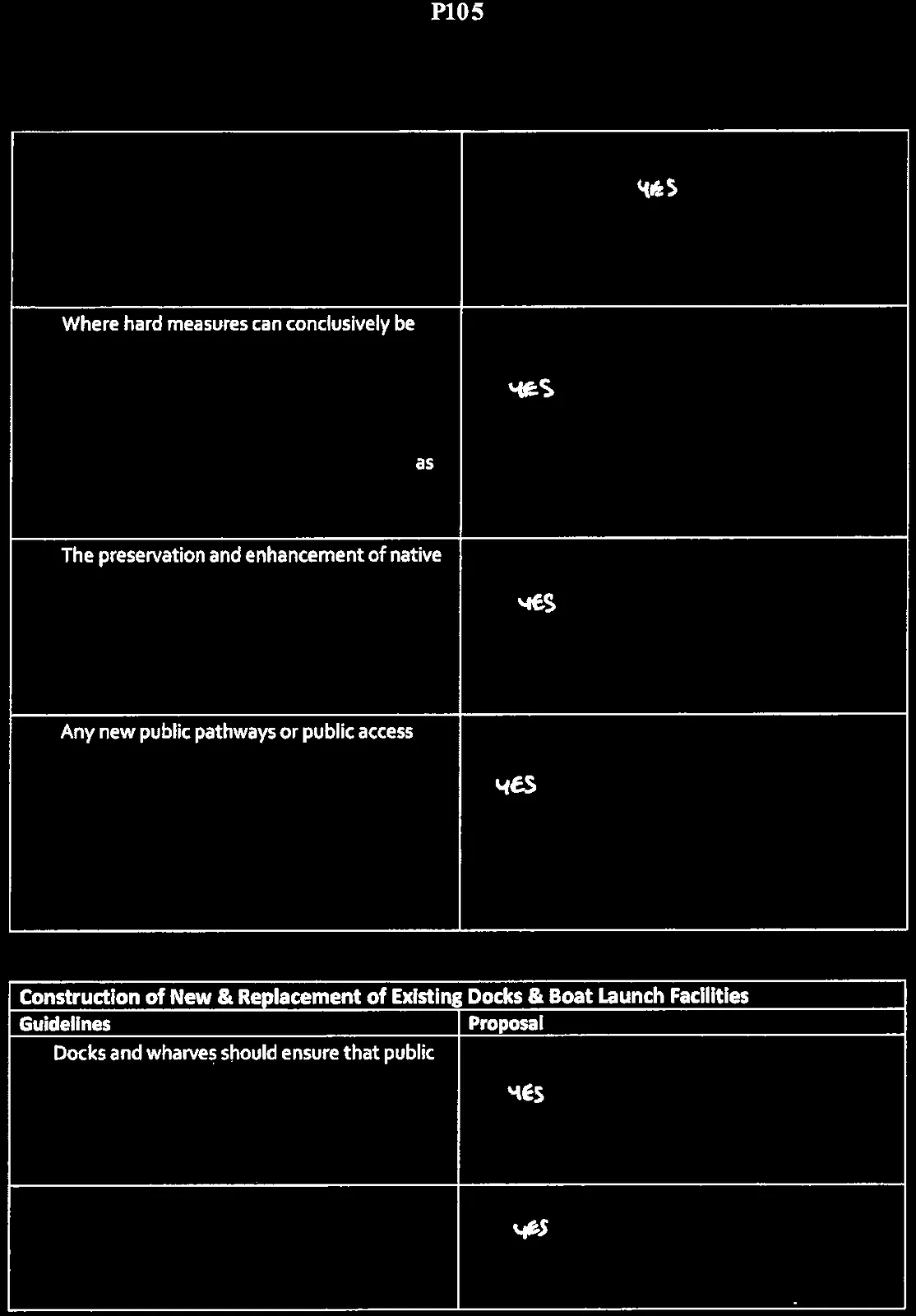
| Where hard measures can conclusively be shown to be the only means of effectively preventing erosion, they should be designed in consultation with a registered professional biologist, qualified environmental professionals and professional engineers, as appropriate. | YES |
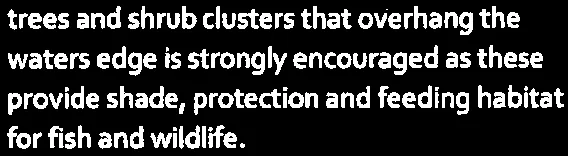
| The preservation and enhancement of native trees and shrub clusters that overhang the waters edge is strongly encouraged as these provide shade, protection and feeding habitat for fish and wildlife. | YES |
| Any new public pathways or public access should be designed and constructed in consultation with a registered professional biologist or qualified environmental professional, as appropriate, and the Town of View Royal Parks Department. | YES |
Construction of New & Replacement of Existing Docks & Boat Launch Facilities
| Guidelines | Proposal |
|---|---|
| Docks and wharves should ensure that public access along the shore is maintained, and should serve multiple users as much as possible rather that one dock per property. | YES |
| Design, size and location of docks and wharves should not limit opportunities for water access for neighbouring private properties. | YES |
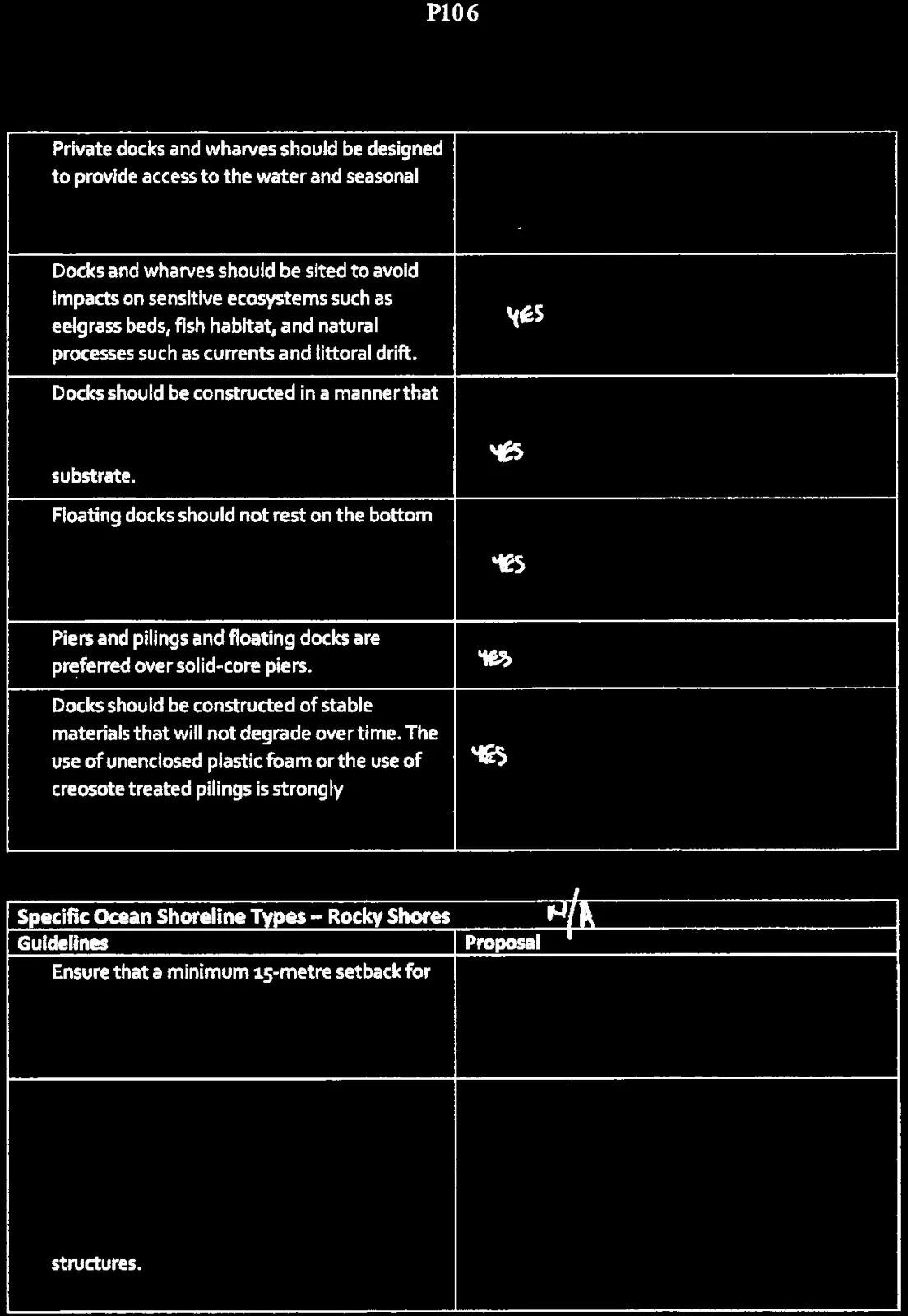
| Private docks and wharves should be designed to provide access to the water and seasonal boating opportunities, rather than sized to facilitate year round moorage of boats. | YES |
| Docks and wharves should be sited to avoid impacts on sensitive ecosystems such as eelgrass beds, fish habitat, and natural processes such as currents and littoral drift. | YES |
| Docks should be constructed in a manner that permits the free flow of water beneath. Supports should be located on a hard substrate. | YES |
| Floating docks should not rest on the bottom at any time and a minimal, moveable ramp should be utilized to connect the dock with the shore rather than a fixed wharf or pier. | YES |
| Piers and pilings and floating docks are preferred over solid-core piers. | YES |
| Docks should be constructed of stable materials that will not degrade over time. The use of unenclosed plastic foam or the use of creosote treated pilings is strongly discouraged. | YES |
Specific Ocean Shoreline Types — Rocky Shores (N/A)
| Guidelines | Proposal |
|---|---|
| Ensure that a minimum 15-metre setback for new buildings and structures, additions to existing buildings and structures or the placement and removal of fill is maintained. | |
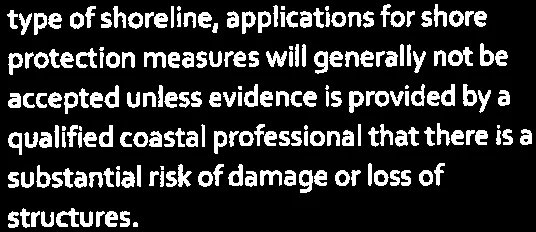
| Due to the inherently stable nature of this type of shoreline, applications for shore protection measures will generally not be accepted unless evidence is provided by a qualified coastal professional that there is a substantial risk of damage or loss of structures. |
Beach Shores (N/A)
| Guidelines | Proposal |
|---|---|
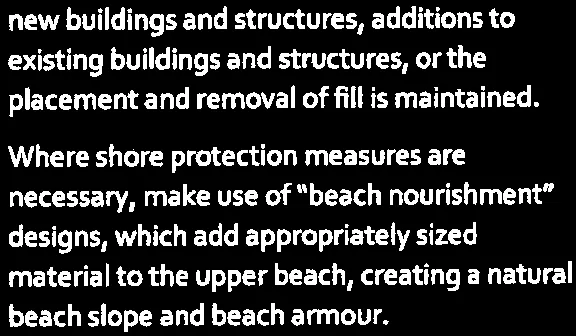
| Ensure that a minimum 15-metre setback for new buildings and structures, additions to existing buildings and structures or the placement and removal of fill is maintained. | |
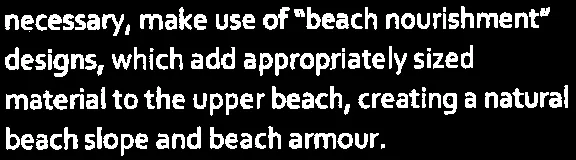
| Where shore protection measures are necessary, make use of "beach nourishment" designs, which add appropriately sized material to the upper beach, creating a natural beach slope and beach armour. | |
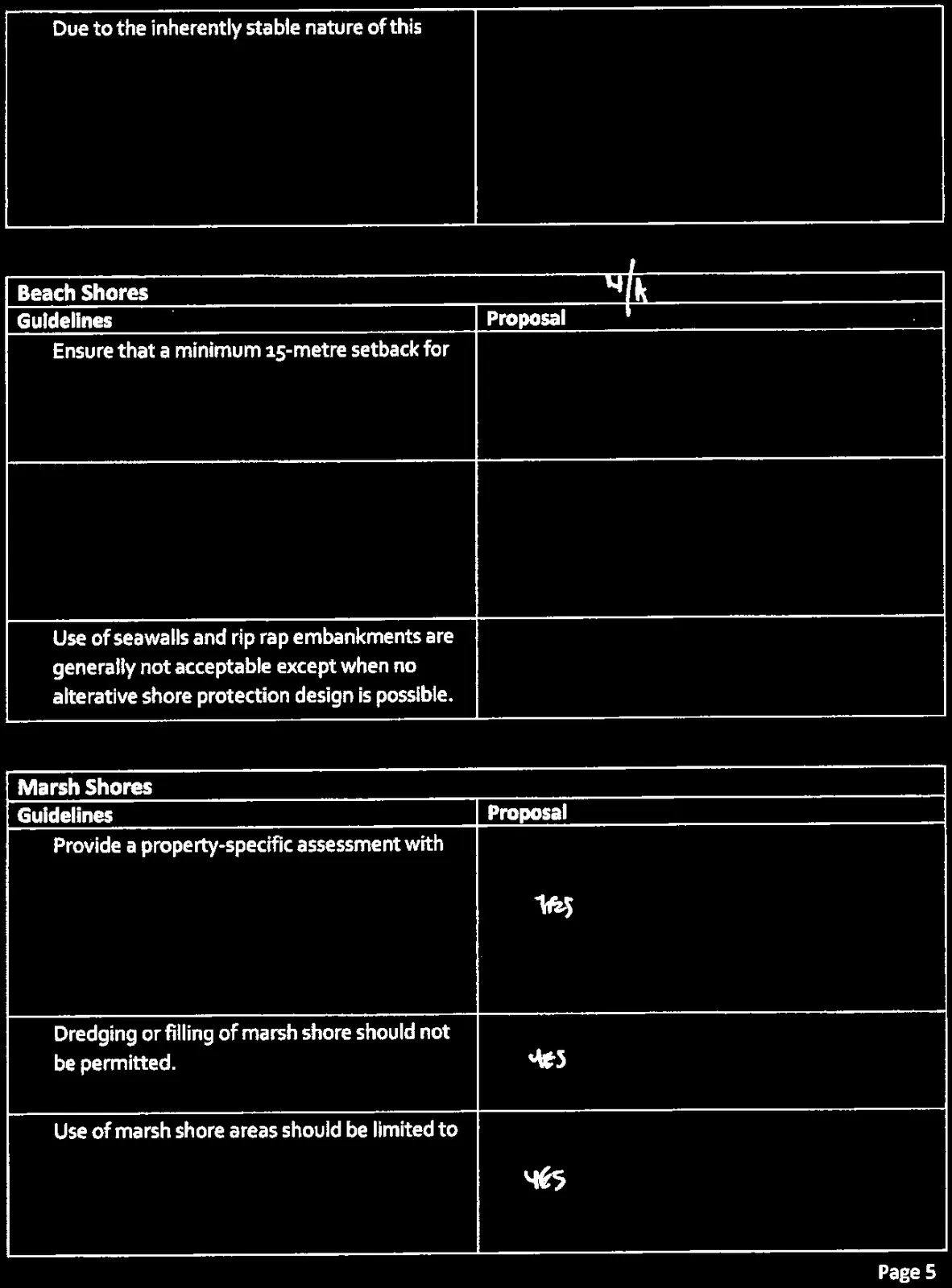
| Use of seawalls and rip rap embankments are generally not acceptable except when no alternative shore protection design is possible. |
Marsh Shores
| Guidelines | Proposal |
|---|---|
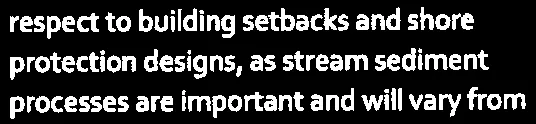
| Provide a property-specific assessment with respect to building setbacks and shore protection designs, as stream sediment processes are important and will vary from site to site. | YES |
| Dredging or filling of marsh shore should not be permitted. | YES |
| Use of marsh shore areas should be limited to park or conservation uses that do not require structural intrusions. | YES |
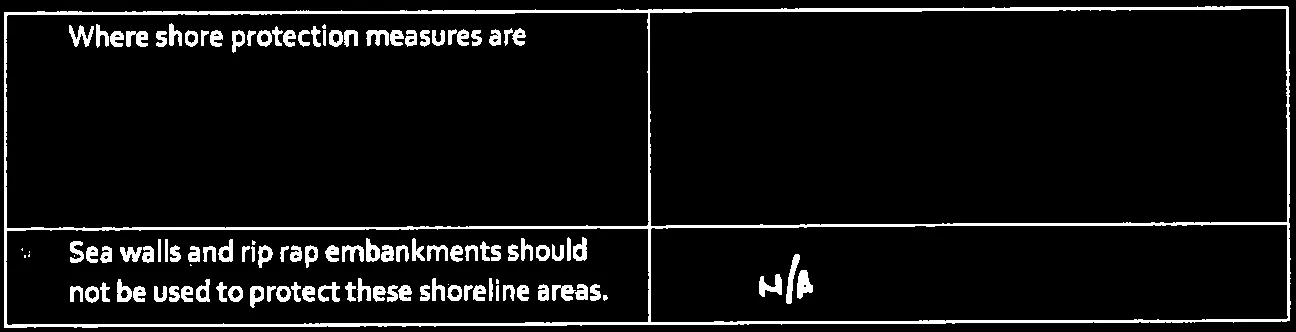
| Where shore protection measures are necessary, make use of "beach nourishment" designs, which add appropriately sized material to the upper beach, creating a natural beach slope and beach armour. | YES / N/A |
| Sea walls and rip rap embankments should not be used to protect these shoreline areas. | N/A |
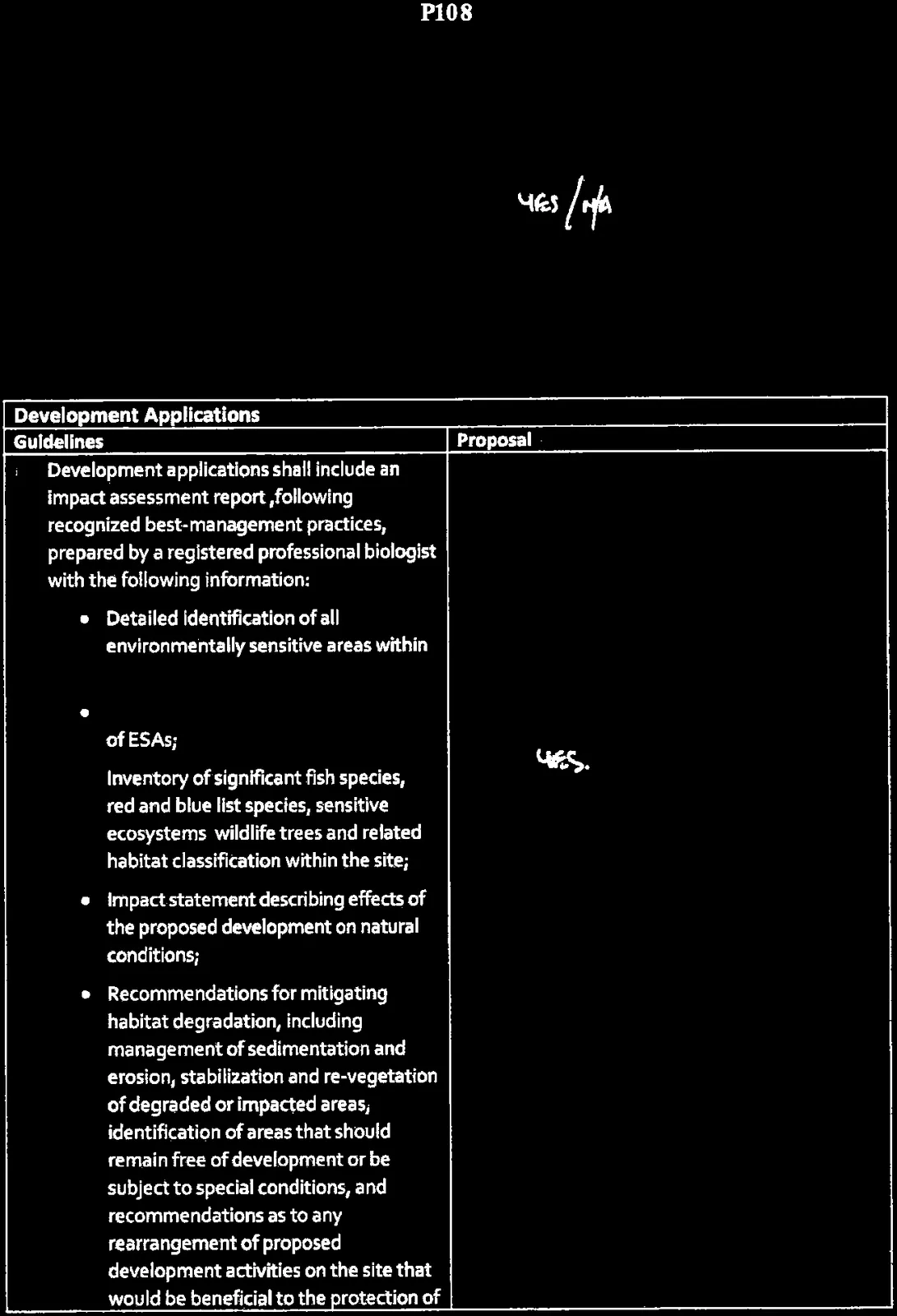
Development Applications
Page 107–113
| Guidelines | Proposal |
|---|---|
Development applications shall include an impact assessment report, following recognized best-management practices, prepared by a registered professional biologist with the following information:
|
YES. |
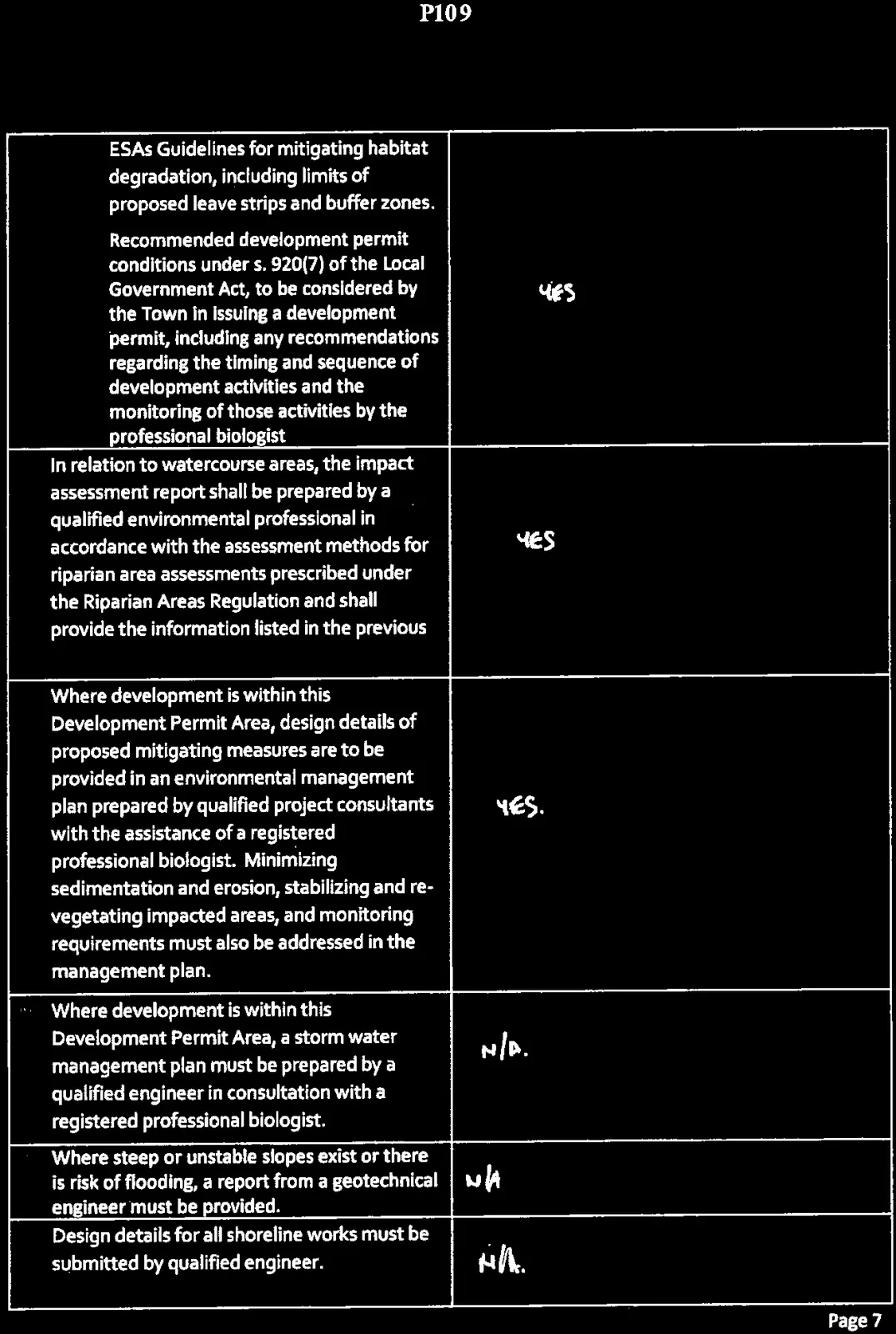
| In relation to watercourse areas, the impact assessment report shall be prepared by a qualified environmental professional in accordance with the assessment methods for riparian area assessments prescribed under the Riparian Areas Regulation and shall provide the information listed in the previous guideline. | YES |
| Where development is within this Development Permit Area, design details of proposed mitigating measures are to be provided in an environmental management plan prepared by qualified project consultants with the assistance of a registered professional biologist. Minimizing sedimentation and erosion, stabilizing and re-vegetating impacted areas, and monitoring requirements must also be addressed in the management plan. | YES. |
| Where development is within this Development Permit Area, a storm water management plan must be prepared by a qualified engineer in consultation with a registered professional biologist. | N/A. |
| Where steep or unstable slopes exist or there is risk of flooding, a report from a geotechnical engineer must be provided. | N/A |
| Design details for all shoreline works must be submitted by qualified engineer. | N/A. |
Page 107–113
Document Images
(31)










Extracted from: 2016 09 20 Council Agenda - Pdf