SPEED LIMIT REDUCTION STRATEGY
Staff report recommending a strategy to reduce traffic speeds on residential streets to 30km/hr and the Island Highway to 40km/hr.
TO: Committee of the Whole DATE: July 3, 2024 FROM: Ivan Leung, P.Eng, Director of Engineering MEETING DATE: July 9, 2024
SPEED LIMIT REDUCTION STRATEGY
PURPOSE:
The purpose of this report is to respond to Council action item C-54-23:
THAT traffic speeds on residential streets in the municipality that are not already 30km/hour, be reduced to 30km/hr.
And to respond to part of Council action item C-24-24 (item b):
THAT the “Change Name and Focus of Island Highway” proposal be referred to staff to assess reducing the speed limit from 50km/hr to 40km/hr.
OPTIONS:
| Option | Description |
|---|---|
| Option #1 (recommended) | THAT the Committee recommend to Council to direct staff in drafting a new Speed Bylaw and revising the Traffic Calming Policy to include policy wording on the establishment of speed limits within the Town of View Royal; AND THAT the Committee recommend to Council to direct staff to create a Project Summary for the rollout of a speed limit reduction implementation program, for future Council budget deliberations. |
| Option #2 | THAT the Committee receive this report for information. |
| Option #3 | The Committee can provide Council with alternative direction. |
ALIGNMENT WITH TOWN INITIATIVES:
A speed limit reduction strategy aligns with the following Town initiatives:
- Active Transportation Network Plan: Action Item 3K – Explore the development of a Speed Limit Establishment Policy.
- Community Climate Action Plan: Strategy 2.1.3 – Adjust speed limits to enable low-speed EV’s on select streets.
A speed limit reduction also aligns with the “Vision Zero” initiative: a strategy focused on eliminating all traffic fatalities and severe injuries while increasing safe, healthy, equitable mobility for all. It is one key initiative in looking at the relationship of speed and safety. The City of Victoria and District of Saanich have adopted this Vision Zero initiative as part of their transportation planning.
EXECUTIVE SUMMARY:
Staff retained transportation consultants Bunt and Associates to provide guidance on reducing speed limits within the Town of View Royal, taking into consideration the need to align with neighbouring municipality strategies and balancing with Town resources the best possible.
Bunt confirmed that the Town has the ability to reduce speed limits within the Town’s residential roads by either:
- Reducing all residential road speed limits to 30km/hr (Township of Esquimalt strategy)
- Reducing all residential roads without yellow centre-lane markings to 30km/hr, and reducing roads with yellow centre-lane markings to 40km/hr (based on test fits conducted on various Town roadways using the District of Saanich’s policy process)
Given that many residential roadways in the Town with a yellow centre-line are already reduced to 30km/hr, it is conceivable that the Town can use the Township of Esquimalt’s methodology.
Bunt also confirmed that the speed limit on the Island Highway, from Admirals Road to the Colwood Interchange, can be reduced to 40km/hr. All strategies will require additional capital investment and annual maintenance costs.
Through Bunt’s technical analysis, should the Committee wish to proceed with reducing speed limits, staff recommend that (1) A speed bylaw be created, (2) the Traffic Calming Policy be revised, and (3) Staff bring forward a Project Summary for the rollout of a multi-year speed limit reduction implementation program, for future budget deliberations.
BACKGROUND AND ISSUE:
Several municipalities in Greater Victoria are adopting different approaches to reducing local speed limits, all requiring varying levels of resource requirements: staffing levels, enforcement ability and capital and operational costs. This was previously stated in the Town’s Active Transportation Network Plan (“ATNP”), whereby the pros / cons of each strategy are hard to assess as each program and policy is still in its early stages.
Lessons learned will need to be collated over time by the region as a result. Because of these unknowns, staff recommend that a ‘View Royal’ strategy should generally align with one or more of its neighbours to avoid confusion by road users.
Various examples regional strategies with anticipated impacts are generalized in Attachment 1.
RCMP Engagement
Reducing the speed limit potentially impacts the level of service of RCMP enforcement: changing driver behaviours often require more than signage and paint. Staff engagement with the RCMP indicated that the RCMP already enforce a few residential streets that have received extraordinary complaints. Therefore, if a reduction in speed limit yields more calls to the RCMP regarding vehicle speeds exceeding 30km/hr, the RCMP have confirmed that a speed limit reduction program could create more work and require more resources, especially at the start of the program when driver behavior norms need to be adjusted.
Financial Implications
Reducing speed limits of all residential streets in View Royal will have financial implications due to anticipated increase in capital investment and maintenance costs.
Motor Vehicle Act (“MVA”) Implications
Generally, the process to reduce the posted speed limit and to allow for 100% enforcement ability under the Motor Vehicle Act requires a substantial amount of regulatory speed signage to be installed. Often times the signage requirement potentially requires:
- ‘Book-ending’ signage for each road segment (one sign on each end of the road, so signage is viewable for traffic going either way along the roadway);
- Installed at every segment of roadway (so that traffic that may not have seen the speed limit sign on a previous roadway get the notification accordingly).
For example, refer to Figure 1 and Figure 2 below of the Harbour Neighbourhood. Figure 1 indicates the ‘perceived’ speed limits: the intended speed limit on roadways within this neighbourhood (per the ATNP baseline conditions report). Figure 2 indicates the legal speed limit as stipulated by the rules of the Motor Vehicle Act (based on existing signage today):
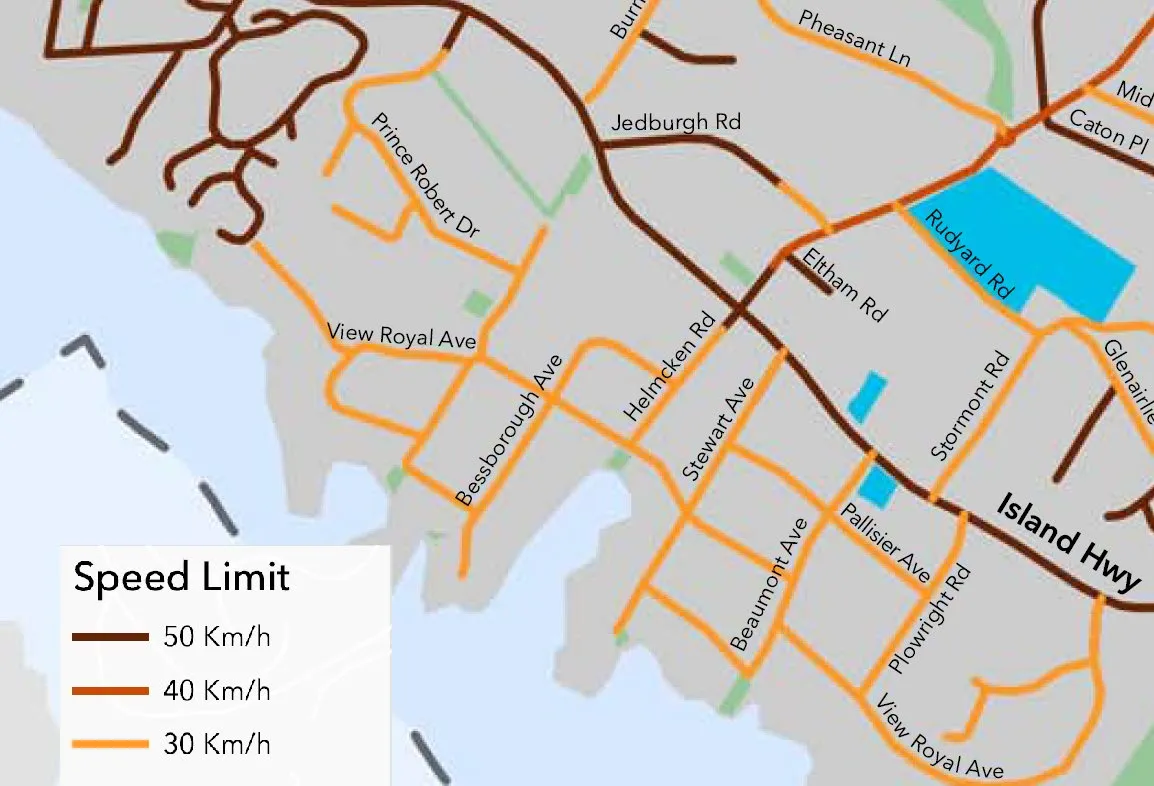
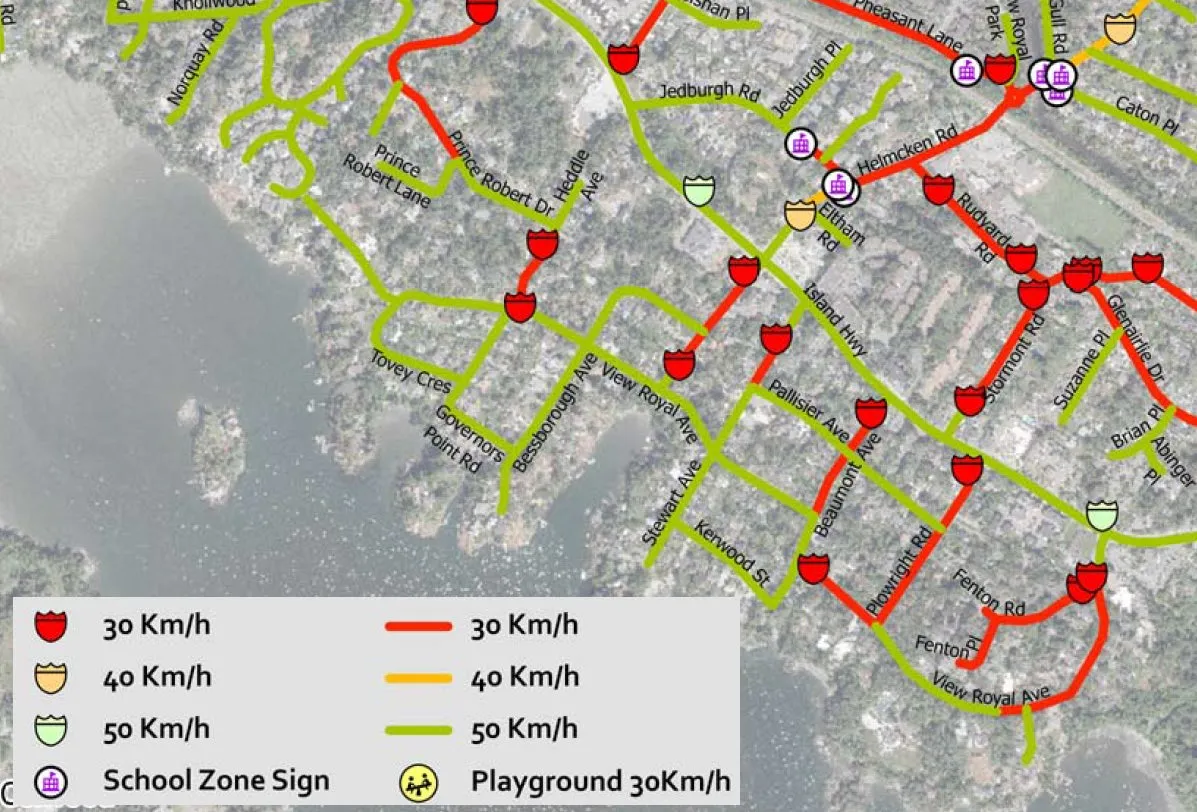
The figures suggest that there is a gap between the expected speed limit and the real speed limit. In order to achieve the perceived speed limits shown in Figure 1, additional speed limit signage would be required. Preliminary estimates indicate, for the Harbour Neighbourhood alone, capital investments with an order of magnitude in the tens of thousands of dollars may be required, followed by additional operational costs in the order of magnitude of hundreds or thousands of dollars per year. Many other neighbourhoods also exhibit the same issue.
Given the above challenges and varying means and methods used regionally to reduce speeds limits, staff engaged the transportation engineering consultant Bunt and Associates (“Bunt”) to provide recommended strategies, based on the Town’s current resources, staffing, budgets, enforcement ability, and alignment with neighbouring municipalities’ speed policies.
DISCUSSION:
Two key factors were used as part of Bunt’s inputs to provide a recommended speed reduction strategy:
- Staffing Resources: Staff do not have the capacity to utilize a heavier based policy approach to regularly determine speed limits such as the District of Saanich’s strategy (the strategy requires detailed inputs into a speed limit determination matrix). Doing so would require additional staffing such as an Active Transportation Coordinator (Action Item 3G of the Active Transportation Network Plan), or through fee for service by retaining transportation consultants.
- Financial Implications: Additional signage could significantly impact operational costs to install and maintain an increased inventory of signage.
As a result, staff retained Bunt to conduct quick ‘test fits’ of varying road corridors and classifications to benchmark the determination of speed limits on residential, collector and major roadways, utilizing the Saanich model. Bunt’s findings were generally as follows:
| Road Classification | Recommended Speed Limit |
|---|---|
| Residential classed roads without a yellow centre-line: | 30km/hr speed limit |
| Many collector and major classed roads (including the Island Hwy, from Admirals Road to the Colwood Interchange: | 40km/hr speed limit |
The test fits indicated that many residential classed roads with a yellow centre-line may have a 40km/hr speed limit under the Saanich model. However, many of these streets are already reduced to a speed limit of 30km/hr (e.g. Creed Rd and Glentana Rd) or are perceived to be 30km/hr (e.g. Midwood Rd). This more closely follows the Esquimalt model in that all roads outside of major roads are to be reduced to a 30km/hr speed limit.
The test fit also identifies the Island Highway (Colwood Interchange to the City of Colwood) and Helmcken Road as roadways that can be reduced to a 40km/hr speed limit (a portion of Helmcken is already signed as 40km/hr). However, staff have concerns over compliance of this speed over a 4-lane roadway towards Colwood (Island Hwy), as well as a thoroughfare that connects to Highway 1 (Helmcken). Additional engagement with the City of Colwood and the Ministry of Transportation and Infrastructure is recommended before adjusting the speed limits on these roadways.
Therefore, the Town has a choice whether to proceed with:
Option 1: A 30km/hr speed limit across all residential streets
Option 2: A 30km/hr speed limit for all residential streets except for those streets with a yellow centre-line, which would subsequently be a 40km/hr speed limit
And the Island Hwy from Admirals Road to the Colwood interchange can be reduced to a 40km/hr speed limit.
How Can Gateway Speed Zones Mitigate Town Resource Use and Costs?
Gateway speed limit signs are used to indicate the speed limit for an area rather than on a road-to-road basis. Their intent is to reduce the number of required signs, thus mitigating the budget impacts of installing speed limit signage. Gateway speed limit signs are typically installed at entrance points to neighbourhoods. The District of Saanich and Township of Esquimalt are both enacting gateway speed zones within their neighbourhoods.
The Town is well positioned to install gateway speed zones in many residential neighbourhoods. For example, by installing gateway speed zone signage at the entrances of Knollwood Road, Prince Robert Drive, Helmcken Road (south), Stewart Avenue, Beaumont Avenue, Plowright Road and View Royal Avenue, the entire Harbour Neighbourhood could be covered to have a 30km/hr speed zone. This could also be replicated for many areas of the Atkins, Burnside, Hospital and sections of the Helmcken Neighbourhoods without installing a significant number of new signs.
Enforcement of Gateway Speed Zones
Speed enforcement can still be successfully administered within gateway speed zones, but the success of ticketing is not absolute. A letter from the BC Minister of Transportation to Union of British Columbia Municipalities members indicated that:
- The MVA does not necessarily stipulate the need to post speed signs on every block
- Communities should take into consideration a range of factors when considering the placement of signage to support enforcement of speeding offences
- Local factors such as the road network in the area under consideration, as well as advice from legal counsel and police are all important considerations in making adjustments to speed limits on local roads
The enforcement ability is thus not completely clear at this time. However, gateway speed zones are one recommendation provided by Bunt to balance effectiveness with costs.
Recommendations
Bunt recommends the following course of action to reduce speed limits in residential zones:
| Action | Description |
|---|---|
| Action 1: Create a new Speed Bylaw and Revise the Traffic Calming Policy | This is required to change the speed limits within Town roadways. While enforcement of some roadways may not be successful until proper signage is installed, the Bylaw provides a segway into the development of the speed limit reduction implementation plan. The Traffic Calming policy will require a revision because the current measures used to determine if traffic calming devices are required becomes unrealistic (e.g. in a 30km/hr zone, traffic calming measures would become eligible if the 85th percentile of vehicles driving on the roadway are travelling above 35km/hr) |
| Action 2: Public Engagement | Most of the public engagement has been done as part of the Active Transportation Network Plan. There was strong community uptake on the idea of reducing vehicle speeds as part of the ATNP engagement process. Therefore, follow-up engagement could be minimal that instead prioritizes public education on the upcoming speed limit changes and obtaining high level commentary to help determine priority areas. |
| Action 3: Implementation | This critical step will be to conduct a detailed implementation plan that will likely live in the form of a multi-year capital program. The program would include at minimum: • Signage Plan – identify opportunities for gateway speed zones and areas where more traditional signage may be required (based on public feedback and ICBC crash data) • Public Education Plan – as an example, the District of Saanich conducted their public education solely through social media messaging. The Town’s new communications coordinator may be able to administer this initiative • Enforcement Plan – Examples from other communities suggest a 2-month grace period where RCMP educate drivers of speed changes, followed by a period of increased and targeted enforcement • Monitoring Program – Employing a data driven process is vital to support speed reduction. View Royal could collaborate with the RCMP and ICBC Accident Data, as an example, to collect and analyze data on vehicle speeds and collision rates before and after speed reductions. Additional measures such as vehicle counts and volumes may be of benefit to determining priority areas for additional measures such as traffic calming |
ALTERNATIVES:
The Committee may also receive this report for information or provide alternative direction to Council.
LEVEL OF ENGAGEMENT:
Substantial public engagement regarding speed limits was incidental to the Town’s Active Transportation Network Plan project, completed in 2023. Public participation under the ATNP was targeted to fulfill the “Involve” and “Collaborate” aspects of the IAP2 Spectrum of Participation.
As engagement has already been completed with a strong community uptake in reducing speed limits in the community, subsequent engagement is proposed to be minimal and within the “Inform” aspect of the spectrum, with a focus on public education.
| CONCURRENCE: | Initials | Comments |
|---|---|---|
| Chief Administrative Officer | SS | I concur with the recommendation. |
| REVIEWED BY: | Initials |
|---|---|
| Director of Corporate Administration | NR |
| Director of Finance | NR |
| Director of Development Services | NR |
| Director of Engineering and Parks | IL |
| Director of Protective Services | NR |
ATTACHMENTS:
- Examples of speed reduction strategies of Neighbouring Municipalities – A Review
Document Images
(1)