ATTACHMENT "A" - Asset Management Strategy
Comprehensive strategy document outlining the methodology, current state of assets, financial funding gaps, and a five-year implementation plan for asset management.
Asset Management Strategy
TOWN OF VIEW ROYAL
JANUARY 2024
Document History
| Version | Summary of Changes | Document Status | Date |
|---|---|---|---|
| 1.0 | First-generation document | Draft for presentation to Committee of the Whole | January 9, 2024 |
Acknowledgements
The Town of View Royal’s Asset Management Strategy was prepared by Christopher Paine, CPA, CGA, Principal with FIT Local Government Consulting, with project oversight and substantial contributions from Ben Lubberts, Deputy Director of Engineering, and Steve Vella, Manager of Accounting. This project was funded in part by the Local Government Infrastructure Planning Grant Program offered by the BC Ministry of Municipal Affairs.
Executive Summary
Asset management (AM) at View Royal is an ongoing program that follows the Asset Management BC (AMBC) Framework for Sustainable Services Delivery. The objectives of View Royal’s AM Program are to:
- Deliver services according to Council’s vision for the community,
- Optimize the use of Town assets to deliver community services,
- Achieve and maintain sustainable service delivery through adequate funding and planning,
- Enhance transparency for all stakeholders in decision-making processes,
- Facilitate investment prioritization.
The purpose of this AM Strategy is to improve the AM Program by assessing the current state of the Town’s AM practices and prioritizing activities over the next five years to advance the program. Through the summer of 2023, the Town conducted AM maturity assessments; broad findings of the AM maturity assessments are as follows:
- Maturity rating: The Town achieved an overall AM maturity rating of 1.8 of out 5 on the Federation of Canadian Municipalities Asset Management Readiness Scale
- Levels of service and risk register: The Town has not developed formal levels of service nor has a formal risk register. Staff rely on best judgement to manage risk and infer service expectations
- Lifecycle costing: Lifecycle costing has not been formally conducted on the Town’s asset inventory and staff rely on professional judgement to recommend funding priorities
- Data and information: The Town has procured AM software and established general asset data collection processes, but the AM software is underutilized due to a lack of AM data standards, and asset data quality varies by department and asset class
- Culture and AM awareness: There is strong cultural support for AM throughout the organization, however, senior management and Council could benefit from structured AM training
The AM Strategy recommends 8 key tasks be undertaken over the next five years to advance the Town’s AM program. Successful implementation of these tasks may advance the Town’s readiness score from a 1.8 to 3.4 by 2028. The recommended implementation strategies include:
- Establish levels of service for all assets
- Prepare AM Plans for critical assets
- Adopt AM Policy & AM Strategy Information
- Integrate data used to develop the Sustainable Infrastructure Replacement Plan (SIR Plan) back into the Town’s existing AM software
- Conduct data audit and establish standards for asset-related data
- Increase contributions to capital renewal reserve as per the SIR Plan
- Establish Cross-Departmental AM Working Group
- Enroll senior management and Council in AM training
The progress of the AM Program will be summarized in an annual report to Council and this AM Strategy will be routinely reviewed approximately every five years.
1. Purpose and Framework
1.1. Purpose
The purpose of the Town’s asset management (AM) program is to develop, monitor and implement a systematic organization-wide approach to AM that will maximize value derived from its assets. The purpose of this strategy is to assess the current state of the Town’s AM practices and prioritize activities over the next five years for the advancement of the AM Program.
1.2. Objectives
The objectives of View Royal’s AM Program are to:
- Deliver services according to Council’s vision for the community,
- Optimize the use of Town assets to deliver community services,
- Achieve and maintain sustainable service delivery through adequate funding and planning,
- Enhance transparency for all stakeholders in decision-making processes,
- Facilitate investment prioritization.
1.3. Methodology and Framework
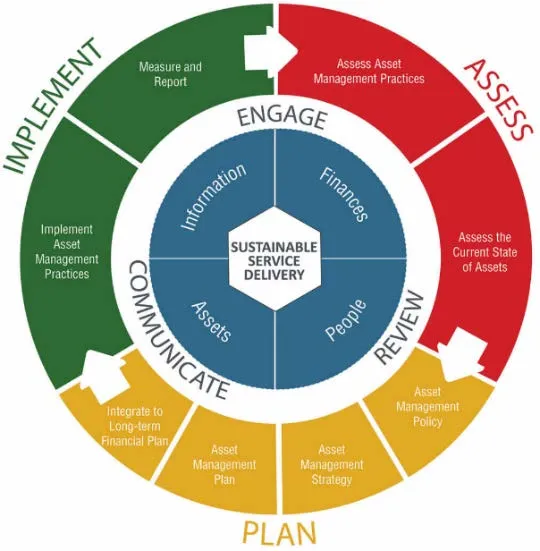
View Royal’s AM program is modelled after the Asset Management BC (AMBC) Framework entitled “Asset Management for Sustainable Service Delivery – A BC Framework” (AMBC, 2019), summarized graphically below. The sections of this strategy are organized in accordance with the AMBC Framework.
During the development of this strategy, AM maturity assessments were conducted with the Town’s key departmental staff. The assessments were conducted in a manner consistent with the methodology and objectives of the following three widely accepted frameworks:
- Federation of Canadian Municipalities (FCM) Asset Management Readiness Scale (AMRS)
- International Infrastructure Management Manual (IIMM)
- International Organization for Standardization (ISO) 55000
The Strategy largely includes key components recommended in the following two AM strategic-development frameworks:
- FCM’s “How to develop an asset management policy, strategy and governance framework”, and
- International Infrastructure Management Manual
2. View Royal's Asset Management Core Elements
The core elements in the AMBC Framework are fundamental to supporting sustainable service delivery through the Town’s AM program. The quality and reliability of these core elements are incrementally improved with the assistance of an AM strategy. The four core elements in the AMBC Framework are (1) Assets, (2) Information, (3) Finances, and (4) People.
2.1. Assets
View Royal manages land and building assets, transportation assets, sewer and drainage assets, vehicles, and park and natural assets. The Town’s assets are generally defined in the table below; note that asset classification is provided for convenience only. This strategy recommends a project to audit the Town’s asset data standards and formalize its asset classification system.
| Asset Class | Sample of Assets | Service Provided |
|---|---|---|
| Park Structures | Playgrounds, fencing, furniture | Recreational |
| Vehicles | Fire trucks, pickup trucks, cars | Corporate, Transportation, Protective, Recreation, Environmental |
| Buildings | Town hall, Public Safety Building, buildings on park land | General Government and Corporate, Protective, Recreation |
| Road Infrastructure | Pavement, sidewalk, curbs, traffic signals, streetlights, bridges | Transportation, Protective |
| Drainage | Drain mains, manholes, culverts, ditches | Environmental and flood protection |
| Sanitary Sewer | Sewer mains, manholes, pump stations | Environmental |
| Natural Assets | Creeks, trees, wetlands | Environmental, Recreational |
Much of View Royals roadway, drainage, and sewer infrastructure was built by the Capital Regional District and the provincial Ministry of Transportation before the Town’s incorporation in 1988. All buildings and park infrastructure were built after incorporation.
2.2. Information
View Royal’s asset inventories are stored across the Town’s asset management software, graphical information system (GIS), and spreadsheets. The Town has gathered some condition assessment information, mostly for the purpose of prioritizing capital renewal funding. No formal levels of service, risk assessments, nor asset management plans have been prepared, which is not uncommon for a young municipality with relatively newer infrastructure, such as View Royal.
AM plans and risk assessments can be developed for each asset class when levels of service are established. Section 3.3 of this strategy recommends key tasks to establish levels of service for all asset classes and develop AM plans for all critical assets.
2.3. Finances
In 2022, the Town developed a long-term financial plan titled the “Sustainable Infrastructure Replacement Plan” (SIR Plan). The purpose of the SIR Plan was to (1) estimate total infrastructure replacement costs, (2) forecast long term spending, and (3) recommend ongoing funding levels to ensure uninterrupted service delivery. The SIR Plan recommended increasing annual infrastructure renewal funding from 2.0M to 4.9M. Below is a summary of the financial findings of the Plan:
| Asset Class | Quantity | Replacement Value | Sustainable Annual Funding | Actual Annual Funding | Annual Funding Gap |
|---|---|---|---|---|---|
| Park Structures | N/A | 2,738,500 | $ 61,500 | 90,600 | $(29,100) |
| Vehicles | 25 units | 8,222,000 | 380,000 | 189,600 | 190,400 |
| Buildings | 3,048 m^2 | 27,092,900 | 698,600 | 442,300 | 256,300 |
| Road Infrastructure | 48.9 km | 102,104,100 | 2,014,800 | 666,600 | 1,348,200 |
| Drainage | 42.8 km | 66,601,100 | 813,900 | 269,300 | 544,600 |
| Sanitary Sewer | 47.1 km | 70,606,800 | 925,600 | 364,300 | 561,300 |
| Total | 227,365,400 | $4,894,300 | 2,022,700 | 2,871,700 |
Refer to Section 3.3 of this report and the SIR Plan for details on the Town’s long-term financial strategies.
2.4. People
Culture
The AM maturity assessments conducted in 2023 revealed that the organization has varying levels of awareness and understanding of the importance and application of AM best practices and principles. However, there was a consistent cross-departmental culture of support for advancing AM in the organization. This strategy recommends establishing a cross-departmental AM working group and providing formal AM training to senior management and Council. These measures will strengthen and cultivate the AM culture across the organization.
Governance and Roles and Responsibilities
No formal governance structure for AM has been established by the Town except for the municipality’s statutory obligation to provide for the stewardship of community assets. Recommendations stemming from the AM maturity assessment would see a cross-departmental AM working group formed and AM training offered to senior management and Council. Given the size of the Town and the desire to remain nimble, an AM steering committee is not recommended. The AM working group would develop formal terms of refence for the group and recommend a formal AM governance structure for Council to consider. An effective governance structure could follow the simple hierarchy shown above.
- Mayor & Council
- Senior Leadership Team
- AM Program Manager
- AM Working Group
3. View Royal’s Asset Management Program
Asset management at View Royal is not a standalone project – it is an ongoing program integrated into the Town’s everyday business. Following the AMBC Framework, asset management involves a cycle of three repeating stages:
- Assessing asset management practices and the state of assets.
- Planning what needs to be done to improve asset management.
- Implementing the plans.
The Town will make incremental improvements to its asset management program by moving through the cycle multiple times, even when things are going well. This will allow the Town to be proactive about managing risks and delivering services in a cost-effective way.
3.1. Assess
Current State of Assets
The table below describes View Royal’s assets generally by class, including where the asset data inventory is stored, the condition and performance (taken from Section B of the SIR Plan), the source of the level of service, and whether an AM Plan and formal risk assessment has been prepared.
| Asset Class | Asset Inventory | Condition and Performance | Levels of Service | AM Plan and Risk Assessment |
|---|---|---|---|---|
| Park Structures | AM Software | B | Staff Judgement | No |
| Vehicles | AM Software and Spreadsheets | B | Staff Judgement | No |
| Buildings | AM Software | B | Staff Judgement | No |
| Road Infrastructure | AM Software / GIS | B | Staff judgement | No |
| Drainage | AM Software / GIS | B | Staff judgement | No |
| Sanitary Sewer | AM Software / GIS | B- | Staff judgement | No |
| Natural Assets | GIS | Unknown | Staff judgement | No |
AM Practices
In 2023, the Town carried out maturity assessments on its asset management practices using the Federation of Canadian Municipalities (FCM) Asset Management Readiness Scale and International Infrastructure Manual (IIMM) frameworks. Workshops included representatives from all Town departments, including Engineering and Parks, Protective Services, Corporate Services, and Development Services. A stand-alone report detailing the results of the maturity assessments is included as Appendix B of this report. The summary of the findings from the maturity assessments are as follows:
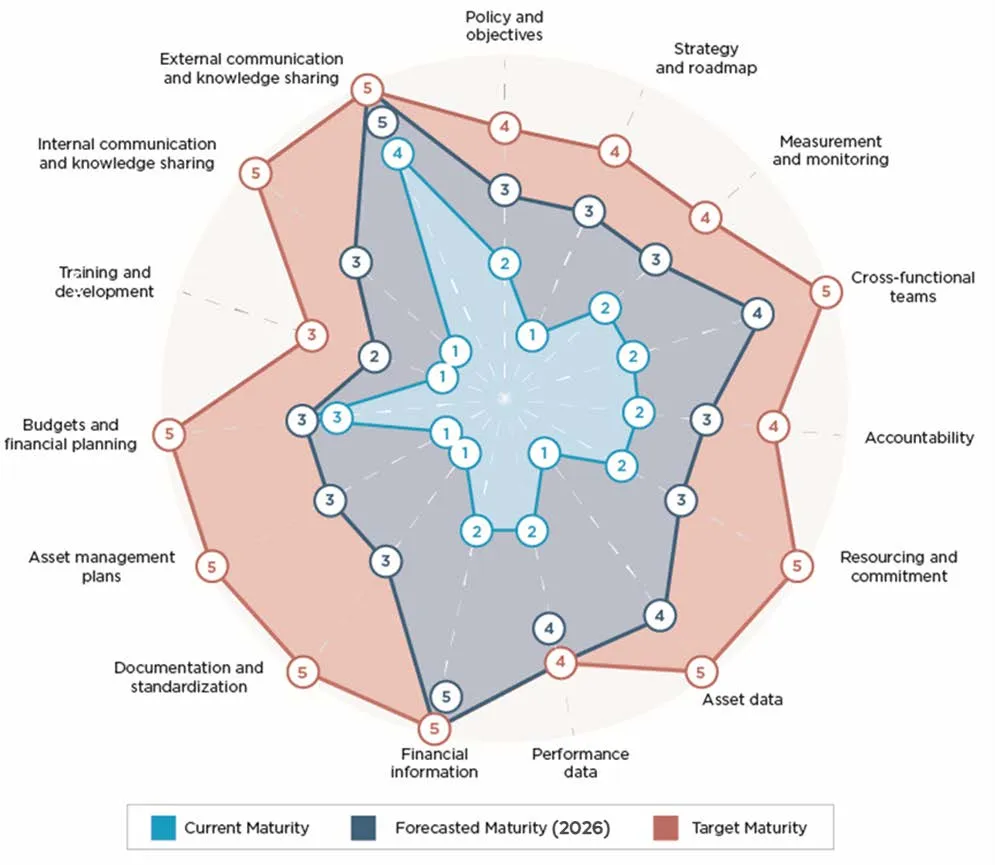
(1) FCM Asset Management Readiness Scale (AMRS) rating The total weighted average of the Town’s AMRS rating was 1.8. For context, 94.5% of organizations that received funding from the Municipal Asset Management Program between 2017 and 2023 registered a rating of 1 or lower at the start of their project. The Town’s highest scoring competencies were external communications and knowledge sharing (4), and budgets and financial planning (3). A graphical summary of the Town’s AM maturity ratings is shown in Figure 1 on the following page.
Provided that the key tasks of this strategy are implemented, the Town’s readiness score is projected to increase to 3.4 within three years.
(2) Levels of service and risk register
- The organization has established few levels of service beyond the regulatory minimums. Staff rely on their best judgement to manage risk, develop capital renewal plans, and infer capital service expectations.
- Council has not yet provided comprehensive input on levels of service but has guided levels of service through funding allocation, occasional direction, and intuitive assessment of the quality of existing services.
- The organization does not have a formal risk register. However, staff have a remarkable knowledge of risk factors related to the assets under their individual department’s management.
(3) Lifecycle costing
- The Town has conducted a detailed analysis of the funding needs for the renewal of existing infrastructure based on high-level assumptions. However, the operating and maintenance costs and useful lives of the assets have not been determined due to the lack of established levels of service.
- Estimating lifecycle costs would greatly improve the existing long-term financial planning.
- Lifecycle costing has been inherently established for critical assets based on staff’s judgement of risk and funding priorities.
(4) Data and Information
- The Town maintains several databases with asset information however, these databases are mostly separated by department and data quality varies by asset class.
- The Town lacks formal AM data standardization.
- The organization is working on consolidating AM data into a single asset management database.
(5) Culture and AM awareness
- The organization has different levels of awareness and understanding of the importance, definition, and application of asset management practices and principles. As a result, some departments have not taken on a clear ownership role in asset management processes.
- There was a consistent interdepartmental culture of support for advancing asset management in the organization.
- Although there was strong support for asset management across the organization, very few staff had formal asset management responsibilities incorporated into their job description.
3.2. Plan
AM Policy
An AM policy demonstrates the organization’s commitment, from the highest level, to be guided by specific principles. In 2022, staff presented a draft of the Town’s Asset Management Policy (Appendix A) which has been included in this strategy as Attachment A. It is recommended that the Council adopt the AM Policy in conjunction with the AM Strategy.
AM Strategy
This AM strategy is a corporate-level document that outlines how an organization will implement AM practices and plans to achieve its AM objectives, while aligning with organizational objectives. The Strategy will guide the Town’s AM Program improvement over the next five years. Section 3.3 of this strategy provides a five-year implementation plan with key tasks and recommendations.
AM Plans
This Strategy recommends that the Town develop AM plans for critical assets following the establishment of levels of service. Individual AM plans are developed for each asset class described in Section 3.1 and each plan will outline the following: (1) Quantity, value, condition, and service of the asset class (2) Current levels of service, desired levels of service, and the gap therein, (3) Risks to service delivery, (4) Practices and strategies required to meet service delivery objectives and manage risk, and (5) Financial and other resources required to achieve service delivery objectives.
Long Term Financial Plan
The Town has developed its first-ever long-term financial plan entitled the Sustainable Infrastructure Replacement Plan (SIR Plan). The SIR Plan estimates forecasted infrastructure renewal spending over a 100-year planning horizon with a -50% to +100% expected range of accuracy. The next step in the long-term financial planning process is to develop a 10-20 year capital expenditure forecast with class D quality estimates (-30% to +60%). With dedicated funding demand established through the SIR Plan, and more accurate forecasts, Council may feel comfortable dedicating funds to long-term capital renewal budgets.
- Establish appropriate funding levels (SIR Plan)
- Develop Spending Priorities
- Refine LTF Plan with 10-20 year capital expenditures
3.3. Implement
Five-Year Implementation Plan
A five-year implementation plan has been developed for the scope of this strategy. The plan has been organized using the four core elements of the AMBC Framework: Assets, Information, Finances, and People. Completion of the tasks detailed in the plan below will improve the Town’s AM program.
| Task | 2024 | 2025 | 2026 | 2027 | 2028 | Estimated Cost |
|---|---|---|---|---|---|---|
| Assets | ||||||
| A.1 Establish levels of services for all assets | $60k | $60,000 | ||||
| A.2 Prepare AM Plans for critical assets | $20k | $20k | $20k | $20k | $80,000 ($20k / plan) | |
| A.3 Adopt AM Policy & AM Strategy | $0 | Internal resources | ||||
| Information | ||||||
| I.1 Integrate SIR Plan data into existing AM software | See Project Summary N-042 | |||||
| I.2 Conduct data audit and establish data standards | $15k | $15,000 | ||||
| Finances – As per the Sustainable Infrastructure Replacement Plan (SIR Plan) | ||||||
| F.1 Dedicate $500,000 of casino revenue annually to capital renewal reserve | Varies | |||||
| F.2 Incrementally increase sewer utility revenue contributions to capital renewal reserve | Varies | |||||
| F.3 Incrementally increase property taxes contributions to capital renewal reserve | Varies | |||||
| F.4 Dedicate retired debt servicing budgets to capital renew reserve | Varies | |||||
| F.5 Dedicate Non-Market Change Revenue to capital renewal reserve funding | Varies | |||||
| People | ||||||
| P.1 Establish Cross-Departmental AM Working Group | $0 | Internal resources | ||||
| P.2 Enroll staff and Council in AM training | $5k | $5k | $5k | $5k | $5k | $25,000 ($5k / year) |
ASSETS
A.1 Establish levels of service for all assets (2024) Defining the desired levels of service (LOS) provided to the community is the first crucial step in developing an effective AM plan, allowing staff to develop plans that consider all activities necessary to maintain the infrastructure in the desired condition and optimize lifecycle costs.
A.2 Prepare AM Plan for critical assets (2025-2028) Once LOS are established for each asset class, preparation of AM plans may commence starting with the most critical asset classes, for example, sanitary sewer, building, IT, and road assets. Each plan would detail the asset inventory, asset condition, risk assessment, lifecycle costs, existing and desired levels of service, and financial considerations.
A.3 Adopt AM Policy and AM Strategy (2024) Council’s adoption of the AM Policy will signal the organization’s commitment to operationalizing an AM program. Adoption of the AM strategy provides clear direction to staff to proceed with specific actions that can be achieved within the strategy’s time horizon.
INFORMATION
I.1 Integrate SIR Plan data into existing AM software (2024) When the Town’s SIR Plan was developed, data was modeled to prepare financial forecasts. The Town owns and utilizes AM software. Currently, the software is being used as a tangible capital asset register and is under-utilized for asset management and financial modeling. Integrating SIR Plan data into back into the Town’s existing AM software would allow the Town to update assumptions on a regular basis and refresh financial forecasts; this project was budgeted in 2023 and will be completed in 2024.
I.2 Conduct data audit and establish data standards (2024) An AM data audit would define AM data standards including classifications and useful attributes. This task will define AM data sources of truth and how data is collected, stored, and maintained. AM data support the Town’s ability to prepare detailed analysis, forecasts, and risk assessments. The data can be used to optimize services and reduce lifecycle costs.
FINANCES
F.1-F.5 SIR Plan funding recommendations Recommendations in the SIR Plan are implemented through the annual financial planning process and include: (1) Dedication of $500,000 of annual casino revenue to capital renewal reserve, (2) Increase sewer utility rates by 5% for 5 years, (3) 12 years of 1% tax increases, (4) Convert debt servicing budgets to capital renewal reserve contributions when debt retires, and (5) Utilize Non-Market Change revenue to increase capital renewal reserves.
Document Images
(1)