Asset Management Maturity Assessment Findings
A report by FIT Local Government Consulting evaluating the Town's current asset management maturity and providing a roadmap for improvement.
September 29, 2023
Ben Lubberts, Deputy Director of Engineering 45 View Royal Avenue Victoria, BC V9B 1A6
Re: Asset Management Maturity Assessment Findings
Dear Mr. Lubberts,
I am pleased to present you with the enclosed report on the asset management maturity assessments conducted July 17 through August 8, 2023
The report includes the following sections:
- Project background and scope
- Assessment methodology
- Key findings
- Recommendations
- Preliminary summary of priority projects through years 1-3 with high level budgets.
This report fulfills the requirements of Milestone 2 in the project charter. We look forward to discussing the report with the Town’s project team and moving forward with the project.
Thank you,
Christopher Paine, CPA, CGA Principal, FIT Local Government Consulting Cell: (236)-508-1556 email: Chris@flgc.ca
1.0 BACKGROUND & SCOPE
In June 2023, FIT Consulting was engaged by the Town to carry out the Strategic Asset Management Plan project (project N-096). The scope of this project included conducting an Asset Management Maturity Assessment. FIT performed this assessment by asking participants to fill out an online survey and by conducting several face-to-face workshops from July 19 to August 8. The workshops involved representatives from all Town departments, such as protective services, general government, Parks, Development Services and Transportation.
The following steps are planned for the completion of this project:
- Preparation and Presentation of the main findings from Asset Management Maturity Assessment.
- Preparation of an Asset Management Strategy using the findings from the Maturity Assessment.
- Preparation of an Asset Management Program Charter based on actions approved in Asset Management Strategy.
2.0 ASSESSMENT METHODOLOGY
The National Asset Management Standards in Canada suggest four possible maturity assessment frameworks: (1) National Assessment Framework, (2) International Organization for Standardization, (3) Federation of Canadian Municipalities (FCM) Readiness Scale, and (4) International Infrastructure Management Manual (IIMM). The FCM framework was chosen because it is commonly used by funding agencies when reviewing grant applications. This framework also allows for easy comparison with other best practice frameworks.
The FCM’s Asset Management Readiness Scale helps local governments assess their progress on asset management across five competency areas: (1) Policy and Governance, (2) People and Leadership, (3) Data and Information, (4) Planning and Decision-making, and (5) Contribution to Asset Management Practice. The assessments should reflect the overall organizational competency and not just the individual performance of some staff members. The assessments should also consider the perceived readiness, culture and competency of the organization, as well as the actual proficiency of the organization’s asset management champions.
The discussion and survey results also helped to create a profile for the organization’s desired future state of asset management readiness. Asset management is a cyclical process that requires constant definition and refinement of the organization’s asset management goals.
The current state and the desired state of the asset management outcome areas were evaluated. The desired state was based on the consultant’s judgment of what is feasible and should be prioritized for the upcoming draft Asset Management Strategy. Therefore, the highest rating of ‘5’ for all outcome areas may not be desirable or practical within that timeframe. Moreover, it is recommended that organizations use a cost-benefit analysis to achieve their desired asset management maturity. Since every organization has competing priorities, the highest rating may not be the most efficient use of limited resources. The consultant translated the FCM assessment results to create and complete an IIMM assessment profile. Both frameworks revealed similar competency gaps, leading to the same suggestions.
3.0 KEY FINDINGS
(1) Federation of Canadian Municipalities Asset Management Readiness Scale
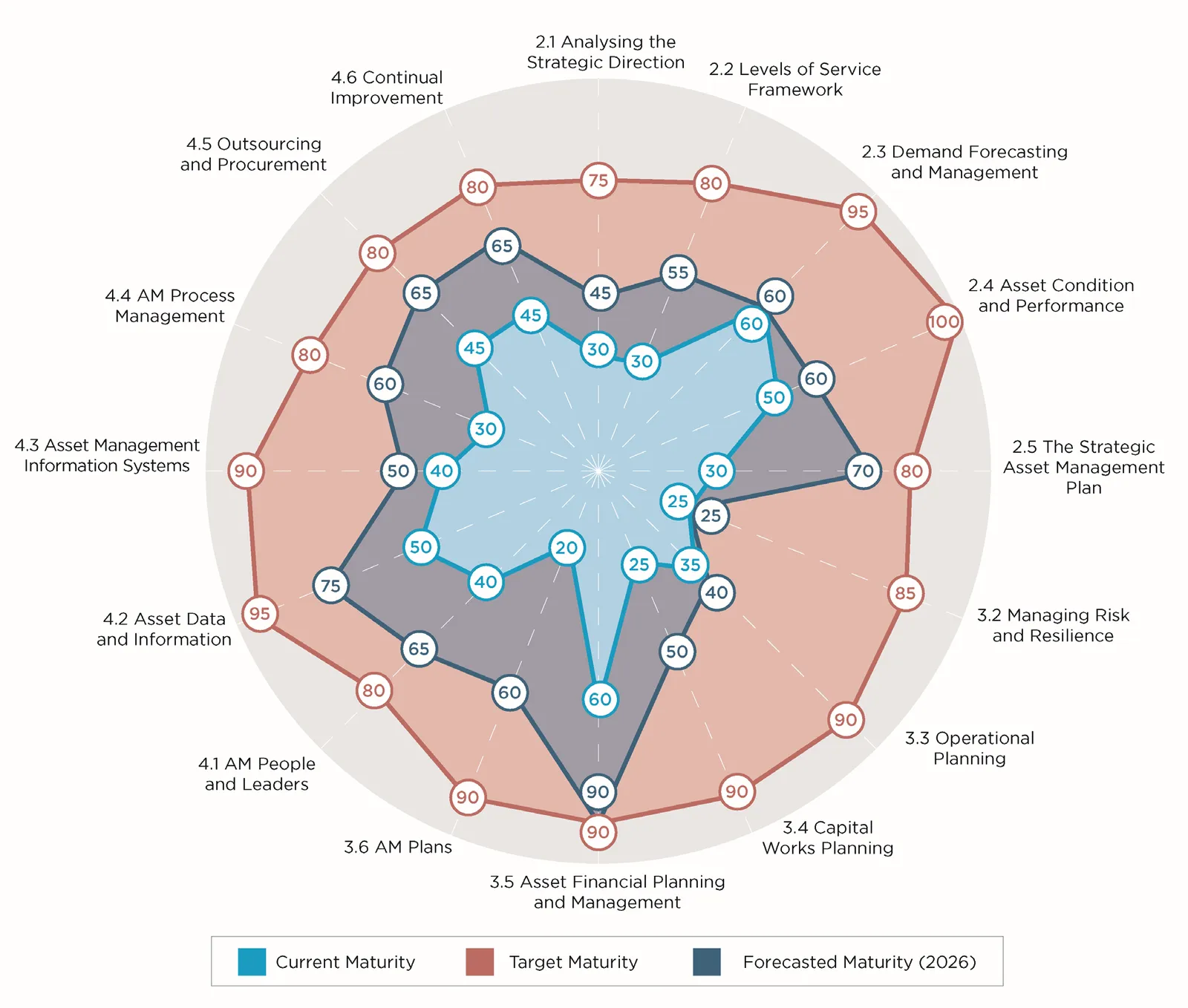
The Town obtained a readiness score of 1 for six competencies, a score of 2 for seven competencies, a score of 3 for one competency, and a score of 4 for one competency (See Appendix A). The total weighted average readiness score for the Town was 1.8. For context, according to the FCM, 94.5% of organizations with Municipal Asset Management Program funded projects from May 2017 – March 2023 began at readiness level 1 or below.¹ Highest scoring competencies were external communications and knowledge sharing (4), and budgets and financial planning (3). The Town’s readiness score is projected to increase to 3.4 within three years, provided that all priority projects are implemented within that timeframe.
(2) Levels of service
- The organization has established few levels of service beyond the regulatory minimums. Staff rely on their best judgement to manage risk and develop capital renewal plans and funding priorities.
- Council has not provided comprehensive input on levels of service. Instead, Council has guided levels of service through funding allocation, occasional direction, and intuitive assessment of the quality of existing services.
- The organization does not have a formal risk register. However, staff have a remarkable knowledge of risk factors related to the assets under their individual department’s management.
(3) Lifecycle costing
- The Town has conducted a detailed analysis of the funding needs for the renewal of existing infrastructure based on high-level assumptions. However, the operating and maintenance costs and useful lives of the assets have not been properly determined due to the lack of established levels of service endorsed by Council
- Estimating lifecycle costs would greatly improve the existing long-term financial planning
- Lifecycle costing has inherently established for critical assets based on staff’s judgement of risk and service expectations.
¹ Asset management insights: People and leadership. (2023, September 13). Federation of Canadian Municipalities. https://fcm.ca/en/resources/mamp/asset-management-insights-people-and-leadership
(4) Data & Information
- The organization has maintained several databases with asset information. However, these databases are mostly separate by departments.
- The data quality and the database structure vary by department and asset class.
- The organization is working on consolidating the data into a single asset management database.
(5) Organizational understanding approach
- The organization has different levels of awareness and understanding of the importance, definition, and application of asset management practices and principles. As a result, some departments have not taken on a clear ownership role in asset management processes.
- There was a consistent interdepartmental culture of support for advancing asset management in the organization.
- Although there was strong support for asset management across the organization, very few staff had formal asset management responsibilities incorporated into their job description.
- Survey respondents showed strong interest in and support for an cross departmental multidisciplinary asset management working group and for formalizing corporate asset management responsibilities. Some staff were widely recognized as asset management champions in the organization.
4.0 RECOMMENDATIONS
The following recommendations are based on the results of the Asset Management Maturity Assessment conducted for the Town:
(1) Establish a Cross-Departmental Asset Management Working Group
The maturity assessments indicated a strong organizational support for the creation of a multidisciplinary cross-departmental asset management working group. The team could have the following terms of reference:
- To facilitate the implementation and adoption of the draft asset management policy,
- To identify and suggest key asset management priorities and projects,
- To provide oversight for key asset management projects
- To advise on professional development priorities across the organization, and
- To ensure data, planning, prioritization, and capital plans are aligned and consistent.
(2) Integrate data into existing asset management software
The Town is currently working on consolidating the data from the Sustainable Infrastructure Replacement Plan into the Town’s Asset Management software. This project involves aligning the Town’s public sector accounting tangible capital asset registry with the graphical information system. This alignment would eliminate the duplication of work.
Additional scope should include:
- Consolidating non-GIS data from other departments into the asset management software;
- Establishing data quality standards for the ongoing maintenance of asset management software. These standards would ensure that the Town collects and maintains data that will support its strategic, cost-effective, and intelligent asset management. For example, data quality standards could require that all new data be provided in Master Municipal Construction Documents format for developer-contributed assets. This would ensure that all new assets are uploaded and utilized in the asset management software in a streamlined manner.
(3) Establish levels of services for all capital services
“Levels of service reflect social and economic goals of the community and may include any of the following parameters: safety, customer satisfaction, quality, quantity, capacity, reliability, responsiveness, environmental acceptability, cost, and availability. The defined levels of service are any combination of the above parameters deemed important by the municipality.”² Without Council endorsed levels of service, staff have to comply with the minimum regulated standards and use professional judgement and ah hoc Council direction. Council endorsed levels of service establish a clear vision for the community that helps staff in creating asset management plans and finding sustainable funding sources. Lifecycle costs are difficult to calculate precisely without established levels of service, as different levels of service visions can influence funding requirements greatly.
The following levels of service categories should be established:
- Regulatory
- Community – defined by a community’s perception and expectation pertaining to the quality and function of service provided
- Technical – defined by specific and quantifiable asset performance.
(4) Asset Management Plans, Critical Assets
The Town will be able to prepare an asset management plan for each of its critical assets once it has established levels of service. Such a plan will cover asset condition, risk register, levels of service, demand forecasting, lifecycle cost quantification, funding strategy, 10 to 20 year capital plan and growth projections.
(5) Asset Management Training – Senior Management and Council
Council and senior management should consider attending formal asset management training. Various training options are scalable and accessible. Attending training will demonstrate strong support and advance a culture of asset management in the organization.
² Federation of Canadian Municipalities. (2002). Developing levels of service. https://fcm.ca/sites/default/files/documents/resources/guide/infraguide-developing-levels-of-service-mamp.pdf
5.0 PRELIMINARY SUMMARY OF 1-3 YEAR HIGH PRIORITY PROJECTS
The high priority projects recommended over the next three years are as follows:
(1) Data Consolidation/Data Standards Audit
The Town has asset management software that it currently uses as the tangible capital asset registry for Public Sector Accounting Standards section 3150 purposes. This use has limited value for asset management. The Town also keeps a detailed geographical information system database for Engineering operations. This database and other departmental databases should be integrated with the asset management software. This would enable the Town to do asset management planning on a comprehensive basis and reduce the redundant work that it currently faces.
The Town is already working to integrate the data from the Sustainable Infrastructure Replacement Plan into the asset management software. The Town should also develop asset management data standards for the regular integration, uploading, maintenance, and use of asset management data.
Preliminary Budget Estimate: $10,000 Sustainable Infrastructure Replacement Plan integration (currently underway) $10,000 Data standards and standard operating procedure development
(2) Levels of Service Development
Developing levels of service will involve extensive community engagement. The Town should also present several level of service options to Council with the corresponding financial, social, environmental and cultural impacts
Preliminary Budget Estimate: $60,000 The preliminary budget includes public engagement costs, internal stakeholder engagement, professionally designed materials, and lifecycle costing quantification.
(3) Asset Management Plans, Critical Assets
Once the Town has developed levels of service and quantified lifecycle costs, it will be well positioned to create asset management plans for its critical assets. It will also be able to use the data gathered in the data consolidation project.
Preliminary Budget Estimate: $60,000 The preliminary budget covers the development of asset management plans for sanitary sewer, stormdrain, and roads asset classes. The budget estimate excludes professional design and a communications/public engagement strategy. The Town may not need such a strategy if it engages the community during the levels of service project development.
It would be most effective to conduct the Levels of Service project prior to the Asset Management Plans as this information is critical to Asset Management Plans. The Data Standards Audit can be conducted concurrently without impacting the effectiveness of the other projects.
Appendix A: Asset Management Maturity Assessment Results
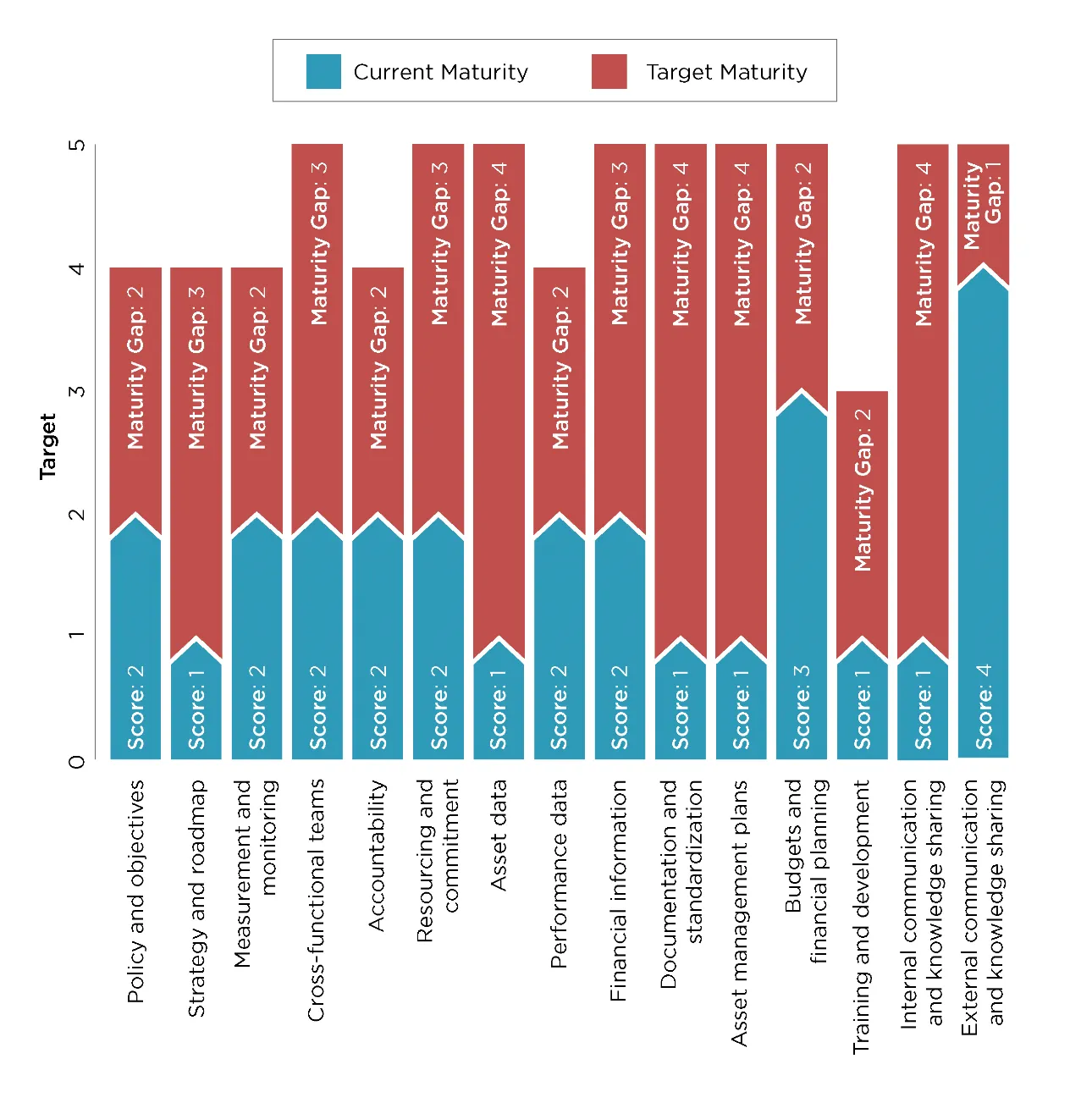
Appendix A: Detailed Asset Management Maturity Assessment Results
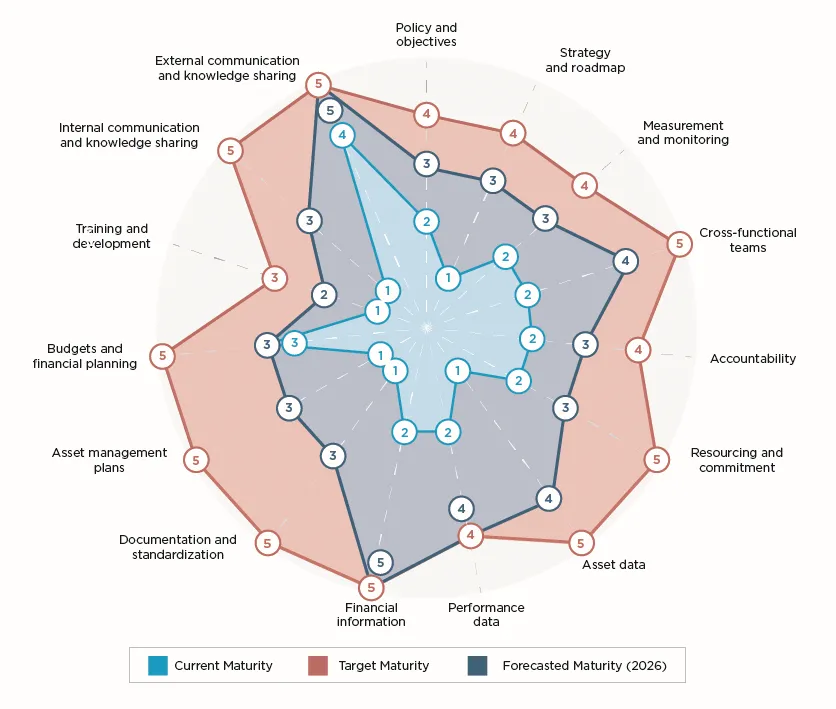
Appendix A: Detailed Asset Management Maturity Assessment Results
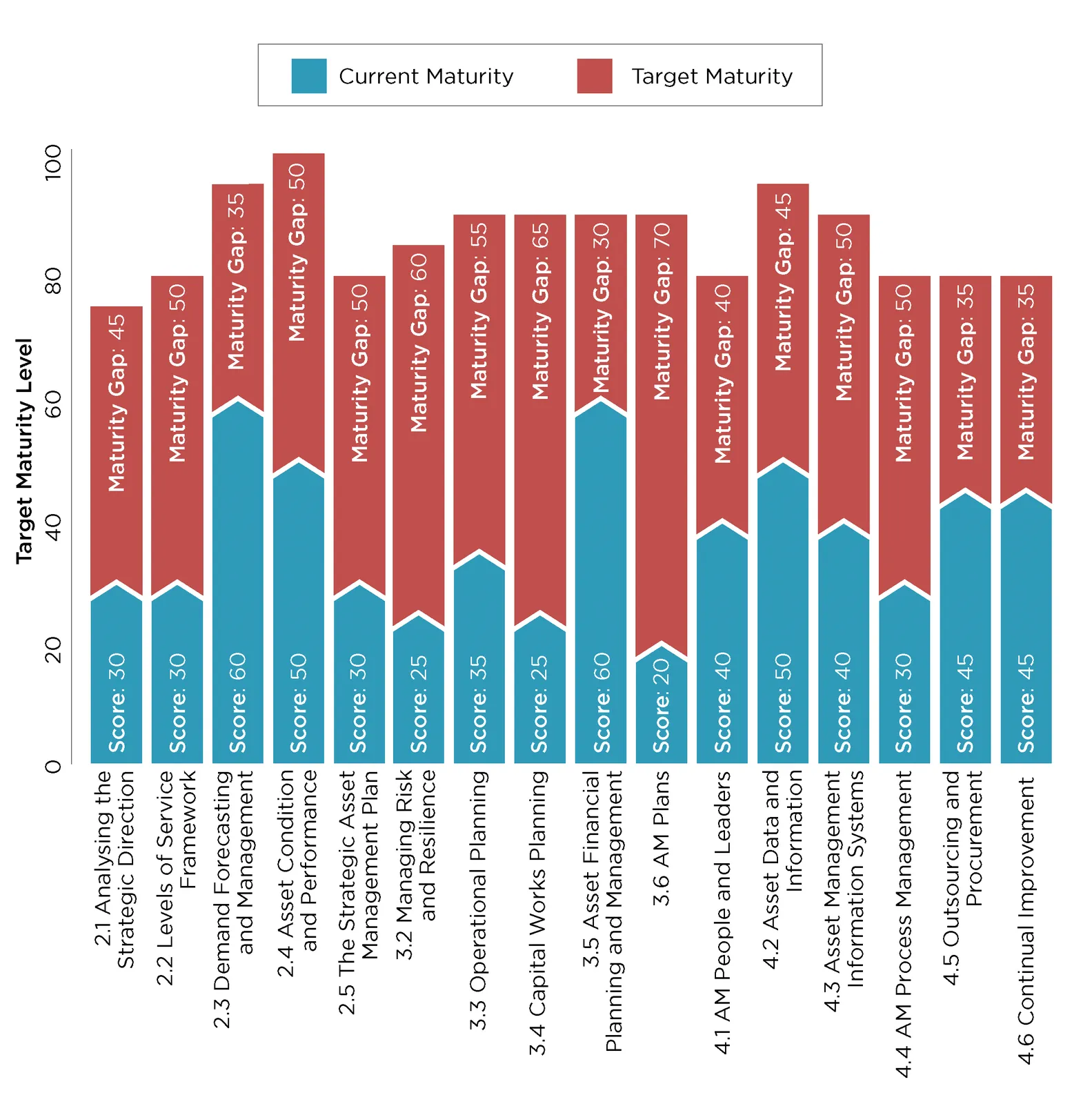
Appendix A: Detailed Asset Management Maturity Assessment Results
Document Images
(2)