Appendix
APPENDIX A - TREE MANAGEMENT PLAN (T1)
June 13, 2023Pages 203–2043 sections
A site map and technical drawing indicating tree protection zones, trees to be removed, and trees to be retained for the 339, 341, 345 Island Highway project.
Date: March 23, 2023Scale: 1:500 @ 11" X 17"Critical root zone radius identified for all trees
Construction Impact Assessment and Tree Management Plan
for 339, 341, 345 Island Highway Prepared for Boardwalk REIT
Page 203–204
APPENDIX A - TREE MANAGEMENT PLAN (T1)
Tree Management Plan - T1: 339, 341, 345 Island Highway, View Royal, BC
THIS PLAN IS PROVIDED FOR CONTEXT ONLY, AND IS NOT CERTIFIED AS TO THE ACCURACY OF THE LOCATION OF FEATURES OR DIMENSIONS THAT ARE SHOWN ON THIS PLAN. PLEASE REFER TO THE ORIGINAL SURVEY PLAN AND ARCHITECTURAL PLANS.
The plan illustrates the proposed development site, including existing tree locations and protection zones.
Map Legend:
- Existing tree with ID # (Trees are represented by [Image 1] through [Image 134])
- Tree protection fencing
- Critical root zone radius (m)
- Tree proposed for removal
- Non-bylaw undersize tree
- Unsurveyed tree
- Site boundary
Map Annotations:
- Island Highway (North boundary)
- Prince Robert Drive (West boundary)
- Hedge 1 (Southwest area)
- Line of underground parkade below.
- Woodland Path Note: "It is understood that the proposed woodland path is conceptual at this stage - the final pathway will be designed to preserve the adjacent bylaw protected trees. Remove ivy from trunk and canopies of retained trees."
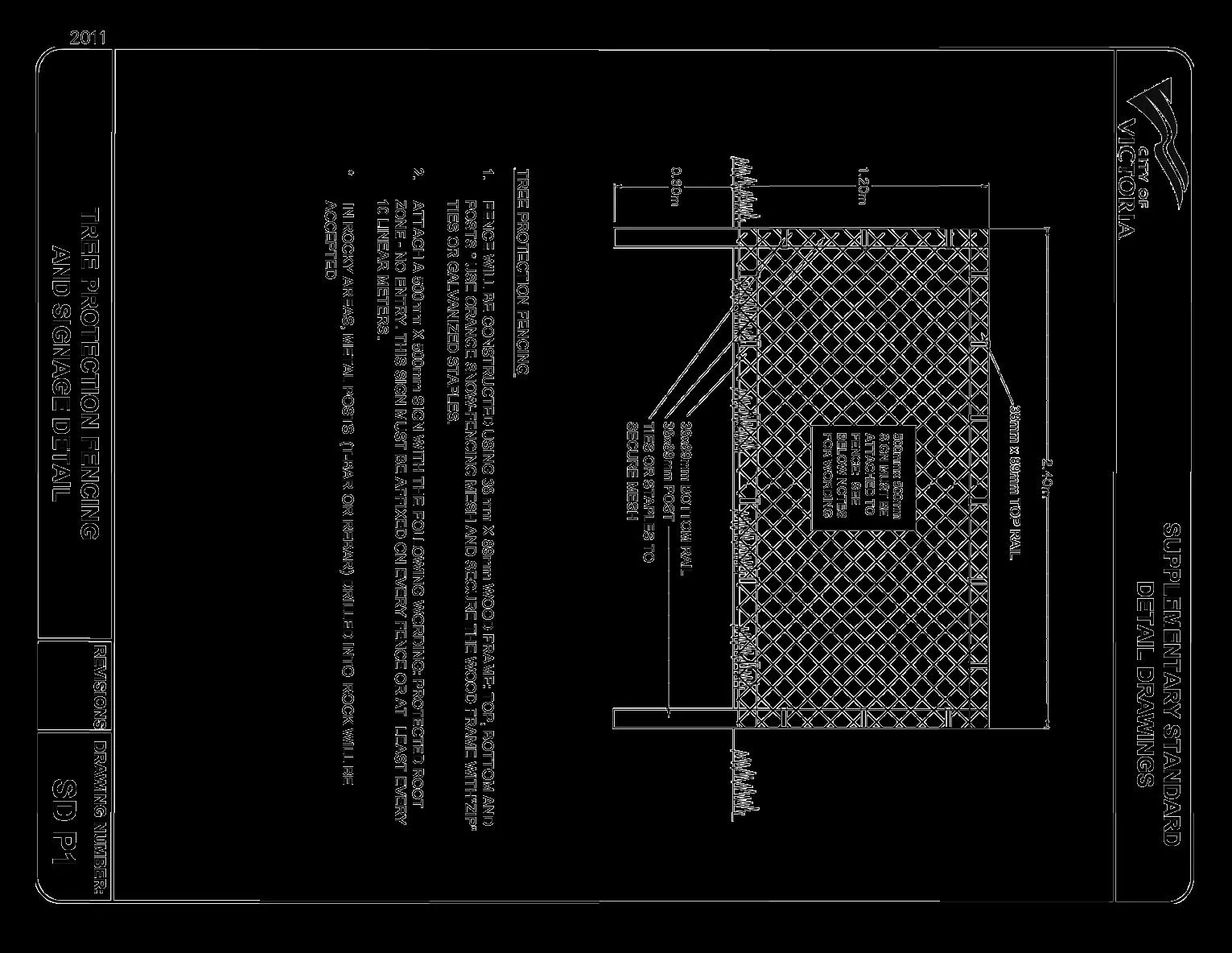
Tree Protection Fencing and Signage Detail
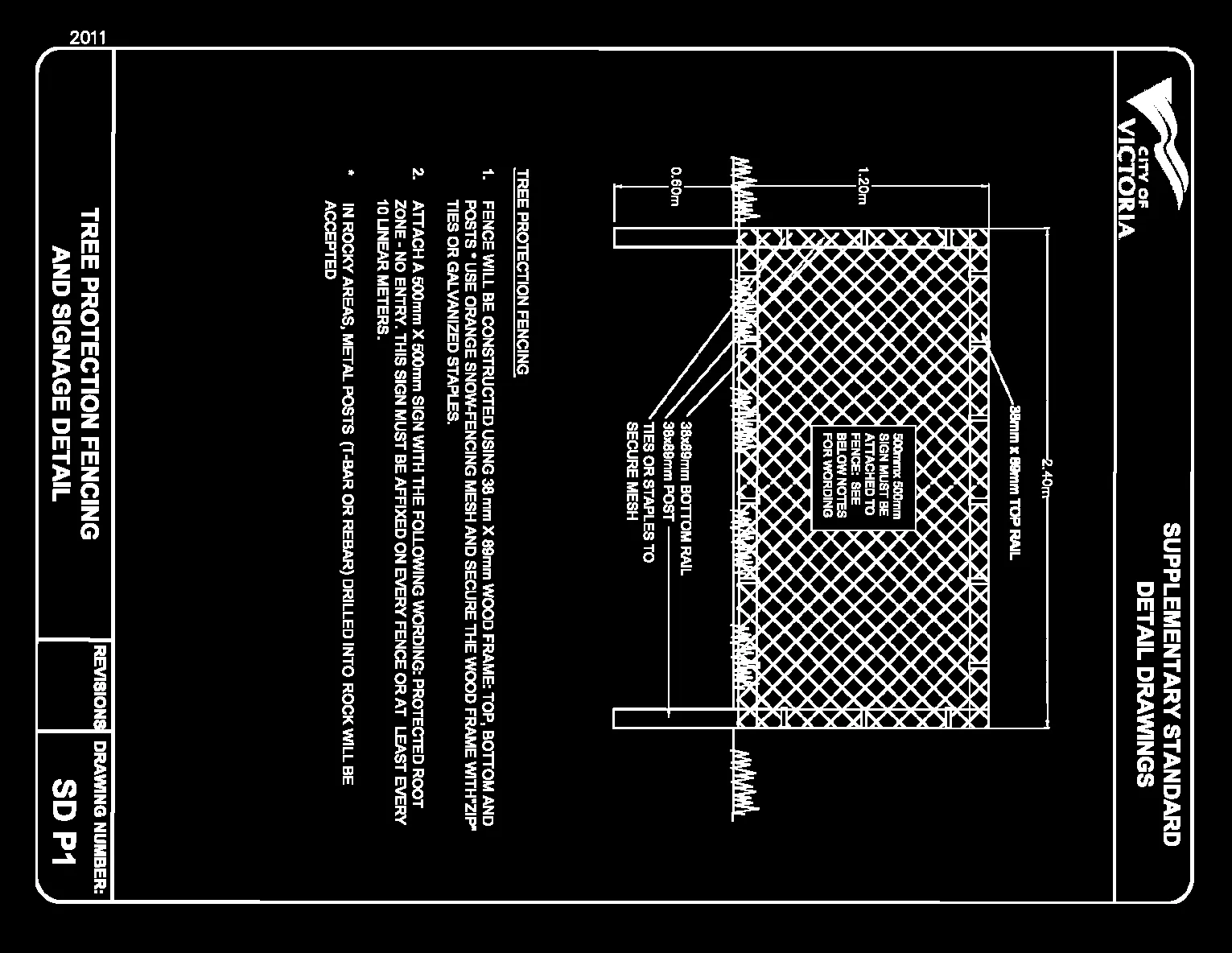
Tree Protection Fencing Notes:
- Fence will be constructed using 38 mm x 89 mm wood frame: top, bottom and posts. Use orange snow-fencing mesh and secure the wood frame with "zip" ties or galvanized staples.
- Attach a 500mm x 500mm sign with the following wording: PROTECTED ROOT ZONE - NO ENTRY. This sign must be affixed on every fence or at least every 10 linear meters.
- In rocky areas, metal posts (T-bar or rebar) drilled into rock will be accepted.
Tree Protection Notes
Page 203–204
- Tree protection barrier: The areas, surrounding the trees to be retained, should be isolated from the construction activity by erecting protective barrier fencing. Where possible, the fencing should be erected at the perimeter of the critical root zone. The barrier fencing to be erected must be a minimum of 1200mm in height, of solid frame construction that is attached to wooden or metal posts. A solid board or rail must run between the posts at the top and the bottom of the fencing. This solid frame can then be covered with flexible snow fencing. The fencing must be erected prior to the start of any construction activity on site (i.e. demolition, excavation, construction), and remain in place through completion of the project. Signs should be posted around the protection zone to declare it off limits to all construction related activity. The project arborist must be consulted before this fencing is removed or moved for any purpose.
- Arborist supervision: All excavation occurring within the critical root zones of protected trees must be completed under the supervision of the project arborist. Any severed or severely damaged roots must be pruned back to sound tissue to reduce wound surface area and encourage rapid compartmentalization of the wound.
- Demolition: The demolition of the existing houses, driveways, and any services that must be removed or abandoned must take the critical root zone of the trees to be retained into account. If any excavation or machine access is required within the critical root zones of trees to be retained, it must be completed under the supervision of the project arborist. If temporarily removed for demolition, barrier fencing must be erected immediately after the supervised demolition.
- Methods to avoid soil compaction: In areas where construction traffic must encroach into the critical root zones of trees to be retained, efforts must be made to reduce soil compaction where possible by displacing the weight of machinery and foot traffic. This can be achieved by one of the following methods:
- Installing a layer of hog fuel or coarse wood chips at least 20cm in depth and maintaining it in good condition until construction is complete.
- Placing medium weight geotextile cloth over the area to be used and installing a layer of crushed rock to a depth of 15cm over top.
- Placing two layers of 19mm plywood.
- Placing steel plates.
- Mulching: Mulching can be an important proactive step in maintaining the health or trees and mitigating construction related impacts and overall stress. Mulch should be made from a natural material such as wood chips or bark pieces and be 5-8cm deep. No mulch should be touching the trunk of the tree. See "methods to avoid soil compaction" if the area is to have heavy traffic.
- Pruning: We recommend that any pruning of bylaw-protected trees be performed to ANSI A300 standards and Best Management Practices.
- Paved surfaces above tree roots: Where paved areas cannot avoid encroachment within critical root zones of trees to be retained, construction techniques, such as floating permeable paving, may be required. The "paved surfaces above tree roots" detail above offers a compromise to full depth excavation (which could impact the health or structural stability of the tree). The objective is to avoid root loss and to instead raise the paved surface above the existing grade (the amount depending on how close roots are to the surface and the depth of the paving material and base layers). Final grading plans should take this potential change into account. This may also result in soils which are high in organic content being left intact below the paved area. To allow water to drain into the root systems below, we also recommend that the surface be made of a permeable material (instead of conventional asphalt or concrete) such as permeable asphalt, paving stones, or other porous paving materials and designs such as those utilized by Grasspave, Gravelpave, Grasscrete and open-grid systems.
- Blasting and rock removal: Care must be taken to ensure that the area of blasting does not extend beyond the necessary footprints and into the critical root zones of surrounding trees. The use of small low-concussion charges and multiple small charges designed to pre-shear the rock face will reduce fracturing, ground vibrations and overall impact to the surrounding environment. Only explosives of low phytotoxicity and techniques that minimize tree damage should be used. Provisions must be made to ensure that blasted rock and debris are stored away from the critical root zones of trees.
- Scaffolding: This assessment has not included impacts from potential scaffolding including canopy clearance pruning requirements. If scaffolding is necessary and this will require clearance pruning of retained trees, the project arborist should be consulted. Depending on the extent of pruning required, the project arborist may recommend that alternatives to full scaffolding be considered such as hydraulic lifts, ladders or platforms. Methods to avoid soil compaction may also be recommended (see "Minimizing Soil Compaction" section).
- Landscaping and irrigation systems: The planting of new trees and shrubs should not damage the roots of retained trees. The installation of any in-ground irrigation system must take into account the critical root zones of the trees to be retained. Prior to installation, we recommend the irrigation technical consult with the project arborist about the most suitable locations for the irrigation lines and how best to mitigate the impacts on the trees to be retained. This may require the project arborist supervise the excavations associated with installing the irrigation system. Excessive frequent irrigation and irrigation which wets the trunks of trees can have a detrimental impact on the tree health and can lead to root and trunk decay.
- Arborists role: It is the responsibility of the client or his/her representative to contact the project arborist for the purpose of:
- Locating the barrier fencing.
- Reviewing the report with the project foreman or site supervisor.
- Locating work zones and machine access corridors where required.
- Supervising excavation for any areas within the critical root zones of trees to be retained including any proposed retaining wall footings and review any proposed fill areas near trees to be retained.
Project Information:
| Detail | Information |
|---|---|
| Date: | March 23, 2023 |
| Prepared For: | Boardwalk REIT |
| Scale: | 1 : 500 @ 11" X 17" |
| Revision: | DRAFT |
| Reference DWG's: | A101 Site plan by DHK Architects Concept Service Plan by McElhanney |
Page 203–204
Document Images
(166)






























































































































Extracted from: 2023 06 13 Committee of the Whole Agenda - Agenda - Pdf