Report to Committee of the Whole - Re: Proposed Amendments to the Development Procedures Bylaw and Introduction of a New Public Notification Bylaw
This report recommends reducing notification distances for development applications and introducing a new public notification bylaw to modernize notice delivery methods via social media and the town's website.
Report to Committee of the Whole Re: Proposed Amendments to the Development Procedures Bylaw and Introduction of a New Public Notification Bylaw Meeting Date: June 13, 2023
| Date | Type | Purpose | Address | |
|---|---|---|---|---|
| construct a multi-unit residential building | ||||
| March 17, 2023 | Notice of Opportunity for Public Comment | Development Variance Permit to construct an accessory building | 305 Anya Court | 31 |
| March 17, 2023 | Notice of Opportunity for Public Comment | Development Permit with Variances to construct a gallant system and dock | 302 Bessborough Ave | 68 |
| November 22, 2022 | Notice of Opportunity for Public Comment | Development Variance Permit for signage | 1681 Island Highway (Burger King) | 140 |
| November 1, 2022 | Notice of Opportunity for Public Comment | Development Permit with Variances for an addition. | 1519 Admirals Road | 440 |
| September 7, 2022 | Notice of Opportunity for Public Comment | Development Variance Permit for construction of a new retaining wall and foundation wall greater than 5 feet along with new deck | 49 Tovey Crescent | 39 |
| Aug 19, 2022 | Public Hearing | Rezoning Amendment Bylaw to construct a duplex | 110 High Street | 529 |
| May 25, 2022 | Public Hearing | Zoning Bylaw Amendment Bylaw to rezone the Glentanna Village Land Use Contract | 1500, 1501, 1507, 1512, 1514, 1611, 1619, and 1621 Glentana | 496 |
| May 25, 2022 | Public Hearing | Temporary Use Permit for the parking lot to be used as a staging area for construction | 2 Hospital Way | 512 |
| Jan 19, 2022 | Public Hearing | Rezoning Amendment Bylaw for a multi-unit residential building | 167, 169, 171 Island Highway | 771 |
A notification distance of 100m is considered an appropriate distance to notify occupiers and/or owners who may be impacted by an OCP amendment and/or rezoning application that is considering proposed changes to the use and density of a parcel. Too short a distance risks not notifying persons that may be directly impacted or feel that they should have had an opportunity to be included in the notice. A greater distance, such as 400m, can result in some persons questioning why they are being included in the notice mailout and the relevance of the development on their use and enjoyment of their property.
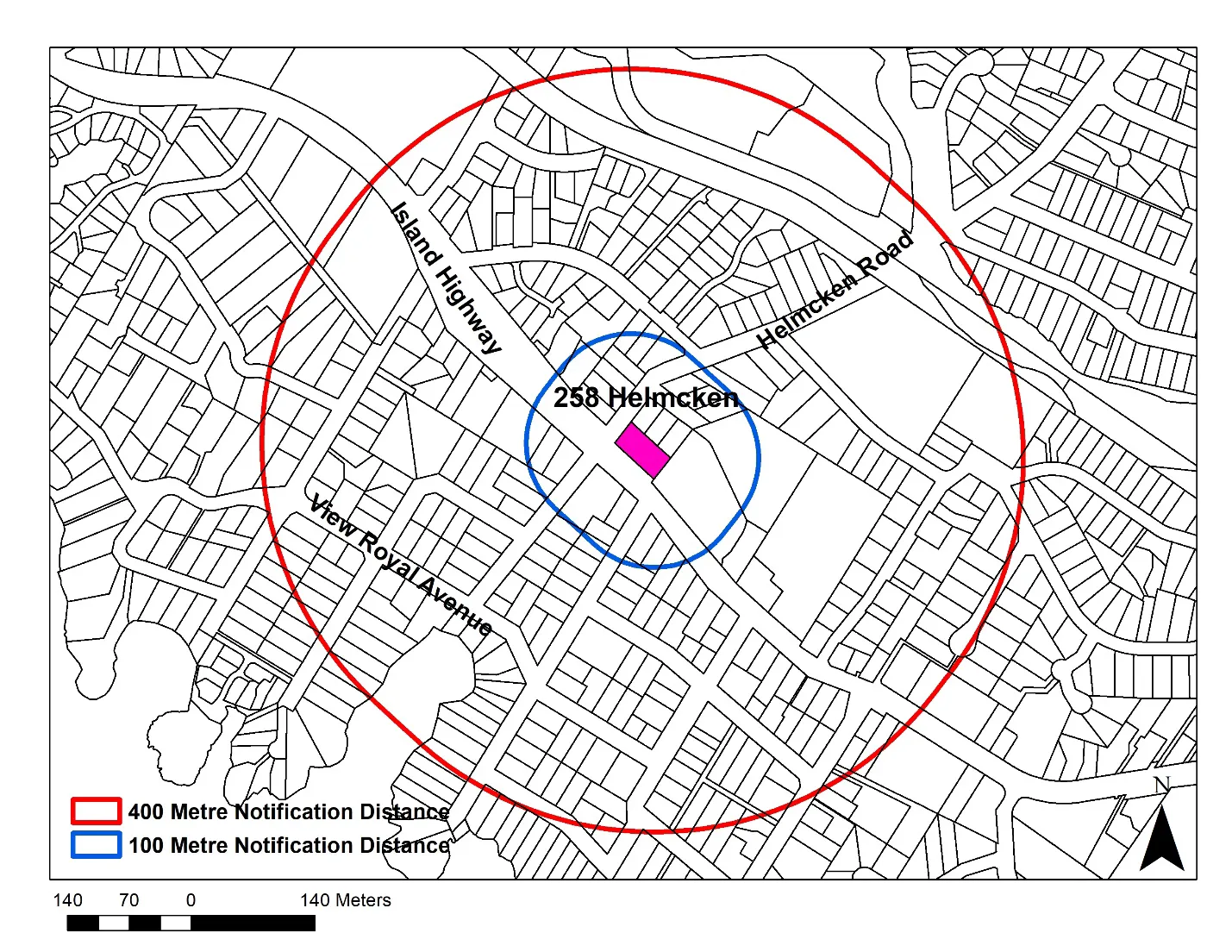
Figure 1 below is a map showing the notification distance for 258 Helmcken Road as an example of the required notification area for 100 m and 400 m and how the two differ with respect to the number of affected properties in each catchment area. A catchment area of 100 m affects 41 properties whereas a catchment area of 400 m affects 379 properties. Where some of these properties are multi-family developments with multiple units, there can be hundreds or more than a thousand notifications that must be sent out. In the sample noted above where 1,600 notices were required, this is one such instance where there were multi-family buildings included in the catchment area.
Figure 1 Notification Map Sample (258 Helmcken Road)
Staff is recommending for Council’s consideration to reduce the notification distance for OCP amendments, all types of rezoning applications, temporary use permit applications and amendments to Land Use Contracts from 400m to 100m, to maintain an appropriate notification distance that will reduce the amount of staff time and resources required to prepare and mail notices as well as reduce costs incurred by the Town. It is still on the higher end of notification distances for these types of applications when compared to neighbouring municipalities.
Reducing the required notification distance for DVP and DPV applications from 100 m to adjacent properties is recommended and can be justified because on-site variances typically impact only those properties that are immediately adjacent to the subject property. An example would be a variance to the maximum fence height, this has little to no impact beyond the property that is immediately adjacent to the property proposing to do the work. However, there are some circumstances where a variance for building height may be more noticeable and have perceived impacts beyond adjacent properties. That said, a reduced notification distance for all types of variances would still meet the intent of informing the public of development activities and provide opportunity for the public to communicate their concerns (or support) with Council. In addition, there are other means of notifying the public of a variance, which are further discussed below.
For Board of Variance (BoV) applications, the notification distance is also 100m. As shown in Table 1 above, other municipalities in the CRD only require owners and/or occupiers of adjacent properties to be notified of a BoV application. Similarly, this is considered an appropriate notification distance because the Board only considers minor variances that generally have little to no impact beyond the properties that are immediately adjacent to the property subject to the proposed work. Again, it takes a significant amount of resources (staff time and costs) to prepare and mail these types of notices for minor variances.
Proposed Public Hearing Changes
The Public Hearing is an opportunity to allow the public to make representation to their local government and for Council to gain better insights into the public’s interest regarding a development proposal. The public interest can collectively be considered the community’s stakeholders, general public, development community, neighbourhood associations, etc. In practice, understanding the public interest is a foundation of local government and community planning. Under the current legislation of the LGA, Council may choose to waive a public hearing where the Zoning Bylaw and OCP Bylaw are consistent. As mentioned above, this initiative was put into place with a view to reduce processing times and increase housing supply.
Under the current legislation, introduced through Bill 26, the approach has changed. A local government is no longer required to hold a public hearing by default where the zoning bylaw and OCP are consistent, electing to waive a public hearing if so desired. Instead, Council may still elect to hold a public hearing, but they must decide to do so prior to first reading. If Council elects to waive a public hearing, advanced notice must be provided to the public prior to first reading. This change in procedure would require that a motion be provided indicating that a public hearing is waived or is to be held. The change passed through Bill 26 has made the Town’s existing Development Procedures Bylaw No. 730, 2009 outdated with respect to public hearing procedures; and therefore, the recommended amendment to the bylaw is to ensure consistency with the LGA, and to provide a clear and concise approach for Council moving forward. The proposed amendments are informed by the July 12, 2023, Committee of the Whole discussions.
Proposed Public Notification Bylaw
The proposed public notification bylaw is a new bylaw that is intended to modernize existing public notice delivery methods introduced through Bill 26. The benefit of having a public notification bylaw is that the public, staff, and Council have clear understanding of the specified public notice requirements. A public notification bylaw also caters to the specific needs of the community, whereas the default requirements outlined in the Community Charter default to generic posting requirements for notices (newspaper, public posting place).
A public notification bylaw would function in tandem with the existing Development Procedures Bylaw. The existing Development Procedures Bylaw specifies the requirements with respect to notification details, notification distance, etc., whereas a public notification bylaw specifies how the notices will be delivered and posted in the Town. Prior to Bill 26, local governments were required to publish notices in a weekly newspaper for two consecutive weeks at least once each week. Ads were also required to be placed in a ‘public posting place’, such as on the Town Hall outdoor notice board. The Town has used these required notification methods in addition to direct mailouts.
Under Section 94 of the Community Charter, local governments may elect to adopt a public notification bylaw that will enable local governments to specify what methods of notification they will use to communicate with their public on rezonings, variance applications, elections, land sales, etc. At the July 12th Committee of the Whole meeting, Council had indicated that they were in support of adopting two new methods of notification, including: uploading information to the Town’s website and social media. Council and staff discussed the concepts “Reliable, Suitable, and Accessible” as the guiding principles for an effective public notice.
Council had expressed mixed interest in keeping newspaper advertisements. Despite revisions to the Charter, the requirement to post ads to a public posting place remain and the Town Hall will remain the default location. Since the July 12th Committee meeting, staff clarified with further review of the guideline document provided by the province that all methods of notification listed in a local government’s public notification bylaw must be carried out, otherwise the conditions of notice will be determined incomplete because all methods of notification were not fulfilled in accordance with the bylaw. Staff have also confirmed that the methods of notification must be consistent regardless of the different types of notices required (e.g., elections vs. planning and land use development applications).
Staff recommends that the proposed public notification bylaw include the addition of two methods of notification (social media and website) as recognized forms of public notice and the continuation of direct notice mailouts and use of the public posting place. At the COW meeting in July 2022, the Committee had indicated a move away from the use of newspaper advertisements. Should Council wish to keep newspaper ads, then there is an alternate motion for Council’s consideration.
Delegated Authority for Minor Variances
At the Committee of the Whole meeting on July 12, 2022, staff had previously introduced to the Committee the legislative changes introduced through Bill 26 which would allow Council to delegate authority, via a bylaw, to staff to approve minor variances. The changes to the LGA are intended to decrease the processing times of applications in effort to address the housing supply challenges. Staff recommend for Council’s consideration that further exploration of delegated authority be carried out by staff and reported back to Council in the future.
SUSTAINABILITY/CLIMATE CHANGE IMPACTS:
Should the proposed bylaws be adopted, a reduction in paper use for direct mailouts is expected.
FINANCIAL IMPLICATIONS:
The proposed amendment bylaw will significantly reduce staff time and resources required to prepare notices. Furthermore, it will reduce costs associated with providing direct mailout notices which are sent at a cost of 0.95 cents per notice, plus a standard fee of $115 per month.
ALTERNATIVES:
THAT the Committee recommend to Council that:
a. reduce the notification distance for OCP amendments, all types of rezoning applications, temporary use permit applications and amendments to Land Use Contracts from 400m to 100m; b. reduce the notification distance for development variance permit development permit with variance and Board of Variance applications from 100m to properties immediately adjacent to the subject property; c. update the Development Procedures Bylaw to ensure that the public hearing procedures are consistent with the Local Government Act; d. draft a new public notification bylaw that includes the following notification requirements: i. direct notice mailouts; ii. two newspaper ads (one each week for two consecutive weeks); iii. posting the notice in the public notice posting place; and iv. uploading information to the Town’s website and social media. e. the delegation of minor variances be further explored and a follow-up report provided to Council.
CONCLUSION:
The proposed bylaws will provide consistency with provincial legislation, improve existing operational efficiencies, and modernize methods of notification to be more aligned with the region. As well, the bylaws would be based on the Committee’s recommendations, a review of other similar bylaws used by municipalities in the region, and a review of the Province’s Public Notice Guidance Materials. Staff recommends that the Development Procedures Bylaw No. 730, 2009 be amended and a new public notification bylaw be prepared for Council’s consideration.
| CONCURRENCE: | Initials | Comments |
|---|---|---|
| Chief Administrative Officer | KA | Recommend Approval |
| REVIEWED BY: | Initials |
|---|---|
| Director of Corporate Administration | SJ |
| Director of Finance | N/A |
| Director of Development Services | LT |
| Director of Engineering and Parks | N/A |
| Director of Protective Services | N/A |
ATTACHMENTS:
- Bill 26 Amendment Review (July 12, 2022 Committee of the Whole Report)