Planning & Development Report - Bill 26 Amendments
An attachment providing an overview of legislative changes from Bill 26 (2021/2022) regarding public notification methods and delegation of authority for minor variances.
TOWN OF VIEW ROYAL Planning & Development Report
TO: Committee of the Whole DATE: July 6, 2022 FROM: Stirling Scory, Community Planner MEETING: July 12, 2022
Bill 26 Amendments
RECOMMENDATION:
THAT the Committee receive the July 6, 2022 report titled “Bill 26 Amendments” from the Community Planner for information.
CHIEF ADMINISTRATIVE OFFICER’S COMMENTS: I concur with the recommendation.
DIRECTOR OF CORPORATE ADMINISTRATION’S COMMENTS: I concur with the recommendation.
DIRECTOR OF DEVELOPMENT SERVICES’ COMMENTS: I concur with the recommendation.
PURPOSE OF REPORT:
- To introduce and provide a summary of the amendments introduced through Bill 26
- To describe how these changes could be implemented
- To seek direction from Council as to how they would like to proceed
TIME SENSITIVE:
Changes to legislation have made the current public hearing process non-compliant with respect to waivers.
BACKGROUND:
In late 2021 and early 2022, amendments to the Community Charter and Local Government Act were introduced through Bill 26 (the Bill). The amendments provide additional tools by which local governments may improve processing efficiencies for development applications. The province has made these changes largely to address the challenges around housing affordability and attainability throughout the province as a response to the housing crisis. The amendments, while limited in scope, provide significant opportunity for municipal governments to update the way they process applications.
The intent of this report is to:
- Provide an overview of the changes to legislation introduced through Bill 26
- Receive comments and suggestions for how Development Procedures Bylaw No. 730, 2009 may be updated with regards to notification
- Receive comments and suggestions for how Development Procedures Bylaw No. 730, 2009 may be updated with regards to delegated authority to staff for minor variances
DISCUSSION:
1. Review and Modernize Public Notification Methods
View Royal’s Public Notification Process Prior to the amendment, View Royal was compliant with legislation and published notices via newspaper, mailouts, and its public notice board.
View Royal has three methods of notification, direct mailout, newspaper ad in the Times Colonist, and public notice display on the board outside of Town Hall.
The Town’s Development Procedures Bylaw outlines how public notice is to be completed; a summary of this process is depicted below in Figure 1.
FIGURE 1
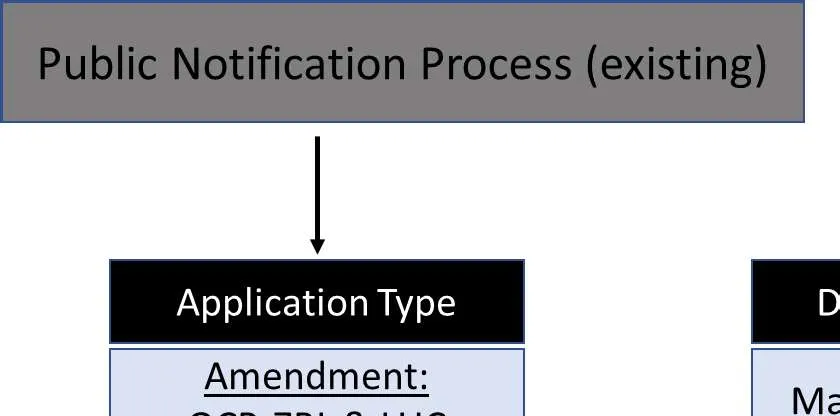
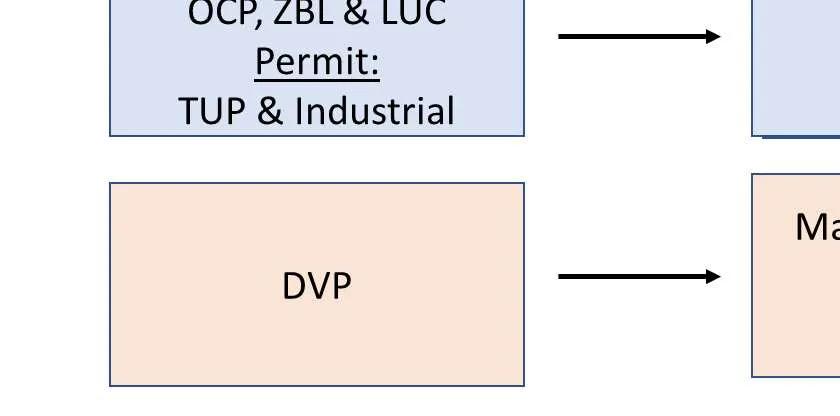
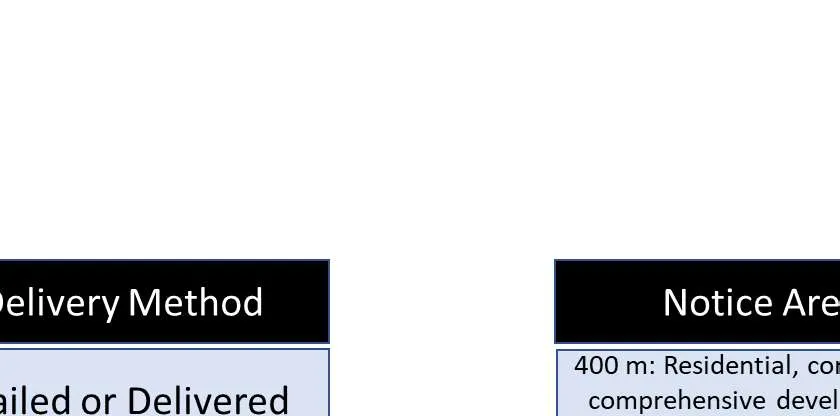
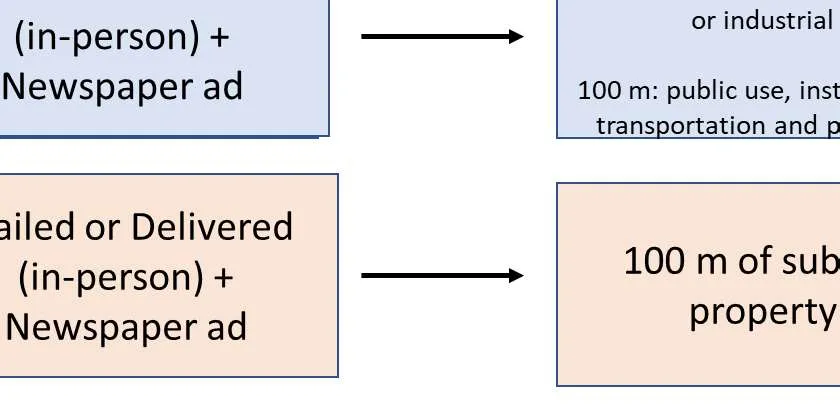
*OCP: Official Community Plan ZBL: Zoning Bylaw LUC: Land Use Contract
New Process in Legislation Local governments now have the option to adopt their own public notice bylaw. Local governments may select two (or more) publication methods that are the most appropriate for their community to provide notice and to notify for a public hearing. Possible methods for notification may include a website, an online newspaper, or direct mail out.
View Royal’s current notification methods are inconsistent with neighbouring municipalities with respect to distance to notify. Distance to notify is typically 100 m for applications, in some instances View Royal’s notification distance is 400 m.
2. Public Hearing Requirements for Rezoning
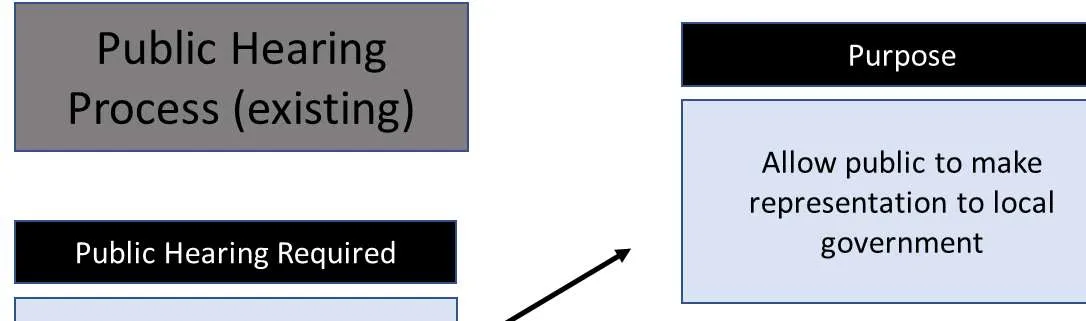
View Royal’s Public Hearing Process View Royal’s current public hearing process (Figure 2) allows Council to waive a public hearing where the local government has an Official Community Plan (OCP) in effect for their area, and the application is consistent with the Zoning Bylaw and the local government’s OCP. This allows applications for a rezoning to have the public hearing waived so long as there is consistency between the Zoning Bylaw and OCP. Fundamentally, the intent of a public hearing is to allow the public to make representation to their local government and for Council to gain better insight into the public interests of their community (stakeholders, general public, developers, neighbourhood associations).
FIGURE 2
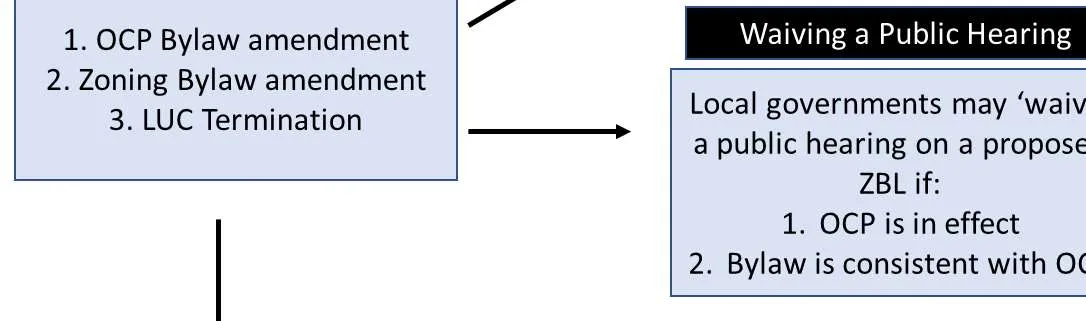
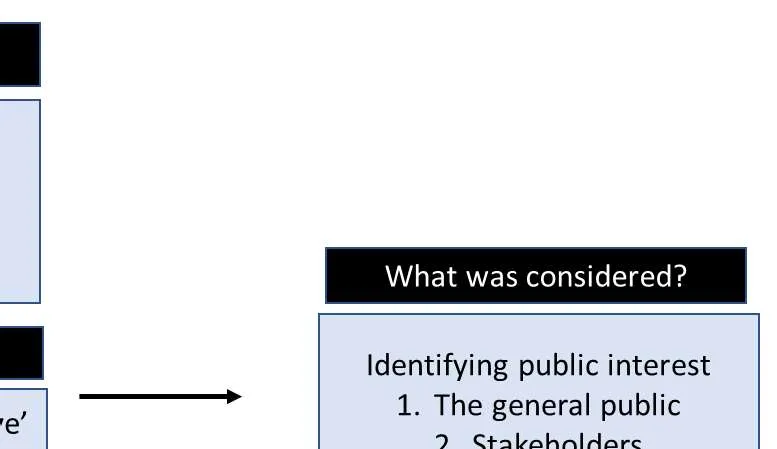
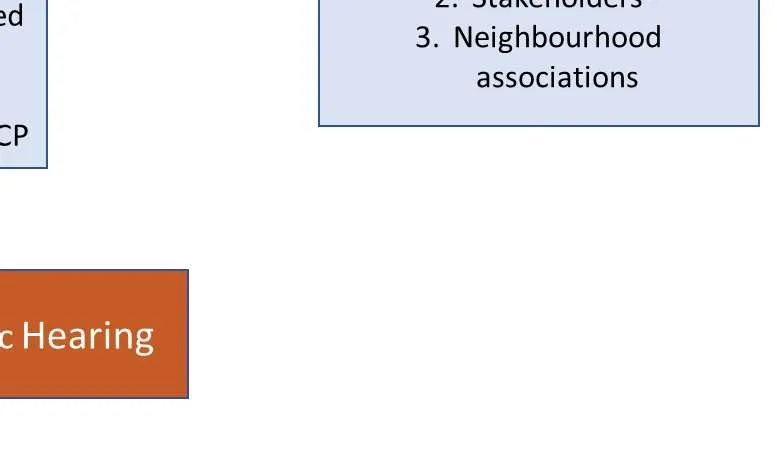
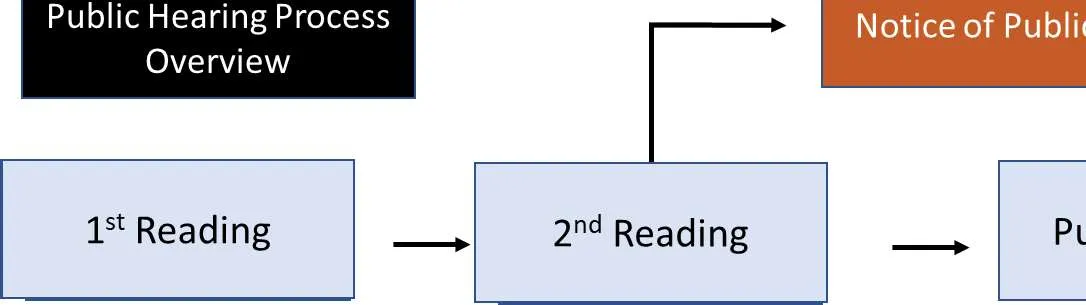
Should Council elect that a public hearing be held or waived, a notice of public hearing, or a notice that the public hearing has been waived, is sent out after 2nd reading of the bylaw amendment.
New Process in Legislation The new legislation now reads that a local government is ‘not required’ to hold a public hearing where the bylaw is consistent with the OCP, where previously they could elect to waive a hearing. Effectively, this means that Councils are no longer required to host a public hearing by default. Moving forward, should Council decide to host a public hearing, they must elect to do so. The process to hold a public hearing will follow the existing process. Should no public hearing be held, advanced notice must be sent out prior to first reading to ensure that the public is aware of the bylaw to be considered. The notice must include an overview of the proposal and the date of the first reading.
In understanding View Royal’s current notification process, outlined above in Figure 1, the change to public hearing requirements will have minimal effect in the processing time because of the method of notification and the distances used to notify. If the intent is to speed up the review process for public hearings in View Royal, Council should consider the timing implications and methods of notification delivery currently used for possible improvement as these are barriers. A decision regarding the public hearing now must be made by Council earlier in the review process than has been done previously in the past.
3. Delegation of Authority to Staff to Approve Minor Variances
Existing Process Owners previously have two methods by which they can seek a variance to a zoning bylaw. The first is through a Development Variance Permit (DVP), issued by Council. The process of requesting a DVP is in the applicant’s request to vary one or more provisions of a bylaw, including a zoning bylaw or sign bylaw. Variance requests cannot vary either use or density.
The second method is through a Board of Variance, whereby applicants apply to the Board for an order that grants a ‘minor’ variance. The Board’s primary function is to provide an avenue of relief for persons seeking a variance from particular provisions of a bylaw that the applicant believes would cause undue hardship should they comply. The Board could determine what ‘minor’ variances encompassed; however, like local governments they cannot not vary either use or density.
New Process in Legislation The amendment enables local governments, by bylaw, to delegate authority to issue DVPs to its officers or employees for minor variances. Like the changes to public hearing requirements discussed above, the intent of the change is to increase local government’s review and processing times for application in the hope to see an increase in the provision of housing. The scope of a minor variance stated in the legislation includes:
- siting, size and dimensions of buildings including, structures and permitted uses
- e.g., the size of a secondary suite;
- off-street parking and loading requirements
- e.g., the number of parking spaces;
- the regulation of signs
- e.g., the size of a sign; and
- screening and landscaping for the purposes of masking or separating uses or to preserve, protect, restore, and enhance the natural environment
- e.g., the type of landscaping materials.
The option to apply to a Board of Variance remains an option.
NEXT STEPS:
Should Council have an interest in making changes to the items discussed above, staff would be required to come back to Council with draft bylaw amendments for their consideration. The Town’s existing Development Procedures Bylaw, No. 730, 2009 would be subject to future amendments and would be subject to the following changes:
- Public notification methods
- Public notification distances
- Public hearing requirements
- Minor variance delegation to municipal employees and or officers
Staff are looking to provide the Committee with an opportunity to provide feedback so that Staff may gain insight into potential bylaw amendments for the future.
The Committee may consider the following items as a starting point for potential discussion in review of the changes through legislation:
- Are the Town’s current notification methods effective in engaging with the public?
- Are the Town’s current notification distances effective in notifying the public of current development activities and files?
- Does Council see benefit or improvements with the delegation of authority to staff for minor variances?
Staff will provide a separate report with recommendations to update Development Procedures Bylaw No. 730, 2009:
- with regards to public notification;
- to incorporate public hearing procedures that are consistent with new legislation; and
- to delegate authority to staff for minor variances.
In conclusion, Staff seek to amend the Development Procedures Bylaw to be compliant with the new legislation. Changes to legislation regarding public notification and minor variance delegation authority provide additional tools for Council and staff to improve efficiencies. With respect to public hearing requirements, new legislation has made the existing process for the Town non-compliant. The Development Procedures Bylaw must be updated to facilitate this change. Public hearings are no longer required by default; however, Council may elect to continue hosting public hearings. This decision can be made in advance at a Committee of the Whole Meeting.
RECOMMENDATION:
THAT the Committee receive the July 6, 2022 report titled “Bill 26 Amendments” from the Community Planner for information.
SUBMITTED BY: S. Scory, Community Planner
REVIEWED BY: L. Chase, Director of Development Services
Document Images
(4)