OFF-STREET PARKING REVIEW REPORT
Comprehensive staff report reviewing current parking regulations and recommending demand management strategies.
TOWN OF VIEW ROYAL COMMITTEE OF THE WHOLE REPORT
TO: Committee of the Whole DATE: July 7, 2021 FROM: J. Davison, MCIP RPP, Community Planner MEETING DATE: July 13, 2021
OFF-STREET PARKING REVIEW
RECOMMENDATION
THAT the report dated July 7, 2021 from the Community Planner titled “Off-Street Parking Review” be received for information.
CHIEF ADMINISTRATIVE OFFICER’S COMMENTS
I concur with the recommendation.
DIRECTOR OF DEVELOPMENT SERVICES’ COMMENTS
I concur with the recommendation.
DIRECTOR OF ENGINEERING’S COMMENTS
I concur with the recommendation.
PURPOSE OF REPORT
This report addresses Action List Item C-091-19 from June 18, 2019:
THAT staff undertake a comprehensive review of parking regulations (both cash-in-lieu provisions and general parking) with the intention of better meeting the Town's parking needs now and into the future.
This report will provide background information about parking regulation, and then will make recommendations regarding approaches to a parking regulation strategy which serves to help View Royal reach its Official Community Plan goals in an efficient, effective, and sustainable manner. It explains that parking regulations put in place by a local government are conscious decisions designed to help meet diverse goals rather than simply tools to enable minimum functional parking standards.
There are many indicators, measures, studies, and examples the Town can use to determine a more appropriate and targeted parking provision than the current system, which is a ‘one size fits all’ regulation regardless of where a development may be in the Town, or in what development context it may sit. This report will make recommendations regarding a more sophisticated estimation of the parking need for various land uses in given locations.
BACKGROUND
The current off-street parking regulations within Zoning Bylaw No. 900, 2014 were updated when that bylaw was adopted almost 7 years ago. They include a payment-in-lieu scheme which allows a developer an as-of-right option to provide up to 15% of required parking in cash. These funds go to the Town’s cash reserves for providing public parking facilities or alternate transportation infrastructure. More recently the Town has amended its parking regulations to include electrified space requirements for new residential and commercial development.
The current parking regulations often lead to requests for parking variances from developers and one-off discussions supported by parking studies which often come to the same conclusions: some development contexts and their provision of measures which encourage non-vehicular mobility often justify less parking provision than our Zoning Bylaw requires. Instead of repeating costly and time-intensive variance processes, incorporating these measures into the Town’s regulations would establish better and more consistent expectations for all stakeholders in advance of a rezoning or Development Permit process.
PROJECT INFORMATION
At their most basic, off-street parking regulations are designed to ensure that adequate parking is supplied on a given lot for a given use. A functional balance would prevent both excessive spillover into adjacent streets and wasteful swaths of unused pavement. Parking regulations have historically served the peak use case, where the parking provided should meet the times of most intense use. The traditional approach is to want to ensure that at least enough parking is described in the parking regulations within bylaws, rather than expressing concern that too much parking may be proposed. While some issues are solved with the provision of adequate peak time demand, the provision of parking can have a large impact on the broader economic, environmental, social, and aesthetic aspects of a municipality.
Far from being a technical matter best reserved for traffic engineers, parking requirements are a policy choice that lies at the intersection of land use and transportation planning…By favouring private vehicle transportation, parking reduces the competitiveness of other travel modes such as transit. It leads to a one-dimensional transportation system based on private vehicles that is not resilient in the face of disruptions such as energy crises or requirements to reduce greenhouse gas emissions. (Willson – Parking Reform Made Easy, 2013)
Excessive, or even traditionally ‘adequate’ parking supply affects design and urban form by shaping site design, lowering density, and contributing to sprawl. It affects economic development by influencing the cost of development, business formation and expansion, and ongoing operations. Environmental sustainability is directly and indirectly impacted by encouraging private vehicle use and lowering density and increasing greenhouse gas emissions and other air and water pollution. Parking favours those who can afford or have the physical and mental ability to operate private vehicles.
When a parking situation becomes inconvenient, unappealing, or intolerable people start to make other choices, and those choices become easier when there are viable alternatives available. Transit, walking, cycling, carpooling, altering schedules and other demand management strategies are regularly referenced as being conducive to a more sustainable urban environment and key tools for meeting greenhouse gas emissions reductions.
A smart approach for a municipality is to see parking regulation as being a policy decision and part of a larger mobility strategy that strives to meet the policy goals of an Official Community Plan. Rarely should parking requirements be considered in a vacuum; they should always consider the context of the land uses they are serving.
Evolving Parking Approaches as Municipalities Grow
Parking needs evolve as density increases. The Town of View Royal is running out of ‘greenfield’ development space and is now increasing density through infill development. The table below identifies parking issues and the range of approaches typical of a suburban to urban environment. In this scenario, it could be said that View Royal is moving towards a ‘transitioning’ parking environment in certain locations from what was a ‘suburban’ context.
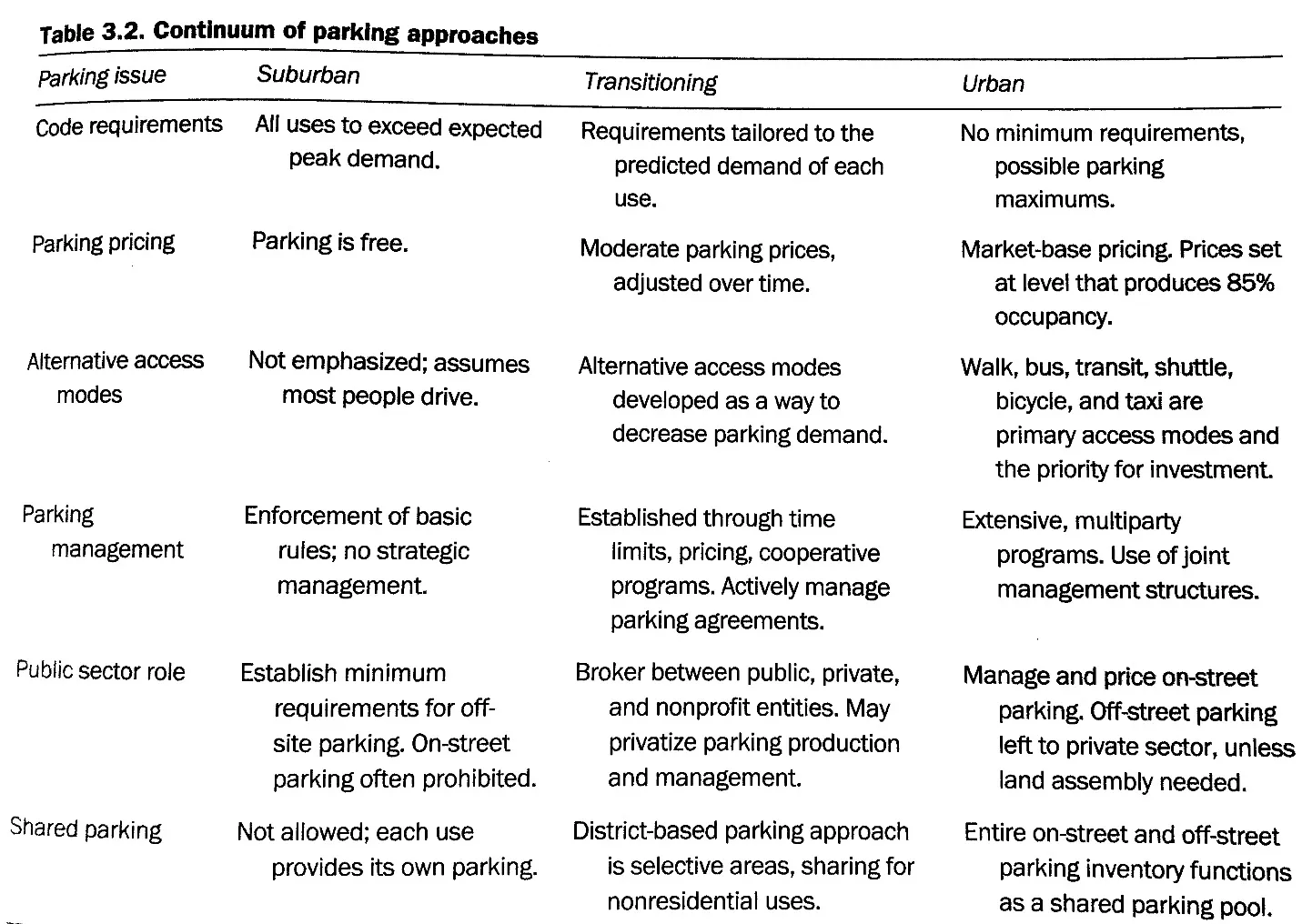
Table 3.2. Continuum of parking approaches
| Parking issue | Suburban | Transitioning | Urban |
|---|---|---|---|
| Code requirements | All uses to exceed expected peak demand. | Requirements tailored to the predicted demand of each use. | No minimum requirements, possible parking maximums. |
| Parking pricing | Parking is free. | Moderate parking prices, adjusted over time. | Market-base pricing. Prices set at level that produces 85% occupancy. |
| Alternative access modes | Not emphasized; assumes most people drive. | Alternative access modes developed as a way to decrease parking demand. | Walk, bus, transit, shuttle, bicycle, and taxi are primary access modes and the priority for investment. |
| Parking management | Enforcement of basic rules; no strategic management. | Established through time limits, pricing, cooperative programs. Actively manage parking agreements. | Extensive, multiparty programs. Use of joint management structures. |
| Public sector role | Establish minimum requirements for off-site parking. On-street parking often prohibited. | Broker between public, private, and nonprofit entities. May privatize parking production and management. | Manage and price on-street parking. Off-street parking left to private sector, unless land assembly needed. |
| Shared parking | Not allowed; each use provides its own parking. | District-based parking approach is selective areas, sharing for nonresidential uses. | Entire on-street and off-street parking inventory functions as a shared parking pool. |
Source: (Willson, 2013)
Being a ‘transitioning’ environment for parking identifies parking regulations as being tailored to the demand of each use, district-based parking (parking based on the demands of different densities and neighbourhoods) and sharing of peak time uses, such as those between residential and non-residential uses in mixed use areas. Those changes can be addressed using various established parking management strategies.
Parking Management Strategies
For the scope of this report there are three major parking management strategies for the Town to consider:
- Required Parking for Land Uses This is the required parking space for each use within the Town of View Royal, regulated within the Zoning Bylaw and typically measured in spaces per dwelling unit for residential and spaces per square meter of floor area for commercial, industrial, and institutional spaces. Sometimes they can be measured in other ways, such as seating capacity for churches or beds for care facilities.
- Supply-side Parking Management This approach involves increasing areas dedicated to parking by changing the requirements for what constitutes a parking space, or sharing spaces with different peak demand, and so forth.
- Demand-side Parking Management This approach involves providing alternatives to private vehicle trips which leads to less demand for parking spaces. It can also be accepting cash-in-lieu for parking provision, among other things.
Parking in View Royal
As a local government which has recently declared a climate emergency and is facing continuing growth pressure and rapidly decreasing housing affordability, the Town of View Royal could look more carefully at the policy implications of its parking regulations as they work to accomplishing the Town’s stated goals within the Official Community Plan (OCP). Changes in attitudes and behaviours are highlighted as a necessity to slow global warming. It is recommended that the Town begin to look at changes to parking regulations as a necessary step that provides benefit and accepts compromises to achieve the OCP goals. While much of the discussion around progressive planning practise is focused on demand-side management strategies of transit, active transportation, walkable neighbourhoods, etc., all three parking management strategies described above can be effective in enabling land uses in a Suburban to Transitioning environment such as View Royal.
Employing Strategy #1 – Changes to Required Parking
Currently the Town has a parking requirement based on the type of unit. This does not vary based on any context which may justify a reduction in the provided parking. A two-bedroom apartment requires 1.5 parking spaces regardless of its status as a rental building, a building which may provide affordable or below-market housing, a building which provides a car share service, a building which may be immediately adjacent to a major employment centre, or a building which is next to a regional pathway or transit hub.
The Town would benefit from identifying different parking standards for the same land use in certain circumstances. With the Town’s increasing density of residences and commercial services the Town may consider moving to adopting some of the approaches in the ‘transitioning’ model for certain areas, meaning that in some contexts less parking would be required for a given use. The City of Victoria has a range of parking regulation, from traditional residential areas to village nodes, to the downtown core.
Recent parking studies submitted to the Town (and other jurisdictions’ studies) have identified different requirements for parking based on types of land uses. The Town could consider adjusting parking requirements based on the following:
- Rental housing requires fewer parking spaces per unit. Lowering parking requirements for purpose-built rental could be considered; it is often recommended that rental units require 0.5-1 space per rental unit, regardless of the number of bedrooms.
- Designated affordable or below-market housing requires fewer parking spaces per unit. The City of Victoria has shown that below-market units have a 40% reduction in parking demand compared to strata units.
- Proximity to transit and to regional pathways could be included in a parking reduction allowance.
- Parking within proximity of growth nodes in the Town, such as adjacent to the Hospital/Eagle Creek, Island Highway/Helmcken, Admirals Walk etc. could be included in a parking reduction allowance.
- The Town’s recent Land Economics Study by Coriolis Consulting Corp identifies reduced parking requirements as a means to improve the economics of mixed-use apartment and commercial development. Often the additional costs associated with providing parking outweigh the value created by additional office density. The Town could consider reducing the off-street parking requirements, particularly for commercial uses, to incentivise such projects.
Employing Strategy #2 – Supply-Side Parking Management
The Town’s current secondary suite parking requirements are among the most directly impactful regulations determining the provision of a land use in the Town and a good example of suburban-style supply-side parking management. If there is no ability for a homeowner to provide three non-tandem, non-garage off-street parking spaces, currently, they are not permitted to have a secondary suite on their property. The provision of housing is, in a very real sense, dictated by private vehicle provision. A parking space for a car is placed in higher priority than a living space for people.
The illustration below, from the Zoning Bylaw, shows that while there are four configurations of parking that are off the road surface, only one meets the parking requirement. This regulation does not permit the provision of garage space, whereas both spaces for a detached residence with no suite can be provided within a garage.
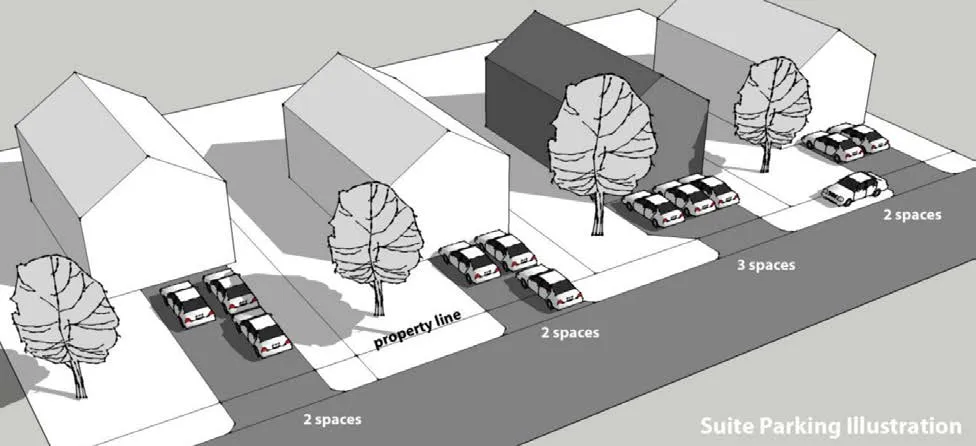
Relating to the above illustration, the Town could increase the supply of housing in the municipality, and increase housing affordability for those who could otherwise install secondary suites in their houses, merely by adopting one or more of the following changes to the current secondary suite parking regulations:
- Removing the ‘non-tandem’ requirement for suite parking. There is no requirement for non-tandem parking in detached residential dwellings without a suite, and it is a common practise for homeowners with multiple vehicles. It makes for a more efficient use of property and is not inconveniencing anyone except the homeowner.
- Permitting suite parking to use driveway space within the boulevard. It is an efficient use of an otherwise wasted space, in an environment where it is only used by the homeowner.
- Permitting suite parking in boulevard space adjacent to the property.
- Permitting garage spaces to be counted towards parking provision for secondary suites.
Another supply-side policy which could be adopted in regulation is sharing parking spaces for separate uses on a site which do not share peak parking demands. An example could be a church parking use with a heavy peak parking demand on a Sunday, and a daycare or recreational parking use during weekdays. In a mixed residential/commercial building daytime parking scenario, commercial uses during the daytime could be used for residential parking in the evening to serve commuters returning home, or visitor spaces on a weekend occupying office space used Monday to Friday. It makes practical sense to share these uses rather than providing parking for both peak use cases on-site and increasing available space for non-parking uses.
Demand Side issues in View Royal
The Town has been engaged in or has benefitted from managing demand-side parking in View Royal for some time, with varying successes. Some of those include:
- The payment-in-lieu scheme for provision of up to 15% of required commercial and attached residential parking spaces.
- The creation and enhancing of regional pathways (E&N, Galloping Goose) to enable active transportation through the Town and region.
- The creation of bike lanes along collector roads within View Royal, either as capital projects or through frontage improvements and servicing agreements within the development process.
- The recent creation of electric bicycle parking facilities regulations for new construction, which will hopefully encourage people to utilize the tremendous potential held in electric bicycles and the regional pathways in View Royal.
- Supporting regional active transportation initiatives such as Bike to Work Week.
A recent parking study by Bunt and Associates has concluded the following regarding the appropriate amount of parking space reduction based on Transportation Demand Management Measures:
| TDM Measure | Approximate Space Reduction |
|---|---|
| Transit Passes | 10% |
| Carshare | 20% |
| Bikeshare | 2% |
The Town should consider parking requirement reductions based on any proposed TDM measures incorporated into a development, including those previously mentioned: carshares, bikeshares, transit passes, and so forth.
Other Parking Issues
In addition to the parking management strategies, Council has expressed an interest over the years in establishing regulation for visitor parking standards and accessible parking locations. Other things to consider could be more refined regulations regarding locations and requirements for parking in EV charging stations, special interest parking regulations (spaces for families with small children and pickup of online orders, etc) and other issues which occasionally come forward.
DISCUSSION
Given the issues raised in this report there are several issues for Council to turn their attention to, and provide feedback on, regarding parking provision in new developments:
- Is Council interested in exploring differential parking regulations for areas such as development nodes, growth areas, transportation hubs and other areas which are shown to require less parking than the current minimum standard?
- Is Council willing to consider reductions in parking requirements for purpose built rental and/or below-market housing land uses?
- Is Council interested in taking the Coriolis Consulting recommendations regarding providing less parking for residential and commercial land uses to benefit the economic viability of certain projects?
- Is Council open to amending suite parking regulations as described in this report?
- Is Council interested in considering allowing shared parking spaces for different uses, such as mixed use residential/commercial properties, or daycares and church properties, and similar?
- Is Council interested in establishing reduced parking requirements for developments which propose traffic demand management measures such as transit passes, car shares, bike shares, etc?
CONCLUSION
Staff sees an opportunity with the provision of parking to not only assist the Town in its increased focus on the stated Climate Emergency, but also to view it as a policy question rather than a minimum functional standard. There are opportunities for increased efficiencies and contributions to the vitality of the built environment, to commerce, to quality-of-life improvements and to the viability of development projects providing living and working spaces for View Royal residents. As View Royal grows and intensifies, so must its recognition that mobility within the municipality will evolve over time.
NEXT STEPS
Staff will take the recommendations within this report and draft bylaw amendments for Council to consider at an autumn session of Council.
RECOMMENDATION
THAT report dated July 7, 2021 from the Community Planner titled “Off-Street Parking Review” be received for information.
Document Images
(3)