Attachment A: An Administrative Work Plan for the Town of View Royal (November 2003)
A historical consultant report reviewing the Town's administrative policies, committee structure, and human resources practices.
An Administrative Work Plan for the Town of View Royal
November 2003
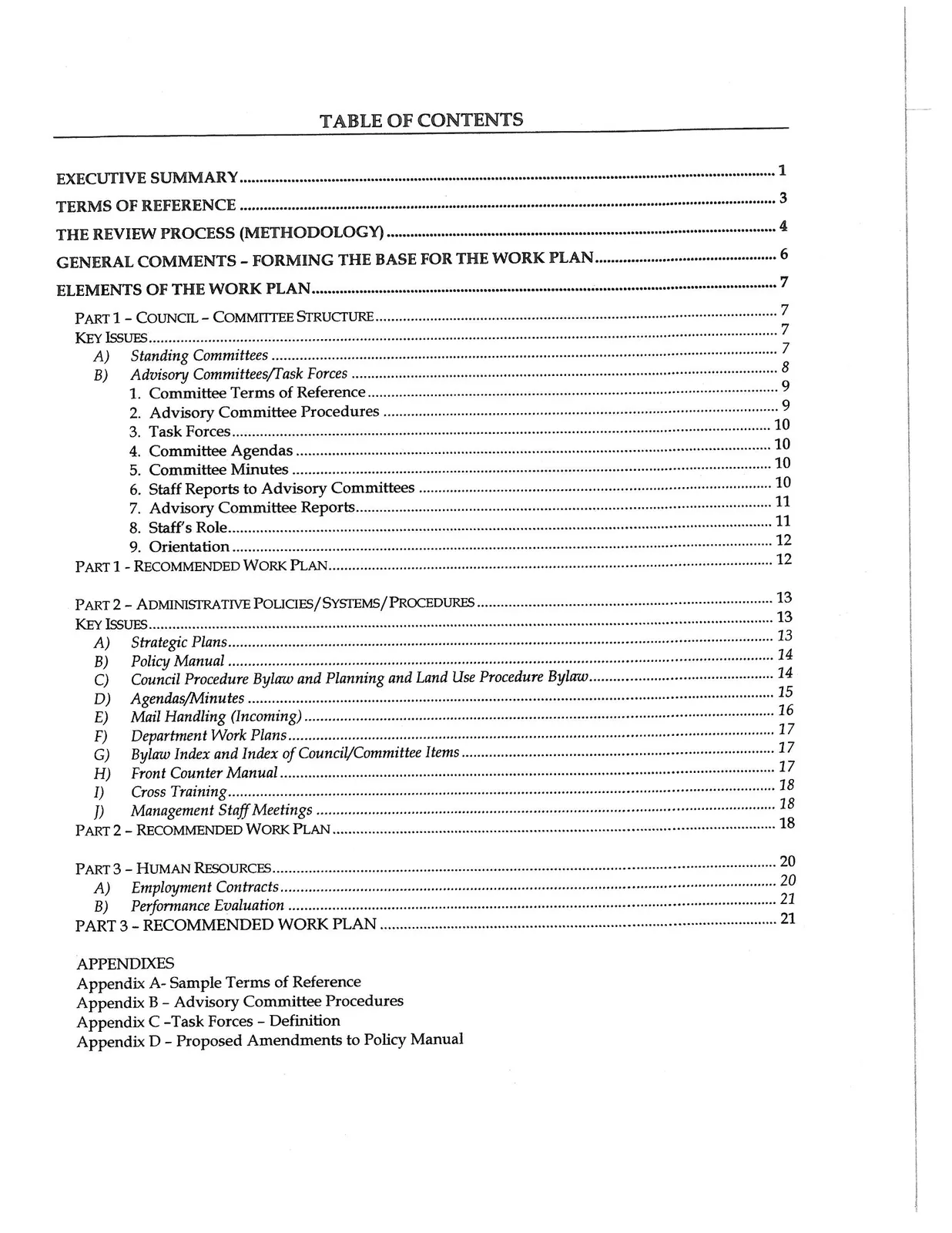
TABLE OF CONTENTS
- EXECUTIVE SUMMARY - 1
- TERMS OF REFERENCE - 3
- THE REVIEW PROCESS (METHODOLOGY) - 4
- GENERAL COMMENTS – FORMING THE BASE FOR THE WORK PLAN - 6
- ELEMENTS OF THE WORK PLAN - 7
- PART 1 – COUNCIL – COMMITTEE STRUCTURE - 7
- KEY ISSUES - 7
- A) Standing Committees - 7
- B) Advisory Committees/Task Forces - 8
- Committee Terms of Reference - 9
- Advisory Committee Procedures - 9
- Task Forces - 10
- Committee Agendas - 10
- Committee Minutes - 10
- Staff Reports to Advisory Committees - 10
- Advisory Committee Reports - 11
- Staff’s Role - 11
- Orientation - 12
- PART 1 – RECOMMENDED WORK PLAN - 12
- PART 2 – ADMINISTRATIVE POLICIES/SYSTEMS/PROCEDURES - 13
- KEY ISSUES - 13
- A) Strategic Plans - 13
- B) Policy Manual - 14
- C) Council Procedure Bylaw and Planning and Land Use Procedure Bylaw - 14
- D) Agendas/Minutes - 15
- E) Mail Handling (Incoming) - 16
- F) Department Work Plans - 17
- G) Bylaw Index and Index of Council/Committee Items - 17
- H) Front Counter Manual - 17
- I) Cross Training - 18
- J) Management Staff Meetings - 18
- PART 2 – RECOMMENDED WORK PLAN - 18
- PART 3 – HUMAN RESOURCES - 20
- A) Employment Contracts - 20
- B) Performance Evaluation - 21
- PART 3 – RECOMMENDED WORK PLAN - 21
- PART 1 – COUNCIL – COMMITTEE STRUCTURE - 7
APPENDIXES
- Appendix A- Sample Terms of Reference
- Appendix B – Advisory Committee Procedures
- Appendix C –Task Forces – Definition
- Appendix D – Proposed Amendments to Policy Manual
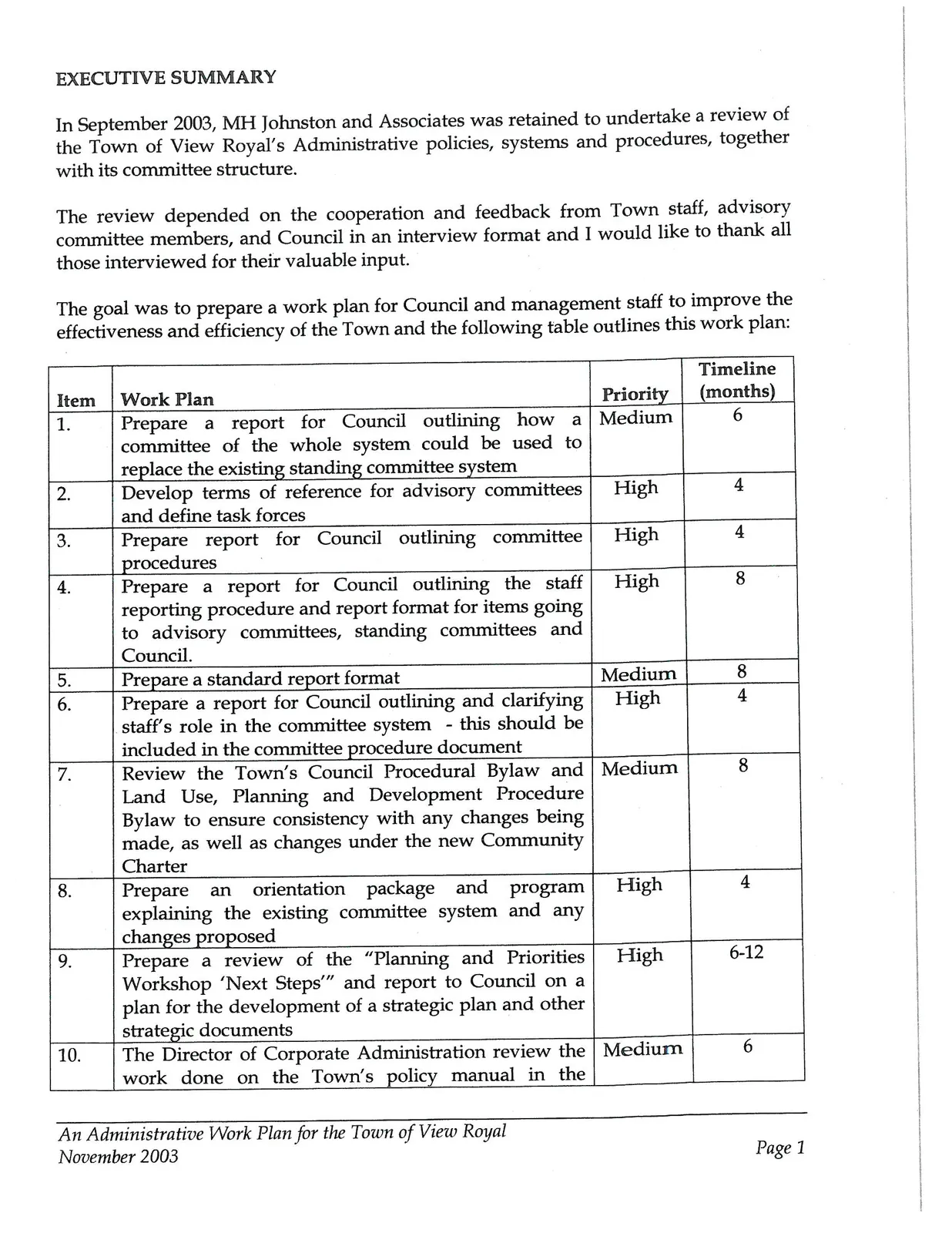
EXECUTIVE SUMMARY
In September 2003, MH Johnston and Associates was retained to undertake a review of the Town of View Royal's Administrative policies, systems and procedures, together with its committee structure.
The review depended on the cooperation and feedback from Town staff, advisory committee members, and Council in an interview format and I would like to thank all those interviewed for their valuable input.
The goal was to prepare a work plan for Council and management staff to improve the effectiveness and efficiency of the Town and the following table outlines this work plan:
| Item | Work Plan | Priority | Timeline (months) |
|---|---|---|---|
| 1. | Prepare a report for Council outlining how a committee of the whole system could be used to replace the existing standing committee system | Medium | 6 |
| 2. | Develop terms of reference for advisory committees and define task forces | High | 4 |
| 3. | Prepare report for Council outlining committee procedures | High | 4 |
| 4. | Prepare a report for Council outlining the staff reporting procedure and report format for items going to advisory committees, standing committees and Council. | High | 8 |
| 5. | Prepare a standard report format | Medium | 8 |
| 6. | Prepare a report for Council outlining and clarifying staff’s role in the committee system - this should be included in the committee procedure document | High | 4 |
| 7. | Review the Town’s Council Procedural Bylaw and Land Use, Planning and Development Procedure Bylaw to ensure consistency with any changes being made, as well as changes under the new Community Charter | Medium | 8 |
| 8. | Prepare an orientation package and program explaining the existing committee system and any changes proposed | High | 4 |
| 9. | Prepare a review of the “Planning and Priorities Workshop ‘Next Steps’” and report to Council on a plan for the development of a strategic plan and other strategic documents | High | 6-12 |
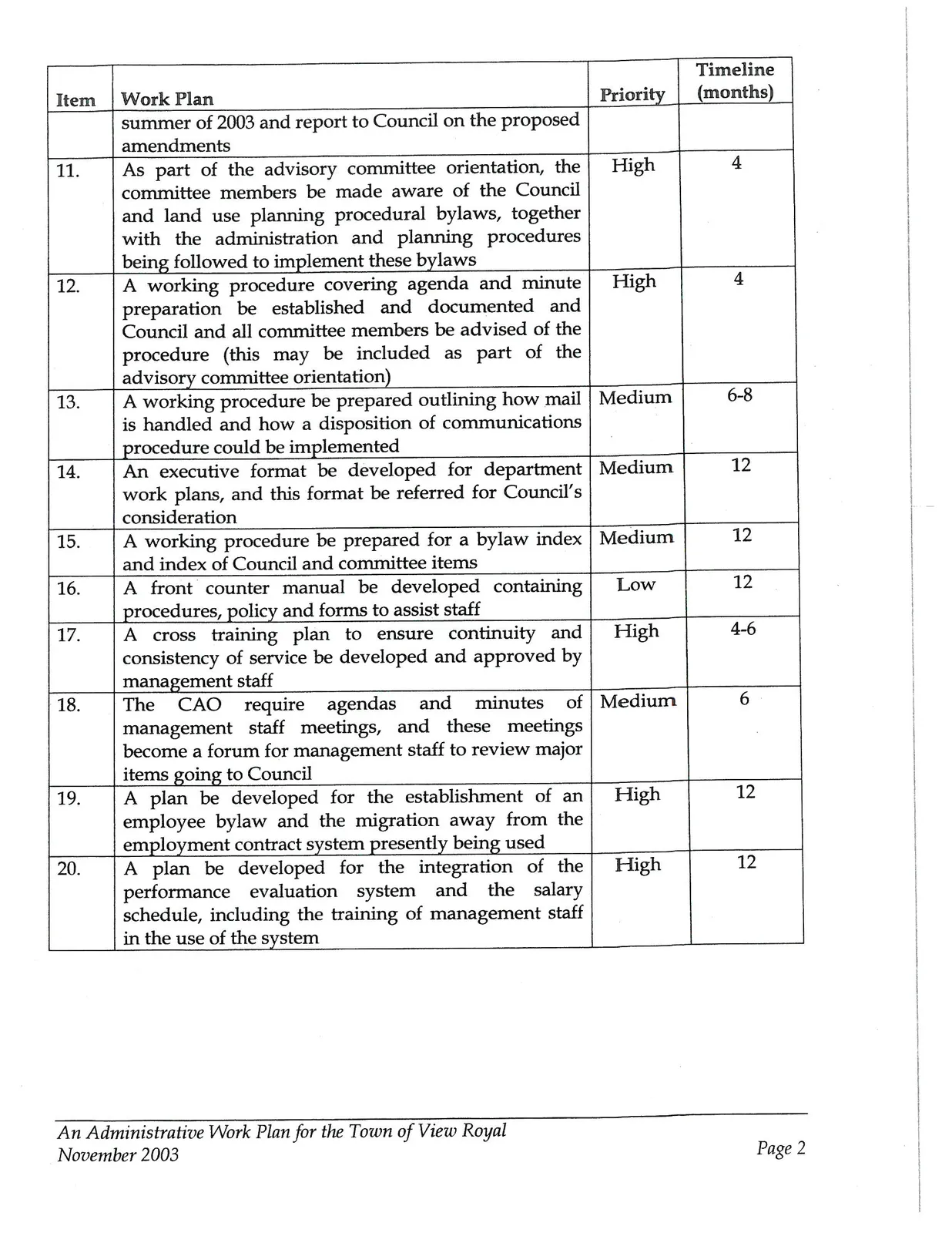
| 10. | The Director of Corporate Administration review the work done on the Town’s policy manual in the summer of 2003 and report to Council on the proposed amendments | Medium | 6 |
| 11. | As part of the advisory committee orientation, the committee members be made aware of the Council and land use planning procedural bylaws, together with the administration and planning procedures being followed to implement these bylaws | High | 4 |
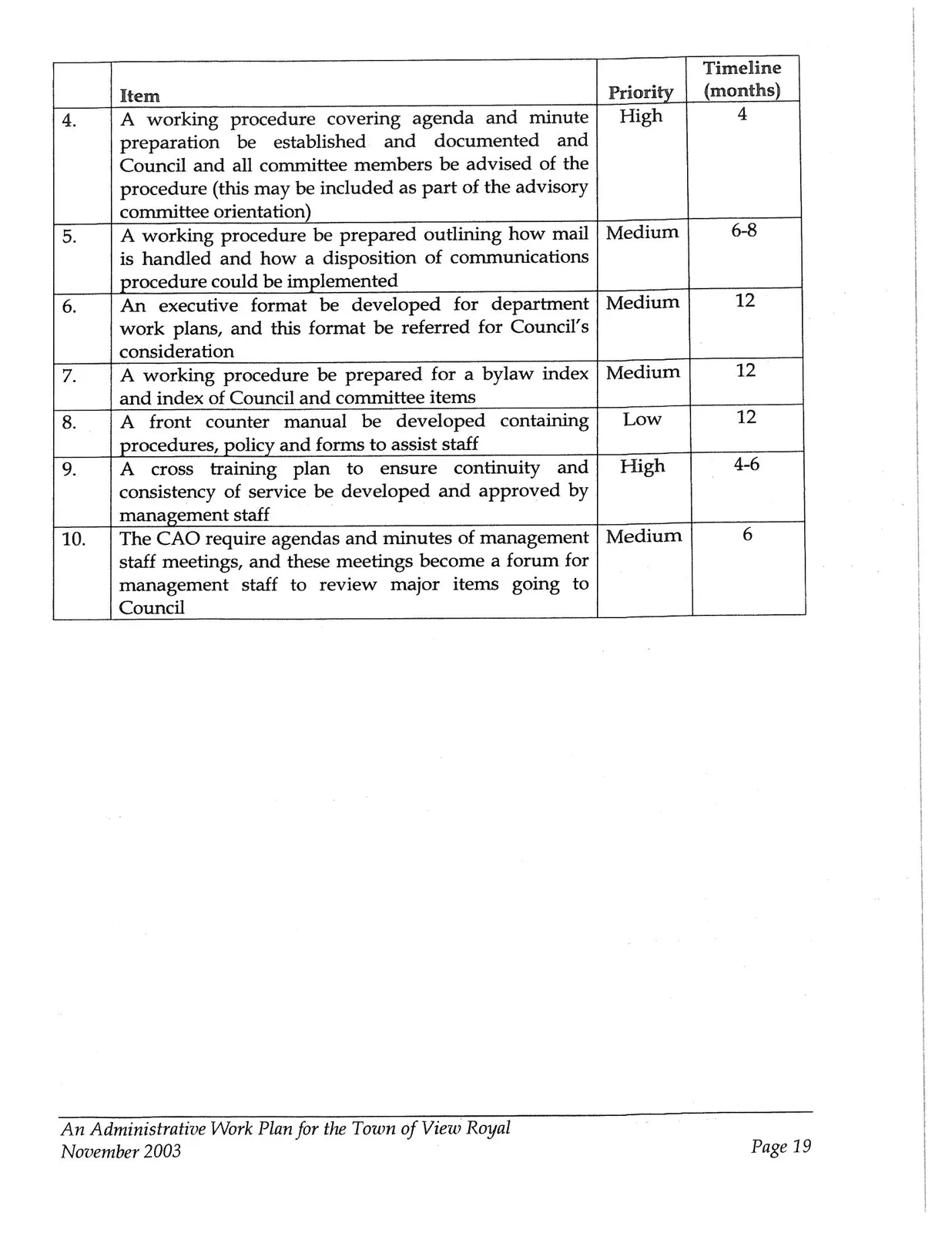
| 12. | A working procedure covering agenda and minute preparation be established and documented and Council and all committee members be advised of the procedure (this may be included as part of the advisory committee orientation) | High | 4 |
| 13. | A working procedure be prepared outlining how mail is handled and how a disposition of communications procedure could be implemented | Medium | 6-8 |
| 14. | An executive format be developed for department work plans, and this format be referred for Council’s consideration | Medium | 12 |
| 15. | A working procedure be prepared for a bylaw index and index of Council and committee items | Medium | 12 |
| 16. | A front counter manual be developed containing procedures, policy and forms to assist staff | Low | 12 |
| 17. | A cross training plan to ensure continuity and consistency of service be developed and approved by management staff | High | 4-6 |
| 18. | The CAO require agendas and minutes of management staff meetings, and these meetings become a forum for management staff to review major items going to Council | Medium | 6 |
| 19. | A plan be developed for the establishment of an employee bylaw and the migration away from the employment contract system presently being used | High | 12 |
| 20. | A plan be developed for the integration of the performance evaluation system and the salary schedule, including the training of management staff in the use of the system | High | 12 |
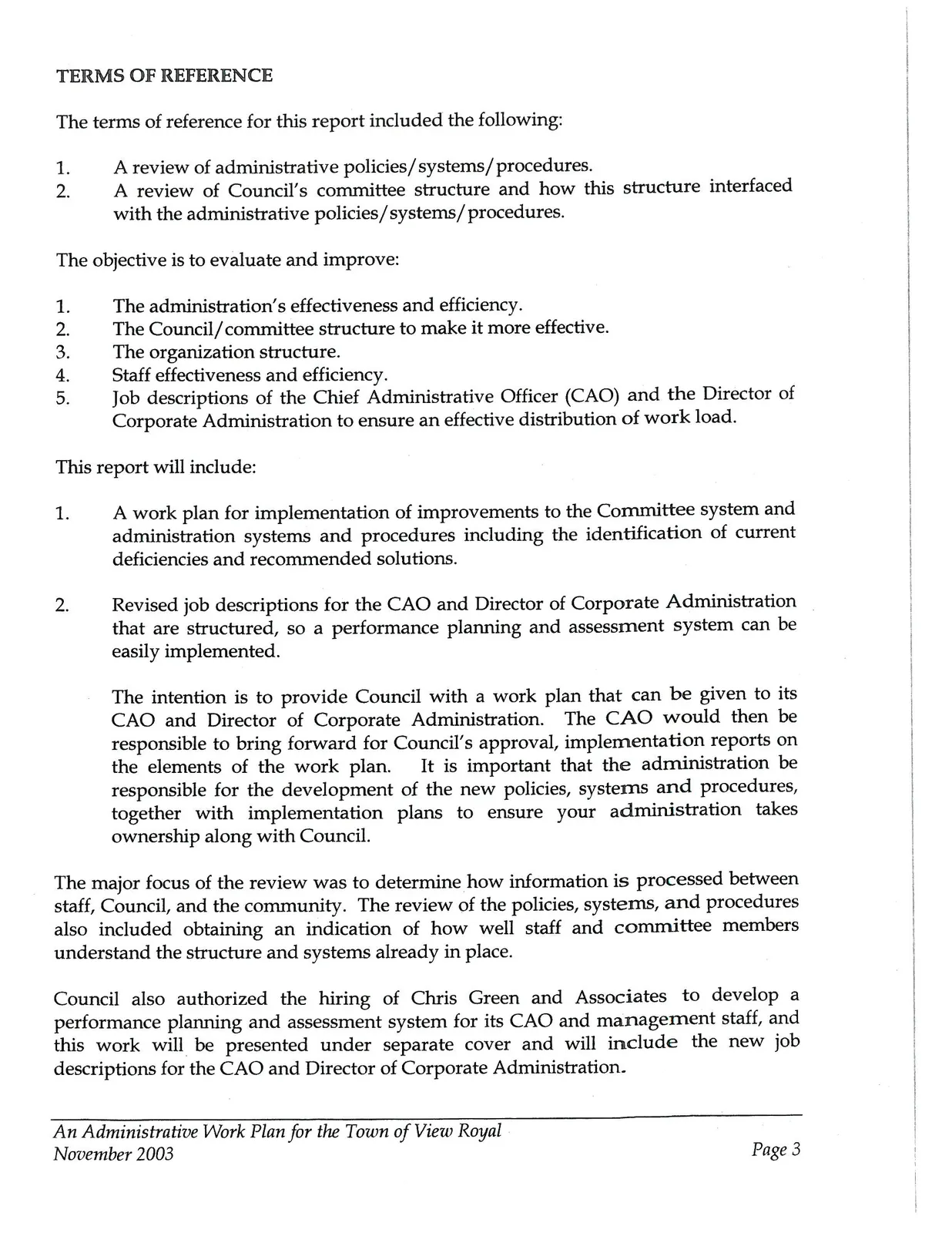
TERMS OF REFERENCE
The terms of reference for this report included the following:
- A review of administrative policies/systems/procedures.
- A review of Council’s committee structure and how this structure interfaced with the administrative policies/systems/procedures.
The objective is to evaluate and improve:
- The administration’s effectiveness and efficiency.
- The Council/committee structure to make it more effective.
- The organization structure.
- Staff effectiveness and efficiency.
- Job descriptions of the Chief Administrative Officer (CAO) and the Director of Corporate Administration to ensure an effective distribution of work load.
This report will include:
- A work plan for implementation of improvements to the Committee system and administration systems and procedures including the identification of current deficiencies and recommended solutions.
- Revised job descriptions for the CAO and Director of Corporate Administration that are structured, so a performance planning and assessment system can be easily implemented.
The intention is to provide Council with a work plan that can be given to its CAO and Director of Corporate Administration. The CAO would then be responsible to bring forward for Council’s approval, implementation reports on the elements of the work plan. It is important that the administration be responsible for the development of the new policies, systems and procedures, together with implementation plans to ensure your administration takes ownership along with Council.
The major focus of the review was to determine how information is processed between staff, Council, and the community. The review of the policies, systems, and procedures also included obtaining an indication of how well staff and committee members understand the structure and systems already in place.
Council also authorized the hiring of Chris Green and Associates to develop a performance planning and assessment system for its CAO and management staff, and this work will be presented under separate cover and will include the new job descriptions for the CAO and Director of Corporate Administration.
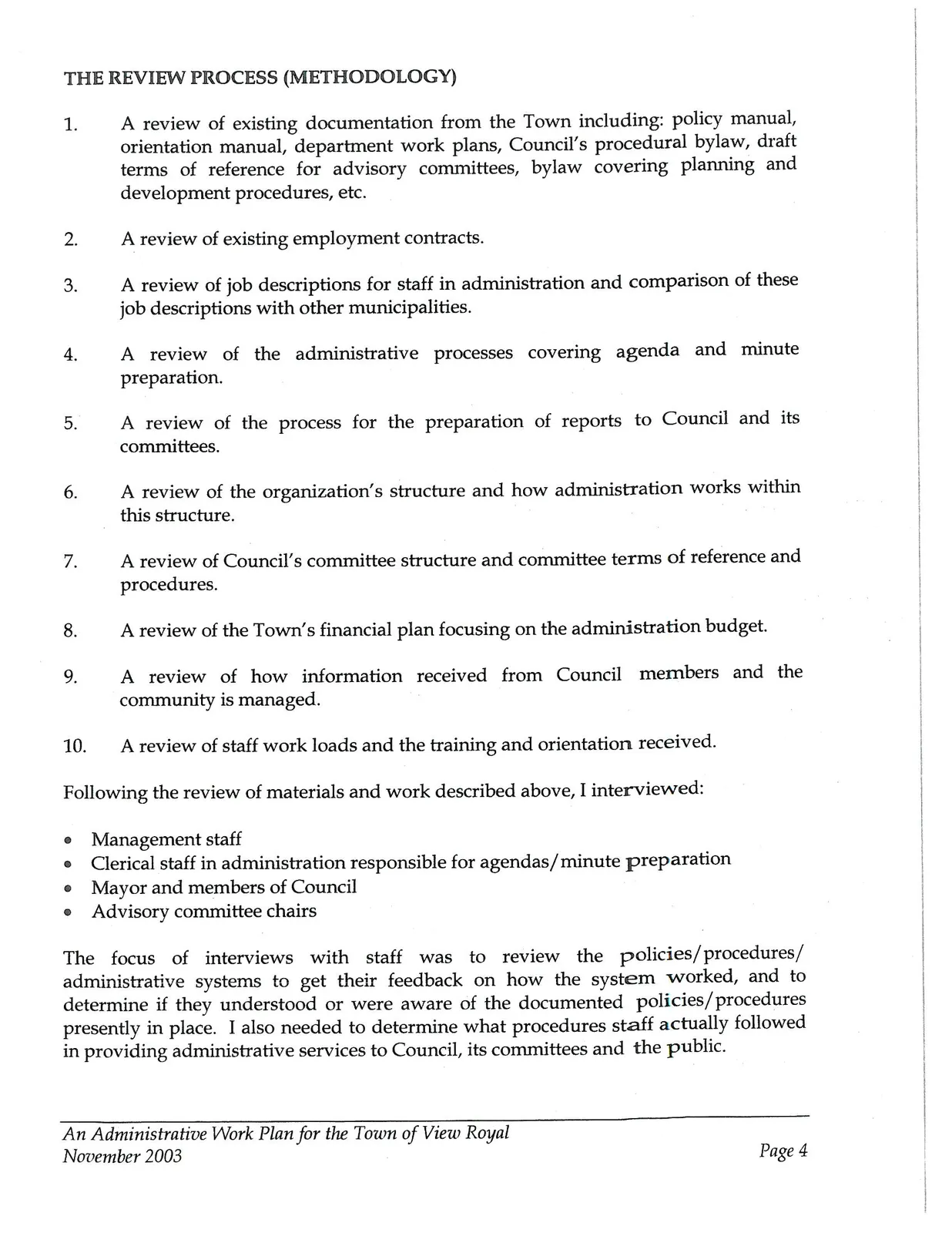
THE REVIEW PROCESS (METHODOLOGY)
- A review of existing documentation from the Town including: policy manual, orientation manual, department work plans, Council’s procedural bylaw, draft terms of reference for advisory committees, bylaw covering planning and development procedures, etc.
- A review of existing employment contracts.
- A review of job descriptions for staff in administration and comparison of these job descriptions with other municipalities.
- A review of the administrative processes covering agenda and minute preparation.
- A review of the process for the preparation of reports to Council and its committees.
- A review of the organization’s structure and how administration works within this structure.
- A review of Council’s committee structure and committee terms of reference and procedures.
- A review of the Town’s financial plan focusing on the administration budget.
- A review of how information received from Council members and the community is managed.
- A review of staff work loads and the training and orientation received.
Following the review of materials and work described above, I interviewed:
- Management staff
- Clerical staff in administration responsible for agendas/minute preparation
- Mayor and members of Council
- Advisory committee chairs
The focus of interviews with staff was to review the policies/procedures/administrative systems to get their feedback on how the system worked, and to determine if they understood or were aware of the documented policies/procedures presently in place. I also needed to determine what procedures staff actually followed in providing administrative services to Council, its committees and the public.
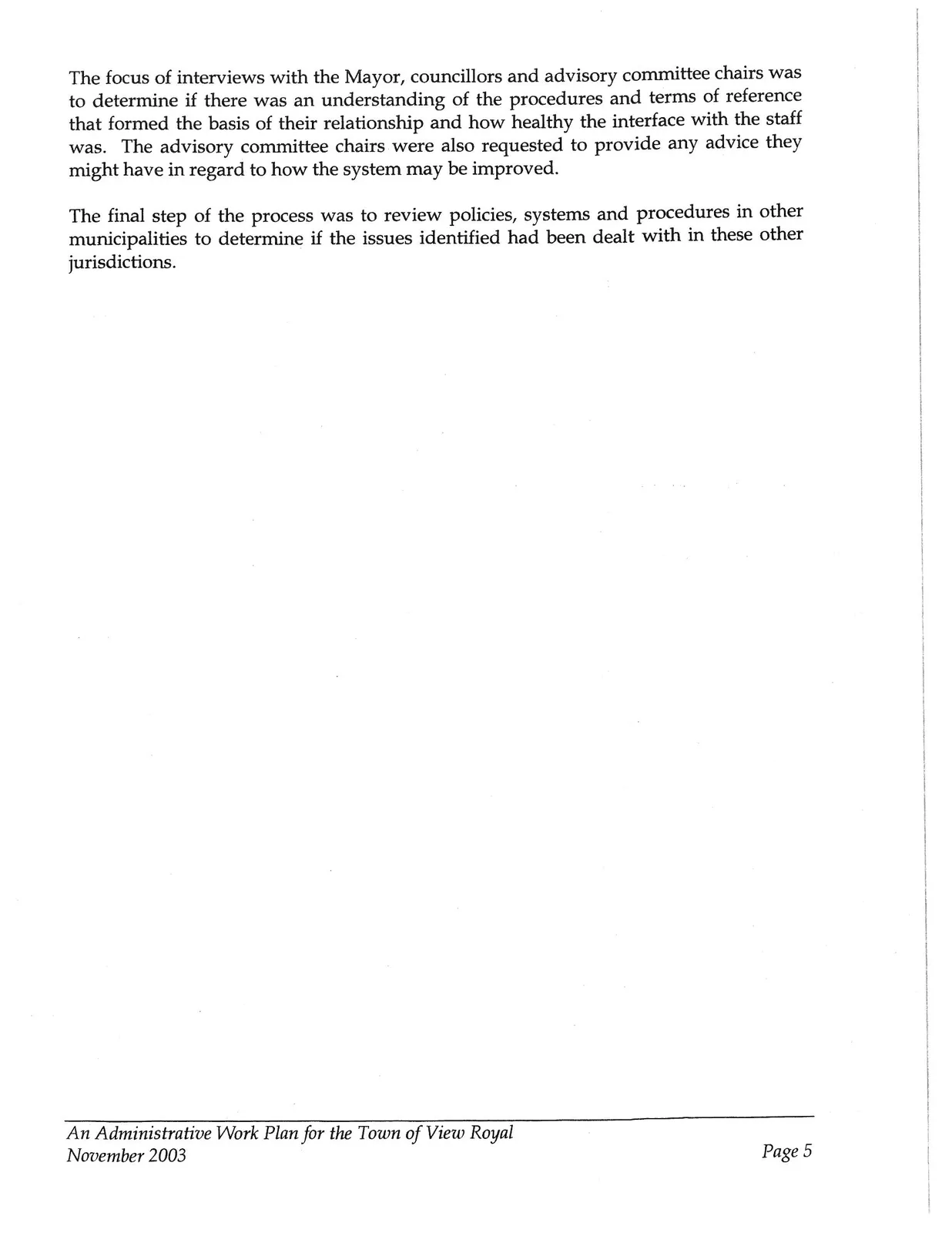
The focus of interviews with the Mayor, councillors and advisory committee chairs was to determine if there was an understanding of the procedures and terms of reference that formed the basis of their relationship and how healthy the interface with the staff was. The advisory committee chairs were also requested to provide any advice they might have in regard to how the system may be improved.
The final step of the process was to review policies, systems and procedures in other municipalities to determine if the issues identified had been dealt with in these other jurisdictions.
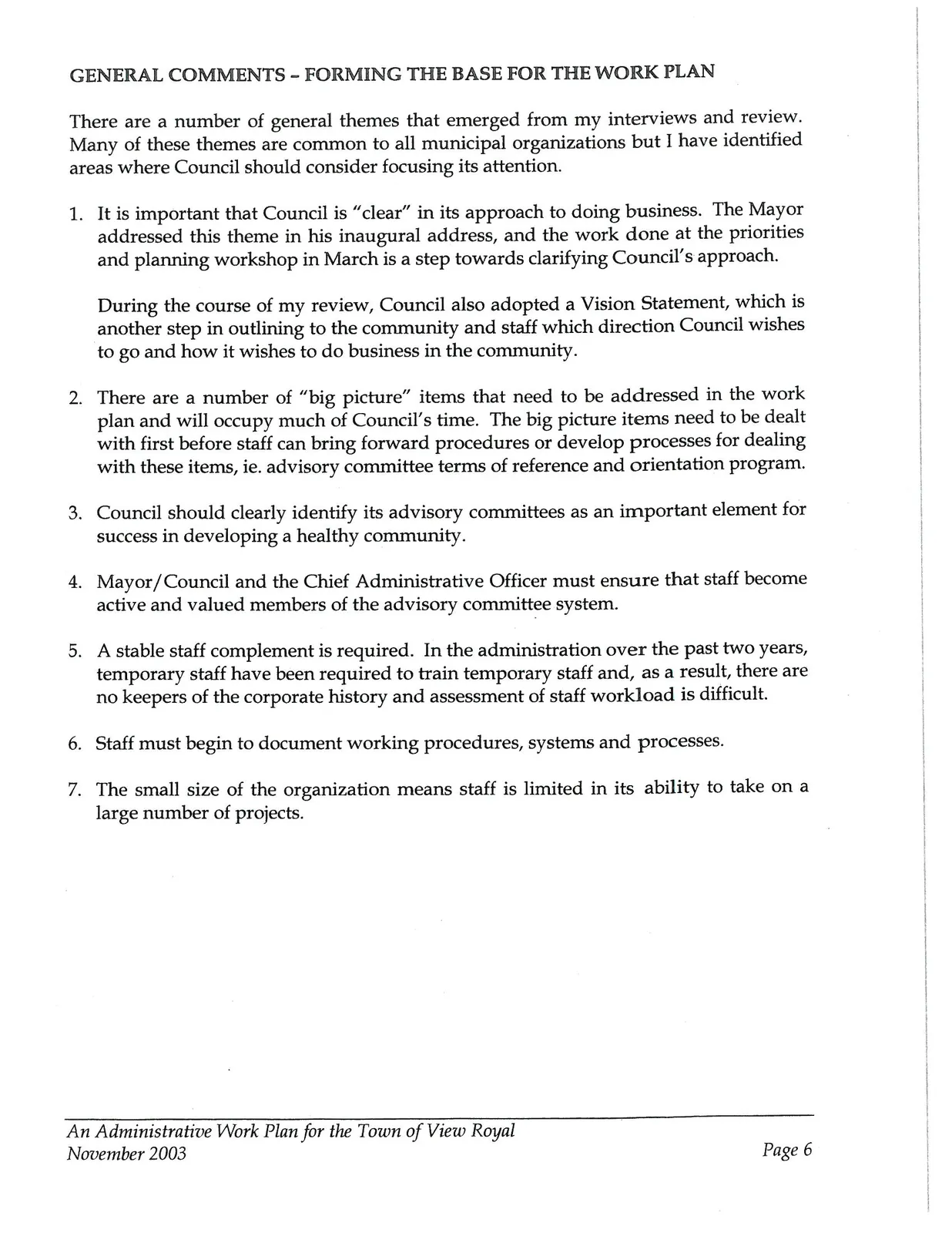
GENERAL COMMENTS - FORMING THE BASE FOR THE WORK PLAN
There are a number of general themes that emerged from my interviews and review. Many of these themes are common to all municipal organizations but I have identified areas where Council should consider focusing its attention.
It is important that Council is “clear” in its approach to doing business. The Mayor addressed this theme in his inaugural address, and the work done at the priorities and planning workshop in March is a step towards clarifying Council’s approach. During the course of my review, Council also adopted a Vision Statement, which is another step in outlining to the community and staff which direction Council wishes to go and how it wishes to do business in the community.
There are a number of “big picture” items that need to be addressed in the work plan and will occupy much of Council’s time. The big picture items need to be dealt with first before staff can bring forward procedures or develop processes for dealing with these items, ie. advisory committee terms of reference and orientation program.
Council should clearly identify its advisory committees as an important element for success in developing a healthy community.
Mayor/Council and the Chief Administrative Officer must ensure that staff become active and valued members of the advisory committee system.
A stable staff complement is required. In the administration over the past two years, temporary staff have been required to train temporary staff and, as a result, there are no keepers of the corporate history and assessment of staff workload is difficult.
Staff must begin to document working procedures, systems and processes.
The small size of the organization means staff is limited in its ability to take on a large number of projects.
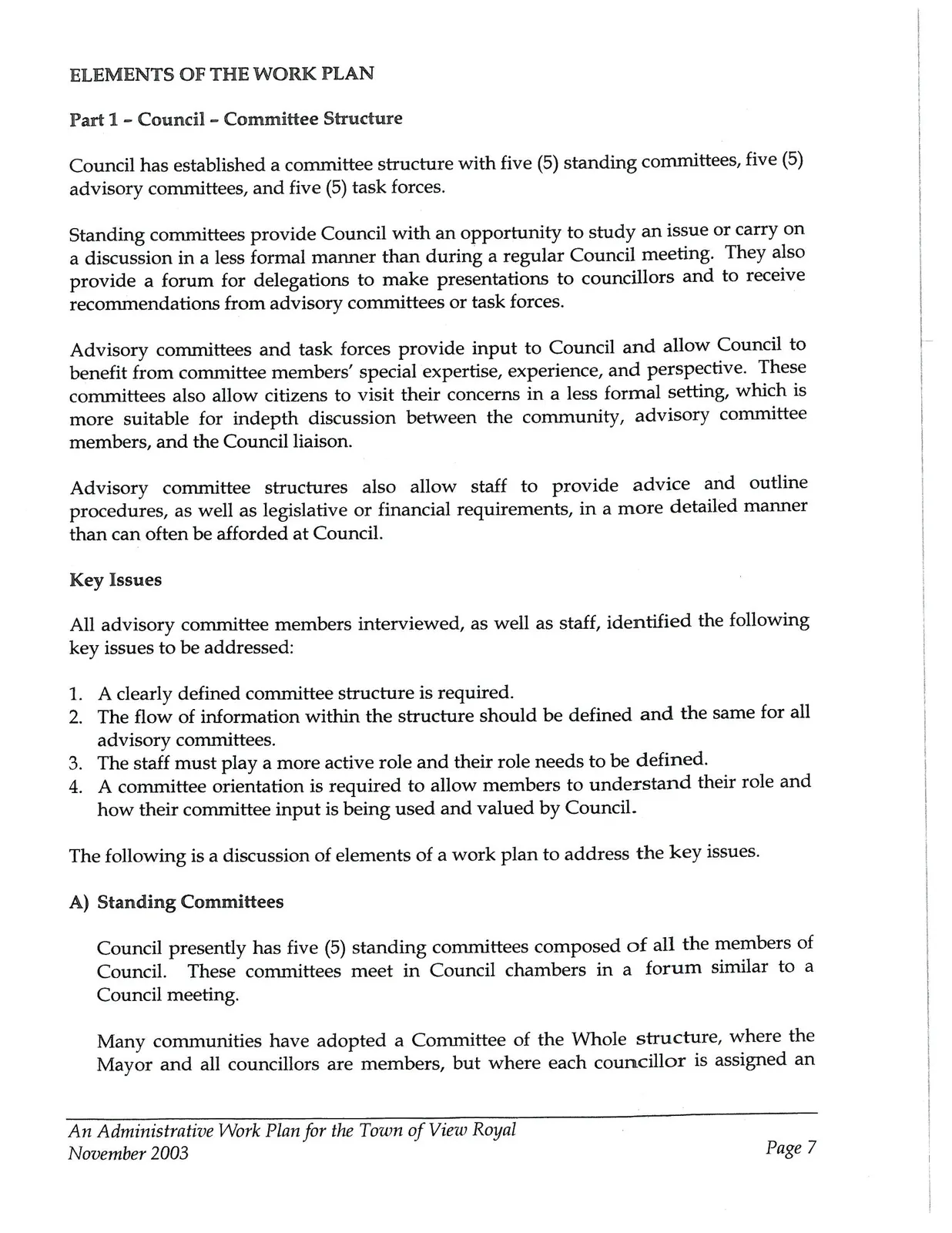
ELEMENTS OF THE WORK PLAN
Part 1 - Council - Committee Structure
Council has established a committee structure with five (5) standing committees, five (5) advisory committees, and five (5) task forces.
Standing committees provide Council with an opportunity to study an issue or carry on a discussion in a less formal manner than during a regular Council meeting. They also provide a forum for delegations to make presentations to councillors and to receive recommendations from advisory committees or task forces.
Advisory committees and task forces provide input to Council and allow Council to benefit from committee members’ special expertise, experience, and perspective. These committees also allow citizens to visit their concerns in a less formal setting, which is more suitable for indepth discussion between the community, advisory committee members, and the Council liaison.
Advisory committee structures also allow staff to provide advice and outline procedures, as well as legislative or financial requirements, in a more detailed manner than can often be afforded at Council.
Key Issues
All advisory committee members interviewed, as well as staff, identified the following key issues to be addressed:
- A clearly defined committee structure is required.
- The flow of information within the structure should be defined and the same for all advisory committees.
- The staff must play a more active role and their role needs to be defined.
- A committee orientation is required to allow members to understand their role and how their committee input is being used and valued by Council.
The following is a discussion of elements of a work plan to address the key issues.
A) Standing Committees
Council presently has five (5) standing committees composed of all the members of Council. These committees meet in Council chambers in a forum similar to a Council meeting.
Many communities have adopted a Committee of the Whole structure, where the Mayor and all councillors are members, but where each councillor is assigned an area of responsibility within the committee. This committee meets at a different time than Council and its meetings have a different format.
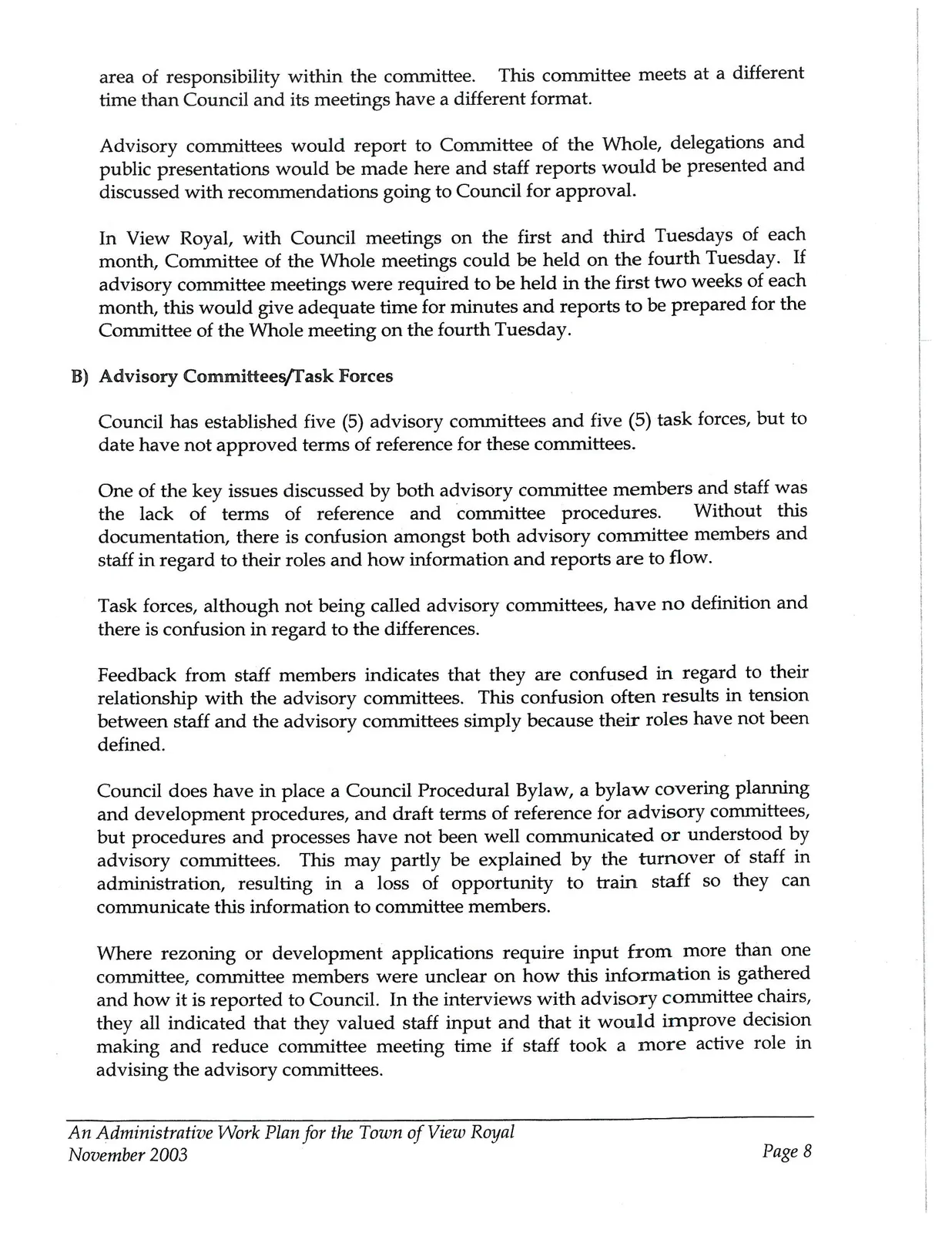
Advisory committees would report to Committee of the Whole, delegations and public presentations would be made here and staff reports would be presented and discussed with recommendations going to Council for approval.
In View Royal, with Council meetings on the first and third Tuesdays of each month, Committee of the Whole meetings could be held on the fourth Tuesday. If advisory committee meetings were required to be held in the first two weeks of each month, this would give adequate time for minutes and reports to be prepared for the Committee of the Whole meeting on the fourth Tuesday.
B) Advisory Committees/Task Forces
Council has established five (5) advisory committees and five (5) task forces, but to date have not approved terms of reference for these committees.
One of the key issues discussed by both advisory committee members and staff was the lack of terms of reference and committee procedures. Without this documentation, there is confusion amongst both advisory committee members and staff in regard to their roles and how information and reports are to flow.
Task forces, although not being called advisory committees, have no definition and there is confusion in regard to the differences.
Feedback from staff members indicates that they are confused in regard to their relationship with the advisory committees. This confusion often results in tension between staff and the advisory committees simply because their roles have not been defined.
Council does have in place a Council Procedural Bylaw, a bylaw covering planning and development procedures, and draft terms of reference for advisory committees, but procedures and processes have not been well communicated or understood by advisory committees. This may partly be explained by the turnover of staff in administration, resulting in a loss of opportunity to train staff so they can communicate this information to committee members.
Where rezoning or development applications require input from more than one committee, committee members were unclear on how this information is gathered and how it is reported to Council. In the interviews with advisory committee chairs, they all indicated that they valued staff input and that it would improve decision making and reduce committee meeting time if staff took a more active role in advising the advisory committees.
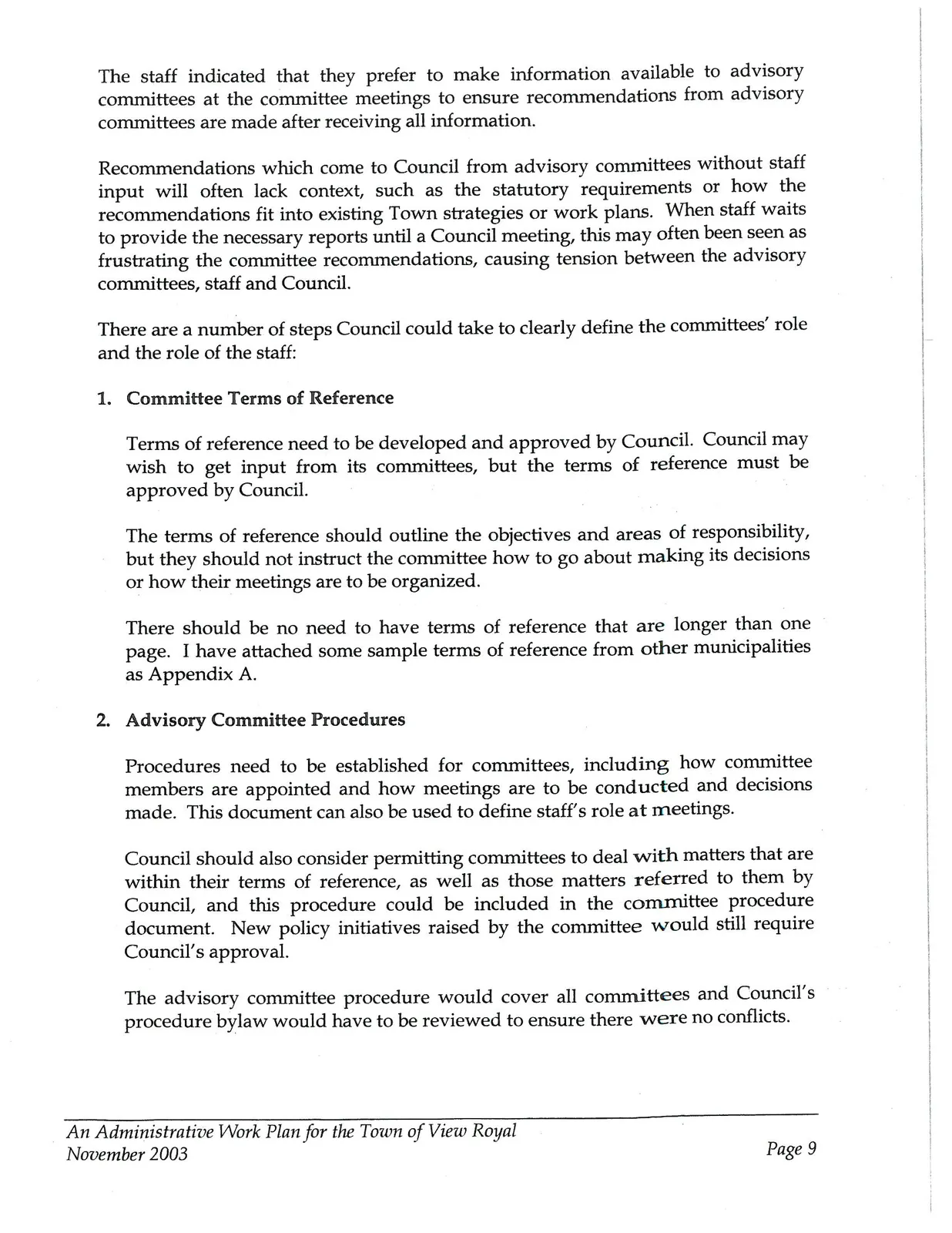
The staff indicated that they prefer to make information available to advisory committees at the committee meetings to ensure recommendations from advisory committees are made after receiving all information.
Recommendations which come to Council from advisory committees without staff input will often lack context, such as the statutory requirements or how the recommendations fit into existing Town strategies or work plans. When staff waits to provide the necessary reports until a Council meeting, this may often been seen as frustrating the committee recommendations, causing tension between the advisory committees, staff and Council.
There are a number of steps Council could take to clearly define the committees’ role and the role of the staff:
1. Committee Terms of Reference
Terms of reference need to be developed and approved by Council. Council may wish to get input from its committees, but the terms of reference must be approved by Council.
The terms of reference should outline the objectives and areas of responsibility, but they should not instruct the committee how to go about making its decisions or how their meetings are to be organized.
There should be no need to have terms of reference that are longer than one page. I have attached some sample terms of reference from other municipalities as Appendix A.
2. Advisory Committee Procedures
Procedures need to be established for committees, including how committee members are appointed and how meetings are to be conducted and decisions made. This document can also be used to define staff’s role at meetings.
Council should also consider permitting committees to deal with matters that are within their terms of reference, as well as those matters referred to them by Council, and this procedure could be included in the committee procedure document. New policy initiatives raised by the committee would still require Council’s approval.
The advisory committee procedure would cover all committees and Council’s procedure bylaw would have to be reviewed to ensure there were no conflicts.
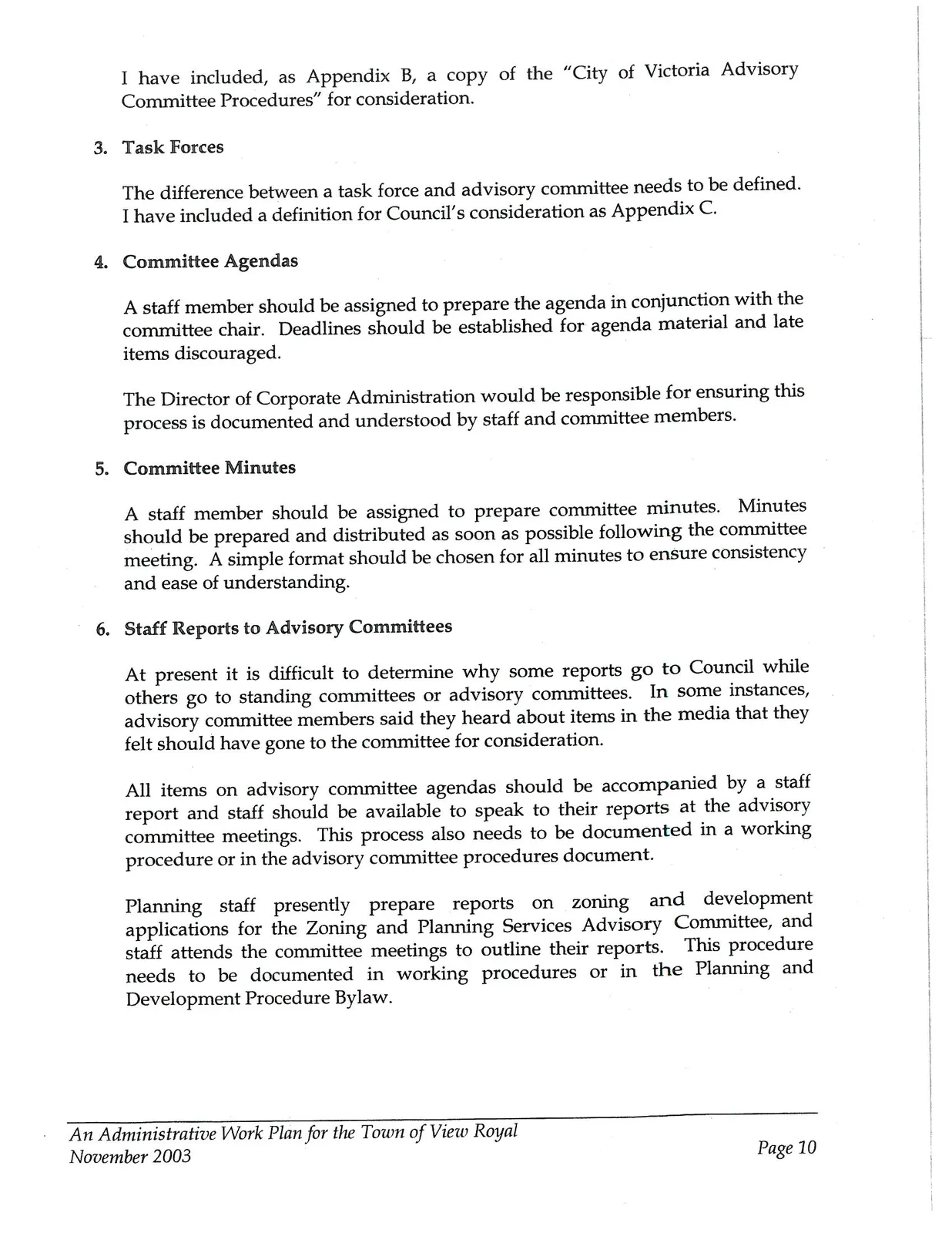
I have included, as Appendix B, a copy of the “City of Victoria Advisory Committee Procedures” for consideration.
3. Task Forces
The difference between a task force and advisory committee needs to be defined. I have included a definition for Council’s consideration as Appendix C.
4. Committee Agendas
A staff member should be assigned to prepare the agenda in conjunction with the committee chair. Deadlines should be established for agenda material and late items discouraged.
The Director of Corporate Administration would be responsible for ensuring this process is documented and understood by staff and committee members.
5. Committee Minutes
A staff member should be assigned to prepare committee minutes. Minutes should be prepared and distributed as soon as possible following the committee meeting. A simple format should be chosen for all minutes to ensure consistency and ease of understanding.
6. Staff Reports to Advisory Committees
At present it is difficult to determine why some reports go to Council while others go to standing committees or advisory committees. In some instances, advisory committee members said they heard about items in the media that they felt should have gone to the committee for consideration.
All items on advisory committee agendas should be accompanied by a staff report and staff should be available to speak to their reports at the advisory committee meetings. This process also needs to be documented in a working procedure or in the advisory committee procedures document.
Planning staff presently prepare reports on zoning and development applications for the Zoning and Planning Services Advisory Committee, and staff attends the committee meetings to outline their reports. This procedure needs to be documented in working procedures or in the Planning and Development Procedure Bylaw.
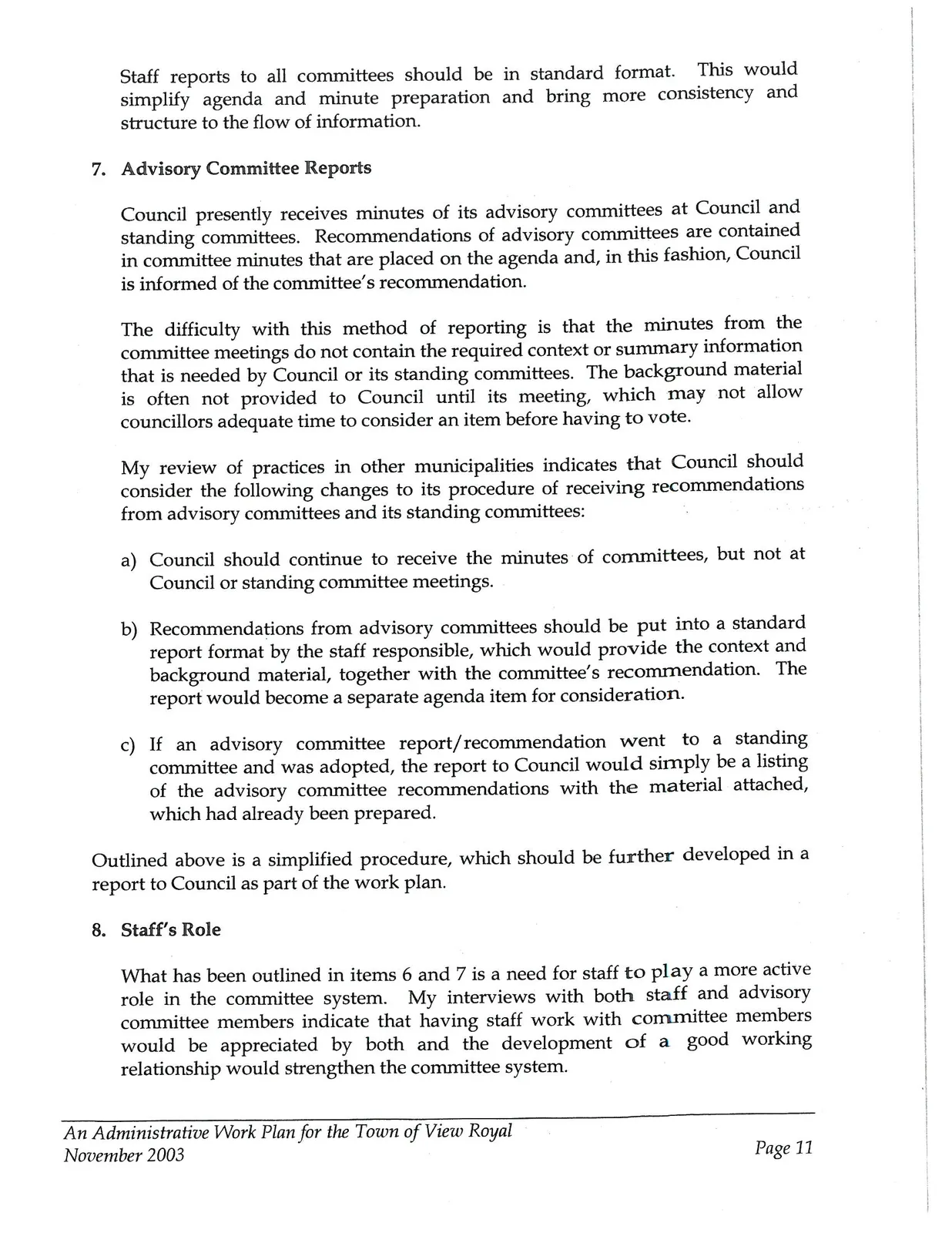
Staff reports to all committees should be in standard format. This would simplify agenda and minute preparation and bring more consistency and structure to the flow of information.
7. Advisory Committee Reports
Council presently receives minutes of its advisory committees at Council and standing committees. Recommendations of advisory committees are contained in committee minutes that are placed on the agenda and, in this fashion, Council is informed of the committee’s recommendation.
The difficulty with this method of reporting is that the minutes from the committee meetings do not contain the required context or summary information that is needed by Council or its standing committees. The background material is often not provided to Council until its meeting, which may not allow councillors adequate time to consider an item before having to vote.
My review of practices in other municipalities indicates that Council should consider the following changes to its procedure of receiving recommendations from advisory committees and its standing committees:
a) Council should continue to receive the minutes of committees, but not at Council or standing committee meetings. b) Recommendations from advisory committees should be put into a standard report format by the staff responsible, which would provide the context and background material, together with the committee’s recommendation. The report would become a separate agenda item for consideration. c) If an advisory committee report/recommendation went to a standing committee and was adopted, the report to Council would simply be a listing of the advisory committee recommendations with the material attached, which had already been prepared.
Outlined above is a simplified procedure, which should be further developed in a report to Council as part of the work plan.
8. Staff’s Role
What has been outlined in items 6 and 7 is a need for staff to play a more active role in the committee system. My interviews with both staff and advisory committee members indicate that having staff work with committee members would be appreciated by both and the development of a good working relationship would strengthen the committee system.
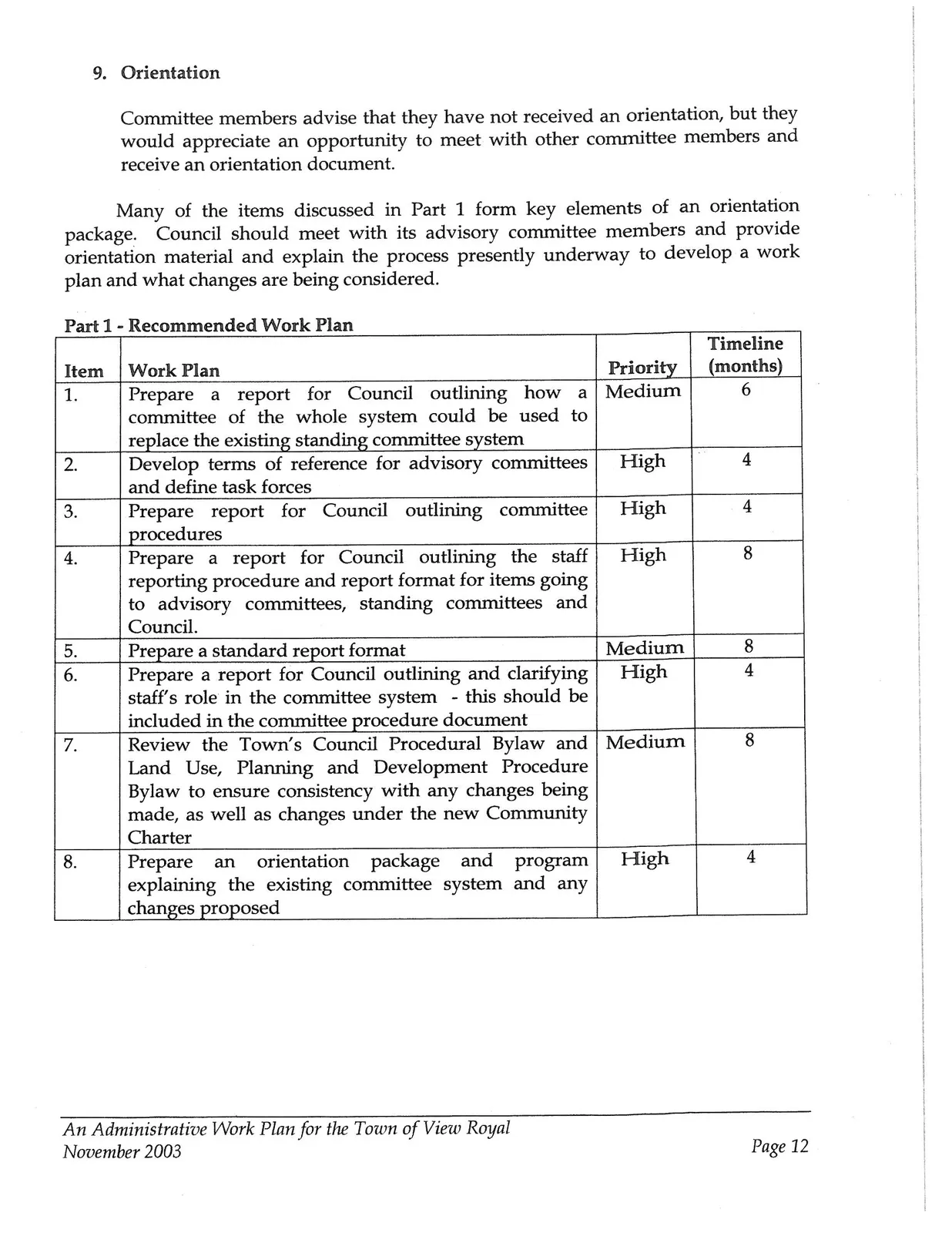
9. Orientation
Committee members advise that they have not received an orientation, but they would appreciate an opportunity to meet with other committee members and receive an orientation document.
Many of the items discussed in Part 1 form key elements of an orientation package. Council should meet with its advisory committee members and provide orientation material and explain the process presently underway to develop a work plan and what changes are being considered.
Part 1 - Recommended Work Plan
| Item | Work Plan | Priority | Timeline (months) |
|---|---|---|---|
| 1. | Prepare a report for Council outlining how a committee of the whole system could be used to replace the existing standing committee system | Medium | 6 |
| 2. | Develop terms of reference for advisory committees and define task forces | High | 4 |
| 3. | Prepare report for Council outlining committee procedures | High | 4 |
| 4. | Prepare a report for Council outlining the staff reporting procedure and report format for items going to advisory committees, standing committees and Council. | High | 8 |
| 5. | Prepare a standard report format | Medium | 8 |
| 6. | Prepare a report for Council outlining and clarifying staff’s role in the committee system - this should be included in the committee procedure document | High | 4 |
| 7. | Review the Town’s Council Procedural Bylaw and Land Use, Planning and Development Procedure Bylaw to ensure consistency with any changes being made, as well as changes under the new Community Charter | Medium | 8 |
| 8. | Prepare an orientation package and program explaining the existing committee system and any changes proposed | High | 4 |
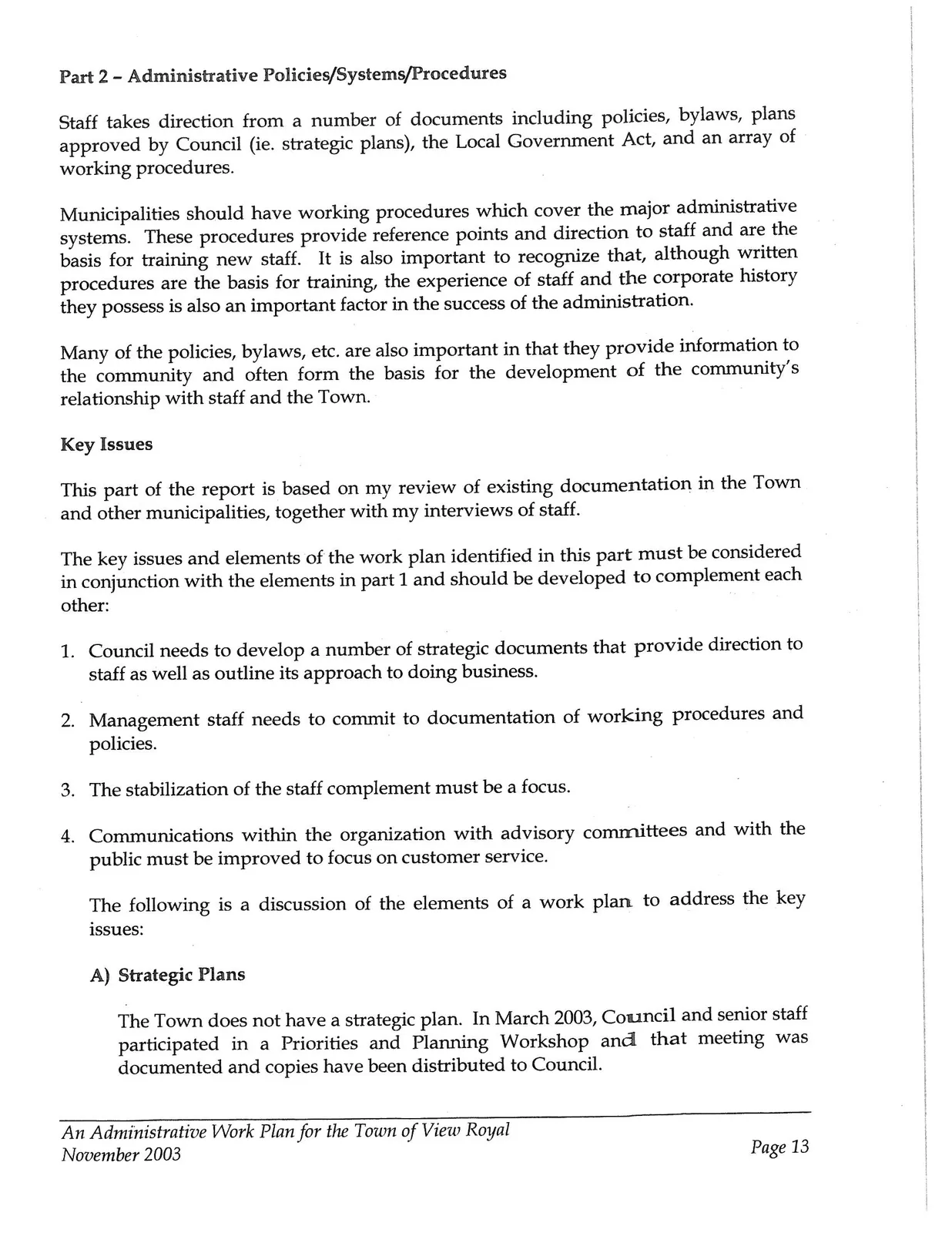
Part 2 - Administrative Policies/Systems/Procedures
Staff takes direction from a number of documents including policies, bylaws, plans approved by Council (ie. strategic plans), the Local Government Act, and an array of working procedures.
Municipalities should have working procedures which cover the major administrative systems. These procedures provide reference points and direction to staff and are the basis for training new staff. It is also important to recognize that, although written procedures are the basis for training, the experience of staff and the corporate history they possess is also an important factor in the success of the administration.
Many of the policies, bylaws, etc. are also important in that they provide information to the community and often form the basis for the development of the community’s relationship with staff and the Town.
Key Issues
This part of the report is based on my review of existing documentation in the Town and other municipalities, together with my interviews of staff.
The key issues and elements of the work plan identified in this part must be considered in conjunction with the elements in part 1 and should be developed to complement each other:
- Council needs to develop a number of strategic documents that provide direction to staff as well as outline its approach to doing business.
- Management staff needs to commit to documentation of working procedures and policies.
- The stabilization of the staff complement must be a focus.
- Communications within the organization with advisory committees and with the public must be improved to focus on customer service.
The following is a discussion of the elements of a work plan to address the key issues:
A) Strategic Plans
The Town does not have a strategic plan. In March 2003, Council and senior staff participated in a Priorities and Planning Workshop and that meeting was documented and copies have been distributed to Council.
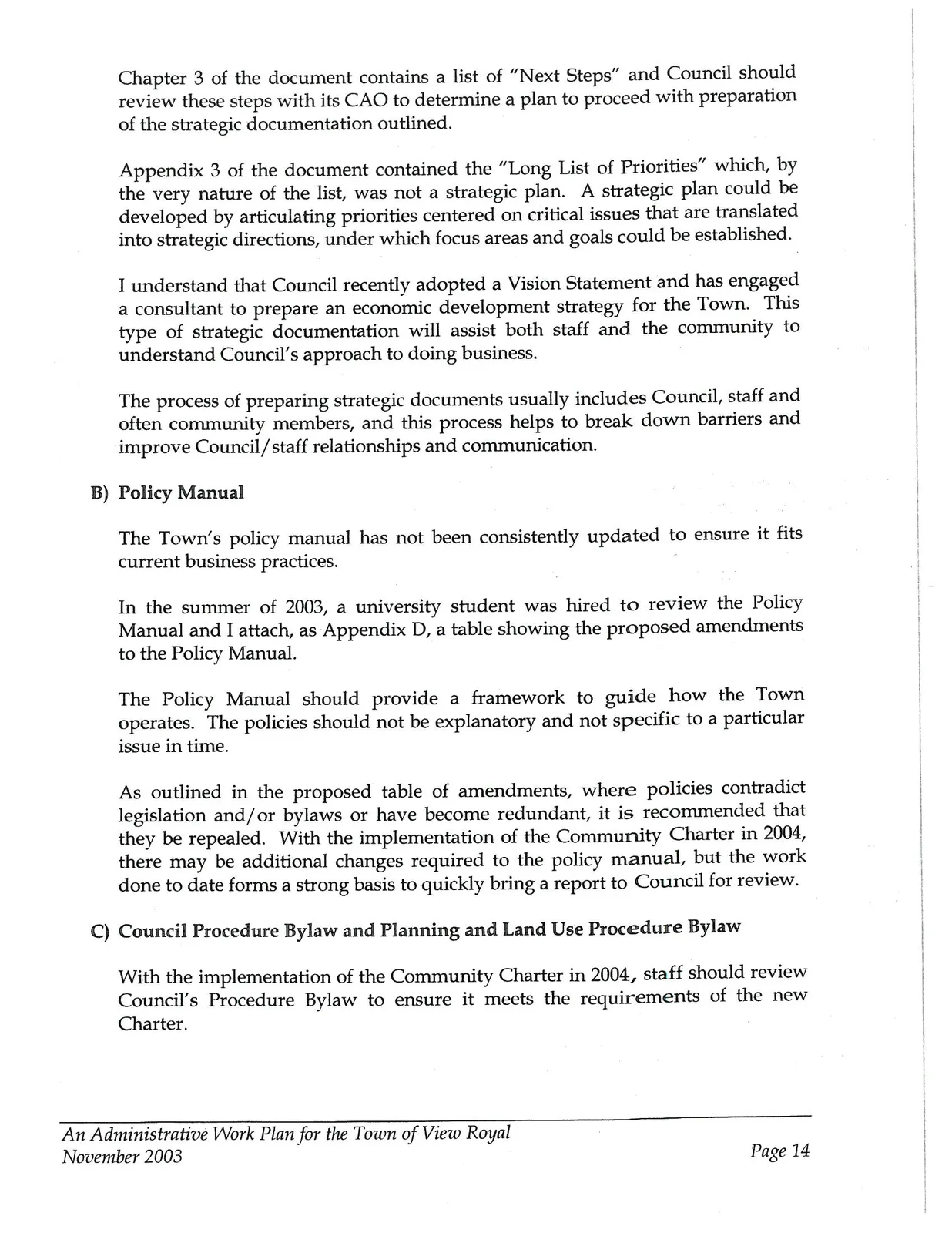
Chapter 3 of the document contains a list of “Next Steps” and Council should review these steps with its CAO to determine a plan to proceed with preparation of the strategic documentation outlined.
Appendix 3 of the document contained the “Long List of Priorities” which, by the very nature of the list, was not a strategic plan. A strategic plan could be developed by articulating priorities centered on critical issues that are translated into strategic directions, under which focus areas and goals could be established.
I understand that Council recently adopted a Vision Statement and has engaged a consultant to prepare an economic development strategy for the Town. This type of strategic documentation will assist both staff and the community to understand Council’s approach to doing business.
The process of preparing strategic documents usually includes Council, staff and often community members, and this process helps to break down barriers and improve Council/staff relationships and communication.
B) Policy Manual
The Town’s policy manual has not been consistently updated to ensure it fits current business practices.
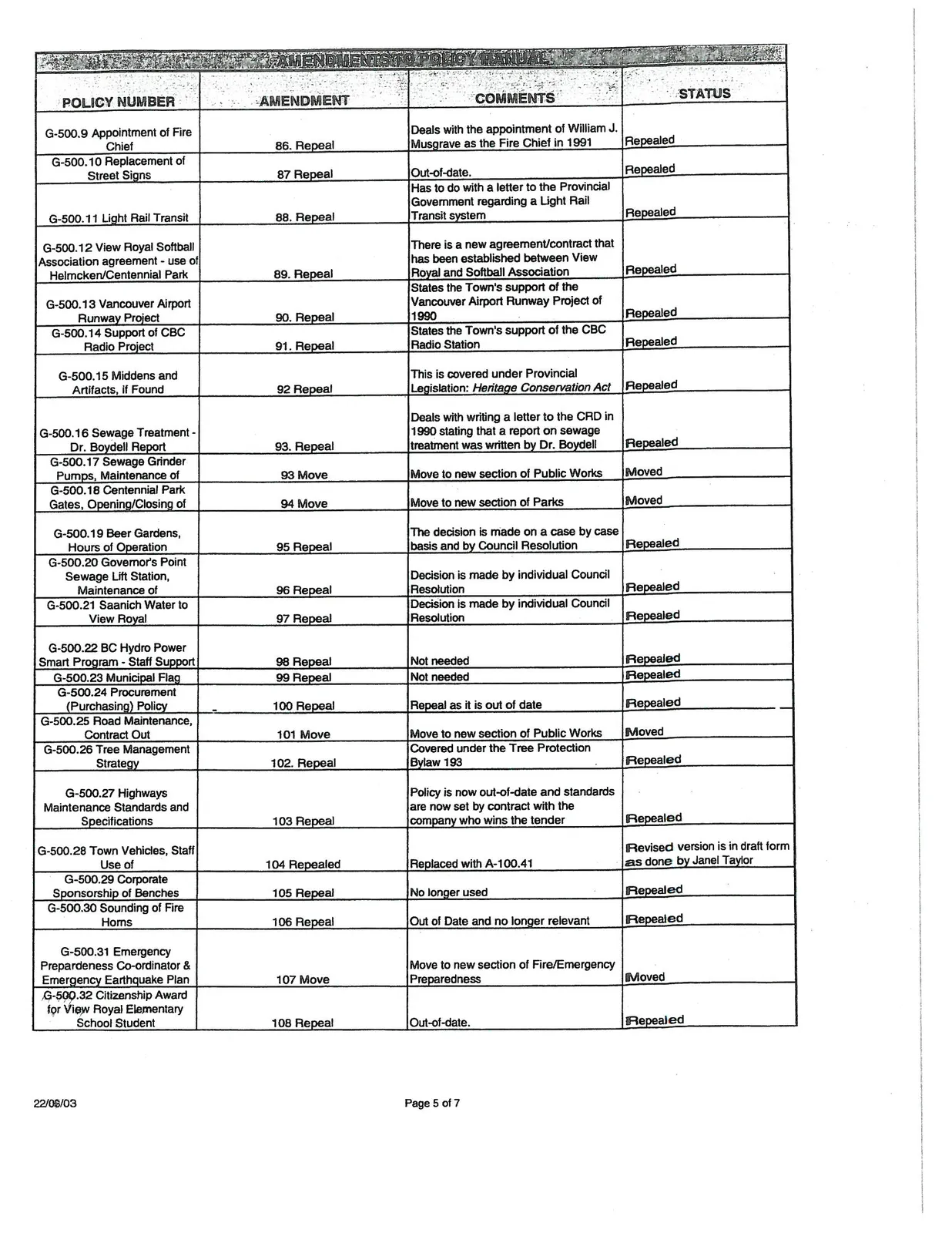
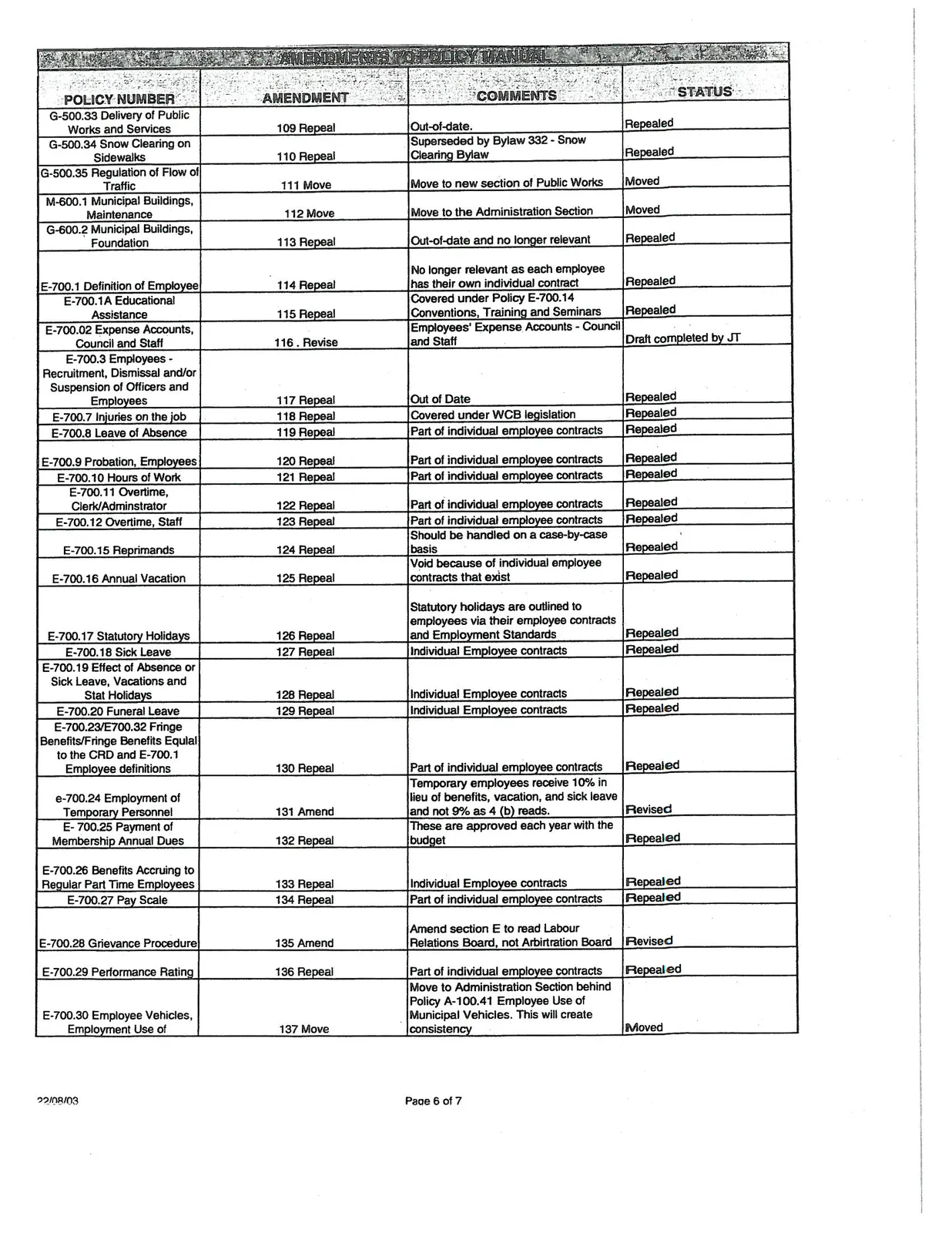
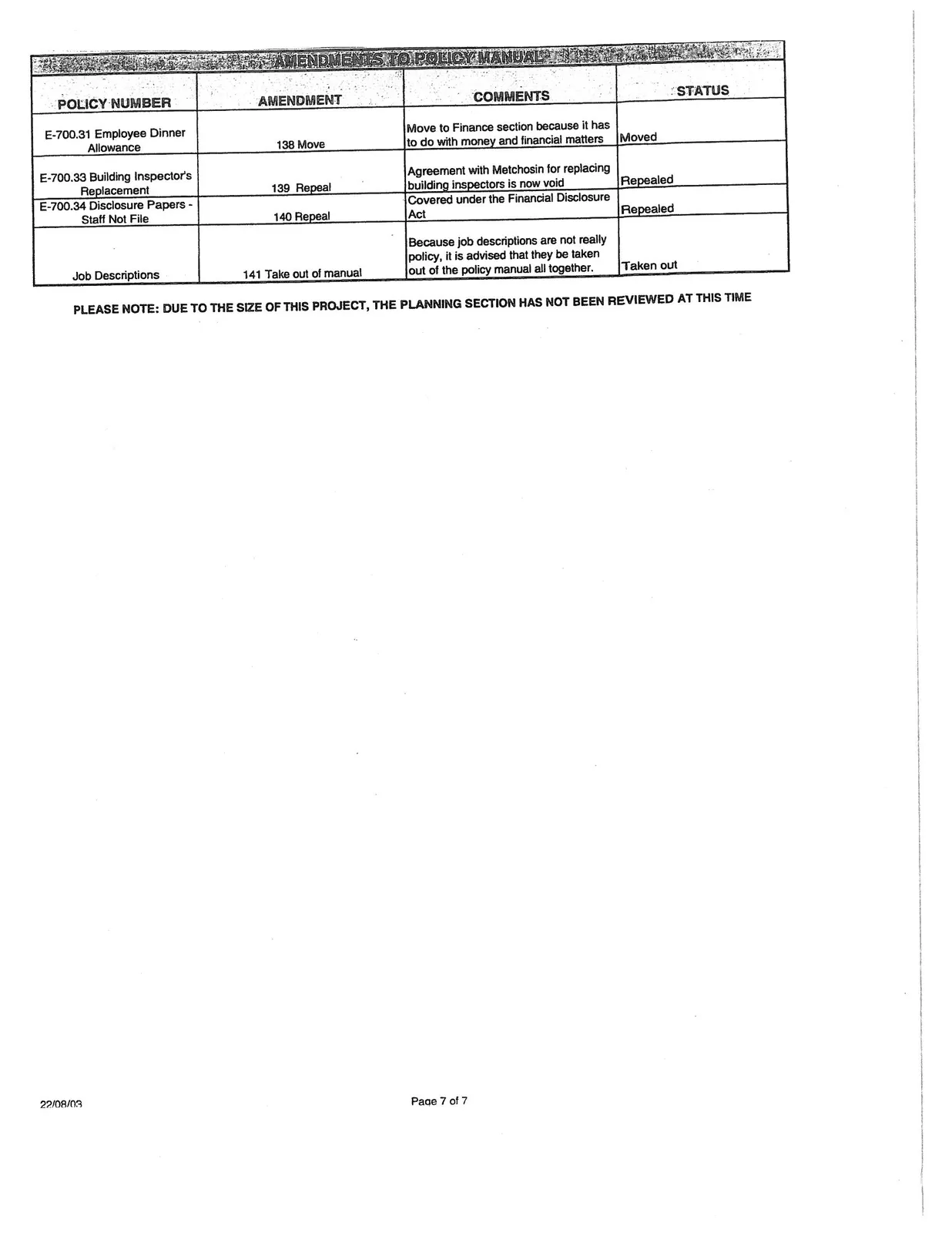
In the summer of 2003, a university student was hired to review the Policy Manual and I attach, as Appendix D, a table showing the proposed amendments to the Policy Manual.
The Policy Manual should provide a framework to guide how the Town operates. The policies should not be explanatory and not specific to a particular issue in time.
As outlined in the proposed table of amendments, where policies contradict legislation and/or bylaws or have become redundant, it is recommended that they be repealed. With the implementation of the Community Charter in 2004, there may be additional changes required to the policy manual, but the work done to date forms a strong basis to quickly bring a report to Council for review.
C) Council Procedure Bylaw and Planning and Land Use Procedure Bylaw
With the implementation of the Community Charter in 2004, staff should review Council’s Procedure Bylaw to ensure it meets the requirements of the new Charter.
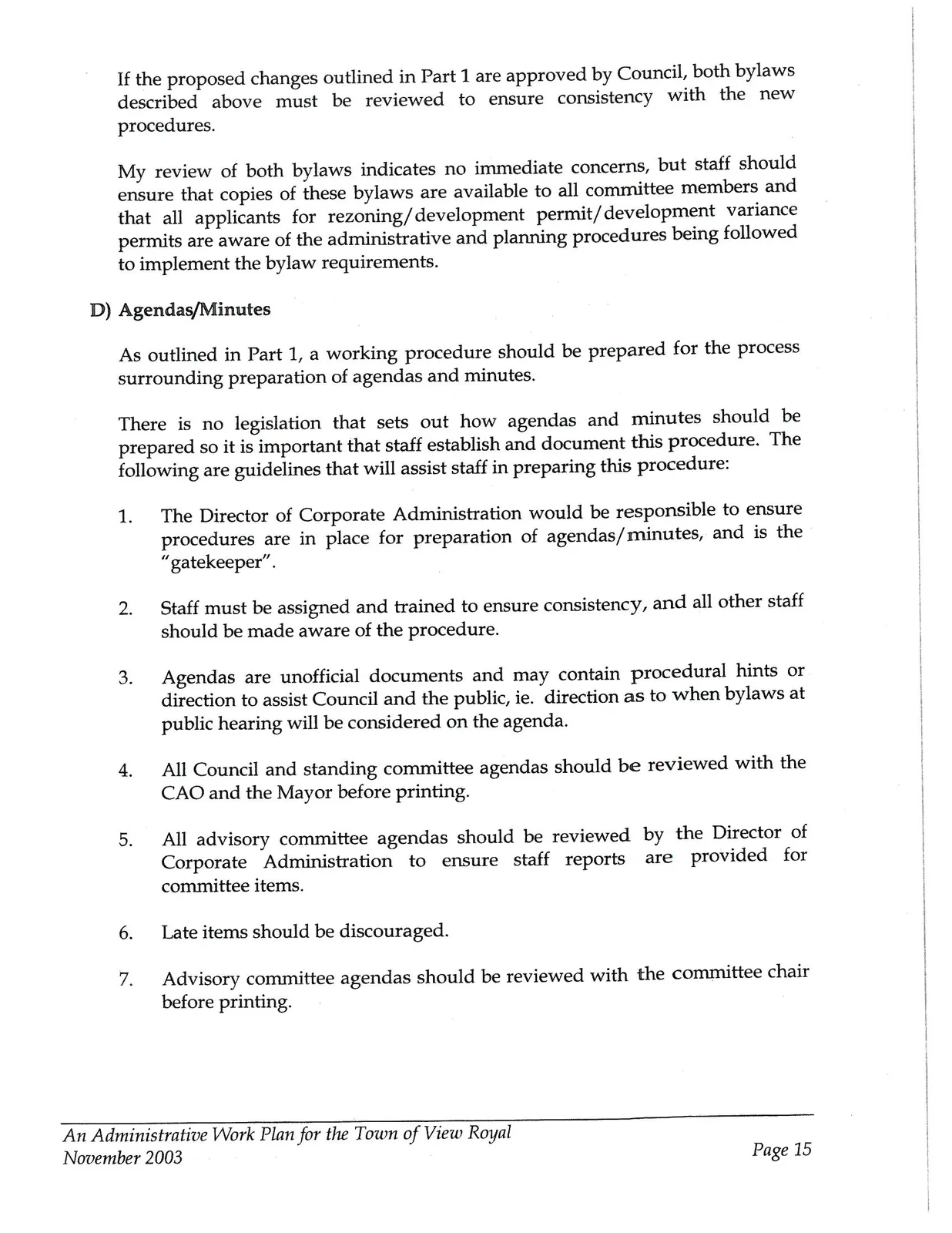
If the proposed changes outlined in Part 1 are approved by Council, both bylaws described above must be reviewed to ensure consistency with the new procedures.
My review of both bylaws indicates no immediate concerns, but staff should ensure that copies of these bylaws are available to all committee members and that all applicants for rezoning/development permit/development variance permits are aware of the administrative and planning procedures being followed to implement the bylaw requirements.
D) Agendas/Minutes
As outlined in Part 1, a working procedure should be prepared for the process surrounding preparation of agendas and minutes.
There is no legislation that sets out how agendas and minutes should be prepared so it is important that staff establish and document this procedure. The following are guidelines that will assist staff in preparing this procedure:
- The Director of Corporate Administration would be responsible to ensure procedures are in place for preparation of agendas/minutes, and is the “gatekeeper”.
- Staff must be assigned and trained to ensure consistency, and all other staff should be made aware of the procedure.
- Agendas are unofficial documents and may contain procedural hints or direction to assist Council and the public, ie. direction as to when bylaws at public hearing will be considered on the agenda.
- All Council and standing committee agendas should be reviewed with the CAO and the Mayor before printing.
- All advisory committee agendas should be reviewed by the Director of Corporate Administration to ensure staff reports are provided for committee items.
- Late items should be discouraged.
- Advisory committee agendas should be reviewed with the committee chair before printing.
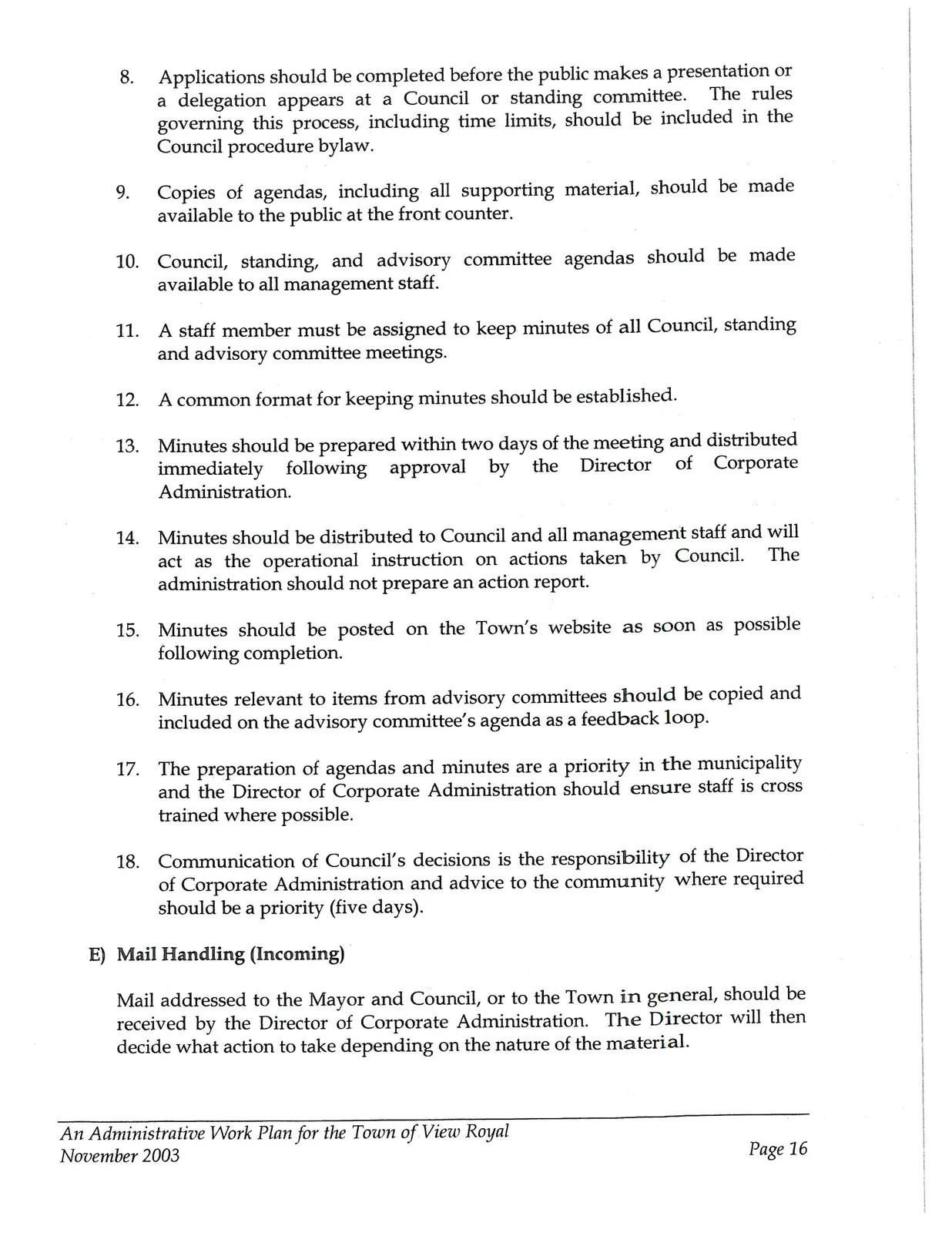
- Applications should be completed before the public makes a presentation or a delegation appears at a Council or standing committee. The rules governing this process, including time limits, should be included in the Council procedure bylaw.
- Copies of agendas, including all supporting material, should be made available to the public at the front counter.
- Council, standing, and advisory committee agendas should be made available to all management staff.
- A staff member must be assigned to keep minutes of all Council, standing and advisory committee meetings.
- A common format for keeping minutes should be established.
- Minutes should be prepared within two days of the meeting and distributed immediately following approval by the Director of Corporate Administration.
- Minutes should be distributed to Council and all management staff and will act as the operational instruction on actions taken by Council. The administration should not prepare an action report.
- Minutes should be posted on the Town’s website as soon as possible following completion.
- Minutes relevant to items from advisory committees should be copied and included on the advisory committee’s agenda as a feedback loop.
- The preparation of agendas and minutes are a priority in the municipality and the Director of Corporate Administration should ensure staff is cross trained where possible.
- Communication of Council’s decisions is the responsibility of the Director of Corporate Administration and advice to the community where required should be a priority (five days).
E) Mail Handling (Incoming)
Mail addressed to the Mayor and Council, or to the Town in general, should be received by the Director of Corporate Administration. The Director will then decide what action to take depending on the nature of the material.
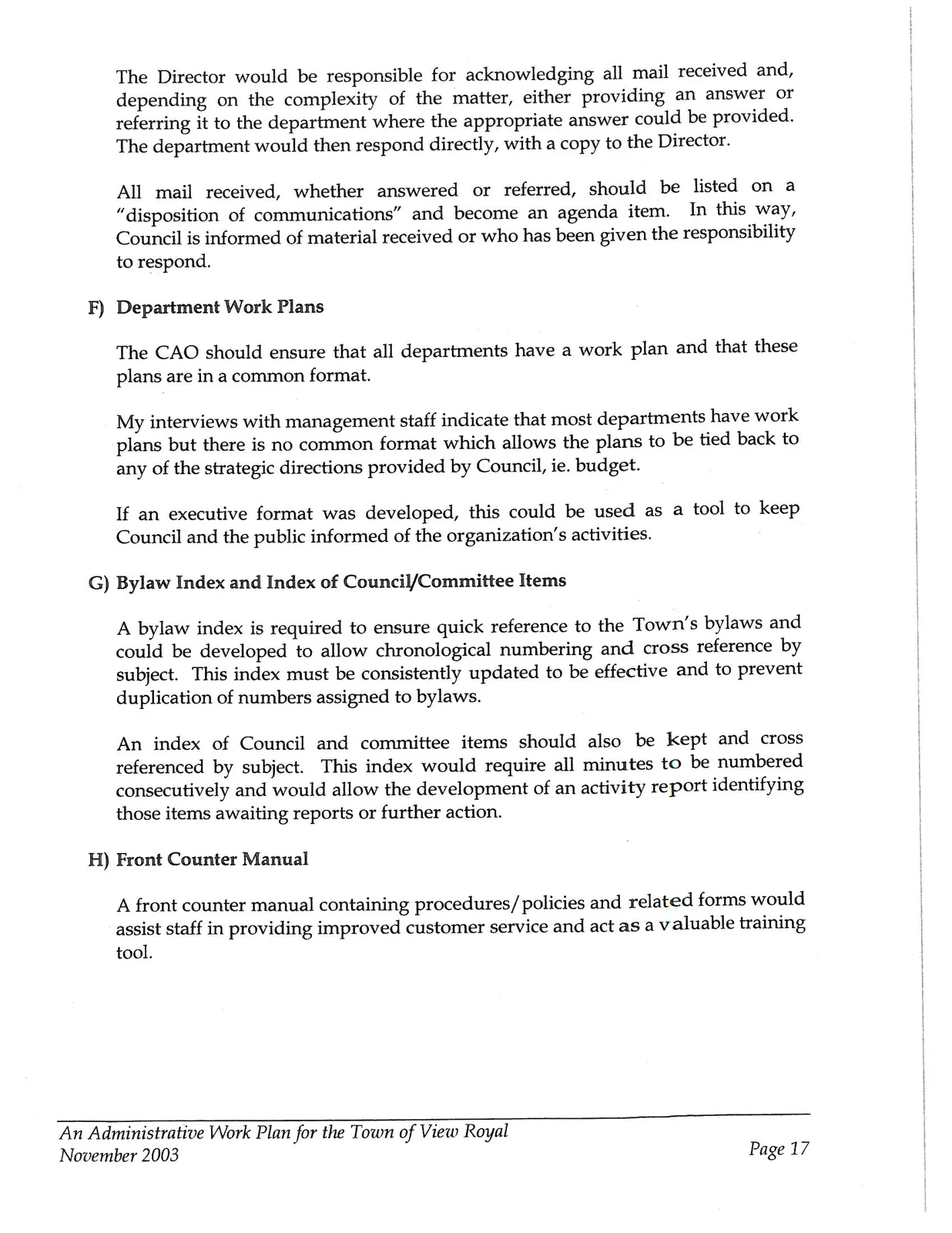
The Director would be responsible for acknowledging all mail received and, depending on the complexity of the matter, either providing an answer or referring it to the department where the appropriate answer could be provided. The department would then respond directly, with a copy to the Director.
All mail received, whether answered or referred, should be listed on a “disposition of communications” and become an agenda item. In this way, Council is informed of material received or who has been given the responsibility to respond.
F) Department Work Plans
The CAO should ensure that all departments have a work plan and that these plans are in a common format.
My interviews with management staff indicate that most departments have work plans but there is no common format which allows the plans to be tied back to any of the strategic directions provided by Council, ie. budget.
If an executive format was developed, this could be used as a tool to keep Council and the public informed of the organization’s activities.
G) Bylaw Index and Index of Council/Committee Items
A bylaw index is required to ensure quick reference to the Town’s bylaws and could be developed to allow chronological numbering and cross reference by subject. This index must be consistently updated to be effective and to prevent duplication of numbers assigned to bylaws.
An index of Council and committee items should also be kept and cross referenced by subject. This index would require all minutes to be numbered consecutively and would allow the development of an activity report identifying those items awaiting reports or further action.
H) Front Counter Manual
A front counter manual containing procedures/policies and related forms would assist staff in providing improved customer service and act as a valuable training tool.
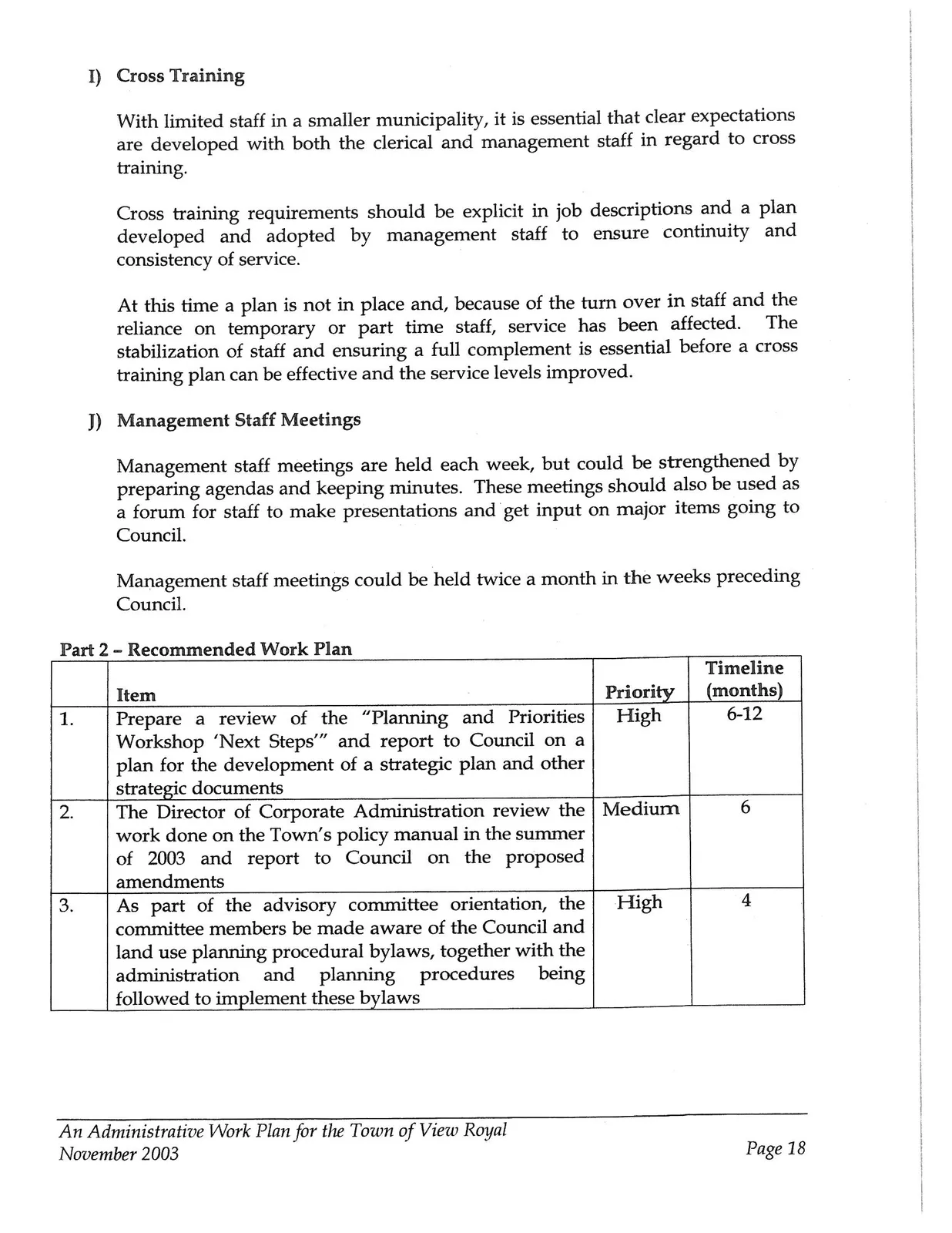
I) Cross Training
With limited staff in a smaller municipality, it is essential that clear expectations are developed with both the clerical and management staff in regard to cross training.
Cross training requirements should be explicit in job descriptions and a plan developed and adopted by management staff to ensure continuity and consistency of service.
At this time a plan is not in place and, because of the turn over in staff and the reliance on temporary or part time staff, service has been affected. The stabilization of staff and ensuring a full complement is essential before a cross training plan can be effective and the service levels improved.
J) Management Staff Meetings
Management staff meetings are held each week, but could be strengthened by preparing agendas and keeping minutes. These meetings should also be used as a forum for staff to make presentations and get input on major items going to Council.
Management staff meetings could be held twice a month in the weeks preceding Council.
Part 2 - Recommended Work Plan
| Item | Work Plan | Priority | Timeline (months) |
|---|---|---|---|
| 1. | Prepare a review of the “Planning and Priorities Workshop ‘Next Steps’” and report to Council on a plan for the development of a strategic plan and other strategic documents | High | 6-12 |
| 2. | The Director of Corporate Administration review the work done on the Town’s policy manual in the summer of 2003 and report to Council on the proposed amendments | Medium | 6 |
| 3. | As part of the advisory committee orientation, the committee members be made aware of the Council and land use planning procedural bylaws, together with the administration and planning procedures being followed to implement these bylaws | High | 4 |
| 4. | A working procedure covering agenda and minute preparation be established and documented and Council and all committee members be advised of the procedure (this may be included as part of the advisory committee orientation) | High | 4 |
| 5. | A working procedure be prepared outlining how mail is handled and how a disposition of communications procedure could be implemented | Medium | 6-8 |
| 6. | An executive format be developed for department work plans, and this format be referred for Council’s consideration | Medium | 12 |
| 7. | A working procedure be prepared for a bylaw index and index of Council and committee items | Medium | 12 |
| 8. | A front counter manual be developed containing procedures, policy and forms to assist staff | Low | 12 |
| 9. | A cross training plan to ensure continuity and consistency of service be developed and approved by management staff | High | 4-6 |
| 10. | The CAO require agendas and minutes of management staff meetings, and these meetings become a forum for management staff to review major items going to Council | Medium | 6 |
Part 3 - Human Resources
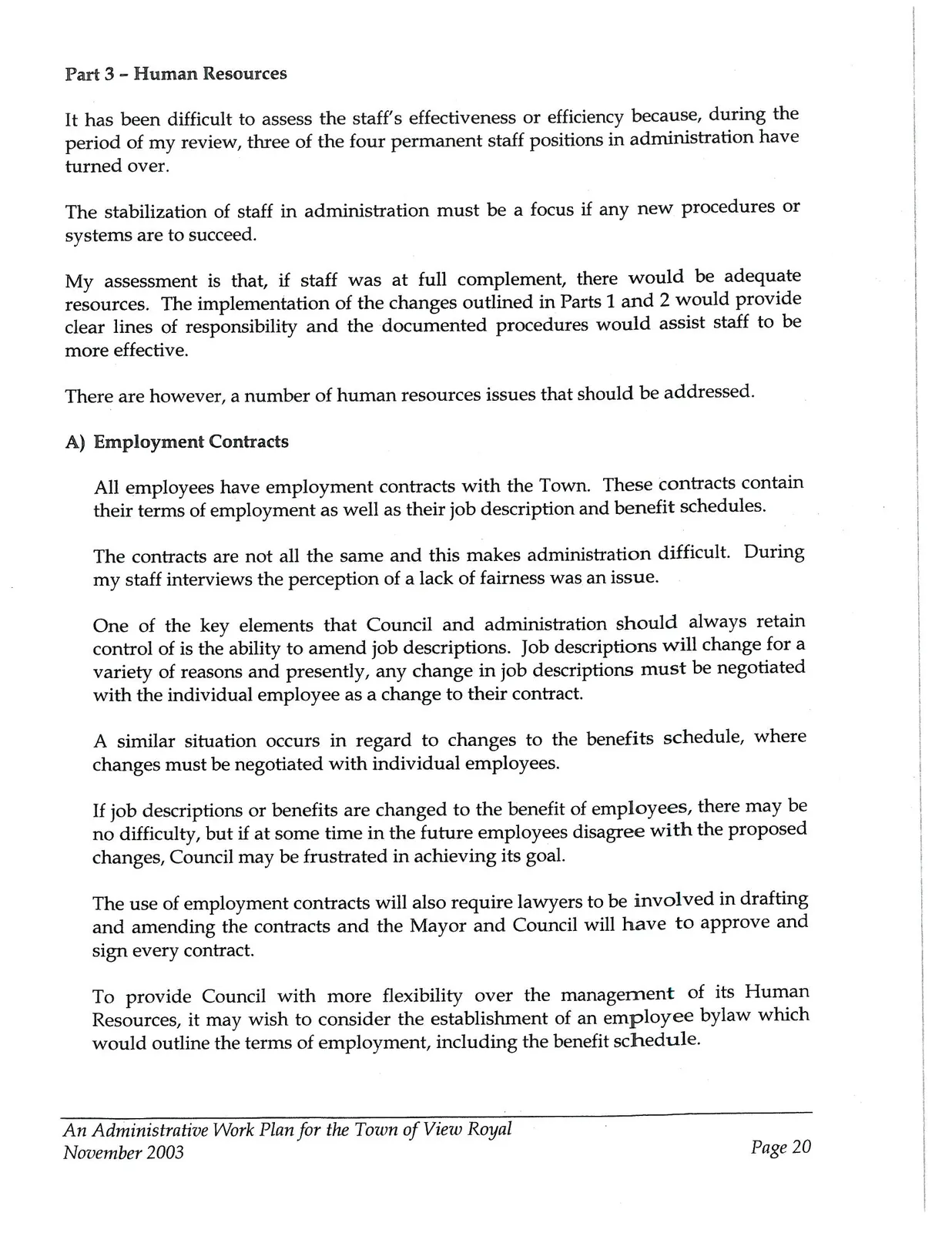
It has been difficult to assess the staff’s effectiveness or efficiency because, during the period of my review, three of the four permanent staff positions in administration have turned over.
The stabilization of staff in administration must be a focus if any new procedures or systems are to succeed.
My assessment is that, if staff was at full complement, there would be adequate resources. The implementation of the changes outlined in Parts 1 and 2 would provide clear lines of responsibility and the documented procedures would assist staff to be more effective.
There are however, a number of human resources issues that should be addressed.
A) Employment Contracts
All employees have employment contracts with the Town. These contracts contain their terms of employment as well as their job description and benefit schedules.
The contracts are not all the same and this makes administration difficult. During my staff interviews the perception of a lack of fairness was an issue.
One of the key elements that Council and administration should always retain control of is the ability to amend job descriptions. Job descriptions will change for a variety of reasons and presently, any change in job descriptions must be negotiated with the individual employee as a change to their contract.
A similar situation occurs in regard to changes to the benefits schedule, where changes must be negotiated with individual employees.
If job descriptions or benefits are changed to the benefit of employees, there may be no difficulty, but if at some time in the future employees disagree with the proposed changes, Council may be frustrated in achieving its goal.
The use of employment contracts will also require lawyers to be involved in drafting and amending the contracts and the Mayor and Council will have to approve and sign every contract.
To provide Council with more flexibility over the management of its Human Resources, it may wish to consider the establishment of an employee bylaw which would outline the terms of employment, including the benefit schedule.
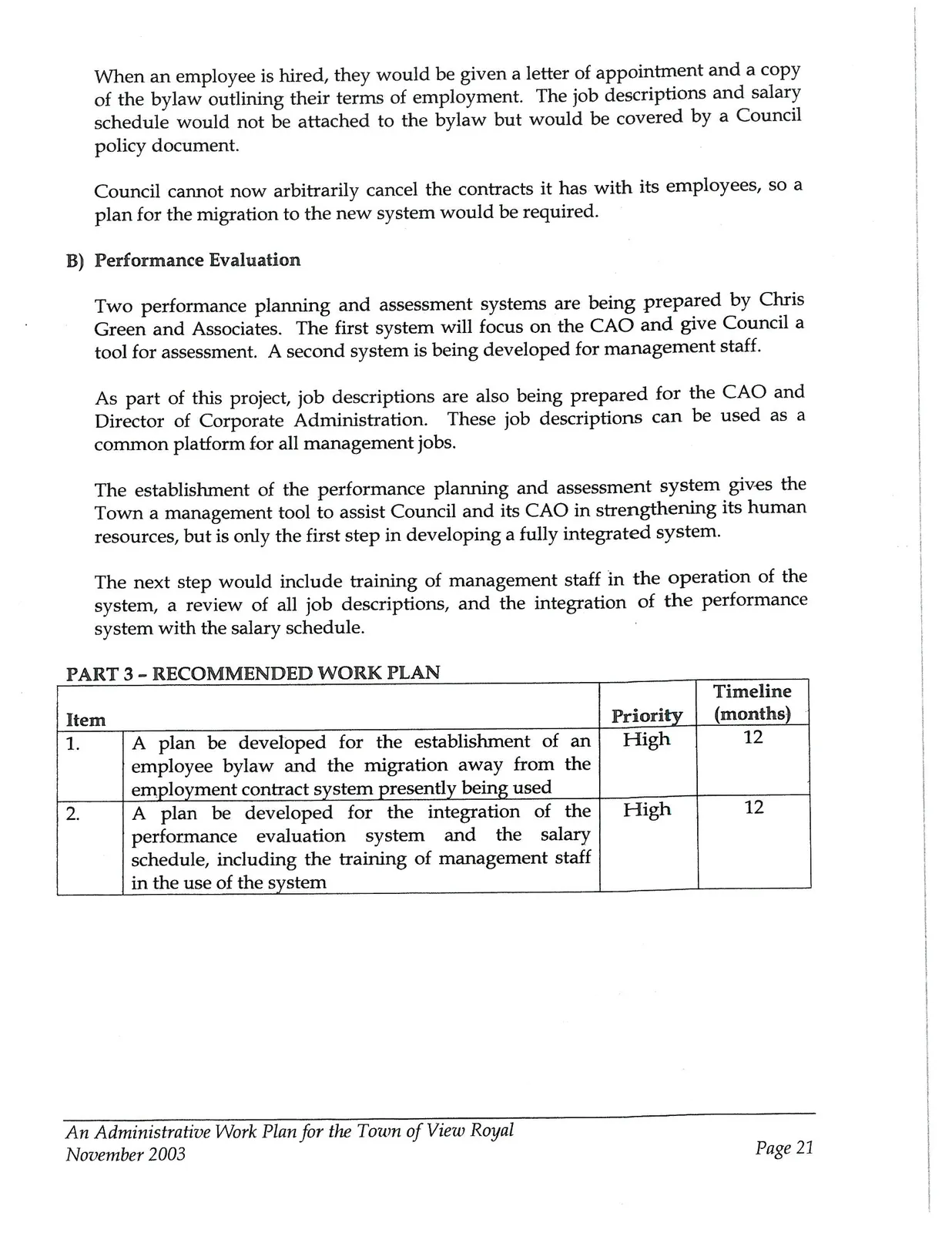
When an employee is hired, they would be given a letter of appointment and a copy of the bylaw outlining their terms of employment. The job descriptions and salary schedule would not be attached to the bylaw but would be covered by a Council policy document.
Council cannot now arbitrarily cancel the contracts it has with its employees, so a plan for the migration to the new system would be required.
B) Performance Evaluation
Two performance planning and assessment systems are being prepared by Chris Green and Associates. The first system will focus on the CAO and give Council a tool for assessment. A second system is being developed for management staff.
As part of this project, job descriptions are also being prepared for the CAO and Director of Corporate Administration. These job descriptions can be used as a common platform for all management jobs.
The establishment of the performance planning and assessment system gives the Town a management tool to assist Council and its CAO in strengthening its human resources, but is only the first step in developing a fully integrated system.
The next step would include training of management staff in the operation of the system, a review of all job descriptions, and the integration of the performance system with the salary schedule.
PART 3 - RECOMMENDED WORK PLAN
| Item | Work Plan | Priority | Timeline (months) |
|---|---|---|---|
| 1. | A plan be developed for the establishment of an employee bylaw and the migration away from the employment contract system presently being used | High | 12 |
| 2. | A plan be developed for the integration of the performance evaluation system and the salary schedule, including the training of management staff in the use of the system | High | 12 |
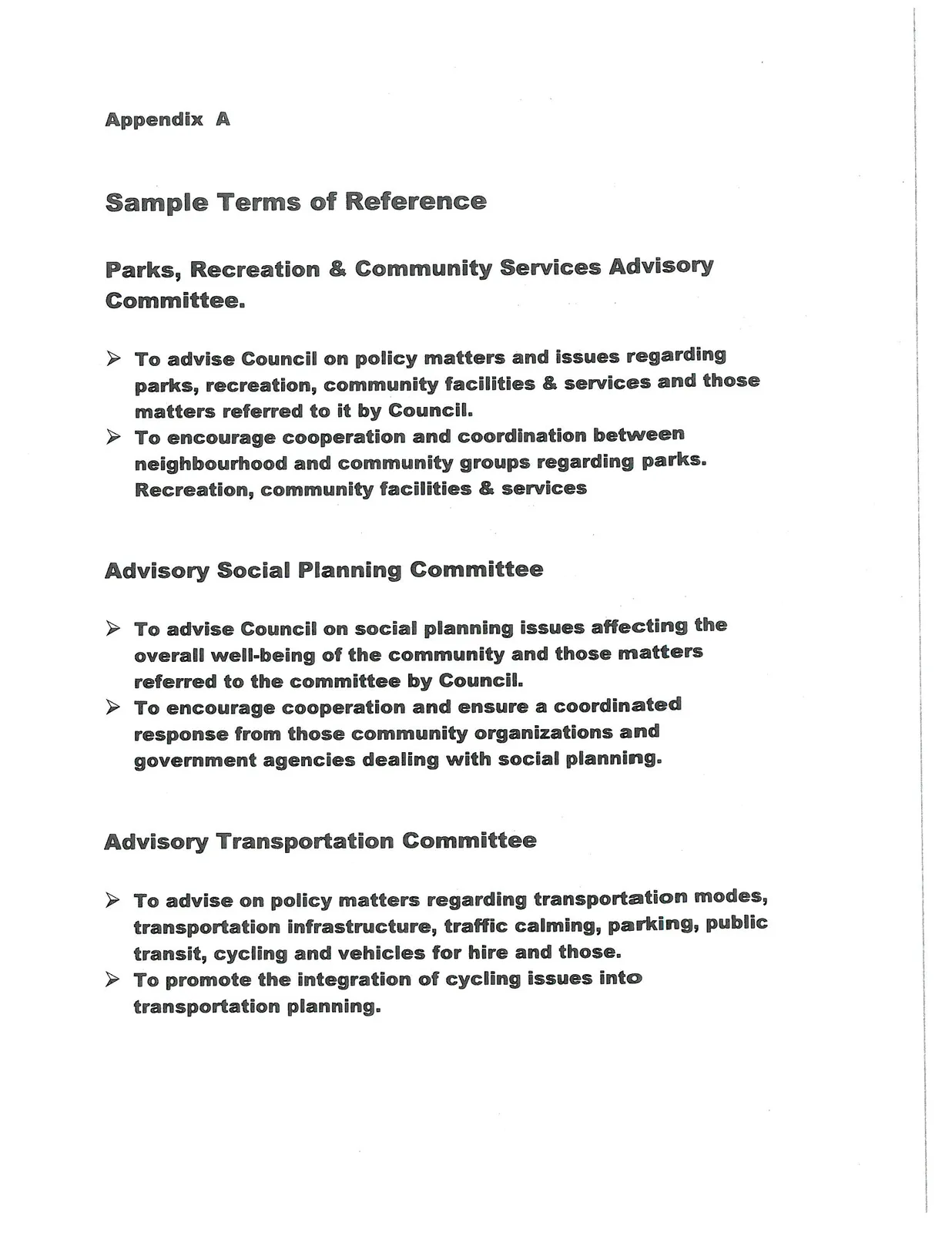
Appendix A
Sample Terms of Reference
Parks, Recreation & Community Services Advisory Committee.
- To advise Council on policy matters and issues regarding parks, recreation, community facilities & services and those matters referred to it by Council.
- To encourage cooperation and coordination between neighbourhood and community groups regarding parks. Recreation, community facilities & services
Advisory Social Planning Committee
- To advise Council on social planning issues affecting the overall well-being of the community and those matters referred to the committee by Council.
- To encourage cooperation and ensure a coordinated response from those community organizations and government agencies dealing with social planning.
Advisory Transportation Committee
- To advise on policy matters regarding transportation modes, transportation infrastructure, traffic calming, parking, public transit, cycling and vehicles for hire and those.
- To promote the integration of cycling issues into transportation planning.
Appendix B
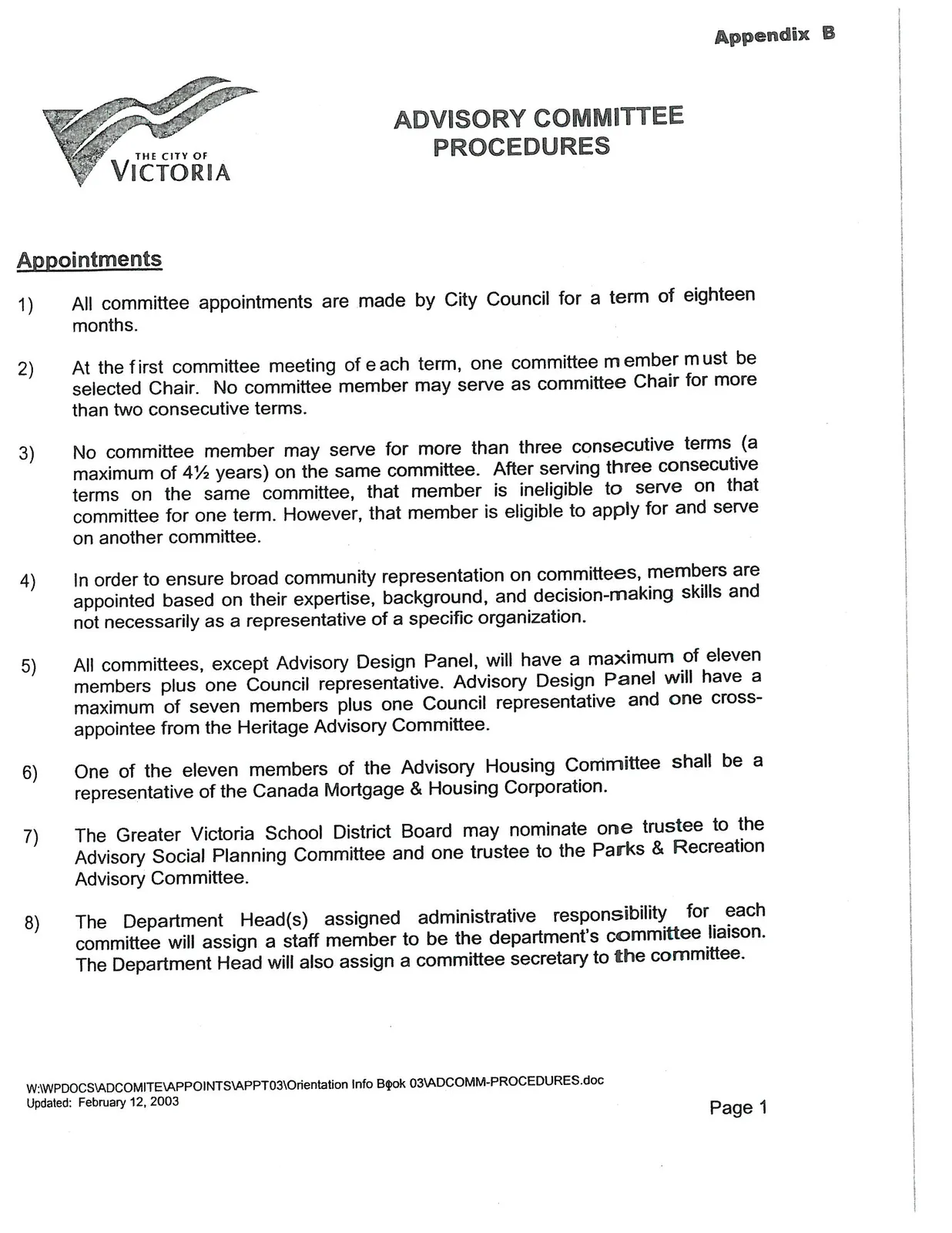
ADVISORY COMMITTEE PROCEDURES
Appointments
All committee appointments are made by City Council for a term of eighteen months.
At the first committee meeting of each term, one committee member must be selected Chair. No committee member may serve as committee Chair for more than two consecutive terms.
No committee member may serve for more than three consecutive terms (a maximum of 4 1/2 years) on the same committee. After serving three consecutive terms on the same committee, that member is ineligible to serve on that committee for one term. However, that member is eligible to apply for and serve on another committee.
In order to ensure broad community representation on committees, members are appointed based on their expertise, background, and decision-making skills and not necessarily as a representative of a specific organization.
All committees, except Advisory Design Panel, will have a maximum of eleven members plus one Council representative. Advisory Design Panel will have a maximum of seven members plus one Council representative and one cross-appointee from the Heritage Advisory Committee.
One of the eleven members of the Advisory Housing Committee shall be a representative of the Canada Mortgage & Housing Corporation.
The Greater Victoria School District Board may nominate one trustee to the Advisory Social Planning Committee and one trustee to the Parks & Recreation Advisory Committee.
The Department Head(s) assigned administrative responsibility for each committee will assign a staff member to be the department's committee liaison. The Department Head will also assign a committee secretary to the committee.
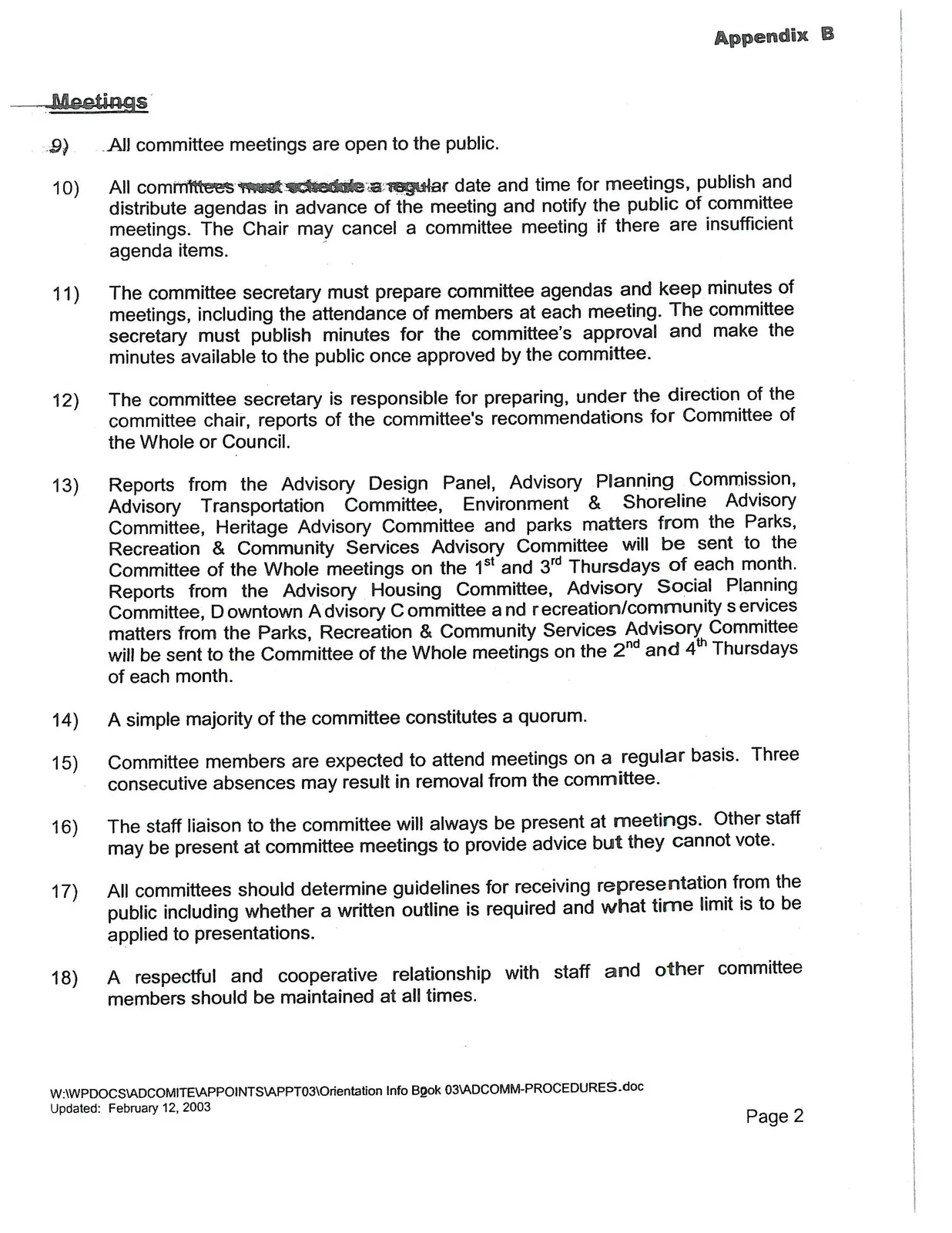
Meetings
All committee meetings are open to the public.
All committees must schedule a regular date and time for meetings, publish and distribute agendas in advance of the meeting and notify the public of committee meetings. The Chair may cancel a committee meeting if there are insufficient agenda items.
The committee secretary must prepare committee agendas and keep minutes of meetings, including the attendance of members at each meeting. The committee secretary must publish minutes for the committee's approval and make the minutes available to the public once approved by the committee.
The committee secretary is responsible for preparing, under the direction of the committee chair, reports of the committee's recommendations for Committee of the Whole or Council.
Reports from the Advisory Design Panel, Advisory Planning Commission, Advisory Transportation Committee, Environment & Shoreline Advisory Committee, Heritage Advisory Committee and parks matters from the Parks, Recreation & Community Services Advisory Committee will be sent to the Committee of the Whole meetings on the 1st and 3rd Thursdays of each month. Reports from the Advisory Housing Committee, Advisory Social Planning Committee, Downtown Advisory Committee and recreation/community services matters from the Parks, Recreation & Community Services Advisory Committee will be sent to the Committee of the Whole meetings on the 2nd and 4th Thursdays of each month.
A simple majority of the committee constitutes a quorum.
Committee members are expected to attend meetings on a regular basis. Three consecutive absences may result in removal from the committee.
The staff liaison to the committee will always be present at meetings. Other staff may be present at committee meetings to provide advice but they cannot vote.
All committees should determine guidelines for receiving representation from the public including whether a written outline is required and what time limit is to be applied to presentations.
A respectful and cooperative relationship with staff and other committee members should be maintained at all times.
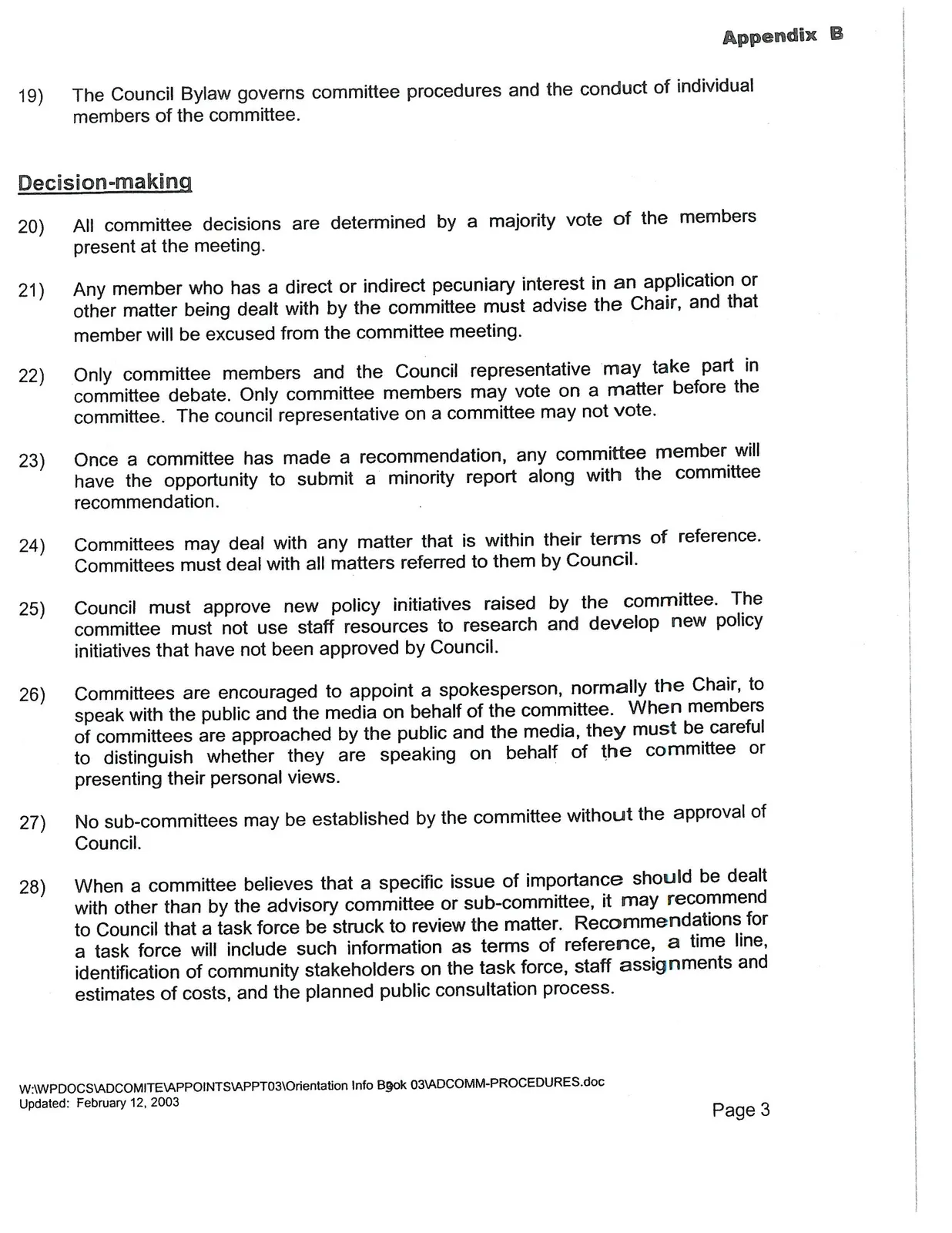
The Council Bylaw governs committee procedures and the conduct of individual members of the committee.
Decision-making
All committee decisions are determined by a majority vote of the members present at the meeting.
Any member who has a direct or indirect pecuniary interest in an application or other matter being dealt with by the committee must advise the Chair, and that member will be excused from the committee meeting.
Only committee members and the Council representative may take part in committee debate. Only committee members may vote on a matter before the committee. The council representative on a committee may not vote.
Once a committee has made a recommendation, any committee member will have the opportunity to submit a minority report along with the committee recommendation.
Committees may deal with any matter that is within their terms of reference. Committees must deal with all matters referred to them by Council.
Council must approve new policy initiatives raised by the committee. The committee must not use staff resources to research and develop new policy initiatives that have not been approved by Council.
Committees are encouraged to appoint a spokesperson, normally the Chair, to speak with the public and the media on behalf of the committee. When members of committees are approached by the public and the media, they must be careful to distinguish whether they are speaking on behalf of the committee or presenting their personal views.
No sub-committees may be established by the committee without the approval of Council.
When a committee believes that a specific issue of importance should be dealt with other than by the advisory committee or sub-committee, it may recommend to Council that a task force be struck to review the matter. Recommendations for a task force will include such information as terms of reference, a time line, identification of community stakeholders on the task force, staff assignments and estimates of costs, and the planned public consultation process.
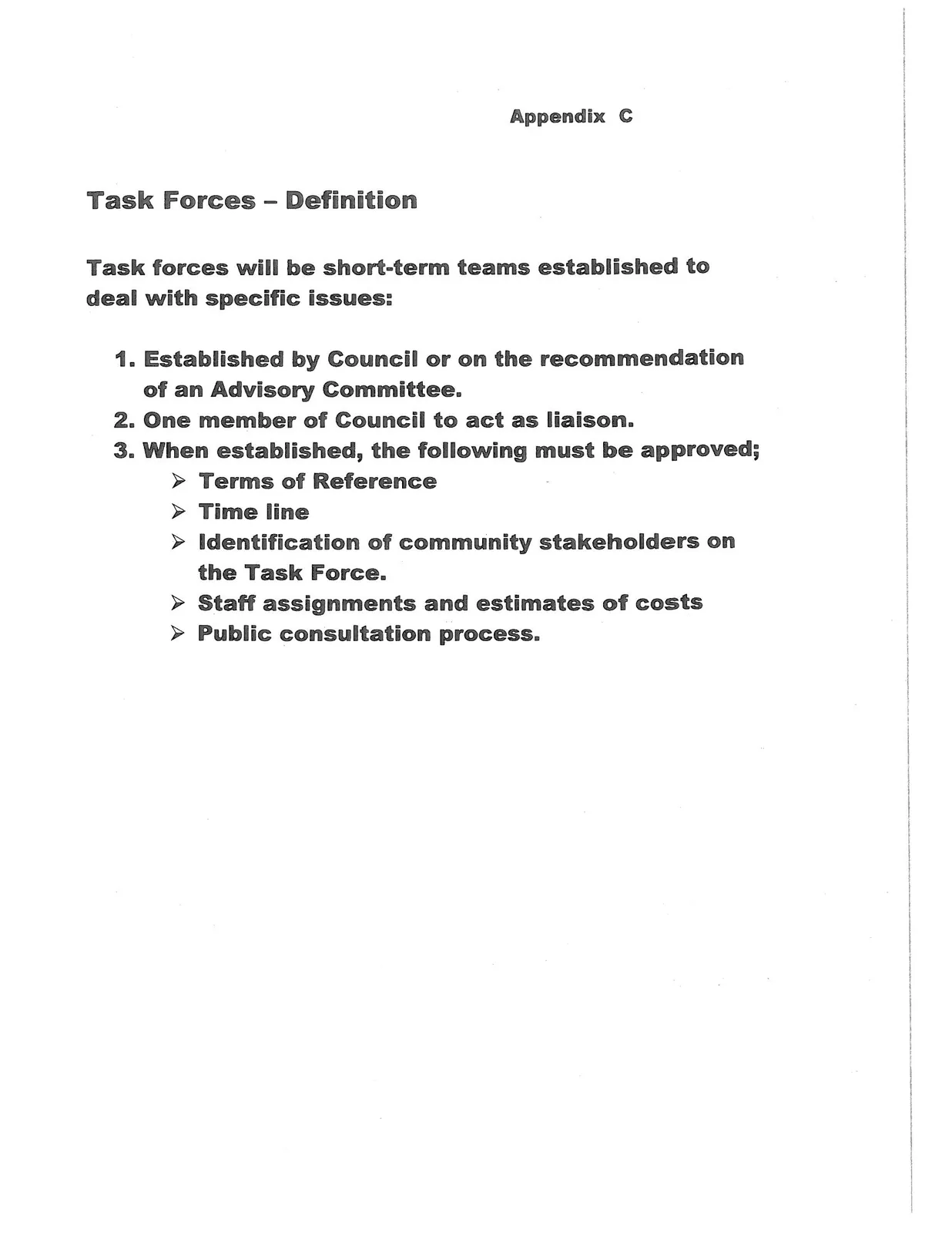
Appendix C
Task Forces - Definition
Task forces will be short-term teams established to deal with specific issues:
- Established by Council or on the recommendation of an Advisory Committee.
- One member of Council to act as liaison.
- When established, the following must be approved;
- Terms of Reference
- Time line
- Identification of community stakeholders on the Task Force.
- Staff assignments and estimates of costs
- Public consultation process.
Appendix D
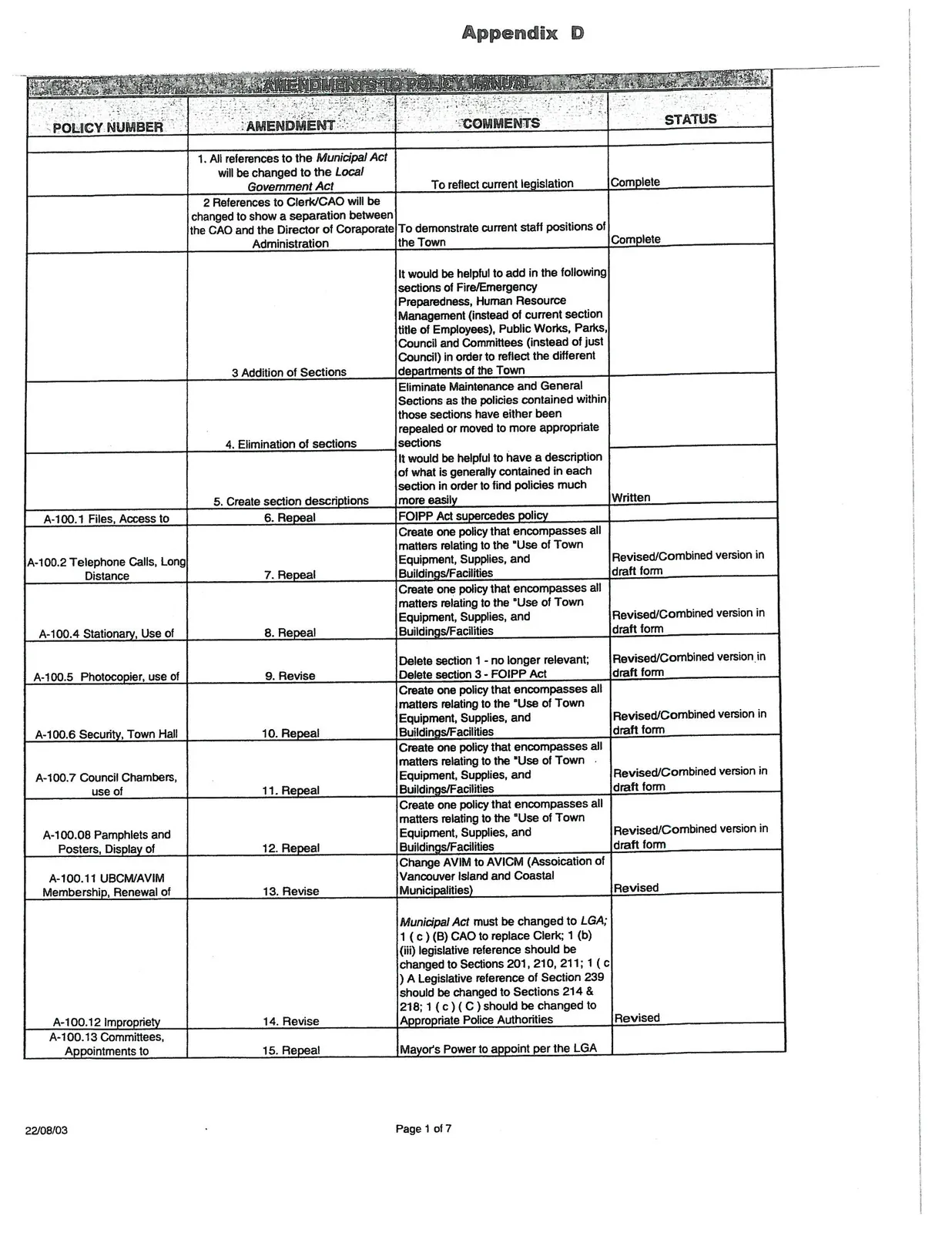
AMENDMENTS TO POLICY MANUAL
| POLICY NUMBER | AMENDMENT | COMMENTS | STATUS |
|---|---|---|---|
| 1. | All references to the Municipal Act will be changed to the Local Government Act | To reflect current legislation | Complete |
| 2. | References to Clerk/CAO will be changed to show a separation between the CAO and the Director of Corporate Administration | To demonstrate current staff positions of the Town | Complete |
| 3. | Addition of Sections | It would be helpful to add in the following sections of Fire/Emergency Preparedness, Human Resource Management (instead of current section title of Employees), Public Works, Parks, Council and Committees (instead of just Council) in order to reflect the different departments of the Town | |
| 4. | Elimination of sections | Eliminate Maintenance and General Sections as the policies contained within those sections have either been repealed or moved to more appropriate sections | |
| 5. | Create section descriptions | It would be helpful to have a description of what is generally contained in each section in order to find policies much more easily | Written |
| A-100.1 Files, Access to | 6. Repeal | FOIPP Act supercedes policy | |
| A-100.2 Telephone Calls, Long Distance | 7. Repeal | Create one policy that encompasses all matters relating to the "Use of Town Equipment, Supplies, and Buildings/Facilities | Revised/Combined version in draft form |
| A-100.4 Stationary, Use of | 8. Repeal | Create one policy that encompasses all matters relating to the "Use of Town Equipment, Supplies, and Buildings/Facilities | Revised/Combined version in draft form |
| A-100.5 Photocopier, use of | 9. Revise | Delete section 1 - no longer relevant; Delete section 3 - FOIPP Act | Revised/Combined version in draft form |
| A-100.6 Security, Town Hall | 10. Repeal | Create one policy that encompasses all matters relating to the "Use of Town Equipment, Supplies, and Buildings/Facilities | Revised/Combined version in draft form |
| A-100.7 Council Chambers, use of | 11. Repeal | Create one policy that encompasses all matters relating to the "Use of Town Equipment, Supplies, and Buildings/Facilities | Revised/Combined version in draft form |
| A-100.08 Pamphlets and Posters, Display of | 12. Repeal | Create one policy that encompasses all matters relating to the "Use of Town Equipment, Supplies, and Buildings/Facilities | Revised/Combined version in draft form |
| A-100.11 UBCM/AVIM Membership, Renewal of | 13. Revise | Change AVIM to AVICM (Association of Vancouver Island and Coastal Municipalities) | Revised |
| A-100.12 Impropriety | 14. Revise | Municipal Act must be changed to LGA; 1 (c) (B) CAO to replace Clerk; 1 (b) (iii) legislative reference should be changed to Sections 201, 210, 211; 1 (c) A Legislative reference of Section 239 should be changed to Sections 214 & 218; 1 (c) (C) should be changed to Appropriate Police Authorities | Revised |
| A-100.13 Committees, Appointments to | 15. Repeal | Mayor's Power to appoint per the LGA | |
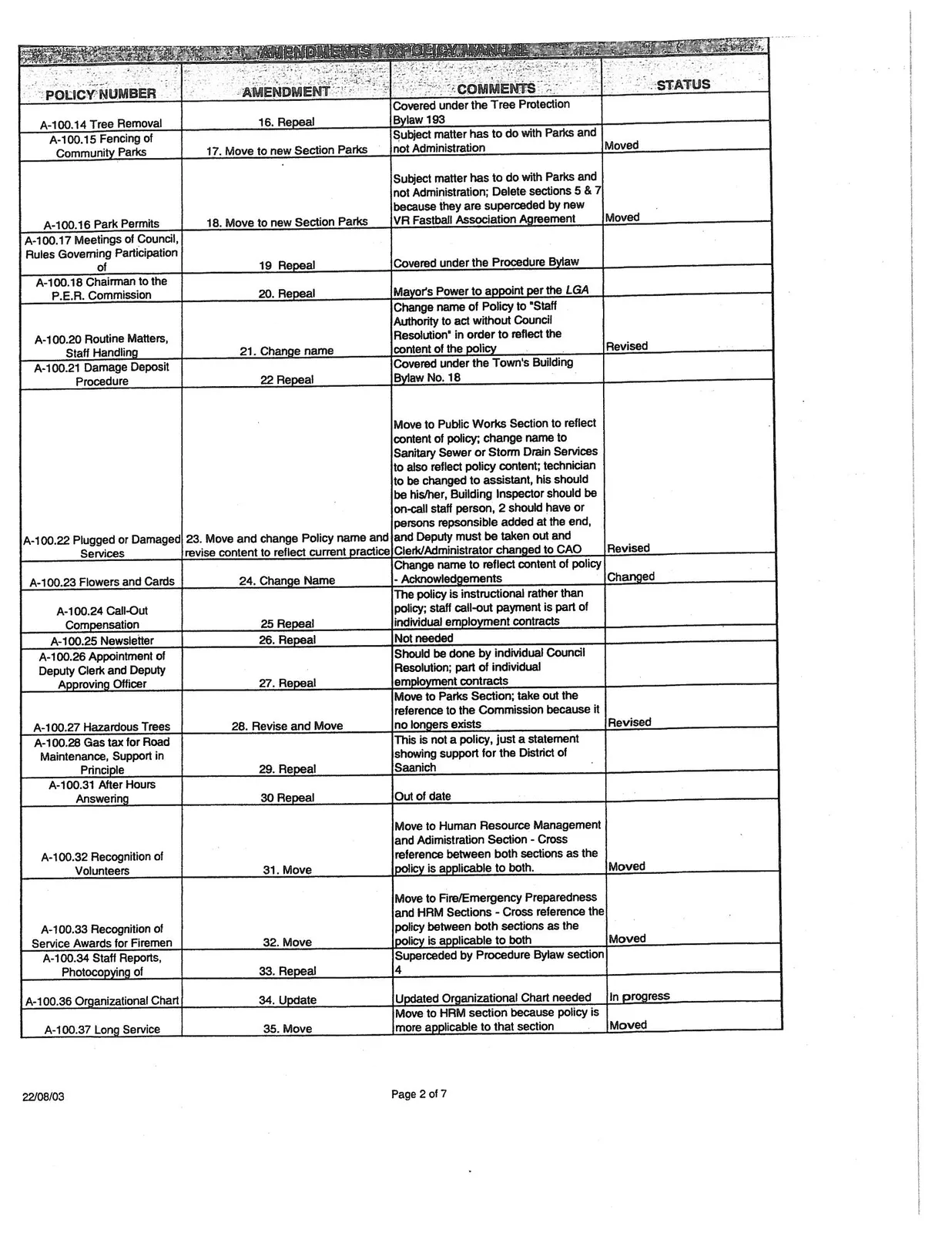
| A-100.14 Tree Removal | 16. Repeal | Covered under the Tree Protection Bylaw 193 | |
| A-100.15 Fencing of Community Parks | 17. Move to new Section Parks | Subject matter has to do with Parks and not Administration | Moved |
| A-100.16 Park Permits | 18. Move to new Section Parks | Subject matter has to do with Parks and not Administration; Delete sections 5 & 7 because they are superceded by new VR Fastball Association Agreement | Moved |
| A-100.17 Meetings of Council, Rules Governing Participation of | 19. Repeal | Covered under the Procedure Bylaw | |
| A-100.18 Chairman to the P.E.R. Commission | 20. Repeal | Mayor's Power to appoint per the LGA | |
| A-100.20 Routine Matters, Staff Handling | 21. Change name | Change name of Policy to "Staff Authority to act without Council Resolution" in order to reflect the content of the policy | Revised |
| A-100.21 Damage Deposit Procedure | 22. Repeal | Covered under the Town's Building Bylaw No. 18 | |
| A-100.22 Plugged or Damaged Services | 23. Move and change Policy name and revise content to reflect current practice | Move to Public Works Section to reflect content of policy; change name to Sanitary Sewer or Storm Drain Services to also reflect policy content; technician to be changed to assistant, his should be his/her, Building Inspector should be on-call staff person, 2 should have or persons responsible added at the end, and Deputy must be taken out and Clerk/Administrator changed to CAO | Revised |
| A-100.23 Flowers and Cards | 24. Change Name | Change name to reflect content of policy - Acknowledgements | Changed |
| A-100.24 Call-Out Compensation | 25. Repeal | The policy is instructional rather than policy; staff call-out payment is part of individual employment contracts | |
| A-100.25 Newsletter | 26. Repeal | Not needed | |
| A-100.26 Appointment of Deputy Clerk and Deputy Approving Officer | 27. Repeal | Should be done by individual Council Resolution; part of individual employment contracts | |
| A-100.27 Hazardous Trees | 28. Revise and Move | Move to Parks Section; take out the reference to the Commission because it no longer exists | Revised |
| A-100.28 Gas tax for Road Maintenance, Support in Principle | 29. Repeal | This is not a policy, just a statement showing support for the District of Saanich | |
| A-100.31 After Hours Answering | 30. Repeal | Out of date | |
| A-100.32 Recognition of Volunteers | 31. Move | Move to Human Resource Management and Administration Section - Cross reference between both sections as the policy is applicable to both. | Moved |
| A-100.33 Recognition of Service Awards for Firemen | 32. Move | Move to Fire/Emergency Preparedness and HRM Sections - Cross reference the policy between both sections as the policy is applicable to both | Moved |
| A-100.34 Staff Reports, Photocopying of | 33. Repeal | Superceded by Procedure Bylaw section 4 | |
| A-100.36 Organizational Chart | 34. Update | Updated Organizational Chart needed | In progress |
| A-100.37 Long Service | 35. Move | Move to HRM section because policy is more applicable to that section | Moved |
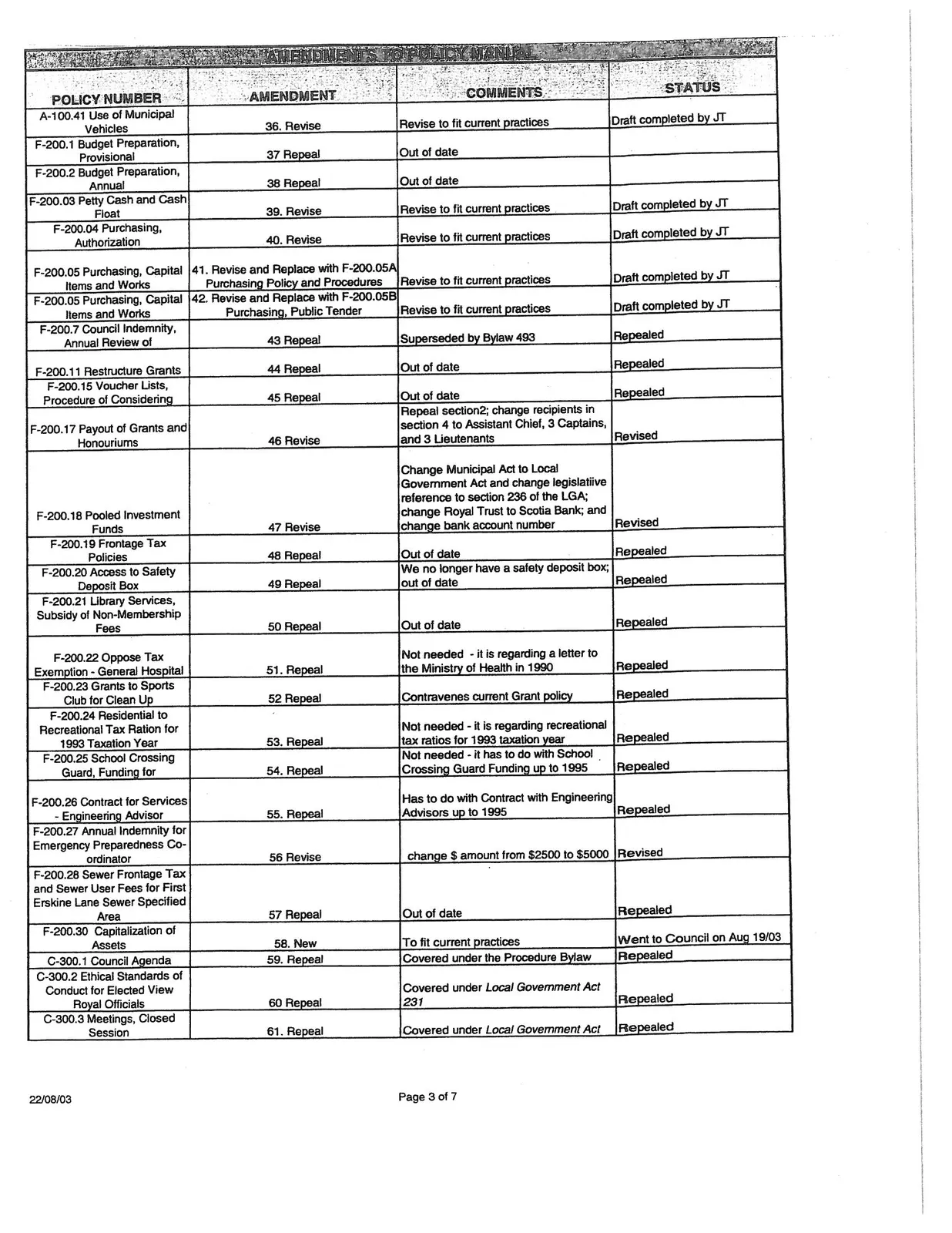
| A-100.41 Use of Municipal Vehicles | 36. Revise | Revise to fit current practices | Draft completed by JT |
| F-200.1 Budget Preparation, Provisional | 37. Repeal | Out of date | |
| F-200.2 Budget Preparation, Annual | 38. Repeal | Out of date | |
| F-200.03 Petty Cash and Cash Float | 39. Revise | Revise to fit current practices | Draft completed by JT |
| F-200.04 Purchasing, Authorization | 40. Revise | Revise to fit current practices | Draft completed by JT |
| F-200.05 Purchasing, Capital Items and Works | 41. Revise and Replace with F-200.05A Purchasing Policy and Procedures | Revise to fit current practices | Draft completed by JT |
| F-200.05 Purchasing, Capital Items and Works | 42. Revise and Replace with F-200.05B Purchasing, Public Tender | Revise to fit current practices | Draft completed by JT |
| F-200.7 Council Indemnity, Annual Review of | 43. Repeal | Superseded by Bylaw 493 | Repealed |
| F-200.11 Restructure Grants | 44. Repeal | Out of date | Repealed |
| F-200.15 Voucher Lists, Procedure of Considering | 45. Repeal | Out of date | Repealed |
| F-200.17 Payout of Grants and Honourariums | 46. Revise | Repeal section 2; change recipients in section 4 to Assistant Chief, 3 Captains, and 3 Lieutenants | Revised |
| F-200.18 Pooled Investment Funds | 47. Revise | Change Municipal Act to Local Government Act and change legislative reference to section 236 of the LGA; change Royal Trust to Scotia Bank; and change bank account number | Revised |
| F-200.19 Frontage Tax Policies | 48. Repeal | Out of date | Repealed |
| F-200.20 Access to Safety Deposit Box | 49. Repeal | We no longer have a safety deposit box; out of date | Repealed |
| F-200.21 Library Services, Subsidy of Non-Membership Fees | 50. Repeal | Out of date | Repealed |
| F-200.22 Oppose Tax Exemption - General Hospital | 51. Repeal | Not needed - it is regarding a letter to the Ministry of Health in 1990 | Repealed |
| F-200.23 Grants to Sports Club for Clean Up | 52. Repeal | Contravenes current Grant policy | Repealed |
| F-200.24 Residential to Recreational Tax Ration for 1993 Taxation Year | 53. Repeal | Not needed - it is regarding recreational tax ratios for 1993 taxation year | Repealed |
| F-200.25 School Crossing Guard, Funding for | 54. Repeal | Not needed - it has to do with School Crossing Guard Funding up to 1995 | Repealed |
| F-200.26 Contract for Services - Engineering Advisor | 55. Repeal | Has to do with Contract with Engineering Advisors up to 1995 | Repealed |
| F-200.27 Annual Indemnity for Emergency Preparedness Co-ordinator | 56. Revise | change $ amount from $2500 to $5000 | Revised |
| F-200.28 Sewer Frontage Tax and Sewer User Fees for First Erskine Lane Sewer Specified Area | 57. Repeal | Out of date | Repealed |
| F-200.30 Capitalization of Assets | 58. New | To fit current practices | Went to Council on Aug 19/03 |
| C-300.1 Council Agenda | 59. Repeal | Covered under the Procedure Bylaw | Repealed |
| C-300.2 Ethical Standards of Conduct for Elected View Royal Officials | 60. Repeal | Covered under Local Government Act 231 | Repealed |
| C-300.3 Meetings, Closed Session | 61. Repeal | Covered under Local Government Act | Repealed |
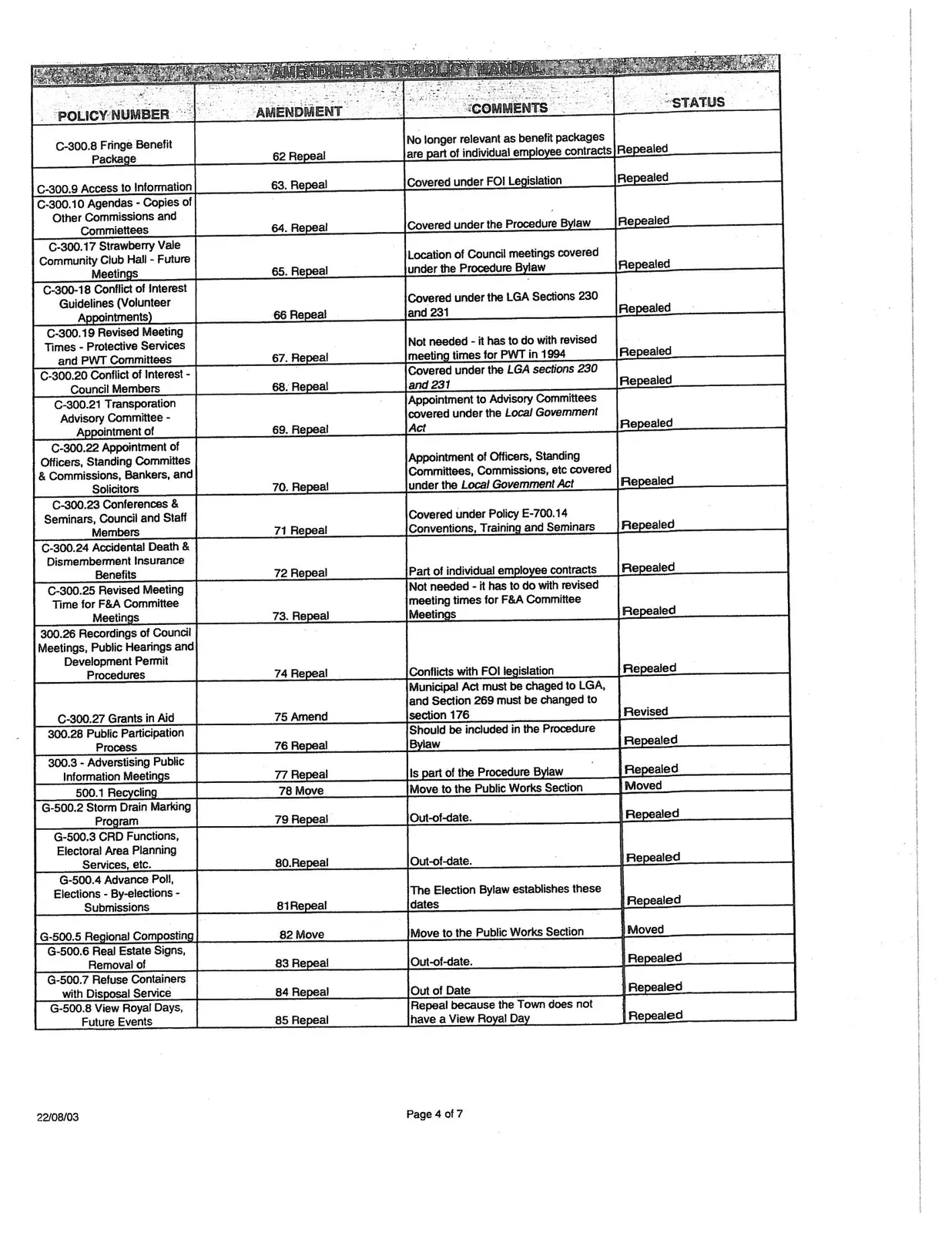
| C-300.8 Fringe Benefit Package | 62. Repeal | No longer relevant as benefit packages are part of individual employee contracts | Repealed |
| C-300.9 Access to Information | 63. Repeal | Covered under FOI Legislation | Repealed |
| C-300.10 Agendas - Copies of Other Commissions and Committees | 64. Repeal | Covered under the Procedure Bylaw | Repealed |
| C-300.17 Strawberry Vale Community Club Hall - Future Meetings | 65. Repeal | Location of Council meetings covered under the Procedure Bylaw | Repealed |
| C-300.18 Conflict of Interest Guidelines (Volunteer Appointments) | 66. Repeal | Covered under the LGA Sections 230 and 231 | Repealed |
| C-300.19 Revised Meeting Times - Protective Services and PWT Committees | 67. Repeal | Not needed - it has to do with revised meeting times for PWT in 1994 | Repealed |
| C-300.20 Conflict of Interest - Council Members | 68. Repeal | Covered under the LGA sections 230 and 231 | Repealed |
| C-300.21 Transporation Advisory Committee - Appointment of | 69. Repeal | Appointment to Advisory Committees covered under the Local Government Act | Repealed |
| C-300.22 Appointment of Officers, Standing Committees & Commissions, Bankers, and Solicitors | 70. Repeal | Appointment of Officers, Standing Committees, Commissions, etc covered under the Local Government Act | Repealed |
| C-300.23 Conferences & Seminars, Council and Staff Members | 71. Repeal | Covered under Policy E-700.14 Conventions, Training and Seminars | Repealed |
| C-300.24 Accidental Death & Dismemberment Insurance Benefits | 72. Repeal | Part of individual employee contracts | Repealed |
| C-300.25 Revised Meeting Time for F&A Committee Meetings | 73. Repeal | Not needed - it has to do with revised meeting times for F&A Committee Meetings | Repealed |
| 300.26 Recordings of Council Meetings, Public Hearings and Development Permit Procedures | 74. Repeal | Conflicts with FOI legislation | Repealed |
| C-300.27 Grants in Aid | 75. Amend | Municipal Act must be chaged to LGA, and Section 269 must be changed to section 176 | Revised |
| 300.28 Public Participation Process | 76. Repeal | Should be included in the Procedure Bylaw | Repealed |
| 300.3 - Adversiting Public Information Meetings | 77. Repeal | Is part of the Procedure Bylaw | Repealed |
| 500.1 Recycling | 78. Move | Move to the Public Works Section | Moved |
| G-500.2 Storm Drain Marking Program | 79. Repeal | Out-of-date. | Repealed |
| G-500.3 CRD Functions, Electoral Area Planning Services, etc. | 80. Repeal | Out-of-date. | Repealed |
| G-500.4 Advance Poll, Elections - By-elections - Submissions | 81. Repeal | The Election Bylaw establishes these dates | Repealed |
| G-500.5 Regional Composting | 82. Move | Move to the Public Works Section | Moved |
| G-500.6 Real Estate Signs, Removal of | 83. Repeal | Out-of-date. | Repealed |
| G-500.7 Refuse Containers with Disposal Service | 84. Repeal | Out of Date | Repealed |
| G-500.8 View Royal Days, Future Events | 85. Repeal | Repeal because the Town does not have a View Royal Day | Repealed |
| G-500.9 Appointment of Fire Chief | 86. Repeal | Deals with the appointment of William J. Musgrave as the Fire Chief in 1991 | Repealed |
| G-500.10 Replacement of Street Signs | 87. Repeal | Out-of-date. | Repealed |
| G-500.11 Light Rail Transit | 88. Repeal | Has to do with a letter to the Provincial Government regarding a Light Rail Transit system | Repealed |
| G-500.12 View Royal Softball Association agreement - use of Helmcken/Centennial Park | 89. Repeal | There is a new agreement/contract that has been established between View Royal and Softball Association | Repealed |
| G-500.13 Vancouver Airport Runway Project | 90. Repeal | States the Town's support of the Vancouver Airport Runway Project of 1990 | Repealed |
| G-500.14 Support of CBC Radio Project | 91. Repeal | States the Town's support of the CBC Radio Station | Repealed |
| G-500.15 Middens and Artifacts, if Found | 92. Repeal | This is covered under Provincial Legislation: Heritage Conservation Act | Repealed |
| G-500.16 Sewage Treatment - Dr. Boydell Report | 93. Repeal | Deals with writing a letter to the CRD in 1990 stating that a report on sewage treatment was written by Dr. Boydell | Repealed |
| G-500.17 Sewage Grinder Pumps, Maintenance of | 93. Move | Move to new section of Public Works | Moved |
| G-500.18 Centennial Park Gates, Opening/Closing of | 94. Move | Move to new section of Parks | Moved |
| G-500.19 Beer Gardens, Hours of Operation | 95. Repeal | The decision is made on a case by case basis and by Council Resolution | Repealed |
| G-500.20 Governor's Point Sewage Lift Station, Maintenance of | 96. Repeal | Decision is made by individual Council Resolution | Repealed |
| G-500.21 Saanich Water to View Royal | 97. Repeal | Decision is made by individual Council Resolution | Repealed |
| G-500.22 BC Hydro Power Smart Program - Staff Support | 98. Repeal | Not needed | Repealed |
| G-500.23 Municipal Flag | 99. Repeal | Not needed | Repealed |
| G-500.24 Procurement (Purchasing) Policy | 100. Repeal | Repeal as it is out of date | Repealed |
| G-500.25 Road Maintenance, Contract Out | 101. Move | Move to new section of Public Works | Moved |
| G-500.26 Tree Management Strategy | 102. Repeal | Covered under the Tree Protection Bylaw 193 | Repealed |
| G-500.27 Highways Maintenance Standards and Specifications | 103. Repeal | Policy is now out-of-date and standards are now set by contract with the company who wins the tender | Repealed |
| G-500.28 Town Vehicles, Staff Use of | 104. Repealed | Replaced with A-100.41 | Revised version is in draft form as done by Janel Taylor |
| G-500.29 Corporate Sponsorship of Benches | 105. Repeal | No longer used | Repealed |
| G-500.30 Sounding of Fire Horns | 106. Repeal | Out of Date and no longer relevant | Repealed |
| G-500.31 Emergency Preparedness Co-ordinator & Emergency Earthquake Plan | 107. Move | Move to new section of Fire/Emergency Preparedness | Moved |
| G-500.32 Citizenship Award for View Royal Elementary School Student | 108. Repeal | Out-of-date. | Repealed |
| G-500.33 Delivery of Public Works and Services | 109. Repeal | Out-of-date. | Repealed |
| G-500.34 Snow Clearing on Sidewalks | 110. Repeal | Superseded by Bylaw 332 - Snow Clearing Bylaw | Repealed |
| G-500.35 Regulation of Flow of Traffic | 111. Move | Move to new section of Public Works | Moved |
| M-600.1 Municipal Buildings, Maintenance | 112. Move | Move to the Administration Section | Moved |
| G-600.2 Municipal Buildings, Foundation | 113. Repeal | Out-of-date and no longer relevant | Repealed |
| E-700.1 Definition of Employee | 114. Repeal | No longer relevant as each employee has their own individual contract | Repealed |
| E-700.1A Educational Assistance | 115. Repeal | Covered under Policy E-700.14 Conventions, Training and Seminars | Repealed |
| E-700.02 Expense Accounts, Council and Staff | 116. Revise | Employees' Expense Accounts - Council and Staff | Draft completed by JT |
| E-700.3 Employees - Recruitment, Dismissal and/or Suspension of Officers and Employees | 117. Repeal | Out of Date | Repealed |
| E-700.7 Injuries on the job | 118. Repeal | Covered under WCB legislation | Repealed |
| E-700.8 Leave of Absence | 119. Repeal | Part of individual employee contracts | Repealed |
| E-700.9 Probation, Employees | 120. Repeal | Part of individual employee contracts | Repealed |
| E-700.10 Hours of Work | 121. Repeal | Part of individual employee contracts | Repealed |
| E-700.11 Overtime, Clerk/Adminstrator | 122. Repeal | Part of individual employee contracts | Repealed |
| E-700.12 Overtime, Staff | 123. Repeal | Part of individual employee contracts | Repealed |
| E-700.15 Reprimands | 124. Repeal | Should be handled on a case-by-case basis | Repealed |
| E-700.16 Annual Vacation | 125. Repeal | Void because of individual employee contracts that exist | Repealed |
| E-700.17 Statutory Holidays | 126. Repeal | Statutory holidays are outlined to employees via their employee contracts and Employment Standards | Repealed |
| E-700.18 Sick Leave | 127. Repeal | Individual Employee contracts | Repealed |
| E-700.19 Effect of Absence or Sick Leave, Vacations and Stat Holidays | 128. Repeal | Individual Employee contracts | Repealed |
| E-700.20 Funeral Leave | 129. Repeal | Individual Employee contracts | Repealed |
| E-700.23/E700.32 Fringe Benefits/Fringe Benefits Equial to the CRD and E-700.1 Employee definitions | 130. Repeal | Part of individual employee contracts | Repealed |
| e-700.24 Employment of Temporary Personnel | 131. Amend | Temporary employees receive 10% in lieu of benefits, vacation, and sick leave and not 9% as 4 (b) reads. | Revised |
| E-700.25 Payment of Membership Annual Dues | 132. Repeal | These are approved each year with the budget | Repealed |
| E-700.26 Benefits Accruing to Regular Part Time Employees | 133. Repeal | Individual Employee contracts | Repealed |
| E-700.27 Pay Scale | 134. Repeal | Part of individual employee contracts | Repealed |
| E-700.28 Grievance Procedure | 135. Amend | Amend section E to read Labour Relations Board, not Arbirtation Board | Revised |
| E-700.29 Performance Rating | 136. Repeal | Part of individual employee contracts | Repealed |
| E-700.30 Employee Vehicles, Employment Use of | 137. Move | Move to Administration Section behind Policy A-100.41 Employee Use of Municipal Vehicles. This will create consistency | Moved |
| E-700.31 Employee Dinner Allowance | 138. Move | Move to Finance section because it has to do with money and financial matters | Moved |
| E-700.33 Building Inspector's Replacement | 139. Repeal | Agreement with Metchosin for replacing building inspectors is now void | Repealed |
| E-700.34 Disclosure Papers - Staff Not File | 140. Repeal | Covered under the Financial Disclosure Act | Repealed |
| Job Descriptions | 141 Take out of manual | Because job descriptions are not really policy, it is advised that they be taken out of the policy manual all together. | Taken out |
PLEASE NOTE: DUE TO THE SIZE OF THIS PROJECT, THE PLANNING SECTION HAS NOT BEEN REVIEWED AT THIS TIME
Document Images
(35)