Heat Pumps in New Construction
Information report on how other North Shore municipalities use the BC Energy Step Code to encourage heat pump installation in new buildings.
TOWN OF VIEW ROYAL PLANNING & DEVELOPMENT REPORT
TO: Committee of the Whole FROM: J. Chow, MCIP, RPP, Senior Planner DATE: September 9, 2021 MEETING DATE: September 14, 2021
HEAT PUMPS IN NEW CONSTRUCTION
RECOMMENDATION
THAT the September 9, 2021 report from the Senior Planner titled “Heat Pumps In New Construction” be received for information.
CHIEF ADMINISTRATIVE OFFICER’S COMMENTS
I concur with the recommendation.
DIRECTOR OF DEVELOPMENT SERVICES’ COMMENTS
I concur with the recommendation.
PURPOSE OF REPORT
To provide information on how the District of North Vancouver and the District of West Vancouver are addressing heat pumps in new construction.
BACKGROUND
The following resolution was endorsed at the June 1, 2021 Council meeting.
MOVED BY: Councillor Rogers SECONDED: Councillor Lemon
C-66-21 THAT staff prepare a report regarding the District of North Vancouver and the District of West Vancouver’s practices with respect to heat pumps in new single family and multi-family construction. CARRIED
DISCUSSION
The prevalence of heat pumps in new construction on the North Shore beginning in 2021 was achieved through the voluntary implementation of higher levels of the BC Energy Step Code in building permit requirements.
Step Code
In January 2022, the mandatory requirements of the BC Building Code’s Energy Step Code will come into effect to set energy performance requirements for new construction across the province. These initial lower levels will require energy modelling and measurable changes to construction methods to improve energy efficiency by 20% over the base Building Code.
- Part 9 (detached residential) buildings will be required to meet Step 3 of 5.
- Part 3 (complex – multifamily and commercial) buildings will be required to meet Step 2. The steps are different for different uses and types of Part 3 buildings, i.e. multifamily residential or commercial use; and wood, concrete or steel construction.
There will be another requirement to meet a higher Step Code level in 2027. The highest level is “net-zero ready” (i.e. able to be heated or cooled without emitting green house gases, typically by using renewable energy such as solar or geothermal) and will be required for all new buildings in 2032.
North Shore Voluntary Implementation of Step Code
In response to their respective declarations of a climate emergency, District of West Vancouver, District of North Vancouver and City of West Vancouver all voluntarily adopted even higher Step Code levels in 2021.
However, a second option was made available in all three municipalities that permits a lower Step Code level if a Low Carbon Emission System (LCES) such as a heat pump is in place (see Tables 1-3). All three municipalities define a Low Carbon Emission System as one that emits less than 3 kg CO2e/m2 per year. This effectively means that fossil fuel heating systems cannot be installed, but it appears that natural gas appliances would be permitted.
Table 1. District of West Vancouver (in effect February 28, 2021)
| Building Type | Previous | Current |
|---|---|---|
| Part 9 Building | Step 3 | Step 5 or Step 3 with LCES |
| Detached Secondary Suite | Step 1 | Step 5 or Step 2 with LCES |
| Part 3 Building | Step 2 | Step 4 or Step 2 with LCES |
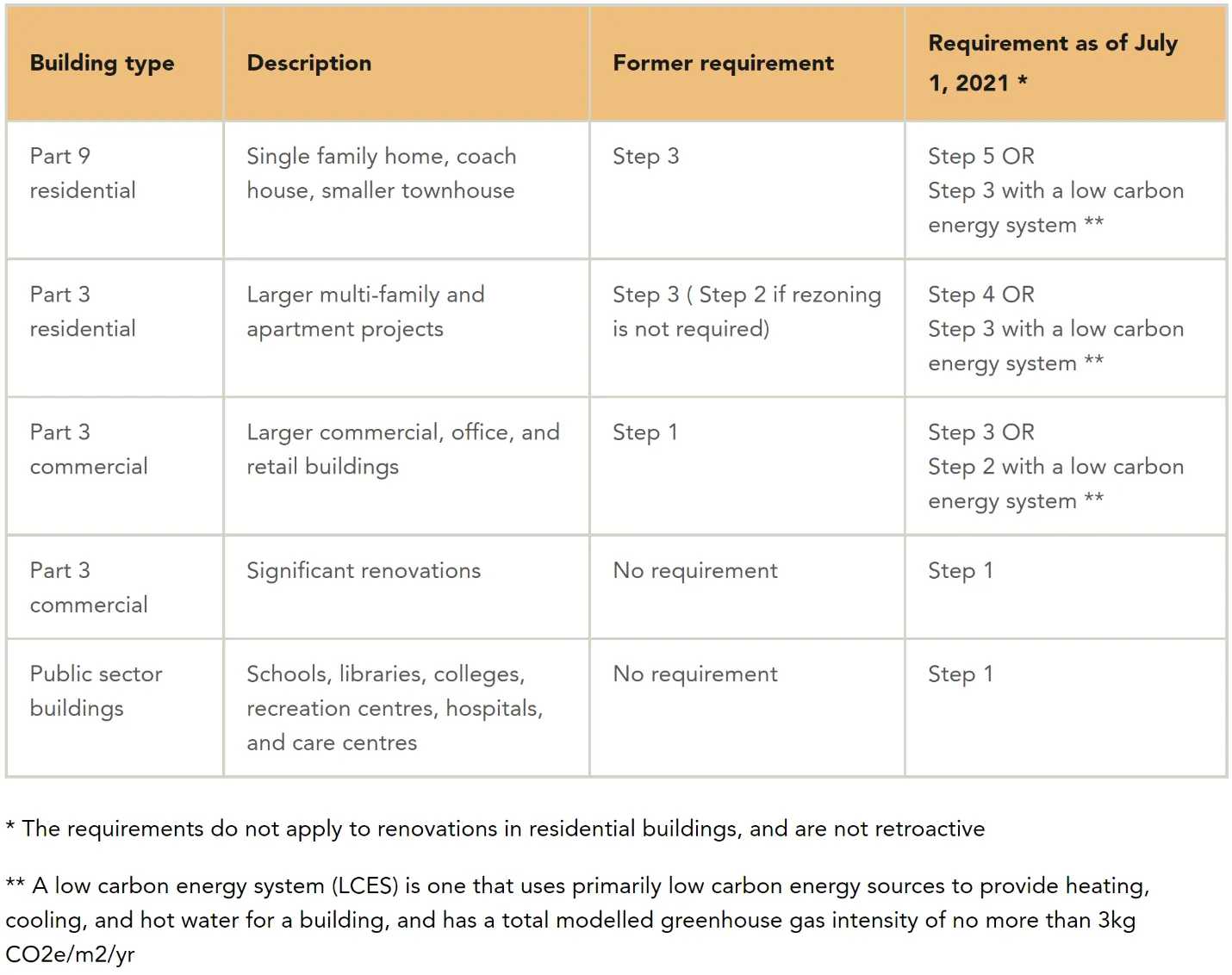
Table 2. District of North Vancouver (in effect July 1, 2021)
| Building type | Description | Former requirement | Requirement as of July 1, 2021 * |
|---|---|---|---|
| Part 9 residential | Single family home, coach house, smaller townhouse | Step 3 | Step 5 OR Step 3 with a low carbon energy system ** |
| Part 3 residential | Larger multi-family and apartment projects | Step 3 ( Step 2 if rezoning is not required) | Step 4 OR Step 3 with a low carbon energy system ** |
| Part 3 commercial | Larger commercial, office, and retail buildings | Step 1 | Step 3 OR Step 2 with a low carbon energy system ** |
| Part 3 commercial | Significant renovations | No requirement | Step 1 |
| Public sector buildings | Schools, libraries, colleges, recreation centres, hospitals, and care centres | No requirement | Step 1 |
* The requirements do not apply to renovations in residential buildings, and are not retroactive
** A low carbon energy system (LCES) is one that uses primarily low carbon energy sources to provide heating, cooling, and hot water for a building, and has a total modelled greenhouse gas intensity of no more than 3kg CO2e/m2/yr
Table 3. City of North Vancouver (in effect July 1, 2021)
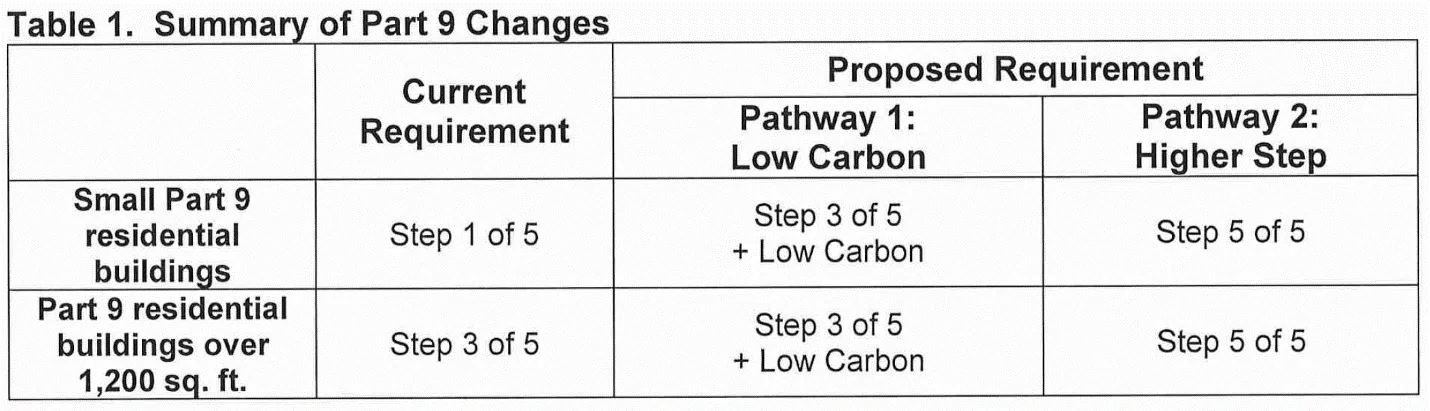
Table 1. Summary of Part 9 Changes
| Current Requirement | Pathway 1: Low Carbon (Proposed) | Pathway 2: Higher Step (Proposed) | |
|---|---|---|---|
| Small Part 9 residential buildings | Step 1 of 5 | Step 3 of 5 + Low Carbon | Step 5 of 5 |
| Part 9 residential buildings over 1,200 sq. ft. | Step 3 of 5 | Step 3 of 5 + Low Carbon | Step 5 of 5 |
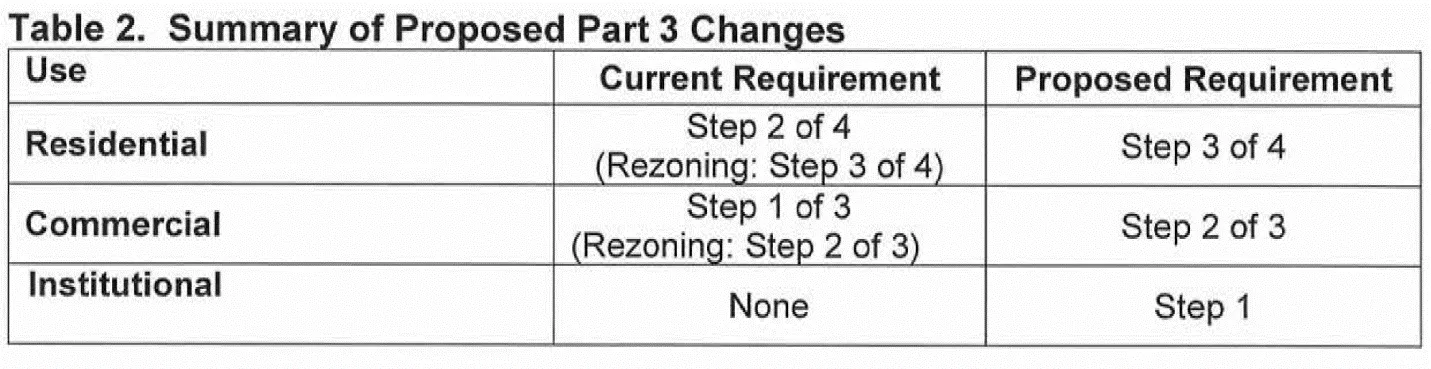
Table 2. Summary of Proposed Part 3 Changes
| Use | Current Requirement | Proposed Requirement |
|---|---|---|
| Residential | Step 2 of 4 (Rezoning: Step 3 of 4) | Step 3 of 4 |
| Commercial | Step 1 of 3 (Rezoning: Step 2 of 3) | Step 2 of 3 |
| Institutional | None | Step 1 |
CONCLUSION
This approach only applies to new construction. Existing residences will not be required to update their heating systems.
The Town will achieve similar objectives through full implementation of the Step Code by 2032.
Voluntary adoption of a higher Step Code requires consultation requirements and a notification period set out by the Province.
RECOMMENDATION
THAT the September 9, 2021 report from the Senior Planner titled “Heat Pumps In New Residential Construction” be received for information.
SUBMITTED BY: J. Chow MCIP RPP, Community Planner REVIEWED BY: L. Chase MCIP RPP, Director of Development Services
Document Images
(3)