PLANNING & DEVELOPMENT REPORT: Community Climate Action Strategy – Public Engagement Summary and Greenhouse Gas Targets
Staff report recommending endorsement of Greenhouse Gas (GHG) reduction targets and providing a summary of community engagement results for the new climate strategy.
TOWN OF VIEW ROYAL PLANNING & DEVELOPMENT REPORT
TO: Committee of the Whole FROM: Jeff Chow, Senior Planner DATE: December 7, 2021 MEETING DATE: December 14, 2021
Community Climate Action Strategy – Public Engagement Summary and Greenhouse Gas Targets
RECOMMENDATION:
THAT the Committee recommend to Council that Green House Gas Reduction targets be endorsed to reduce community Green House Gas emissions by:
- 45% from 2007 levels by 2030
- 100% from 2007 levels by 2050.
CHIEF ADMINISTRATIVE OFFICER’S COMMENTS:
I concur with the recommendation.
DIRECTOR OF DEVELOPMENT SERVICES’S COMMENTS:
I concur with the recommendation.
PURPOSE:
- To provide a 'What We’ve Heard” summary from community engagement events
- To seek Council direction on key policy decisions in advance of drafting the plan
BACKGROUND:
The purpose of the Community Climate Action Strategy (CCAS) is to:
- Forecast community Green House Gas emissions (GHGe)
- Set GHGe reduction targets
- Develop an action plan to meet the targets while working towards carbon neutrality
- Increase community awareness and encourage action by individuals to reduce community GHGe by such means as a community resource guide and by referencing the District of Saanich carbon calculator (revised November 2021).
- Establish strategies for regular monitoring and progress reporting
Community GHGe are territorial emissions, i.e. those generated within the Town, with allocations made for air and marine travel. They do not include consumption-based emissions, i.e. emissions generated elsewhere in the production of food and other goods.
DISCUSSION:
1. Public engagement component
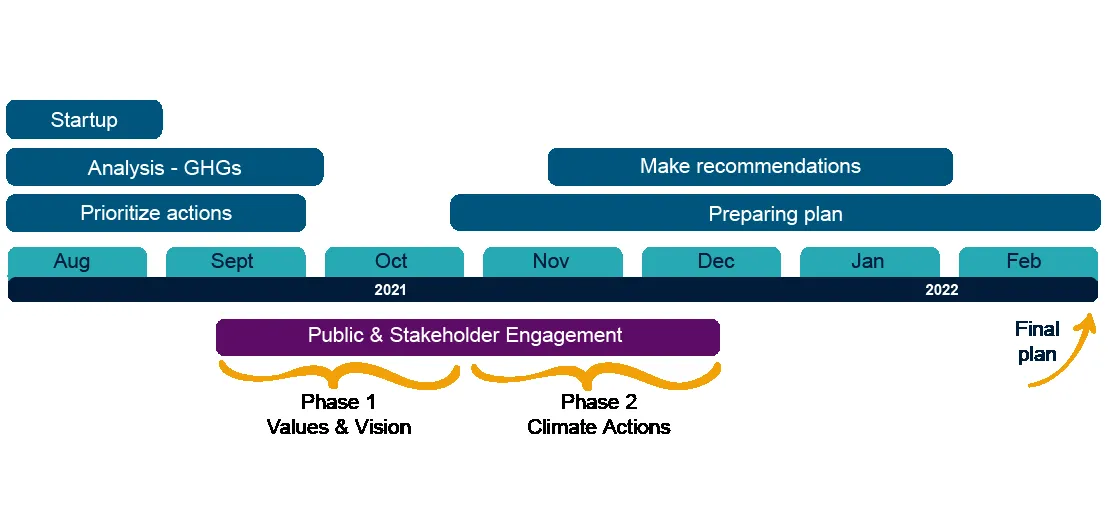
The public and stakeholder engagement to gather community input for plan preparation (see Figure 1) has concluded and is summarized in Attachment 1. There were two workshops and two community surveys.
Workshops Two online workshops were held in October. Early analysis indicates that the primary GHGe in the Town are buildings, transportation, and waste. These themes were reflected in the topics selected for deeper engagement in the second workshop.
Community Surveys Parallel to the workshops, two community surveys were also conducted in October and November. These were available on the Town’s website and were distributed through social media, the Town’s RSS feeds and via email to advisory committees.
The information from this input is being used to help determine priorities for the strategy. The first item to consider is the Greenhouse Gas Emissions Reduction Targets.
2. Greenhouse Gas Emissions Targets
Community Energy Association, the consultant for the CCAS, provides the following recommendations for setting a GHG reduction targets.
| Current Town of View Royal Greenhouse Gas Reduction Targets | |
|---|---|
| Current Official Community Plan target: | Achieve or exceed Provincial targets. 12% below 2007 levels by 2017, 33% by 2030 |
| Climate Emergency Declaration: | Carbon neutrality by 2030 |
Recommended New View Royal Community Greenhouse Gas Reduction Target
- 45% reduction from 2007 by 2030
- 100% reduction from 2007 levels by 2050
Our Rationale The recommendations above are aligned with the necessary ambition and timeline for reaching the overarching goal of limiting global warming to 1.5C, as per the Intergovernmental Panel on Climate Change (IPCC) report from October 2018.
Reaching the goal of carbon neutrality or a 100% reduction in emissions by 2030 is extremely ambitious and will most likely not be met by any jurisdiction in North America. Additionally, it would be difficult to achieve without the support of higher levels of government and without imposing significant cost on residents.
At present there are several critically supportive policy tools that are available from the federal and provincial governments which will help to meet the 2050 target. However, these policies will not be implemented in time to reach an ambitious 2030 target.
These policies include:
Government of Canada
- A rising price on carbon pollution
Province of BC from CleanBC
- A stronger price on carbon pollution, aligned with or exceeding federal requirements, with built in supports for people and businesses
- Increased clean fuel requirements and doubling the target for renewable fuels produced in B.C. to 1.3 billion litres by 2030
- An accelerated zero-emission vehicle (ZEV) law (26% of new light-duty vehicles by 2026, 90% by 2030, 100% by 2035)
- New ZEV targets for medium- and heavy-duty vehicles aligned with California Complete B.C.’s Electric Highway by 2024 and a target of the province having 10,000 public EV charging stations by 2030
- Actions to support mode-shift towards active transportation and public transit
- A cap on emissions for natural gas utilities with a variety of pathways to achieve it
- New requirements for all new buildings to be zero carbon and new space and water heating equipment to be highest efficiency by 2030
- A 100% Clean Electricity Delivery Standard for the BC Hydro grid
Other Government and Regional Targets
Table 1. Other Levels of Government*
| Jurisdiction | Near Term | Mid Term | Long Term |
|---|---|---|---|
| CRD | 33% below 2007 levels by 2020 | 61% by 2038 | |
| Province of BC | 40% reduction from 2007 levels by 2030 | 60% by 2040 | 80% by 2050 |
| Government of Canada | 40-45% reduction below 2005 levels by 2030 | Net-zero by 2050 | |
| City of Vancouver | 50% reduction by 2030 | carbon neutral before 2050 |
(*Staff note: See Table 2 for CRD municipalities)
Resident Support for Bold Action
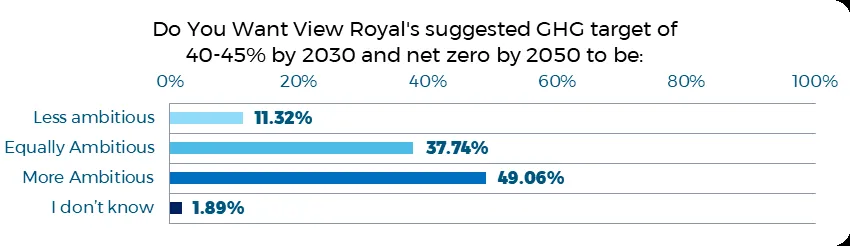
Residents who completed the second community survey were supportive of the recommended targets with the bulk of respondents supporting even more ambitious action.
Staff Comment
A comparison of community GHG reduction targets for other jurisdictions within the Capital region is summarized in Table 2. The proposed targets for 2030 and 2050 are still ambitious and would place the Town among the leaders within the region.
Table 2. Regional Targets
| Jurisdiction | Near Term reduction* (Target) | Near Term reduction* (Year) | Long Term reduction* (Target) | Long Term reduction* (Year) |
|---|---|---|---|---|
| Proposed - View Royal | 45% | 2030 | 100% | 2050 |
| Capital Regional District | 33% | 2020 | 61% | 2038 |
| Central Saanich (OCP underway) | 45% | 2030 | 80% | 2050 |
| Colwood | 45% | 2030 | 80% | 2050 |
| Esquimalt (Climate Plan underway) | 38% | 2030 | Net zero (100%) | 2050 |
| Highlands | 26% | 2030 | 80% | 2050 |
| Langford | 25% | 2030 | 33% | 2050 |
| Metchosin | 33% | 2020 | blank | blank |
| North Saanich (OCP underway) | 25% | 2020 | 45% | 2040 |
| Oak Bay | 33% | 2020 | 61% | 2038 |
| Saanich | 50% | 2030 | Net zero (100%) | 2050 |
| Sidney (OCP/Climate Plan underway) | 30% | 2030 | 80% | 2050 |
| Sooke (OCP review underway) | a. (Current) 33% b. (Draft) 40% |
a. 2020 b. 2030 |
(Draft) 90.5% | 2050 |
| Victoria | 50% | 2030 | 80% | 2050 |
* From 2007 GHGe levels
The latest community GHGe estimate for the Town (Attachment 2) is a 5.5% reduction in 2018 from 2007 levels. If the targets are endorsed by Council, an action plan would be developed as part of the CCAS to build on the 2018 figure to achieve the targets. The action plan is expected to include estimated costs for implementation so that the actions and endorsed targets may be fine-tuned if necessary. It is anticipated the final targets would be formalized in the new Official Community Plan and through an amendment to the Climate Action Emergency declaration.
Alternatives to the consultant’s recommendation include the following:
ALTERNATIVE RECOMMENDATION 1 (Status quo – highly ambitious):
THAT the Committee recommend to Council that the target to reduce community Green House Gas emissions by 100% from 2007 levels (carbon neutrality) by 2030 be endorsed.
Council’s March 15, 2019 Climate Emergency Declaration included a target of working toward carbon neutrality by 2030. Achieving the goal in that time frame is unlikely because it can be expected take more than eight years, if not decades, for the community to switch away from fossil fuels.
ALTERNATIVE RECOMMENDATION 2 (less ambitious):
THAT the Committee recommend to Council that targets be endorsed to reduce community Green House Gas emissions by:
- 37% from 2007 levels by 2030
- 75% from 2007 levels by 2050.
These targets are the current average of the other municipalities in the CRD and could be consistent with the Regional Growth Strategy target of a 60% reduction from 2007 levels by 2038. Staff recommends the targets proposed by the consultant because community engagement indicates support for meaningful climate action. If it is found that the action plan is unrealistic, the targets can be adjusted, as long they continue to address the Regional Growth Strategy targets at minimum.
RECOMMENDATION:
THAT the Committee recommend to Council that Green House Gas Reduction targets be endorsed to reduce community Green House Gas emissions by:
- 45% from 2007 levels by 2030
- 100% from 2007 levels by 2050.
SUBMITTED BY: Jeff Chow, MCIP, RPP, Senior Planner
REVIEWED BY: Lindsay Chase, MCIP, RPP, Director of Development Services
Attachments:
- Community Climate Action Strategy Community Engagement Summary - Community Energy Association, December 2021 (35 pages)
- Capital Regional District – Municipalities and Electoral Areas -2007 Base Year and 2018 Reporting Year Energy & GHG Emissions Inventory– Capital Regional District, June 24, 2020 (excerpt)
Document Images
(3)