COMMUNITY CLIMATE ACTION PLAN PRIMER - Planning and Development Report
Report presenting new community GHG emission data and outlining the process to update the 2012 Community Climate Action Plan.
TOWN OF VIEW ROYAL
Planning and Development Report
TO: Committee of the Whole DATE: November 5, 2020 FROM: J. Chow, Senior Planner MEETING: November 10, 2020
COMMUNITY CLIMATE ACTION PLAN PRIMER
RECOMMENDATION:
THAT the November 5, 2020 report from the Senior Planner titled “Community Climate Action Plan Primer” be received for information.
CHIEF ADMINISTRATIVE OFFICER’S COMMENTS:
I concur with the recommendation.
DIRECTOR OF DEVELOPMENT SERVICES’ COMMENTS:
I concur with the recommendation.
PURPOSE:
- To present the latest community greenhouse gas emission data
- To discuss the development of the new Community Climate Action Plan
BACKGROUND AND LEGISLATIVE CONTEXT
The Local Government Act and Community Charter were amended by Local Government (Green Communities) Statutes Amendment Act (Bill 27) in 2008 to require local governments to include targets, policies and actions for the reduction of greenhouse gas (GHG) emissions in their Official Community Plans. To meet these requirements and the Town’s voluntary commitments to both the Federation of Canadian Municipalities’ Partners for Climate Protection and the Provincial Climate Action Charter (Attachment 1), the Town developed a climate action strategy (see Attachment 2) to inform the Official Community Plan. The strategy was comprised of the following:
- 2012 Community Climate Action Plan
- 2010 Corporate Energy and Emissions Plan
DISCUSSION
This report addresses the following:
- New community GHG emission data – how have we done?
- Why a new Community Climate Action Plan is needed at this time
- Approach
- Next steps
1. New Community GHG emission data
Most municipalities, including the Town, have used the Provincial Community Energy and Emissions Inventory (CEEI) to monitor emissions but there have been challenges with receiving current and detailed data. For example, reports at the municipal level were provided for 2007 and 2010, but the 2012 CEEI report was released in 2017 and was unable to include on-road transportation data (due to limited vehicle travel data samples).
Because of the lack of key reliable data, the Capital Regional District commissioned the 2020 CRD Member Municipalities GHG Inventory Study (Attachment 3) at the municipal level in accordance with the widely used standards of the “Global Protocol for Community-Scale Greenhouse Gas Emission Inventories”. The emissions measured are slightly different from the Town’s plan (e.g. the CRD inventory includes transportation allocations for air and water travel) so retroactive data to the base year of 2007 was also provided. The benefit is that a consistent methodology has been used and comparisons can be made within the region.
The data is summarized in Figure 1 and indicates that even with an increase in energy consumption of 4.1% between 2007 and 2018, community GHG emissions within the Town have decreased by 5.5% from 2007 base year levels.
While the 2012 Community Climate Action Plan target was a decrease of 12% from 2007 base year levels, this achievement is remarkable considering how much growth has occurred since 2007. The inventory has also benefitted from externally driven changes such as the rise of hybrid and electric vehicles, increased fuel efficiency in new vehicles, incremental BC Building Code requirements for energy efficiency. The results indicate that there has been strong progress toward reducing emissions, but more needs to be done.
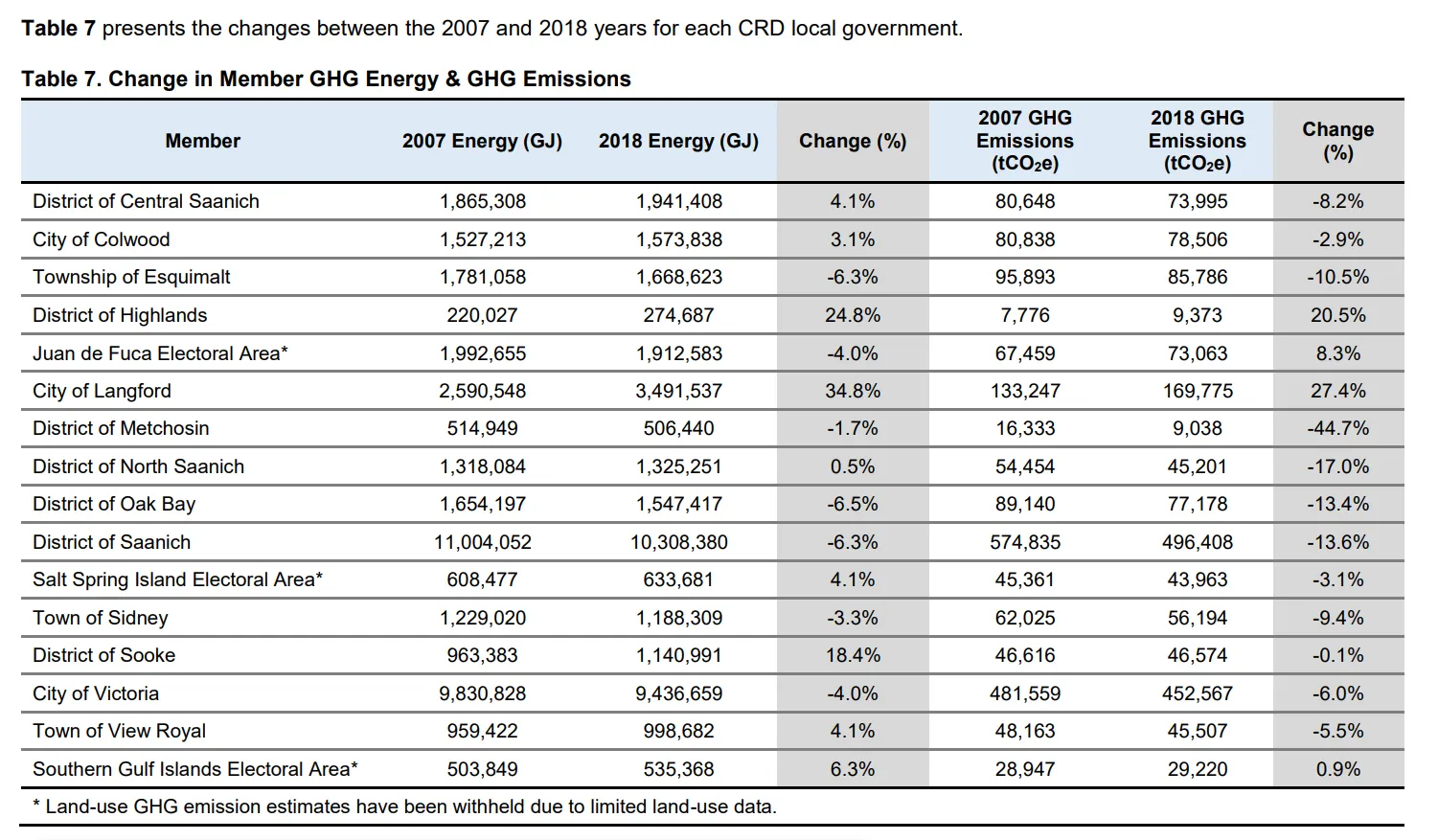
Figure 1. GHG Emission Inventory from CRD study
Table 7. Change in Member GHG Energy & GHG Emissions
| Member | 2007 Energy (GJ) | 2018 Energy (GJ) | Change (%) | 2007 GHG Emissions (tCO2e) | 2018 GHG Emissions (tCO2e) | Change (%) |
|---|---|---|---|---|---|---|
| District of Central Saanich | 1,865,308 | 1,941,408 | 4.1% | 80,648 | 73,995 | -8.2% |
| City of Colwood | 1,527,213 | 1,573,838 | 3.1% | 80,838 | 78,506 | -2.9% |
| Township of Esquimalt | 1,781,058 | 1,668,623 | -6.3% | 95,893 | 85,786 | -10.5% |
| District of Highlands | 220,027 | 274,687 | 24.8% | 7,776 | 9,373 | 20.5% |
| Juan de Fuca Electoral Area* | 1,992,655 | 1,912,583 | -4.0% | 67,459 | 73,063 | 8.3% |
| City of Langford | 2,590,548 | 3,491,537 | 34.8% | 133,247 | 169,775 | 27.4% |
| District of Metchosin | 514,949 | 506,440 | -1.7% | 16,333 | 9,038 | -44.7% |
| District of North Saanich | 1,318,084 | 1,325,251 | 0.5% | 54,454 | 45,201 | -17.0% |
| District of Oak Bay | 1,654,197 | 1,547,417 | -6.5% | 89,140 | 77,178 | -13.4% |
| District of Saanich | 11,004,052 | 10,308,380 | -6.3% | 574,835 | 496,408 | -13.6% |
| Salt Spring Island Electoral Area* | 608,477 | 633,681 | 4.1% | 45,361 | 43,963 | -3.1% |
| Town of Sidney | 1,229,020 | 1,188,309 | -3.3% | 62,025 | 56,194 | -9.4% |
| District of Sooke | 963,383 | 1,140,991 | 18.4% | 46,616 | 46,574 | -0.1% |
| City of Victoria | 9,830,828 | 9,436,659 | -4.0% | 481,559 | 452,567 | -6.0% |
| Town of View Royal | 959,422 | 998,682 | 4.1% | 48,163 | 45,507 | -5.5% |
| Southern Gulf Islands Electoral Area* | 503,849 | 535,368 | 6.3% | 28,947 | 29,220 | 0.9% |
* Land-use GHG emission estimates have been withheld due to limited land-use data.
2. Why an update is needed at this time
The plan provided a baseline for 2007 and strategies for achieving the 2017 target. The plan has been effective in supporting policies and actions to reduce emissions. These include transportation infrastructure upgrades (bike lanes, sidewalks, signal timing etc.) and Official Community Plan policies. One of the major challenges has been encouragement of energy efficiency upgrades to older building stock as those tend to be expensive for property owners.
The Community Climate Action Plan is included in the 5 Year Financial Plan for 2021. This new plan is necessary because: a. A policy response to the Climate Action Emergency declaration is needed b. It is dated and external targets have changed c. The Official Community Plan update has been initiated
a. Climate Action Emergency On March 5, 2019, the Town declared a climate action emergency, a goal of carbon neutrality by 2030 and that climate action be a priority in the Strategic Plan. There are less than ten years to work towards this target. The plan needs to be updated to respond to the declaration and develop strategies to support the community in meeting this ambitious target.
b. Outdated Plan The plan had a target date of 2017, which has now passed, and new targets need to be established. Secondly, plans have been updated at the national, provincial, and regional level (see Attachment 4). The Regional Growth Strategy has set a target to reduce community greenhouse gas emissions by 33% (from 2007 levels) by 2020, and by 61% by 2038. In 2019 the Regional Context Statement in the Official Community Plan was amended to show how plan policies address these targets. The updated Community Climate Action plan will have to consider the RGS targets.
c. Official Community Plan Update The Official Community Plan update has been initiated and refreshing the Community Climate Action Plan will be necessary to establish new targets and policies. The timing is important so that required content from the Community Climate Action Plan can be incorporated into the new OCP. Based on other recent Official Community updates in the region, it is anticipated that climate action will be a key issue.
3. Approach
The proposed plan development process is outlined in Figure 2. Elements will include: a. Continuous public education and engagement b. Analysis of current data and policies c. Modelling of scenarios to establish targets d. Development of policies and actions e. Establishment of a monitoring strategy f. Community resource guide
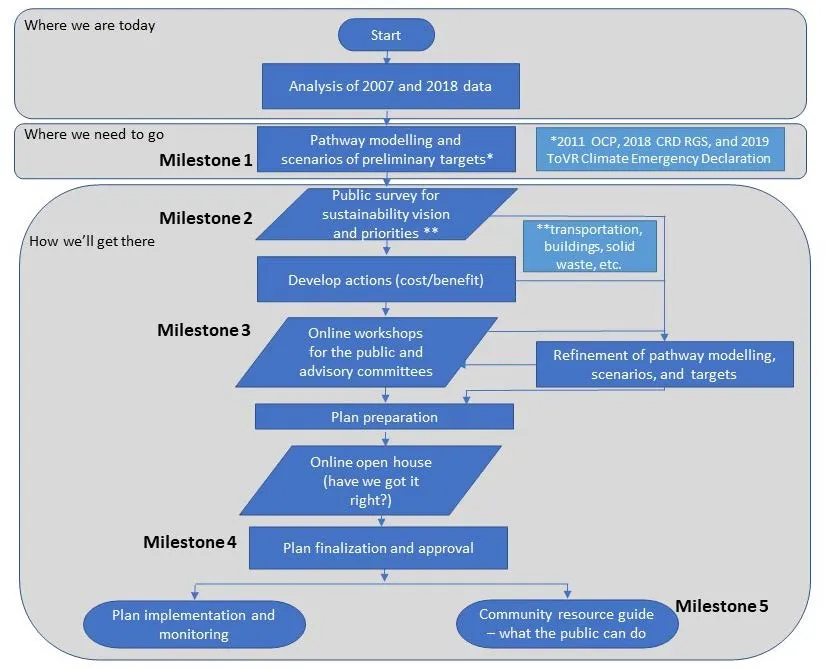
a. Public education and engagement Throughout the process, public engagement is crucial to establish and confirm community priorities and information will need to be presented to help inform opinions. Given that the COVID-19 pandemic is expected to continue, a strategy will be developed for communication and effective public participation/input in accordance with public health requirements.
b. Data analysis and policy review The CRD inventory will need to be studied in greater depth to understand the trends since the 2007 base year. Existing policies, actions and strategies would be reviewed for relevance.
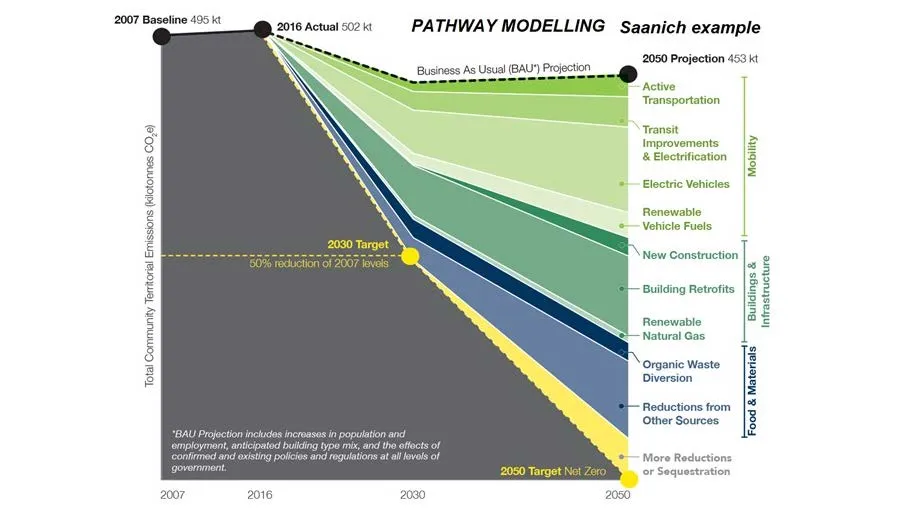
c. Data modelling to establish targets In addition to reviewing the targets of the March 5, 2019 Climate Emergency Declaration and the current OCP targets (Policy NE4.2 12) for 12% reduction from 2007 levels of GHG emissions by 2017 and 33% reduction from 2007 levels by 2030, there are a number of targets (see Attachment 2) to consider, in particular those from the Regional Growth Strategy that will need to be addressed in the Official Community Plan’s Regional Context Statement.
Data and pathway models (Figure 3) will be developed to show how the targets can be achieved and how each sector (transportation, buildings, etc.) can be approached.
d. Development of policies and actions Policies and actions and policies would be developed to achieve the targets. Workshops including a session with the joint Council advisory committees is proposed to help determine community priorities for policies and actions.
e. Monitoring strategy A monitoring strategy will be needed to ensure that efforts stay on track and that the plan will continue to be relevant over time.
f. Development of a community resource guide Several municipalities have recently developed webpage and document resources to help inspire the community to take individual actions to reduce community greenhouse gas emissions. The Town can influence infrastructure management and can regulate new development, but the direct actions of individuals can have a significant cumulative impact. A guide can provide resources to help focus and maximize these individual actions.
Other considerations: a. In a growing community it is challenging to reduce GHG emissions, but the current data shows it is possible. b. The plan needs to be more community oriented and engaging to be effective. This has been the trend in new community climate action plans. c. The plan needs to be practical and strategic. The Town has limited resources and the plan should focus on things that can be done and will have maximum cost benefits. d. The plan needs to be a ‘made in View Royal’ solution. While ideas can be drawn from other municipalities’ plans, the context of each is different (e.g. different transportation networks, land uses, population distribution, demographics, etc.). Policies and actions should be evaluated on their effectiveness in View Royal. e. It should be recognized that many community emissions are beyond the Town’s control (e.g. existing buildings are a significant source of emissions, but the Town has limited abilities to provide reduction incentives); however the Town can play a role in raising awareness and inspiring change.
4. Next steps
Staff is preparing a Terms of Reference document which provides a baseline document describing the Town’s requirements and standards for updating the Community Climate Action Plan and will guide a Request for Proposal document for those components of the Community Climate Action Plan which will be completed by a consultant team.
It is expected that the plan updating process will begin in early 2021 with a completion date in the latter half of 2021.
It is important to note that the scope of the plan does not address climate change adaptation and mitigation of impacts such as sea level rise (including storm surges and tsunami risks) on private property and Town infrastructure. It is anticipated that this issue may arise in the development of the new plan and could become a future addition to the Town’s climate action strategy.
RECOMMENDATION:
THAT the November 5, 2020 report from the Senior Planner titled “Community Climate Action Plan Primer” be received for information.
Attachments
- Climate Action Charter overview
- Climate Action Strategy overview
- 2020 CRD Member Municipalities GHG Inventory Study (40 pages)
- Overview of Current Federal, Provincial and Regional Climate Action Plans
Document Images
(2)