BUSINESS LICENSE BYLAW REVIEW Report
An introductory report analyzing potential updates to the Business License Bylaw No. 580, including fee structures and intermunicipal schemes.
TOWN OF VIEW ROYAL
Planning & Development Report
TO: Committee of the Whole DATE: May 5, 2016 FROM: J. Chow, Senior Planner MEETING DATE: May 10, 2016
BUSINESS LICENSE BYLAW REVIEW
RECOMMENDATIONS:
- That the May 5, 2016 report from the Senior Planner titled "Business License Bylaw Review" be received.
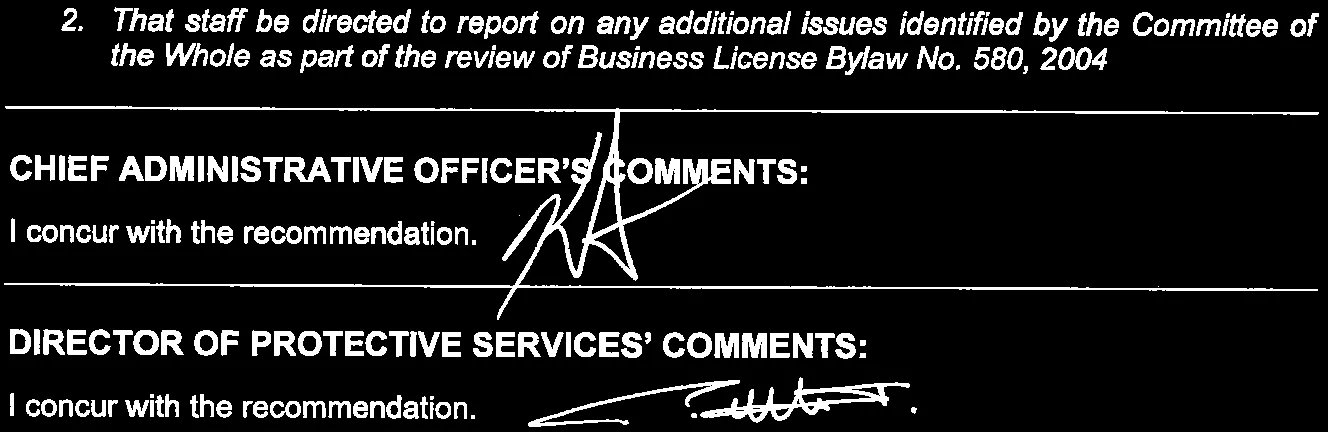
- That staff be directed to report on any additional issues identified by the Committee of the Whole as part of the review of Business License Bylaw No. 580, 2004.
CHIEF ADMINISTRATIVE OFFICER'S COMMENTS:
I concur with the recommendation.
DIRECTOR OF PROTECTIVE SERVICES' COMMENTS:
I concur with the recommendation.
DIRECTOR OF DEVELOPMENT SERVICES' COMMENTS:
I concur with the recommendation.
PURPOSE OF REPORT:
- To introduce a review of Business License Bylaw No. 580, 2004.
- To seek input from the Committee for any additional issues to investigate.
BACKGROUND:
To help ensure that key bylaws reflect community needs, the View Royal Strategic Plan 2015-2018 identified the need for a review of the Business License Bylaw in 2016. There have been two amendments to the current Business License Bylaw No. 580, 2004 (Attachment 1): a minor amendment in 2006 and a more recent amendment in 2015 to regulate the sales of drug paraphernalia.
This report highlights a number of issues relating to business licensing and provides an opportunity for the Committee to identify any other issues that may be relevant for the bylaw update.
ISSUES AND ANALYSIS:
The considerations for the Business License Bylaw Review include the following: a) Statutory authority b) Regional context and comparison c) Review of current bylaw d) Additional issues to consider e) Timing of bylaw f) Notice of bylaw and opportunities for public comment g) Next steps toward Council consideration
A. Statutory Authority
Fundamental powers granted to municipalities in section 8 of the Community Charter include the regulation of business. Under s.15 of the Community Charter, councils can: a. prohibit any activity or thing until a license, permit or approval has been granted; b. set the effective periods of licenses, permits and approvals; c. set requirements for obtaining, continuing, renewing a license; d. grant, refuse, suspend, or cancel licenses, permits and approvals
License fees may be charged under section 194 of the Community Charter.
In regulating business, specific powers granted in section 59 of the Community Charter include the ability of Council to enact bylaws to:
- Require landlords to keep a register of their residential tenants;
- Require dealers of second-hand goods to notify police and keep goods for a set period;
- Require manufacturers and processors to dispose of waste in a specified manner;
- Prohibit the operation of a public show, exhibition, carnival or performance of any kind or in any particular location;
- Prohibit the operation of "places of amusement"
- Prohibit professional boxing, professional wrestling and other professional athletic contests.
For the most part, the other municipalities in the Capital Regional District have not chosen to address these powers in their business license bylaws. Esquimalt, Langford, Sidney have general requirements prohibit manufacturing waste to accumulate around premises, although there is legislation such as the Environmental Management Act, Hazardous Materials Regulations and Contaminated Sites Regulations in place. The CRD Regional Source Control Program also has been active region-wide since the adoption of the CRD's Sewer Use Bylaw in 1994 to reduce the amount of contaminants entering the sanitary sewer system. Esquimalt also regulates secondhand dealers and pawnbrokers.
Currently there has been no need to implement the six specific powers, but if the Committee desires, staff can address them further in a future report.
B. Regional Context and Comparison
Intermunicipal Licensing The Town is party to the Intermunicipal Business License Agreement, which is a multi-lateral agreement between municipalities in the CRD. The 1999 agreement allows for intermunicipal business licenses so that certain mobile businesses (predominantly trades) that are based in one municipality can conduct business throughout the CRD without having to obtain a separate non-resident business license in each municipality. Consequently, the classes of business in Schedule B of the Town's bylaw cannot be modified except in accordance with the agreement.
Business Classifications A general summary of business classifications and fees in the CRD can be found in Attachment 2. Of the thirteen municipalities within the CRD, eight (including View Royal) use a common business classification that includes the following basic categories:
- Home Crafts
- Intermunicipal
- Commercial – Small (typically gross floor area < 465m²/ 5000ft²)
- Commercial – Large (typically gross floor area > 465m²/ 5000ft²)
- Non-Resident
The benefit of having broad categories allows for efficient administration. Some the other seven municipalities using the classification system that the Town also uses have added special classifications in response to local issues as shown below:
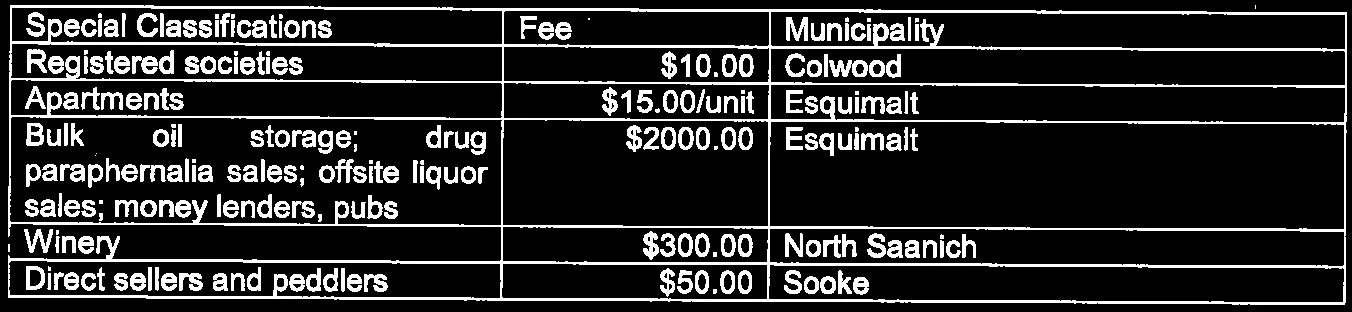
| Special Classifications | Fee | Municipality |
|---|---|---|
| Registered societies | $10.00 | Colwood |
| Apartments | $15.00/unit | Esquimalt |
| Bulk oil storage; drug paraphernalia sales; offsite liquor sales; money lenders, pubs | $2000.00 | Esquimalt |
| Winery | $300.00 | North Saanich |
| Direct sellers and peddlers | $50.00 | Sooke |
The higher fees generally relate to business that likely require more frequent inspections by the municipality, while the lower amounts for registered societies and direct sellers/peddlers may be considered to require less administration in those municipalities. The bylaw contains special classifications for apartments, drug paraphernalia sales, and pubs, similar to Esquimalt. Staff does not recommend adding any of the other special classifications at this time.
Four municipalities (Oak Bay, Metchosin, Sidney and Victoria) have their own business classification systems with fees that sometimes include sliding scales for gross floor area and number of employees. Highlands does not require business licenses at all, although inter-municipal licenses are issued so that businesses based in that municipality can conduct business elsewhere in the CRD.
C. Review of Current Bylaw
The Town is a small municipality that is centrally located within a larger region and one of the Official Community Plan’s key goals is to promote View Royal as a business-friendly community, so fees should be comparable to others in the region. It should be noted that fees for basic business classifications have not increased for more than twelve years, similar to most of the other municipalities. The Town’s fees are generally in line with others in the region.
An initial section-by-section review of the bylaw can be found in Attachment 3. The main changes to the bylaw proposed at this time include the following: a. Remove outdated language such as “whereas” preambles, clarifications about gender-specific language. b. Clarifying tools for enforcement (no mention of Municipal Ticket Information Bylaw No. 643, 2007, which contains business licensing fines). c. Adding a home occupation business classification. Currently, they are classified as Commercial – Small, which is confusing for applicants. The key benefit is that it would separate home occupations from full commercial uses, and provide better information to the Town for economic analysis. d. Only a few municipalities including Esquimalt and View Royal charge business license fees for apartments based on the number of apartment units. A base fee should be charged. Also, the owner of a single condominium unit could be required to have a business license for which the fee would be $15.00 per year. Staff recommends wording to address this.
D. Additional Issues to Consider
Renewal Fees Langford and Colwood have instituted one-time business license fees. Langford issues “perpetual” licenses that only terminate under certain conditions, but the initial application fee must still be paid. In April, Colwood adopted a new business license bylaw that requires an initial application fee but no annual renewal fee if the license is renewed by the annual deadline (through a fillable PDF form). In both cases, the underlying principle was that the loss in business license fee revenue would be made up for by reduced administration work and that any business-related problems would be addressed through the bylaw enforcement process.
The purpose of fees is to cover the general cost of providing a service. Without a renewal fee, the cost of providing the service would have to be borne by general property taxes rather than by the business sector. Based on 2015 figures, business license fees were approximately $33,000 and providing the same level of service (assuming reduced administrative work is made up for by increased bylaw enforcement work) could translate into an average property tax increase of up to 0.5%. At this time, staff considers the business licensing program including authority to inspect premises for compliance with the regulations bylaw to be valuable to the local business community because it helps to ensure that there is an equitable basis for conducting business.
Short Term Licenses At least five municipalities offer day rates for business licenses and the Town does not. The bylaw does not provide for short-term or seasonal licenses. Seasonal, short term, special event or one-day business licenses could be considered to support filming, “pop-up” stores and events that would contribute to the local economy, culture, and community development.
Non-resident Businesses The Intermunicipal Business License Agreement has worked well to reduce red tape for the businesses within the CRD that are approved as mobile businesses. Non-resident businesses (e.g. a plumber from Duncan) are required to have a separate business license for each municipality in the CRD. This also applies to other mobile business types that are not listed in the Intermunicipal Business License Agreement, such as consultants, instructors, food trucks, farm markets, and filming. Unfortunately, this requires changes at the intermunicipal level and is beyond the scope of this review. If Council wishes to update this portion of the bylaw, can bring the item forward to Intermunicipal Business License Group.
E. Timing of Bylaw Adoption
To be in place for the 2017 business license term, adoption of the new bylaw by July 19, 2016 is recommended to provide ample to staff to provide information to the public and implement any necessary changes for new business license applications and for the renewal process that begins in October.
F. Notification of bylaw
The Community Charter requires Council to consider how notification of bylaw will be made and to provide opportunities for public comment prior to adoption of the bylaw. At this point no significant fee increases are proposed so no extraordinary measures are currently recommended. As the bylaw is prepared, there will be time for Council to determine if more widespread notification is warranted.
G. Next Steps
Staff will collect additional information that may requested by Council. Once Council is satisfied that issues are in hand, a bylaw would be prepared with a report that would include recommendations on bylaw notification and opportunities for public comment.
RECOMMENDATIONS:
- That the May 5, 2016 report from the Senior Planner titled "Business License Bylaw Review" be received.
- That staff be directed to report on any additional issues identified by the Committee of the Whole as part of the review of Business License Bylaw No. 580, 2004.
SUBMITTED BY: Jeff Chow, MCIP, RPP, Senior Planner
REVIEWED BY: Lindsay Chase, MCIP, RPP, Director of Development Services
ATTACHMENTS:
- Business License Bylaw No. 580, 2004 (14 pages)
- Regional Business Bylaw comparison
- Initial Bylaw Review (2 pages)
Document Images
(14)