Attachment 4. Tree Impact Assessment - January 7, 2022
Arborist report assessing on-site and neighboring trees for a slope management project.
Scotty Tree & Arborist Service Ltd.
Tree Impact Assessment
Prepared for 53 Knollwood Rd, View Royal, BC SUBMITTED 7 Jan, 2022
Scott Mitchell ISA Arborist PN-6138-A Hazard Tree Assessor CTRA 309 TRAQ certified 250-220-9298
To whom it may concern,
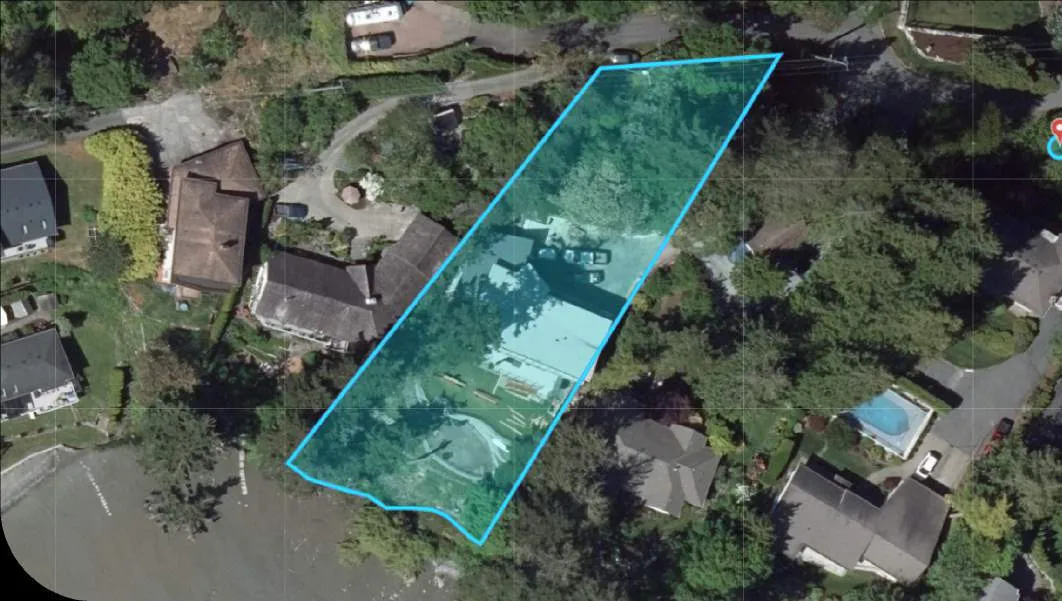
By request, Scotty Tree & Arborist Service Ltd has assessed the trees on the property of 53 Knollwood Road, View Royal BC for a riparian slope management project.
Executive Summary:
The slope management project is being done to stop the considerable subsiding of the steep bank. To do this the existing rock walls will be removed and replaced with contemporary gabion retaining walls. Five bylaw protected trees are in the back yard of this property that warrant consideration for this subdivision project. In addition, there are 10 bylaw protected neighboring trees considered for due diligence. Two property hazardous trees should be removed regardless of the proposal. With appropriate protective measures, the remainder of the trees should not be negatively affected long-term. To ensure this, arborist direction and supervision (as required) is required for excavation through the protected root zones (PRZ).
Tree impact summary table
| Tree status | Total | retained | removed | planted |
|---|---|---|---|---|
| On site bylaw protected | 5 | 3 | 2 | As directed |
| On site non bylaw protected | 0 | 0 | 0 | 0 |
| Municipal trees | 0 | 0 | 0 | 0 |
| Neighboring bylaw protected | 10 | 10 | 0 | 0 |
| Neighboring non bylaw protected | 3 | 3 | 0 | 0 |
| total | 18 | 16 | 2 | 0 |
Introduction:
Scotty tree was contracted to assess the trees on this property to determine the impact of redeveloping the back yard riparian slope. The back yard of the property was assessed, including neighboring trees.
Methodology:
Detailed analysis of the proposed development plan was used to inform analysis of the trees, particularly in terms of the underground service excavation locations. Of particular concern are the protected root zones of the neighboring trees in the back yard. Scotty Tree used standard arboricultural observation and physical examinations to determine tree health and confirm rooting areas. Soil analysis was conducted by physical exploration. Consultation with the leading reference book (Trees and Development, Nelda Matheny and James R. Clark) was used to determine protected root zones and tree suitability for development on this property.
Observations and Discussion:
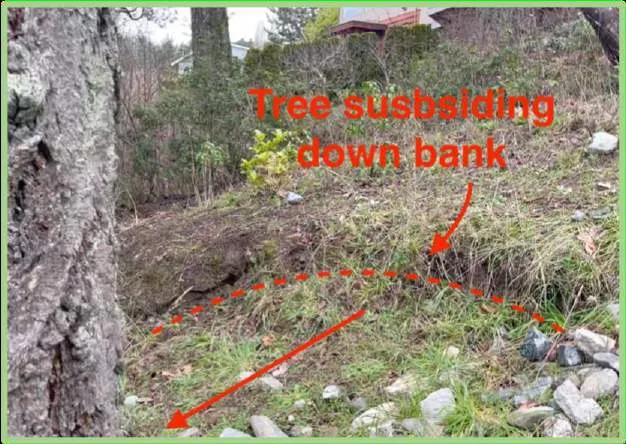
1. The entire back yard slope is subsiding, including two large Douglas Fir trees:
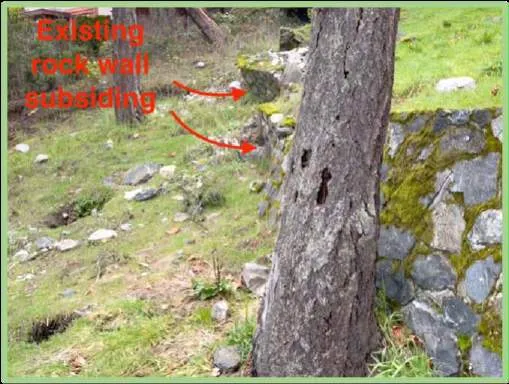
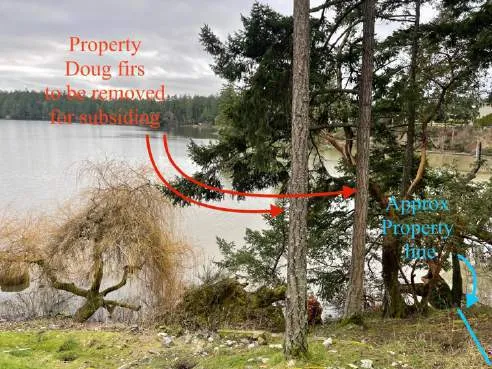
There is evidence of substantial slope-subsiding with the existing rock walls. Of particular concern is the subsiding of two Douglas Fir trees, which have shown considerable movement. One tree revealed one foot of down-slope movement, separating the root base from the surrounding soil. In both cases the root plates are cracked. This compromises the stability of the trees and presents a toppling hazard for both. Expect whole tree failures.
2. Existing standing-dead Douglas Fir tree to be removed via previous permit:
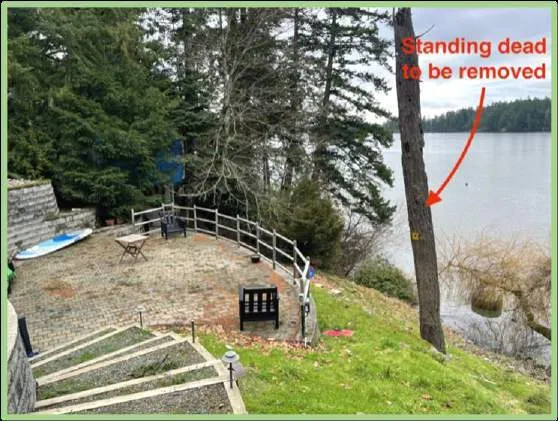
The standing dead habitat Douglas Fir has been approved for removal from a previous permit.
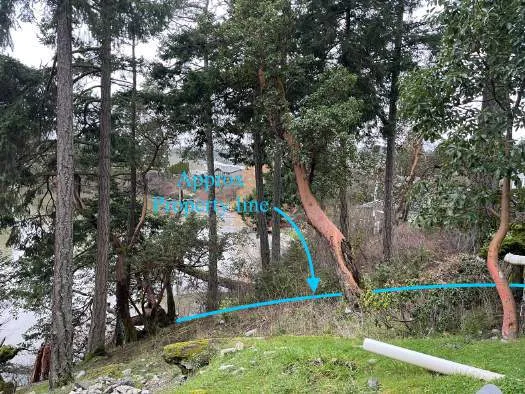
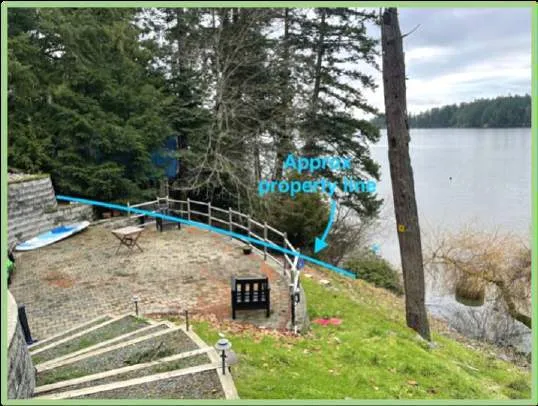
3. The back yard is bracketed by neighboring trees that will require due diligence when excavating property:
Conclusions and Recommendations:
This slope management proposal is viable from a tree management perspective. Other than the two hazardous trees, the project poses little threat to the bylaw protected trees on this property or to the neighboring trees if due diligence measures are adhered to. The excavation requires arborist direction and supervision (as required) in key PRZ areas. Other than the standing dead and one neighboring Arbutus, the trees of concern are generally healthy. The two subsiding Firs are healthy but at high risk of toppling. The proposed excavation and slope management location is suitably distant from the trees whereby few significant roots are expected to be encountered.
1. Arborist direction or supervision is required for excavation of the back yard:
Arborist direction or supervision in key locations is required for excavation in root zones of the back yard. This is particularly important near the neighboring properties as both contain several bylaw and non-bylaw protected trees.
2. Remove hazardous tree #199 and adjacent Douglas Fir:
Given the considerable subsiding and compromised root plate structures of these trees, they should be removed.
3. Careful excavation is required when digging down past original grade near neighboring property lines:
Although the excavation is not expected to negatively impact the neighboring trees, the potential to disrupt the rooting areas exists, and due-diligence measures are required.
4. Install anti-compaction measures for access to excavation areas:
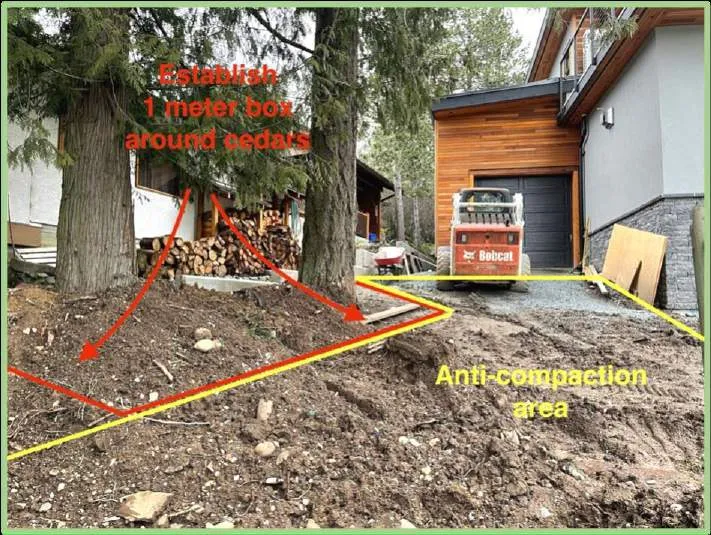
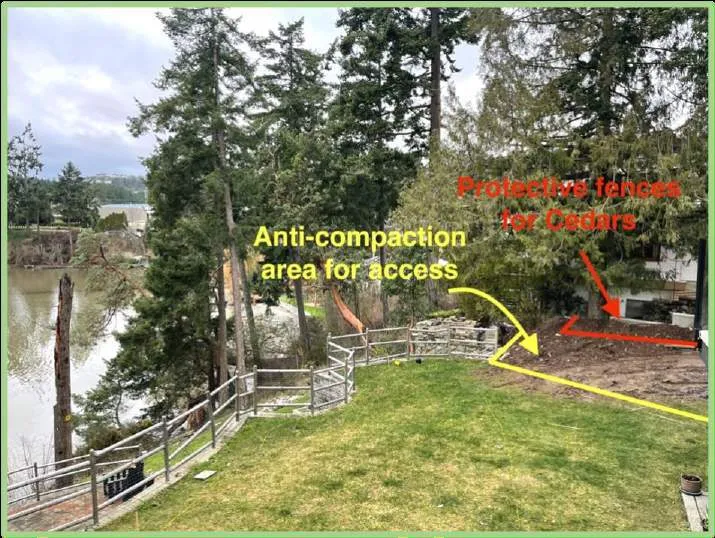
To provide protection to property and neighboring property PRZ’s, anti-compaction measures should be established in the access areas to the excavation location. This mainly consists of the areas behind the garage and between the patio and western neighboring property line. Of note, the property owner indicated the garage has a double-ended opening and this may be a good solution to gain access to the back yard. The western side of the garage has gravel and acts as suitable anti-compaction. Otherwise, anti-compaction should consist of 2 x 19mm plywood, 20cm woodchips or 10cm crushed rock (3/4 minus) in designated anti-compaction areas. Additionally, no material or equipment storage should occur within anti-compaction areas. The project arborist will outline specific anti-compaction areas prior to excavation.
NOTE: No material storage should occur on the upper grass terrace as this area also contains PRZ’s. (See photo below)
Ant-compaction cont.
5. Install protective fences that cordon off remaining property and neighboring trees:
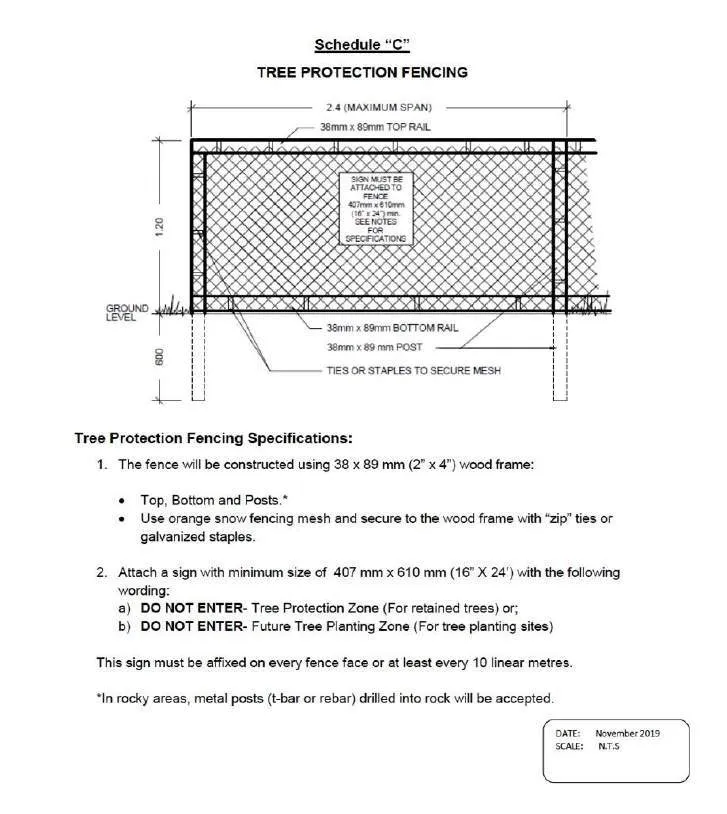
Protective fences and signage should be installed around bylaw protected trees as specified by View Royal municipal guidelines. Protective fence dimensions, although not necessarily representative of the critical rooting zones will serve as a visual reminder to workers of the importance of not impacting these areas. These fence recommendations should be installed to ensure machinery, foot traffic and material storage on the lawn areas do not infringe on the protection zones around all trees.
Schedule "C" TREE PROTECTION FENCING
Tree Protection Fencing Specifications:
- The fence will be constructed using 38 x 89 mm (2" x 4") wood frame:
- Top, Bottom and Posts.*
- Use orange snow fencing mesh and secure to the wood frame with "zip" ties or galvanized staples.
- Attach a sign with minimum size of 407 mm x 610 mm (16" X 24") with the following wording: a) DO NOT ENTER- Tree Protection Zone (For retained trees) or; b) DO NOT ENTER- Future Tree Planting Zone (For tree planting sites)
This sign must be affixed on every fence face or at least every 10 linear metres. *In rocky areas, metal posts (t-bar or rebar) drilled into rock will be accepted.
Note: This is the Saanich protective fence document guide for installation and signage. This serves as a best practice guide. Refer to View Royal specific guidelines.
a. Install protective fences that cordon off neighboring back yard properties:
Establish protective fences that isolates the neighboring property lines. Although these do not encompass the entire rooting area, these fences provide a visual reminder of the trees’ PRZ’s during excavation activities. See previous images of approx. property lines.
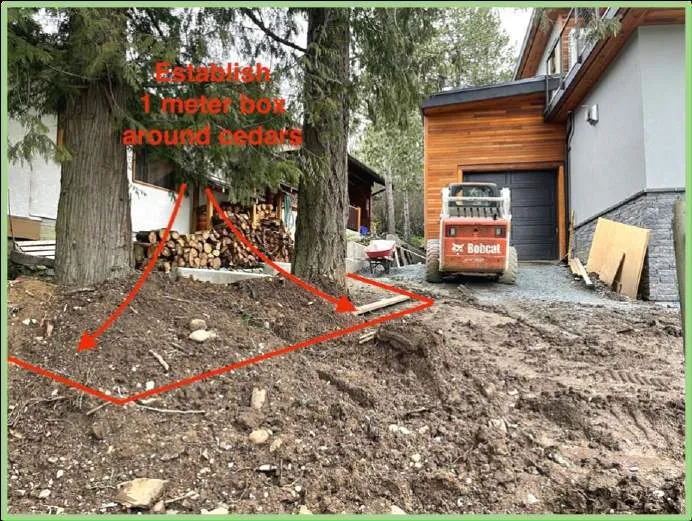
b. Install a protective fence box around the back yard property cedar trees:
Install a 1-meter protective fence that boxes off both Cedar trees. This provides for some protection and construction access. The use of anti-compaction measures in conjunction will adequately protect these PRZ’s.
For further clarifications feel free to text 250-220-9298.
Sincerely,
Scott Mitchell Submitted 7 Feb, 2022
ISA Arborist, PN-6138-A, PNW CTRA 309, TRAQ certified Pacific Northwest Hazard Tree Assessor, CTA 309
Scotty Tree & Arborist Service #7 10075 Fifth St, Sidney BC, V8L-2X8 Scott Mitchell
Document Images
(4)