Committee of the Whole Report: Energy Step Code
A staff report from the Auxiliary Building Official providing background on the Energy Step Code and recommending its implementation for new building construction in View Royal.
TOWN OF VIEW ROYAL COMMITTEE OF THE WHOLE REPORT
TO: Committee of the Whole DATE: February 1, 2022 FROM: Avy Woo, Auxiliary Building Official MEETING DATE: February 8, 2021
Energy Step Code
RECOMMENDATION:
THAT Committee of the Whole receive this report for information.
CHIEF ADMINISTRATIVE OFFICER’S COMMENTS:
I concur with the recommendation.
DIRECTOR OF DEVELOPMENT SERVICES’S COMMENTS:
I concur with the recommendation.
PURPOSE OF REPORT:
This report provides Council with background information on:
- the Step Code as a tool for addressing the energy efficiency of new buildings
- information on current regional initiatives relating to Step Code and greenhouse gas reduction
- the Regional Working Group for Step Code coordination/implementation
- next steps
BACKGROUND DISCUSSION:
The Step Code represents an important step in improving the energy efficiency of the buildings sector in BC. It establishes a consistent and predictable approach to the regulation of energy efficiency across the province, and is the primary framework that local governments must reference when they wish to encourage or require higher levels of energy efficiency than the base building code. The Step Code was also established as a means of reducing greenhouse gas intensity (GHGi) from the buildings sector.
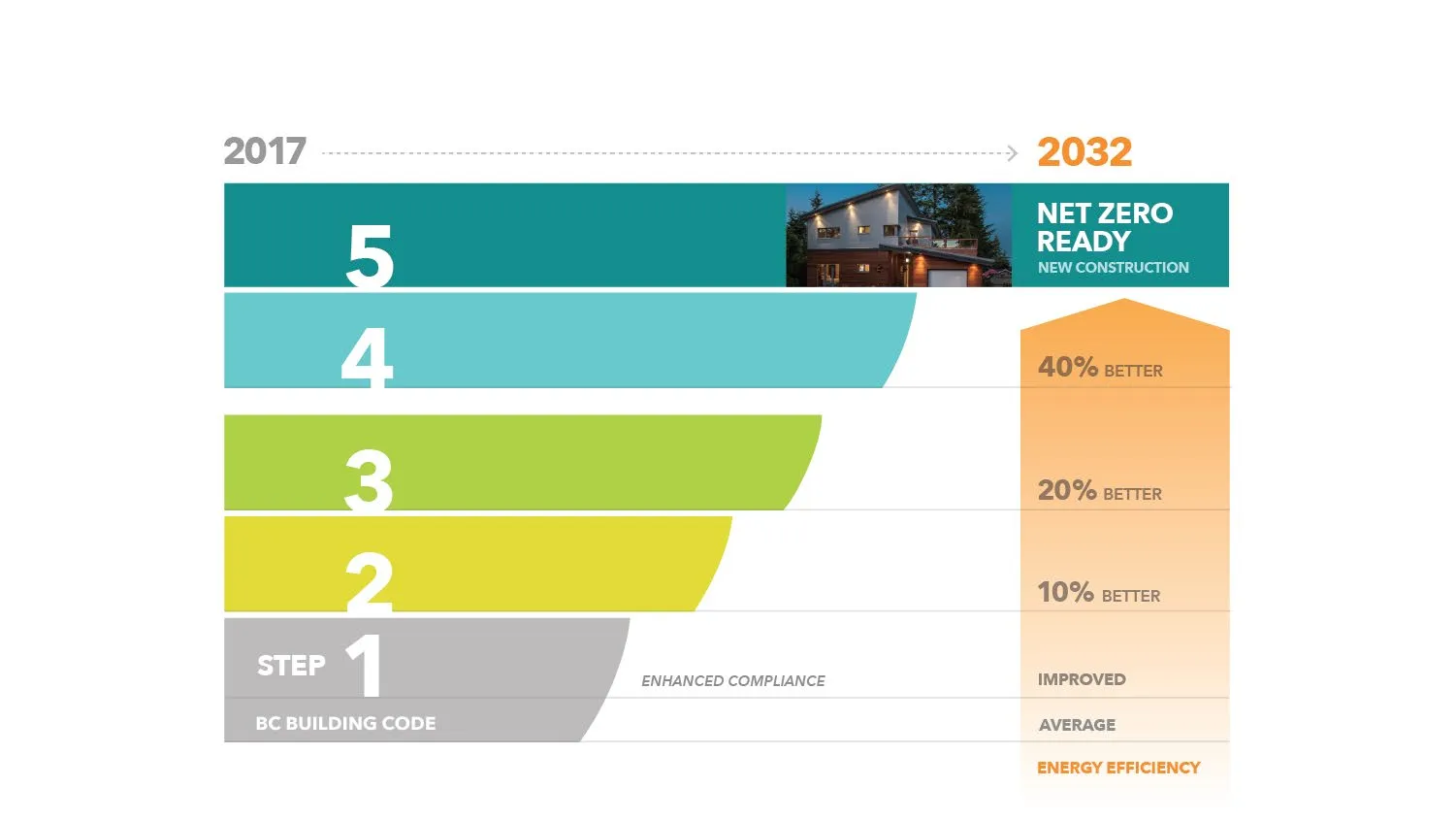
The province is moving towards net zero energy requirements through building code changes by 2032, with incremental steps in 2022 and 2027. Many regional local governments are implementing the steps ahead of the mandatory requirements to be more proactive in energy conservation, such as Vancouver, Richmond, District of North Vancouver, Victoria, and Saanich. Council can opt to either stay course with the BC Building Code as the Province introduces new incremental requirements, or the Town can be part of the early adopters for the Step Code.
It is predicted the Provincial government will mandate that by the end of 2022, all new Part 9 buildings must meet Step 3, and Part 3 buildings must meet or exceed Step 2. There is no action required by the Town to follow the provincial requirements. To move in advance of the requirements would be done by bylaw.
At the June 2, 2020 Council meeting, the following motion was approved:
Energy Step Code Adoption
- Report dated April 21, 2020 from the Building Official The Director of Protective Services summarized the report for Council. MOVED BY: Councillor Rogers SECONDED BY: Councillor Mattson C-69-20 THAT by 2022, following the Provincial guidelines, Part 3 buildings be required to meet Step 2 and Part 9 buildings be required to meet Step 3 of the BC Energy Step Code; AND THAT the related Strategic Plan work plan item under the “Environmental Stewardship” priority be amended to reflect this delay. CARRIED
When adopted into the BC Building Code, the Town will be required to meet these standards, as will all other communities in BC. As the Town has chosen to advance implementation of the Step Code, bylaw amendments to the Building Bylaw are necessary. These will be presented in late Spring, along with implementation considerations.
Other municipalities in the CRD are currently exploring whether or not they should move to Step 4 in advance of the planned 2027 incremental move. Town staff are engaging in regional meetings and will report back on this topic as Council may wish to consider participating in a more regional approach. We also note that under a rezoning or subdivision application, there is an opportunity to seek out better energy efficiency (i.e. higher step code) in buildings as part of the development approval process.
The Community Climate Action Strategy project identified that most community emissions in the Town derive from buildings and transportation. Ensuring that new buildings are as energy efficient as possible is one way of mitigating future GHG emissions.
Energy Step Code Summary
The Step Code is designed as a set of incremental building energy performance levels, termed “Steps”. The Step Code applies to Part 9 and Part 3 residential and commercial buildings, as classified in the BC Building Code. In general, Part 9 buildings include single family homes, duplexes, townhouses, and small apartment buildings. Part 3 buildings include larger apartment buildings, condos, office buildings, and retail buildings. Since the earlier enactment in April 2017 of the Step Code, the Province has introduced further implementation dates as show in Figure 1 below. The current requirement in the BC Building Code is Step 1, and it is anticipated that the Province will introduce by December 2022 Step 3 for new houses, and Step 2 for Part 3 buildings.
Figure 1
The current BC Building Code requirement does not specify a GHGi target, nor electric vehicle charging requirements. The Town has pro-actively amended our zoning requirements to ensure that all new residential buildings are EV ready. GHGi measures carbon output by a building during the life of the building, mainly when users of the building heat and cool over the seasons. The Step Code’s focus on energy efficiency does not guarantee the level of emissions reductions necessary to drive emissions to zero or near-zero levels.
While a well-designed energy efficient building implies a lower carbon output, it is not explicitly required. Building designers need to implement lower carbon emission mechanical system options in order to meet the Province’s vision of zero emissions buildings. In general, electrical systems have a lower carbon output than gas appliances. Staff will bring forward a more detailed comparative and feedback on the building sector acceptance of the various scenarios in a future report.
Regional Energy Step Code Working Group
There are a wide variety of approaches to adopting the Step Code in BC, several jurisdictions have adoption schedules that reach the highest steps for the most common building types well in advance of the required 2032 implementation date. It is common for building bylaws to include schedules that indicate adoption dates for the highest steps for all part 9 residential buildings, and all part 3 residential buildings (below 6 storeys). Several jurisdictions allow for lower steps to be met for buildings built with a low carbon energy system (LCES). This approach aligns with Council motions pertaining to heat pumps. There is an expectation that the Province will settle on how to best include a GHGi as a requirement in the Step Code in the next code change in December 2022.
Currently, the following nearby local governments have either adopted the Step Code or have taken some actions towards compliance with the Step Code. There is a move to explore providing alternative acceptance when Step 4 is implemented, to accept a Step 3 model if low carbon emissions can be demonstrated. A summary of the current requirements of some regional local governments are:
| Building Type | Saanich, Victoria and Colwood | Oak Bay |
|---|---|---|
| Part 9 Buildings | Step 3 [Step 2 for 111.5m2 or less] | Step 3 |
| Part 3 – residential wood frame building six storeys or less | Step 3 | Step 2 (large multi family) |
| All other Part 3 Buildings | Step 2 | Step 2 (commercial/office buildings) |
It is timely that the Town is considering adopting the Step Code, as there is a wider regional effort underway, with involvement from CRD, Victoria, Saanich and Central Saanich. This means that the stakeholder engagement can take place collaboratively with other jurisdictions. Some industry partners have already expressed they would like a regional approach to minimize discrepancies across local governments and have efficiencies in the consultation process.
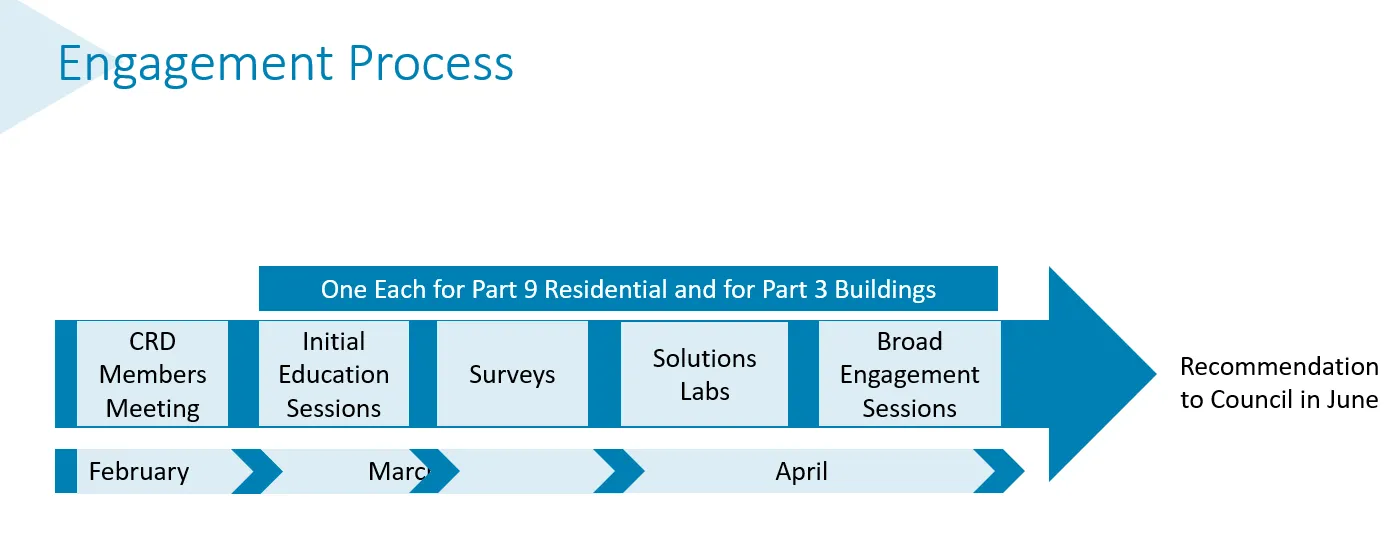
Currently, the working group is looking at the following timelines for the engagement process:
- Local Government Workshop – potentially February 9, 2022
- Part 9 Industry Workshop – week of Feb 28, 2022
- Part 3 Industry Workshop – week of Feb 28, 2022
The consultation and workshops are intended to seek feedback from industry partners on staying ahead of the Province on the Step Code and further explore GHGi reduction tradeoff methods. Once this engagement is concluded, staff will report back on the results and will advise Council if there is regional interest in advancing step code implementation sooner than the provincial increments.
Engagement Process
Staff does not have enough information on which step the Town might target (beyond Step 3) ahead of the stakeholder consultation. If we stay with the regional targets, and also to be ahead of the province’s anticipated code change in December 2022, it could be Step 4 for Part 9 buildings and Step 3 for Part 3 buildings. Future reports will seek to clarify if a regional approach is suitable for the Town, particularly one that advances implementation above Step 3 in advance of provincial requirements. Further action should be considered after the Community Climate Action Strategy has been received (and approved) by Council.
If Council wishes to be an early adopter in line with some of the regional local governments, this would be accomplished by bylaw. The target steps would be identified in the Building Bylaw, and would indicate the needed lead time for the bylaw to come into effect so that our industry stakeholders will have time to design their buildings in accordance with the performance expectations from the higher energy steps.
In conjunction with the above, staff will review whether further requirements for electric vehicle (EV) charging for new construction are possible. Even though requirements are included in the Zoning Bylaw for EV charging, there may be other opportunities to add EV charging to different scenarios. The market is demanding charging outlets and stations already, so setting a baseline to require them is anticipated to be an easy outcome. Staff is proposing to include this item when we conduct stakeholder consultation.
NEXT STEPS:
- That staff will bring back a report on regional engagement with the development community regarding consistent Step Code implementation and GHG reductions;
- THAT staff will bring back a follow up report on adopting policies and bylaws on energy and carbon reductions, including advancing implementation of the Step Code and GHGi reduction methods in new buildings with options for Council to consider.
- That staff will update necessary documentation, processes and website content to communicate upcoming changes.
RECOMMENDATION:
THAT Committee of the Whole receive this report for information.
SUBMITTED BY: Avy Woo, Auxiliary Building Official
REVIEWED BY: L. Chase, Director of Development Services
Document Images
(2)