Draft Community Climate Action Strategy - Attachment 1
A detailed strategy document outlining goals and specific actions for passenger transportation electrification, building decarbonization, and organic waste management to reduce community GHG emissions.
• A robust and strategically designed charging network ensures infrastructure is available at workplaces and public parking spaces.
Strategies for Electrifying Passenger Transportation
New vehicle sales are approximately 10% of total vehicle stock annually. Switching to an EV from a fossil fuel vehicle eliminates almost 100% of the emissions in BC. The more that people can walk, cycle and take transit in the community and between communities may reduce the % of EV's required for the first target year. In 2019, 10% of car sales (not including trucks and SUVs) were EV's, though this is not even across BC. Provincial ZEV mandates do not require even portions of sales regionally so Town of View Royal can help influence local EV adoption.
| Strategy | Actions Summary | Adaptation Benefits | Lever | Time | Cost |
|---|---|---|---|---|---|
| 1.1 – Adopt EV-ready building requirements - single family home | ✓ COMPLETE – Zoning bylaw amendments passed in 2021 | As summer temperatures increase, tailpipe emissions will increase ground level ozone. Reducing these emissions will improve air quality. Improving air quality also helps to build resilience. | [Pencil icon] | $ | |
| 1.2 – Adopt EV-ready building requirements - MURBs & Commercial | ✓ COMPLETE – Zoning bylaw amendments passed in 2021 | See 1.1 | [Pencil icon] | $ | |
| 1.3 - Implement supportive policies to accelerate EV adoption | ✓ Adjust speed limits to enable low-speed EVs on select streets. | See 1.1 | [Pencil icon] | $ | |
| 1.4 - Design, fund and build public EV charging | ✓ Leverage grant opportunities to install an annually increasing number of EV charging stations at key locations throughout the community. ✓ Collaborate with other local governments and the CRD on a regional charging network strategy. |
See 1.1 | [Wrench icon] | [Blue bar] | $$ $ |
| 1.5 - Provide incentives to EV drivers such as priority parking | ✓ Provide perks to EV drivers such as priority parking. Incent ride hailing, taxi operators and other fleet operators to switch to EV’s. | See 1.1 | [Pencil icon] | [Blue bar] | $ |
| 1.6 - Develop and deliver an EV outreach strategy | ✓ Work with third-party organizations to educate builders and developers on EV charging requirements, strategies, and funding opportunities though open houses and workshops. ✓ Partner with other organizations to host engagement events such as ride-alongs. ✓ Provide information to residents about Provincial EV charging incentives ✓ Advise local groups of EV outreach incentives from Emotive |
See 1.1 | [Speech bubbles icon] | [Blue bar] | $ |
| 1.7 - Advocate to higher levels of government to continue offering EV purchase rebates | ✓ With a focus on rebates for used vehicle and differing incentive rates for lower income residents and charging station rebates for MURB’s. | See 1.1 | [Pencil icon] | $ |
Where We Live and Work
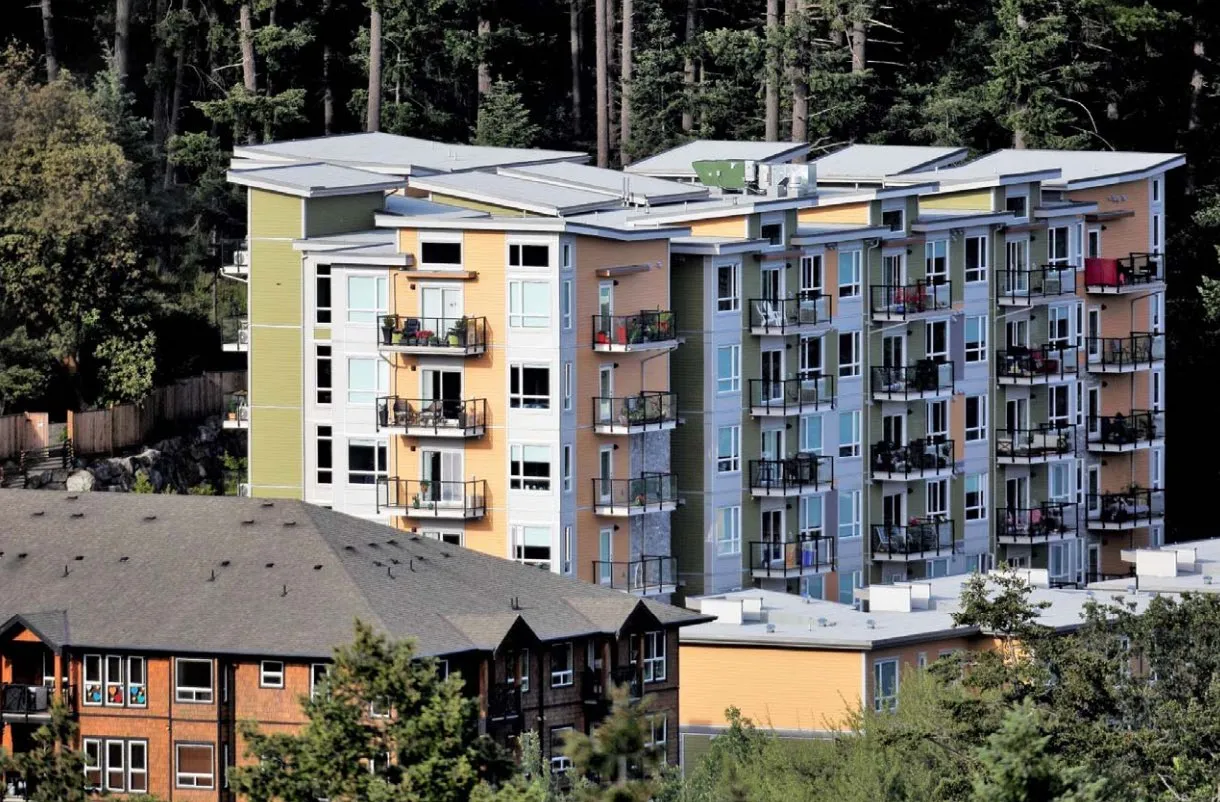
Vision:
Our community’s buildings are exceptionally energy efficient, and powered, heated and cooled with 100% renewable energy.
Current State:
Our homes and commercial buildings are responsible for 25% of the greenhouse gas emissions generated in View Royal. The main source of emissions is natural gas and fuel oil used for space and water heating in existing building.
Big Moves for Buildings
| Step Up New Buildings | Decarbonize Existing Buildings |
|---|---|
| Enhance energy efficiency and low carbon heating in new buildings | Support deep energy retrofits and fuel switching |
Step Up New Buildings
Enhance energy efficiency and low carbon heating in new buildings
Overview
View Royal’s population is growing rapidly, and every new building built to minimum code standards and using fossil fuels for heating is a lost opportunity for improved energy efficiency, reduced carbon emissions. One more building that will have to be retrofitted down the road.
While existing buildings generate the majority of building-related greenhouse gas emissions, new construction is still very important for reducing emissions. They can do so via the BC Energy Step Code, a section of the BC Building Code that local governments may use to require or incentivize better-than-code energy performance in new construction. While the Step Code is a great tool for improving overall building energy performance, it does not explicitly address emissions from new buildings. Local governments can influence emissions by implementing the regulation in tandem with incentives that target zero-emission heating and cooling systems in advance of the new provincial target of 2030.
Looking Forward to 2030 – An Aspirational Target
- All new buildings will be built to the BC Energy Step Code and will begin to become more efficient ahead of the provincially mandated timeline.
- The building industry is now focused on whole building performance, as opposed to prescriptive code requirements.
- Energy performance is quantified and verified, so homeowners and buyers now have a better understanding on the long-term operations cost of the home.
- Homes are quiet, comfortable and durable. Energy costs are minimized through efficient design that reduces demand.
Objectives
- Adopt the BC Energy Step Code
- Prioritize a low-carbon approach (e.g. heat pumps)
Provincial Action
The province’s CleanBC Roadmap to 2030 The Provincial commits the province to developing a zero-carbon building code by 2030.
This accelerated the existing timelines for the BC Energy Step Code performance targets:
- By 2027, all new buildings will be 40% more energy efficient
CleanBC Better Homes links homeowners and residential builders to rebates and resources, and CleanBC Better Buildings provides funding and capital incentives to encourage energy efficient design, construction and renovation in larger buildings.
Federal Action
Natural Resources Canada’s Build Smart: Canada’s Buildings Strategy establishes the goal that all provinces and territories will adopt a net-zero energy-ready model building code by 2030.
Strategies for Stepping Up New Buildings
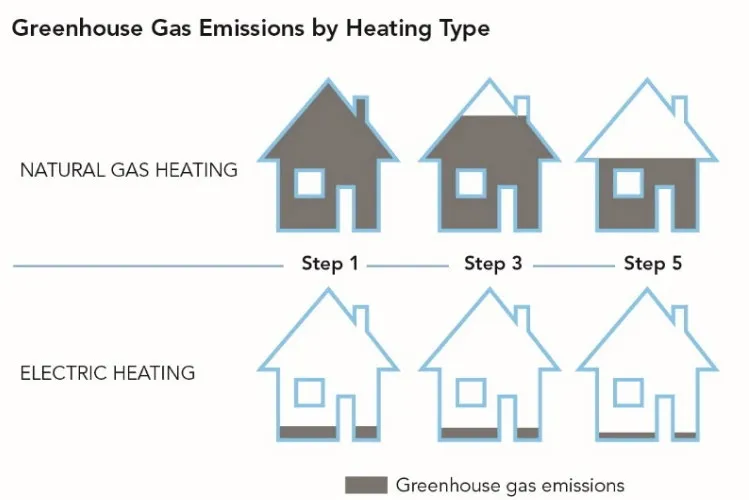
Step Code is an efficiency code, not a GHG code. Energy efficiency is a good first step, but to get deep emissions reductions the heating fuel must be low/no emissions. Electricity is nearly emissions free in BC and heat pumps use 1/2 to 1/4 the energy of a home heated by baseboard heaters, saving energy and money over the long run. The graphic to the right illustrates that the Energy Step Code alone does not sufficiently address GHG emissions in new buildings. The fuel source for heating is the biggest influencer of emissions. Source: Metro Vancouver Climate 2050 Buildings Roadmap.
| Strategy | Actions Summary | Adaptation Benefits | Lever | Time | Cost |
|---|---|---|---|---|---|
| 1.1 Adopt the BC Energy Step Code and timeline for full implementation (i.e.) Step 5 | ✓ Amend Building Bylaw to require Step 3 for Part 9 buildings, and exploring Step 4 in advance of the Provincial deadline of 2027 (and Step 5 in 2032). ✓ For Part 3 buildings, the Town should work to phase in requirements for the various categories of Part 3 buildings in advance of the Provincial deadlines. |
Better insulated buildings will be better able to withstand periods of extreme heat. More airtight buildings, and those with heat recovery ventilators (aka “fresh air machines”), will be more resilient during episodes with poor air quality. |
[Pencil icon] | $ | |
| 1.2 Prioritize a low-carbon approach (e.g. heat pumps) | ✓ Conduct consultation with the local building industry about low carbon approaches to the Energy Step Code ✓ Adopt a tiered approach encouraging low carbon energy systems (e.g. Step 3 community wide, Step 2 if they connect their project to a district energy system or implement a low carbon energy system (primarily heat pumps). ✓ Adopt the Provincial GHG metrics when they become available in 2022. |
Heat pumps also provide efficient air conditioning, and will make a building more resilient during periods of extreme heat. | [Pencil icon] | $ | |
| 1.3 Require home energy labelling as part of Step Code compliance | ✓ Require that all new homes receive an EnerGuide label as part of the administrative requirements for step code compliance. http://energystepcode.ca/app/uploads/sites/257/2018/07/Bulletin1-HomeEnergyLabelling-July2018.pdf | Ties in to the same adaptation benefits as 1.1 and 1.2, as the more efficient the building and the more efficient the heating / cooling system, the better the EnerGuide label. | [Pencil icon] | $ |
Decarbonize Existing Buildings
Support deep energy retrofits and fuel switching
Overview
In 2030, the vast majority of the buildings in View Royal will be ones that are already standing today. Many buildings use more energy than is necessary. Owners of 20-year-old gas-heated homes can lower their energy bills by as much as 30% through energy efficiency retrofits and reduce about 1.8 tonnes of greenhouse gas emissions per year. Homeowners can pursue various degrees of building energy retrofits—from replacing individual pieces of equipment to comprehensive overhauls of the whole building, known as deep energy retrofits.
Deep energy retrofits involve changes to the entire building, including insulation, windows and doors, and air barrier, as well as ventilation and space and water heating equipment. To ensure emissions reductions as well as energy reductions, the energy retrofit must include fuel switching, from fossil fuel sources to zero carbon sources such as electricity or 100% renewable gas. Such projects usually rely on the expertise of an energy advisor, who conducts energy modelling and airtightness testing.
The Town of View Royal has limited jurisdiction over requirements for existing building retrofits but has an opportunity to influence and enable building owners to make investments in the energy efficiency of their buildings.
Objectives
- Improve energy efficiency
- Encourage and enable fuel switching
- Build industry capacity and increase demand
Provincial Action
The CleanBC Roadmap to 2030 commits to incorporating energy-efficiency standards for existing buildings into the BC Building Code starting in 2024.
CleanBC Better Homes links homeowners and renovators to rebates and resources, and CleanBC Better Buildings provides funding and capital incentives to encourage energy efficient renovation in larger buildings. The Province is currently working on an Existing Buildings Renewal Strategy, which will enable increased energy efficiency retrofits in the existing building stock.
Federal Action
The Canada Greener Homes Grant provides grants for energy efficiency upgrades and up to $600 for pre- and post-retrofit EnerGuide assessments. The program also supports training Energy Advisors across Canada to meet increasing demand.
Looking Forward to 2030 – An Aspirational Target
- Approximately 80 homes will undergo an energy efficiency retrofit annually between now and 2030.
- Approximately 40 homes with a fossil fuel heating and hot water systems will replace them with low carbon systems annually between now and 2030.
Strategies for Decarbonizing Existing Buildings
Building envelope improvements reduce energy needed to heat the building. An average retrofit can save 10% to 20% of energy while a deep retrofit ($80,000-$100,000) can save 50% to 60%. Heat pumps use 1/2 to 1/4 the energy of a home heated by baseboard heaters. Electricity has >80% less emissions than natural gas. Perpetual locked-in renewable gas contracts (buying the environmental benefits of renewable gas produced somewhere) may be an option in the future.
| Strategy | Actions Summary | Adaptation Benefits | Lever | Time | Cost |
|---|---|---|---|---|---|
| EXISTING BUILDINGS: Improve Energy Efficiency and Enable Fuel Switching | |||||
| 1.1 Encourage & enable energy retrofits through supportive policies and removing barriers | ✓ The Town will explore the various policy recommendations for supporting low carbon retrofits as per sections 3 and 4 of this report: https://docs.communityenergy.ca/wp-content/uploads/2021-03-19_BCH_LCB_Toolkit_Final-1.pdf AND will monitor the upcoming “Retrofit Code” expected to be released in 2024. | Better insulated buildings will be better able to withstand periods of extreme heat. More airtight buildings will be more resilient during episodes with poor air quality. |
[Pencil icon] | [Pink bar] | $ |
| 1.2 Establish requirements for home energy labelling and building energy benchmarking | ✓ Making energy use visible is an important part of creating value for energy efficiency in the market and driving emissions reductions in from buildings. ✓ View Royal should explore joining Building Benchmark BC and signing up large building owners in the Town to the program. ✓ The Province of BC committed to home energy labelling as part of the recently launched CleanBC roadmap to 2030. |
Ties in to the same adaptation benefits as 1.1 and 1.2, as the more efficient the building and the more efficient the heating / cooling system, the better the Benchmark rating / EnerGuide label. | [Pencil icon] | [Pink bar] | $ |
| 1.3 Continue to provide top-up incentives for building through CleanBC rebates top-ups | ✓ IN PROGRESS – In the fall of 2021 View Royal Council supported providing heat pump top-up rebates to residents through the CleanBC Better Homes program. | Heat pumps also provide efficient air conditioning, and will make a building more resilient during periods of extreme heat. | [Pencil icon] | [Pink bar] | $$ |
| 1.4 Support the development of CRD regional retrofit service for residents. | ✓ IN PROGRESS – Work with the CRD to develop a retrofit concierge service that aids View Royal residents to better understand the retrofits needed to reach the Town’s climate targets. The service will also provide support on applying to available incentives and choosing contractors. | See 1.1 | [Pencil icon] | [Pink bar] | $ $ |
| 1.5 Identify and remove barriers to heat pump installation | ✓ The Town should identify and remove barriers to heat pump installation, including streamlining permitting processes, optimizing noise regulations, and restructuring permit fees. | See 1.3 | [Pencil icon] | [Pink bar] | $ |
| EXISTING BUILDINGS 2: Build Industry Capacity and Increase Demand | |||||
| 2.1 Partner with other CRD on any long-term marketing campaigns | ✓ The Town will collaborate with the CRD, through the Regional Retrofit Service, to develop a long-term marketing campaign aimed at encouraging residents to undertake building envelope improvements, electrification or low carbon fuel sources | See 1.1 and 1.3 In addition, this action can help with marketing to the public on how to make their properties more resilient to climate change. |
[Speech bubbles icon] | [Pink bar] | $ |
| 2.2 Partner with CRD to educate renovators/realtors on energy efficiency and low carbon choices for heating/hot water | ✓ Educate renovators and realtors on energy efficiency and low carbon choices for space and water heating. In conjunction with all the other actions in this Big Move. | See 1.1 and 1.3 In addition, this action can help with marketing to key stakeholders and the public on how to make buildings more resilient to climate change. |
[Speech bubbles icon] | [Pink bar] | $ |
How We Manage ‘Waste’
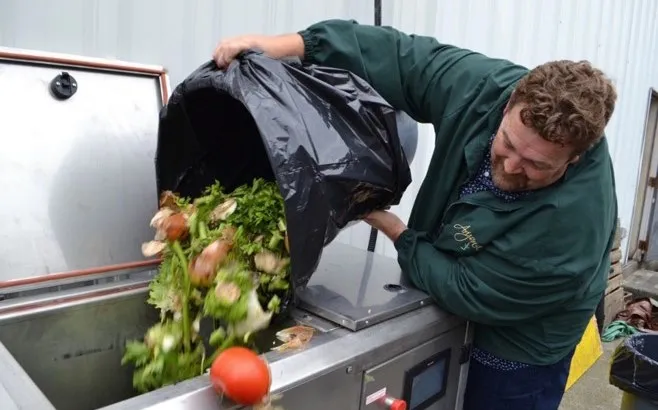
Vision:
Our community diverts all of our organic waste, such as food scraps and yard trimmings, from landfills and recovers value from everything that enters the waste stream.
Current State:
Organic landfill waste accounts for 5% of our community’s GHG emissions. There is currently organic waste pick up service in View Royal but it needs to be expanded to more building types and further efforts to keep construction and demolition waste out of the landfill are needed.
Big Move for Waste
| Close the Loop on Waste |
|---|
| Divert organics and capture value from waste |
Close the Loop on Waste
Divert organics and capture value from waste
Overview
Emissions from waste occur when organic waste mixed in with garbage decomposes in the landfill and produces methane, a potent greenhouse gas that is released into the atmosphere. While View Royal currently has organic waste pick-up for food waste from homes, other sources of organic materials (such as wood waste and paper) that cannot be recycled (such as food-soiled paper), and textiles are still ending up in the landfill.
While the CRD has been a leader in diverting the region’s organic waste from the landfill and capturing landfill gas, there is still action to be taken to ensure that other organics like clothing, construction and demolition waste, organics for multi-unit residential buildings, etc. remain out of the landfill.
A 2017 CRD study pointed out the “only material to have increased in waste generation compared to all other years since 2001 was wood and wood products, now representing 61 kg/capita” in the Hartland Landfill. This is primarily wood from construction, renovation and demolition activities.
Note that the Hartland Landfill has been capturing landfill gas for electricity generation for BC Hydro, but will instead soon start selling this to FortisBC for its Renewable Natural Gas program.
Looking Forward to 2030 – An Aspirational Target
- Residential food and yard waste will be converted to usable compost at a regional processing facility.
- All the compost created is repurposed into high quality soil for use in local farms and gardens.
Objectives
- Further divert organics from the landfill
- Expand organics pick up to more building types including multi-unit residential buildings, commercial properties, etc.
Provincial Action
The Province of British Columbia has committed to ensuring that, by 2030, 95% of organic waste will be diverted from landfills, and 75% of landfill gas will captured. The province has also committed to fund workforce training.
Federal Action
The Government of Canada, through its Investing in Canada Infrastructure Program (ICIP) provides funding for infrastructure that enables resource recovery, such as generating renewable fuel from waste.
Strategies for Closing the Loop on Waste
| Strategy | Actions Summary | Adaptation Benefits | Lever | Time | Cost |
|---|---|---|---|---|---|
| 1.1 – Adopt policies that drive increased organics diversion (e.g. deconstruction policy) | ✓ Despite curbside organics pick-up, organic waste still makes up a large portion of the waste stream in the CRD. ✓ Part of this organic waste stream is composed of wood waste from demolition of existing buildings (particularly wood framed homes). View Royal should evaluate the benefit of a deconstruction policy to ensure that the valuable old growth timber in these buildings is reused and does not end up in the landfill where it turns to methane. ✓ Support CRD in identifying and pursuing options to support and grow the market for salvaged deconstruction materials. |
The composted waste from organics diversion initiatives can have a strong adaptation benefit. Compost added to soil can help the soil’s capacity to absorb water (e.g. during high precipitation events), and to retain it (e.g. during periods of drought). | [Speech bubbles icon] | $ | |
| 1.2 – Include MURBs, institutional (e.g. Island Health), and commercial properties in requirements to divert organics & recycle | ✓ Work with CRD to complete assessment (inventory) of community organic waste volumes and feasibility of further landfill diversion from MURBS. ✓ Expanding this service will ensure further organics stay out of the landfill. |
See 1.1 | [Wrench icon] | $$ $ |
|
| 1.3 - Implement an enhanced organics collection (public waste bins) | ✓ Implement organics collection in public waste bins in high traffic areas throughout View Royal (including Recreation Centre, major shopping centres, transit hubs, etc). | See 1.1 | [Wrench icon] | [Blue bar] | $ |
| 1.4 - Collect construction, demolition, agricultural, and industrial wood waste | IN PROGRESS ✓ This waste is currently not sufficiently collected. Although there can be difficulties in collecting some of this waste due to potential contamination issues, opportunities to expand collection of it could be explored with CRD. |
See 1.1 | [Wrench icon] | $ | |
| 1.5 - Develop and deliver a comprehensive zero waste outreach | IN PROGRESS ✓ Work with the CRD and neighbouring communities to share a zero-waste outreach program that may include community-led composting projects, school programs, participation in the Provincial “Love Food Hate Waste” campaign and education around source-separation requirements. ✓ Educate and communicate the source-separation requirements in the region on Town social media. ✓ Support existing and new capacity for reusable resources, including Free Swaps, Share Sheds, free-store for unwanted goods, and building materials depot. |
See 1.1 | [Speech bubbles icon] | [Blue bar] | $ |
| 1.6 - Consider advocating to the CRD for expanded regional organics processing (facility for composting, or anaerobic digestion) | ✓ Work with the CRD to ensure that capacity for regional organics processing is expanded, to help ensure that organics stay out of the landfill. | See 1.1 | [Pencil icon] | [Blue bar] | $ |
| 1.7 - Establish a regular yard waste pickup for detached dwellings | ✓ Consider integrating it in to the kitchen waste pickup. | See 1.1 | [Wrench icon] | [Blue bar] | $ |
Other Opportunities
In the engagement workshops we explored opportunities for the Town of View Royal beyond the prescribed Big Moves. These included local renewable energy actions, primarily rooftop solar, carbon sequestration actions including preservation of natural assets, wood-framed buildings for new buildings, and carbon capture technologies. The action summaries and timelines for implementation are shown below.
| Strategy | Actions Summary | 2022 | 2023 | 2024 | 2025 | Later |
|---|---|---|---|---|---|---|
| LOCAL RENEWABLE ENERGY | ||||||
| 1.1 Remove barriers to building-level renewable energy projects. | Amend zoning bylaws, permitting process, etc. to remove barriers to local renewable energy projects such as rooftop solar panels. | X | ||||
| SEQUESTRATION | ||||||
| 2.1 Explore encouraging Low Embodied Carbon Buildings | Consider ways to support or encourage building materials that have low embodied carbon or even have a net negative carbon balance, e.g. by relaxing Step Code requirements for wood-frame Part 3 buildings and encouraging larger wood-frame Part 3 buildings. | X | ||||
| 2.2 Preserve & expand urban tree canopy within the municipal boundary | Create a strategy or plan to achieve this, and then implement. | X | ||||
| 2.3 Collaborate with other governments, organizations and industry to pursue low-carbon and carbon capture technologies | Keep abreast of ways that local governments can be involved in, and support carbon capture & sequestration, e.g. through Province of BC, CEA, and Pacific Institute for Climate Solutions. | X | ||||
| OTHER | ||||||
| 1.1 Encourage people to buy local in our grocery stores (to reduce commercial vehicle traffic) | Conduct public engagement on this. This action will help to reduce waste, commercial vehicle traffic, and promote resilience by supporting local businesses and people and keeping money local. | X | ||||
| 1.2 Encourage people to buy less and waste less, encourage meal planning, try to change mindsets | Create a public engagement campaign to provide support for repair cafes, tool lending libraries, etc. Share info on CRD’s food waste campaign on Town social media. | X |
Organizational Leadership
Implementation for Success
Several key factors are important for the successful implementation of community climate action strategies based on research conducted by CEA, QUEST, and Smart Prosperity. Among others, they include establishing broad support for implementation, building staff and financial capacity for implementation, and institutionalizing the plan in order to withstand political and staff turnover. With regards to institutionalization, ideas on how this can be done are shown in the table below.
| Category | Implementation Idea |
|---|---|
| Incorporate | Embed climate action into other planning documents such as the OCP, bylaws and policies, departmental/master plans, as well as development proposals. Climate action could also be incorporated into Town staff job descriptions. Some communities report on climate action or sustainability implications in reports to Council. |
| Budget | Embed climate action into the budgeting process. Further ideas for external funding are provided in the chart on the following page. |
| Monitor | Monitor indicators as outlined in the Monitoring and Evaluation section. |
| Network & Convene | Network with leaders in the climate action sector. View Royal staff can join CEA’s BC Hydro funded Step Code, retrofit, and EV peer networks. A View Royal Council member might also want to join CEA’s BC Municipal Climate Leaders Council. Continue to host regular meetings to discuss implementation, innovative technology and methods, new legislation, and necessary pivots with internal and/or external stakeholders. |
| Report | Report regularly to Council on progress and accomplishments. Annual reporting is recommended. In the past many communities aligned this reporting with the annual CARIP reporting for the Province. CARIP is currently being redesigned and the opportunity to align will most likely still exist. Submit the plan to Federation of Canadian Municipalities’ Partners for Climate Protection Program (CEA can assist). A Monitoring and Evaluation Framework with key performance indicators is located in Appendix C. Staying Accountable. |
| Renew | Prepare for plan renewal approximately every five years. |
Funding Climate Action
Funding sources that communities typically use for climate action are shown in the table below.
| Internal Funding Sources | External Funding Sources |
|---|---|
| 1. Allocation from operating budget 2. Revolving energy efficiency fund (from corporate projects) 3. Forgone revenue (charge less for a municipal service to use the difference to fund a climate initiative) 4. General revenue (e.g. property taxes) 5. Recycling and solid waste user fees 6. Building permit fees and other service fees charged by Development Services 7. Electrical utility and water user fees |
1. Union BC Municipalities Gas Tax Agreement Funds 2. Federation of Canadian Municipality’s Green Municipal Fund supports plans, studies, capital projects and pilot projects for environmental initiatives in a number of focus areas 3. FCM Community Efficiency Financing Program for financing community-scale retrofit infrastructure 4. Federal government programs such as the Greener Homes Grant, Low Carbon Economy Challenge, and Clean Energy Innovation Program 5. Provincial government programs such as the Clean Energy Vehicle Program, BikeBC Program, and CleanBC Communities Fund 6. Emotive grants for EV educational events to foster greater EV adoption 7. CleanBC and FortisBC energy efficiency incentives for new home construction and for increasing energy efficiency in existing buildings 8. BC Housing and FortisBC for education or demonstration projects to encourage the building industry to construct low energy and GHG emission homes. 9. FortisBC free energy grants for municipal buildings, and subsequent rebates for retrofits 10. Potential funding from CARIP replacement |
Forecasting: Action Plan Projection
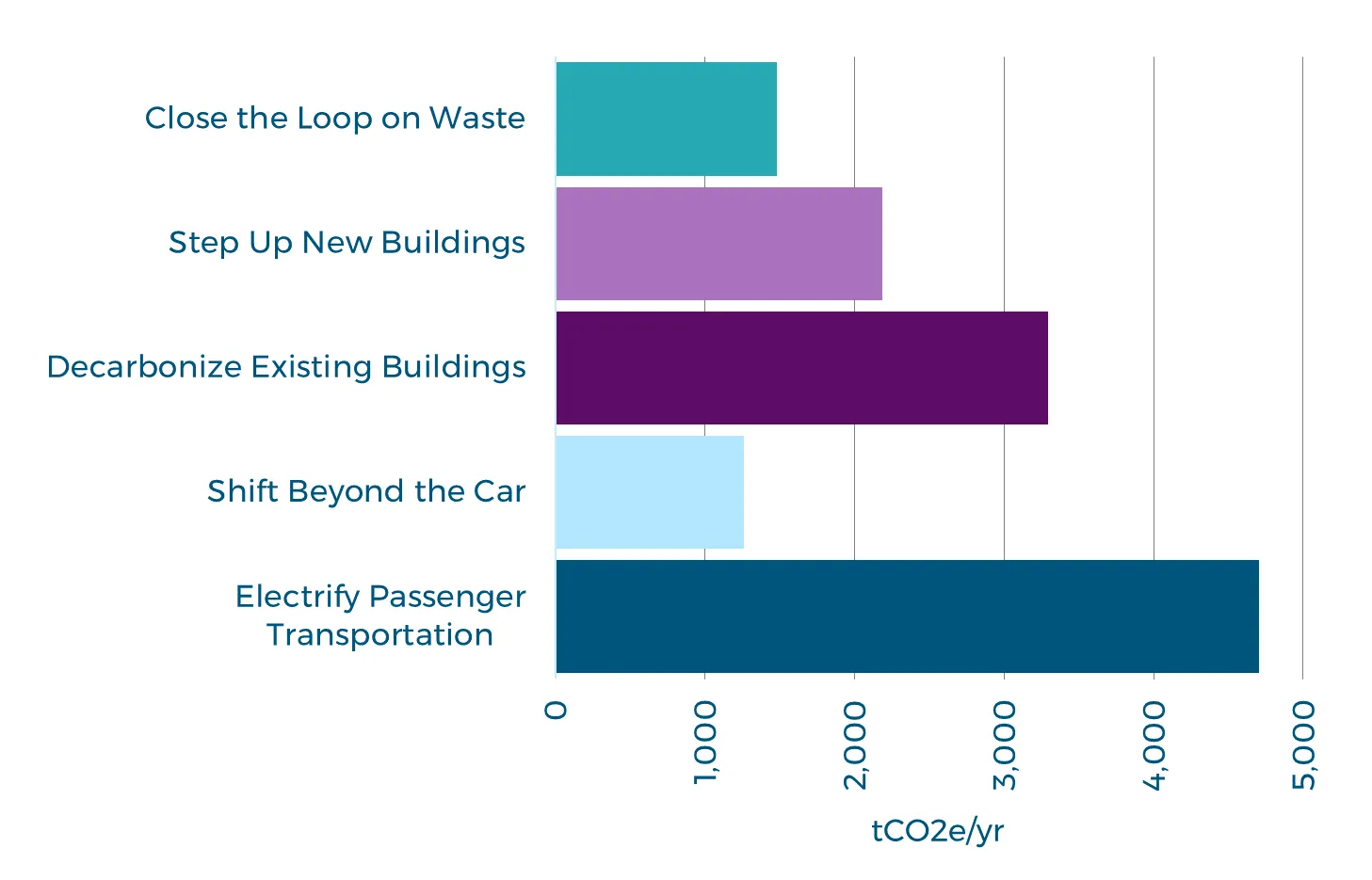
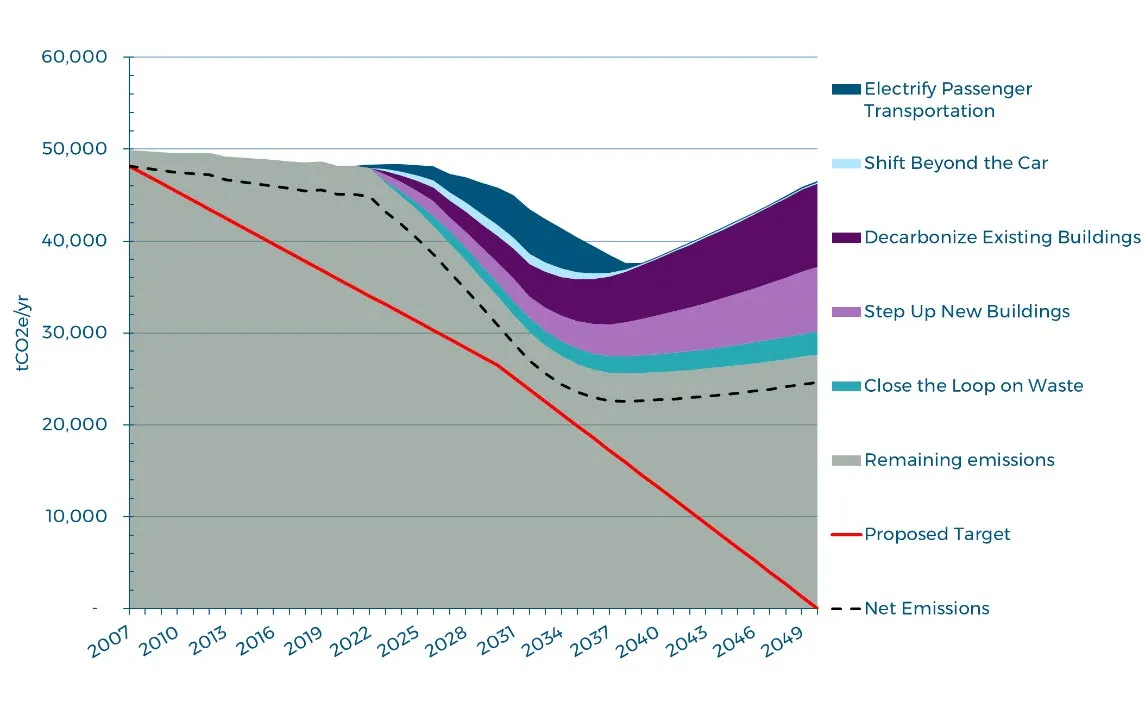
The chart shows the modelled emissions reduction by Big Move for the year 2030, relative to business as usual (BAU) projections. If all Big Moves are implemented in View Royal to the degree outlined in this Plan, GHG emissions in 2030 could be reduced by 12,900 tonnes of CO2e below the 2030 BAU, or 17,300 tonnes below 2007 levels, a total reduction of 36%.
Whilst the BAU scenario assumes a certain level of passenger vehicle electrification, this Big Move still presents the greatest opportunity for emissions reductions, at 4,700 tonnes CO2e. Shifting Beyond the Car offers the potential to further reduce transportation emissions by 1,260 tonnes CO2e. Retrofitting the existing building stock by fuel switching and improving energy efficiency presents a savings of 3,290 tonnes CO2e. Enhancing efficiency and implementing GHG reduction measures for new buildings can reduce emissions by 2,180 tonnes CO2e. Closing the Loop on Waste by diverting more organics from landfill can reduce emissions by 1,480 tonnes CO2e.
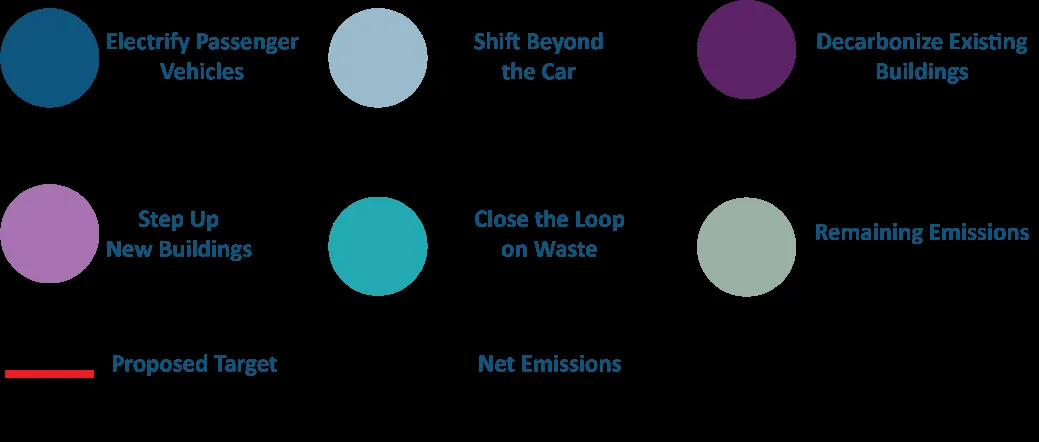
The following chart shows the emissions reduction by Big Move to 2050 relative to the BAU. Note that although the 2050 emission reduction target is not met, it is anticipated that new technologies and levers will become available in the future which will enable View Royal to achieve the target.

Emissions reductions over time
Eliminating fossil fuels from transportation and heating are key actions moving forward. By 2030, the majority of emissions savings will be from actions to electrify transportation. By 2040 and 2050, actions to reduce emissions from community buildings will have a big impact on reaching targets.
Remaining emissions
Tackling remaining emissions between 2040 and 2050 will come from added support at a provincial and federal level and technological improvements. The solutions and technology to reduce emissions in our community will grow and become more sophisticated over time. This will include new and innovative solutions to capture and store carbon and offsetting emissions.
What’s important is that we get started now implementing proven solutions like the Big Moves to ensure we are well positioned to take advantage of emerging technology.