Burnaby Council Report: Community Impacts of Elimination of Home Mail Delivery
A detailed technical report from Burnaby staff outlining the social, operational, and land-use impacts of Canada Post's move to community mailboxes.
COUNCIL REPORT
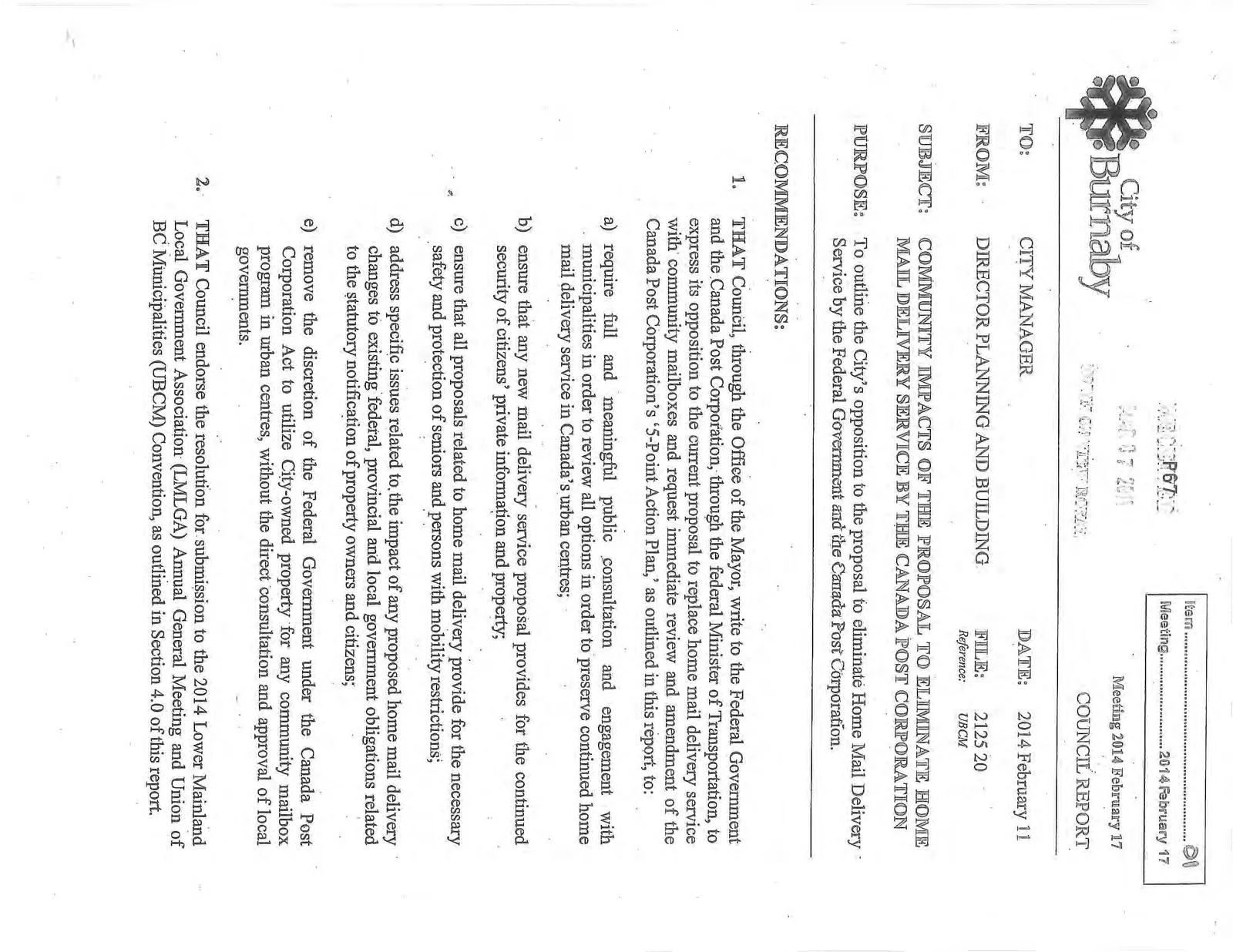
TO: CITY MANAGER DATE: 2014 February 11 FROM: DIRECTOR PLANNING AND BUILDING FILE: 2125 20 REFERENCE: UBCM SUBJECT: COMMUNITY IMPACTS OF THE PROPOSAL TO ELIMINATE HOME MAIL DELIVERY SERVICE BY THE CANADA POST CORPORATION PURPOSE: To outline the City’s opposition to the proposal to eliminate Home Mail Delivery Service by the Federal Government and the Canada Post Corporation.
RECOMMENDATIONS:
- THAT Council, through the Office of the Mayor, write to the Federal Government and the Canada Post Corporation, through the federal Minister of Transportation, to express its opposition to the current proposal to replace home mail delivery service with community mailboxes and request immediate review and amendment of the Canada Post Corporation’s ‘5-Point Action Plan,’ as outlined in this report, to: a) require full and meaningful public consultation and engagement with municipalities in order to review all options in order to preserve continued home mail delivery service in Canada’s urban centres; b) ensure that any new mail delivery service proposal provides for the continued security of citizens’ private information and property; c) ensure that all proposals related to home mail delivery provide for the necessary safety and protection of seniors and persons with mobility restrictions; d) address specific issues related to the impact of any proposed home mail delivery changes to existing federal, provincial and local government obligations related to the statutory notification of property owners and citizens; e) remove the discretion of the Federal Government under the Canada Post Corporation Act to utilize City-owned property for any community mailbox program in urban centres, without the direct consultation and approval of local governments.
- THAT Council endorse the resolution for submission to the 2014 Lower Mainland Local Government Association (LMLGA) Annual General Meeting and Union of BC Municipalities (UBCM) Convention, as outlined in Section 4.0 of this report.
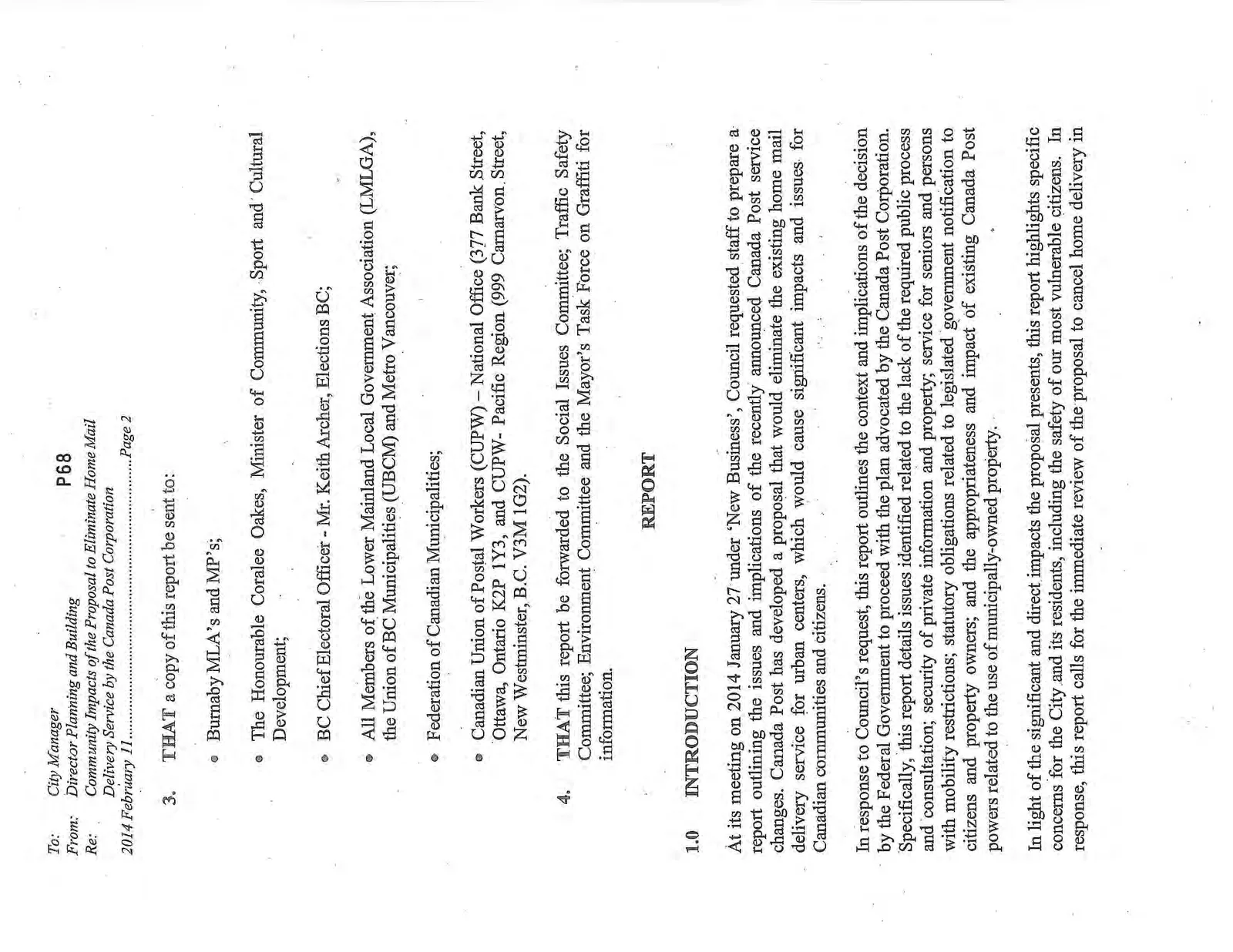
- THAT a copy of this report be sent to:
- Burnaby MLA’s and MP’s;
- The Honourable Coralee Oakes, Minister of Community, Sport and Cultural Development;
- BC Chief Electoral Officer - Mr. Keith Archer, Elections BC;
- All Members of the Lower Mainland Local Government Association (LMLGA), the Union of BC Municipalities (UBCM) and Metro Vancouver;
- Federation of Canadian Municipalities;
- Canadian Union of Postal Workers (CUPW) – National Office (377 Bank Street, Ottawa, Ontario K2P 1Y3, and CUPW- Pacific Region (999 Carnarvon Street, New Westminster, B.C. V3M 1G2).
- THAT this report be forwarded to the Social Issues Committee; Traffic Safety Committee; Environment Committee and the Mayor’s Task Force on Graffiti for information.
REPORT
1.0 INTRODUCTION
At its meeting on 2014 January 27 under ‘New Business’, Council requested staff to prepare a report outlining the issues and implications of the recently announced Canada Post service changes. Canada Post has developed a proposal that would eliminate the existing home mail delivery service for urban centers, which would cause significant impacts and issues for Canadian communities and citizens.
In response to Council’s request, this report outlines the context and implications of the decision by the Federal Government to proceed with the plan advocated by the Canada Post Corporation. Specifically, this report details issues identified related to the lack of the required public process and consultation; security of private information and property; service for seniors and persons with mobility restrictions; statutory obligations related to legislated government notification to citizens and property owners; and the appropriateness and impact of existing Canada Post powers related to the use of municipally-owned property.
In light of the significant and direct impacts the proposal presents, this report highlights specific concerns for the City and its residents, including the safety of our most vulnerable citizens. In response, this report calls for the immediate review of the proposal to cancel home delivery in urban centres to ensure full public consultation and actions to protect the interests of all Canadians.
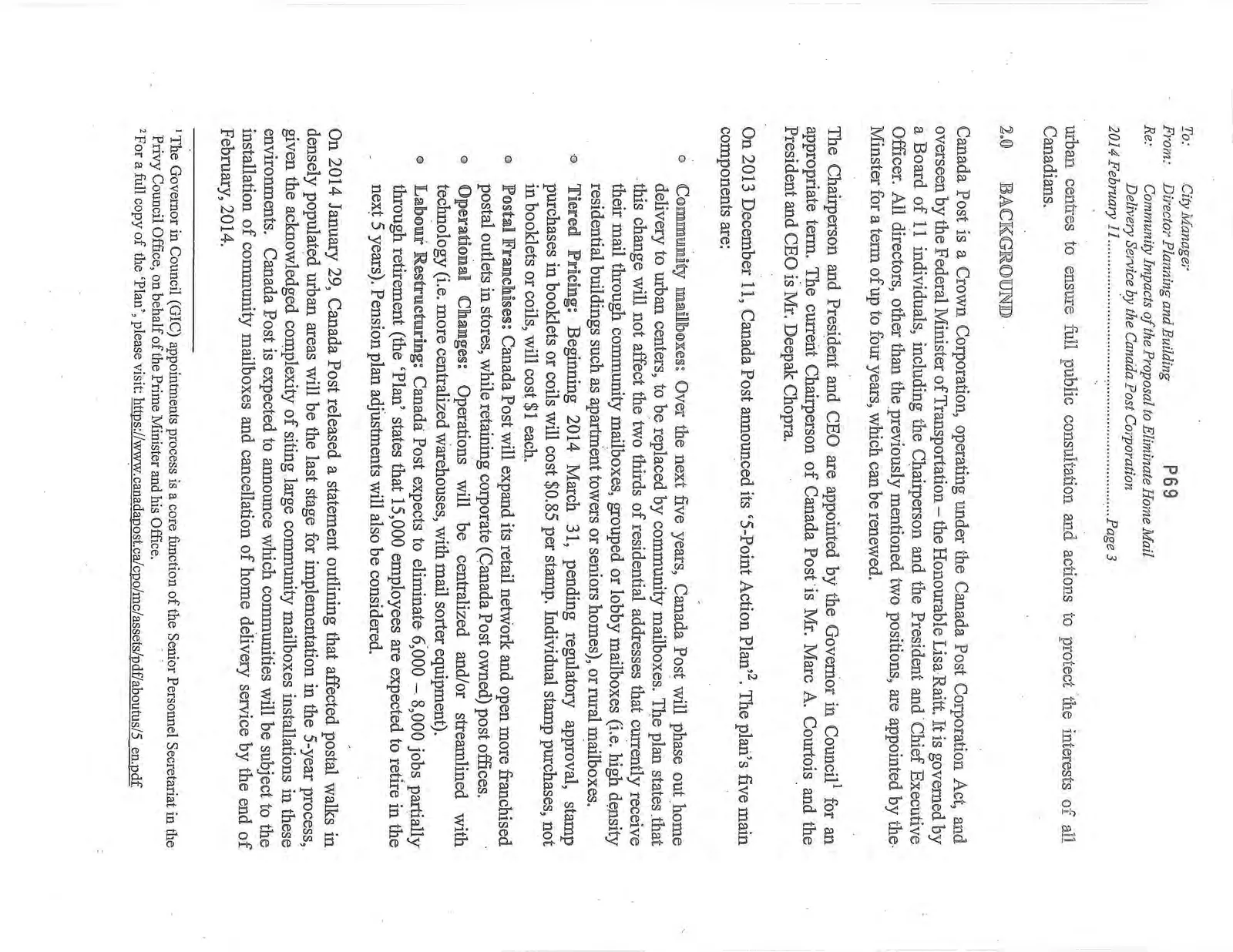
2.0 BACKGROUND
Canada Post is a Crown Corporation, operating under the Canada Post Corporation Act, and overseen by the Federal Minister of Transportation – the Honourable Lisa Raitt. It is governed by a Board of 11 individuals, including the Chairperson and the President and Chief Executive Officer. All directors, other than the previously mentioned two positions, are appointed by the Minister for a term of up to four years, which can be renewed.
The Chairperson and President and CEO are appointed by the Governor in Council¹ for an appropriate term. The current Chairperson of Canada Post is Mr. Marc A. Courtois and the President and CEO is Mr. Deepak Chopra.
On 2013 December 11, Canada Post announced its ‘5-Point Action Plan’². The plan’s five main components are:
- Community mailboxes: Over the next five years, Canada Post will phase out home delivery to urban centers, to be replaced by community mailboxes. The plan states that this change will not affect the two thirds of residential addresses that currently receive their mail through community mailboxes, grouped or lobby mailboxes (i.e. high density residential buildings such as apartment towers or seniors homes), or rural mailboxes.
- Tiered Pricing: Beginning 2014 March 31, pending regulatory approval, stamp purchases in booklets or coils will cost $0.85 per stamp. Individual stamp purchases, not in booklets or coils, will cost $1 each.
- Postal Franchises: Canada Post will expand its retail network and open more franchised postal outlets in stores, while retaining corporate (Canada Post owned) post offices.
- Operational Changes: Operations will be centralized and/or streamlined with technology (i.e. more centralized warehouses, with mail sorter equipment).
- Labour Restructuring: Canada Post expects to eliminate 6,000 – 8,000 jobs partially through retirement (the ‘Plan’ states that 15,000 employees are expected to retire in the next 5 years). Pension plan adjustments will also be considered.
On 2014 January 29, Canada Post released a statement outlining that affected postal walks in densely populated urban areas will be the last stage for implementation in the 5-year process, given the acknowledged complexity of siting large community mailboxes installations in these environments. Canada Post is expected to announce which communities will be subject to the installation of community mailboxes and cancellation of home delivery service by the end of February, 2014.
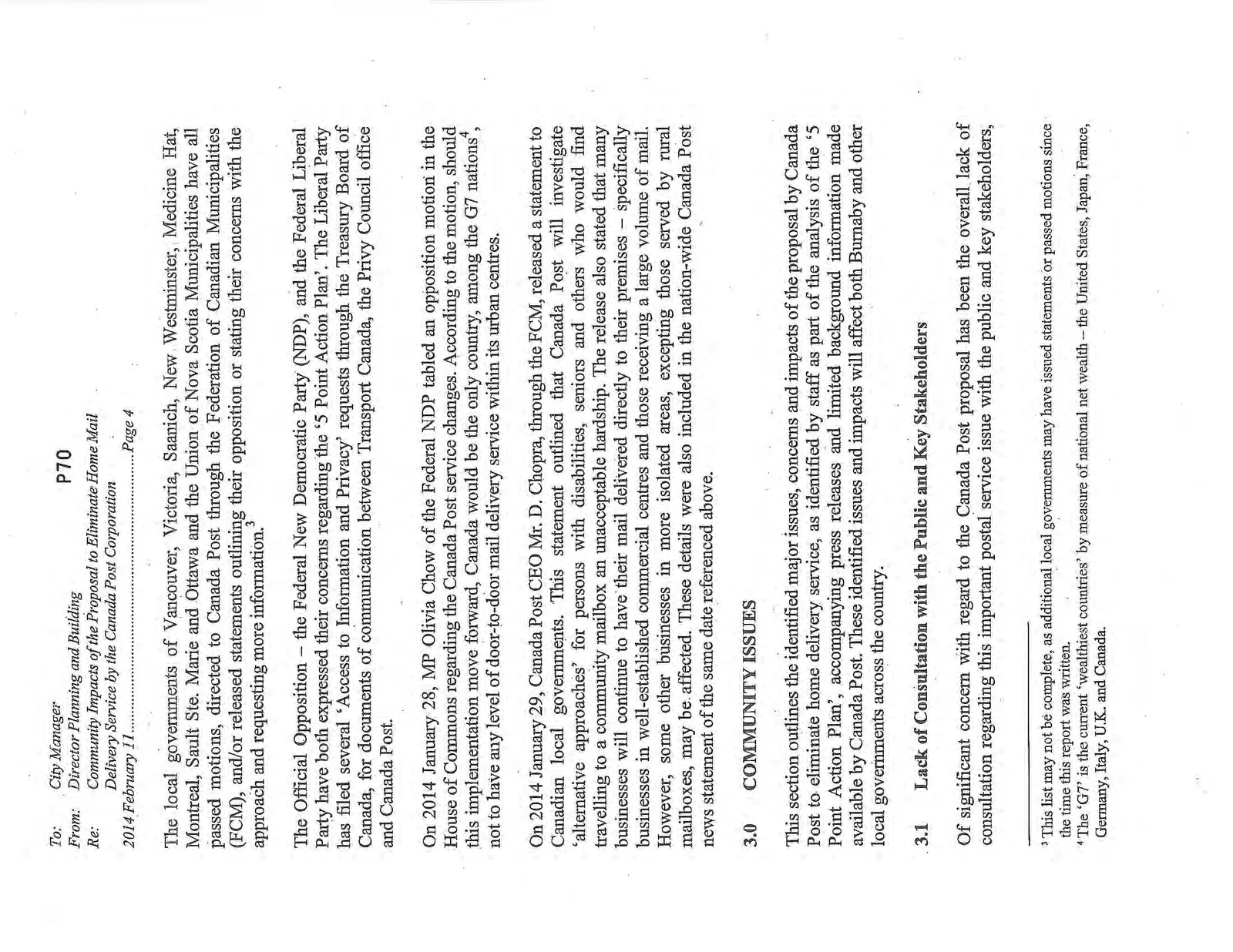
The local governments of Vancouver, Victoria, Saanich, New Westminster, Medicine Hat, Montreal, Sault Ste. Marie and Ottawa and the Union of Nova Scotia Municipalities have all passed motions, directed to Canada Post through the Federation of Canadian Municipalities (FCM), and/or released statements outlining their opposition or stating their concerns with the approach and requesting more information³.
The Official Opposition – the Federal New Democratic Party (NDP), and the Federal Liberal Party have both expressed their concerns regarding the ‘5 Point Action Plan’. The Liberal Party has filed several ‘Access to Information and Privacy’ requests through the Treasury Board of Canada, for documents of communication between Transport Canada, the Privy Council office and Canada Post.
On 2014 January 28, MP Olivia Chow of the Federal NDP tabled an opposition motion in the House of Commons regarding the Canada Post service changes. According to the motion, should this implementation move forward, Canada would be the only country, among the G7 nations⁴, not to have any level of door-to-door mail delivery service within its urban centres.
On 2014 January 29, Canada Post CEO Mr. D. Chopra, through the FCM, released a statement to Canadian local governments. This statement outlined that Canada Post will investigate ‘alternative approaches’ for persons with disabilities, seniors and others who would find travelling to a community mailbox an unacceptable hardship. The release also stated that many businesses will continue to have their mail delivered directly to their premises – specifically businesses in well-established commercial centres and those receiving a large volume of mail. However, some other businesses in more isolated areas, excepting those served by rural mailboxes, may be affected. These details were also included in the nation-wide Canada Post news statement of the same date referenced above.
¹ The Governor in Council (GIC) appointments process is a core function of the Senior Personnel Secretariat in the Privy Council Office, on behalf of the Prime Minister and his Office. ² For a full copy of the ‘Plan’, please visit: https://www.canadapost.ca/cpo/mc/assets/pdf/aboutus/5_en.pdf ³ This list may not be complete, as additional local governments may have issued statements or passed motions since the time this report was written. ⁴ The ‘G7’ is the current ‘wealthiest countries’ by measure of national net wealth – the United States, Japan, France, Germany, Italy, U.K. and Canada.
3.0 COMMUNITY ISSUES
This section outlines the identified major issues, concerns and impacts of the proposal by Canada Post to eliminate home delivery service, as identified by staff as part of the analysis of the ‘5 Point Action Plan’, accompanying press releases and limited background information made available by Canada Post. These identified issues and impacts will affect both Burnaby and other local governments across the country.
3.1 Lack of Consultation with the Public and Key Stakeholders
Of significant concern with regard to the Canada Post proposal has been the overall lack of consultation regarding this important postal service issue with the public and key stakeholders, including local governments. From the limited available information it has been determined that the consultation completed to date has been advanced without benefit of the general public being provided with information of the specific proposals presented for implementation.
Public Consultation
Canada Post maintains that their consultation process focussed on engaging with members of the public and the business community. According to the limited information being released by Canada Post, the corporation contends that it conducted a 5-month public consultation process from April – August, 2013. This ‘consultation process’ included a 2013 April 24 news release, an online forum available for discussion through the Canada Post website, signage in post offices and franchise outlets, information on printed postal receipts, and participation of Canada Post leaders in over 40 talk and call-in shows. In addition, Canada Post maintains that it held 46 community forums with invited representatives from different sectors (e.g. business) and neighbourhoods with different types of delivery service. In the Lower Mainland, these conversations occurred in Vancouver and Coquitlam.
Generally, however, staff would conclude that the process undertaken for this consultation process does not meet the basic threshold required for either public engagement or consultation for an issue of such national importance and scope. Given the implications of the changes proposed, a wider and more sustained discussion should have included presentation of facts and issues, followed with specific options that reflected public feedback and concerns. Additionally, the general public should have been provided an opportunity to participate in the process and attend public information meetings. At a basic level, the Canada Post Corporation’s claim of wide public consultation and engagement is not well supported, as it was too broad, high-level, severely limited direct public involvement and did not disclose the true intent of the wide-spread and important changes being contemplated for immediate implementation.
Stakeholder Consultation - Local Government
Local governments, as a key stakeholder, would be most directly impacted by these proposed changes in terms of the proposal’s impact on residents, corporate services, urban form and land-use policies. Canada Post maintains that as part of its consultation process that it met directly with the Mayors and senior administrative officials of six local governments. It is noted that the information provided by Canada Post does not identify the six communities or the range of issues that were reviewed or if any of the known technical aspects related to the proposal were advanced for review. The size, location and nature of the communities has also not been disclosed by Canada Post.
Again, given the importance of the issues being advanced, the lack of engagement with Canada’s local governments, or their regional or national organizations, erodes confidence that the stakeholder review process was in any sense complete or comprehensive. As British Columbia’s third largest City, Burnaby should have had an opportunity to review the proposals being advanced and to participate in a technical review to analyze and comment on specific proposals.
As outlined, to the City’s knowledge, no urban municipality, or agency representing Canadian cities, was specifically engaged on the issues of replacing home delivery services with community mailboxes.
Given the implications of the Canada Post proposal to all urban municipalities and their citizens, staff are of the opinion that a more sustained and substantive consultation process with local governments prior to the service delivery changes being decided upon and announced would have been of benefit in identifying and determining issues and impacts of these service changes, including possible remediation approaches.
It is therefore proposed that Council advance its opposition to the proposal on the basis of the lack of wide public and local government review, and request the Federal Government require full and meaningful public consultation and engagement with municipalities, in order to review all options related to preserve continued home mail delivery in Canada’s urban centres.
3.2 Mail Security
Another immediate and important concern with the proposal to eliminate home-delivery service is the high level of crime and vandalism experienced at existing community mailboxes. While Canada Post maintains that it locates community mailboxes in areas of natural surveillance, community mailboxes are more prone to many security concerns regardless of their location. The most serious concern is theft of mail through vandalism and breaking locks and access points to community mailboxes. The design and quality of the Canada Post community mailboxes have proven not to be secure and have left citizens’ property vulnerable to theft. Additionally, mailboxes are a target of vandalism through graffiti and damage.
According to an investigative report by the Canadian Broadcasting Corporation (CBC), community mailboxes in the Lower Mainland and other urban/suburban areas are particular targets. Burnaby itself is reported to have had several dozen incidents over the past 5 years, including one act of arson, four acts of theft, and several Canada Post mailboxes being over turned and damaged. The number and severity of incidences appear to increase in communities with more community mailboxes already in place. For example, the City of Surrey is reported to have experienced almost 900 incidences over the same period, while the District of Maple Ridge and the City of Langley and District of Langley are reported to have experienced upwards of 400 incidences⁵.
The issue of crime and vandalism of the existing community mailbox program has other widespread impacts that have been demonstrated in a number of recent incidents across Canada. Canada Post does not have the capacity or infrastructure to maintain the existing community mailbox program in order to respond quickly and effectively to repair all of the mailboxes that can be damaged by organized criminal activities. In some instances several community mailboxes within a city are targeted within a single crime event. The impacts to citizens include the suspension of mail delivery for several weeks to affected communities. In some cases resident’s mail would be made available through a Canada Post outlet until repairs can be completed. However, these locations can be located far away from affected neighbourhoods and without the staffing available to effectively serve the public.
The proposal to increase the number of community mailboxes in urban areas will exacerbate the issue of mail theft and impact many more citizens on an ongoing basis. Of specific and serious concern is the vulnerability of community mailboxes to crimes related to identity theft through access to personal information and sensitive mail. Direct theft of cheques, currency, gifts, and parcels has also been reported and associated with community mailboxes. The impact of crime associated with the introduction of community mailboxes on local police detachments through an increase in service calls has not been analyzed or reviewed. Additionally, none of these issues have been fully addressed by Canada Post or included in any public consultation efforts related to the discussion of the proposal to cancel home mail delivery.
It is therefore proposed that Council advance its opposition to the proposal on the basis of the lack of study and information related to implementation of provisions for theft prevention and mail security, and request the Federal Government ensure that any new mail delivery service proposal provides for the continued security of citizens’ private information and property.
⁵ For more information, see the CBC Investigative Report at: http://www.cbc.ca/news/canada/british-columbia/are-canada-post-s-community-mailboxes-really-safe-1.2460515.
3.3 Safety and Access for Seniors and Persons with Mobility Restrictions
For many senior citizens and persons with mobility restrictions, living in areas currently receiving the home delivery postal service, the proposal to restrict their mail delivery to community mailboxes will represent a significant hardship. For many such persons, it may be difficult or impossible to travel to community mailboxes particularly in inclement weather, if they do not drive, are not in an area well-serviced by public transit, or have few family members and/or others whom they can ask for assistance.
For some persons with disabilities, there may also be hand-dexterity considerations as keys are required to open each mail slot.⁶ Another potential issue is with the height of assigned mail slots. For some persons utilizing a wheelchair or another mobility device, or who have limited upper body movement, they may be unable to reach up significantly to access their mail slot. Finally, for many individuals isolation is also a factor and the ‘human connection’ of home delivery service provides a much needed and valuable opportunity for daily conversation, interaction and connection to the wider community.
It is of great concern that Canada Post did not identify these important social planning issues as part of any public consultation program for citizens which should have ensured that vulnerable citizens and their issues were adequately addressed as part of the proposed change to the home delivery service. Subsequent assurances by Canada Post to further study the issue, as outlined in Section 2.0 of this report, further emphasize the lack of planning and consultation that has occurred to date regarding this important issue and does not provide any confidence that the matter would be resolved through a consultative public process.
It is therefore proposed that Council advance its opposition to the proposal and request the Federal Government ensure that all proposals related to home mail delivery provide for the necessary safety and protection of seniors and persons with mobility restrictions.
⁶ When persons move into a neighbourhood serviced by a community mailbox, keys to an assigned slot are available for pick-up at a local postal outlet.
3.4 Provincial Statutory Public Notification Procedures
Of significant concern is the fact that the Canada Post proposal has been advanced without consultation and review with regard to addressing any conflicts with existing B.C. Provincial Statutory Public Notification procedures. While these processes, and any requirements of mail notification through Canada Post, remain the responsibility of the Provincial Government, there are many impacts on local governments and its citizens. These include but are not limited to the Local Government Act, Elections BC and other statutory municipal notifications.
The proposal to cancel home mail delivery has been advanced without benefit of oversight or any review related to the legal implications regarding a local municipality’s responsibility to ensure public notification under the Local Government Act. These laws were originally developed under the basis of existing daily home mail delivery services. For example, notices of a Public Hearing must, as mandated by Section 892 (4)(b) of the Local Government Act, be mailed or otherwise delivered by local governments to all property owners at least 10 days before the hearing date. While Canada Post may maintain that community mailboxes would provide postal service to all residents, many issues remain of concern. Notification may not be deemed to have occurred within the statutory timeframe as property owners would only receive their mail upon collection at a community mailbox, which may not provide timely notification. However, currently home mail service has been deemed to provide legal notification to property owners upon its delivery to a private residence.
Additionally, Burnaby, other local governments and government agencies have not had the opportunity to review and comment on the potential impact of the proposal related to its internal corporate and bylaw practices concerning the legal notification of property owners and residents. This includes taxation notices, bylaw infraction notices, local elections notices and emergency response information and procedures. It is unclear at this point whether the existing notification procedures and stated periods are still adequate or need to be reviewed and updated, based on the current or future mail delivery changes being considered by Canada Post.
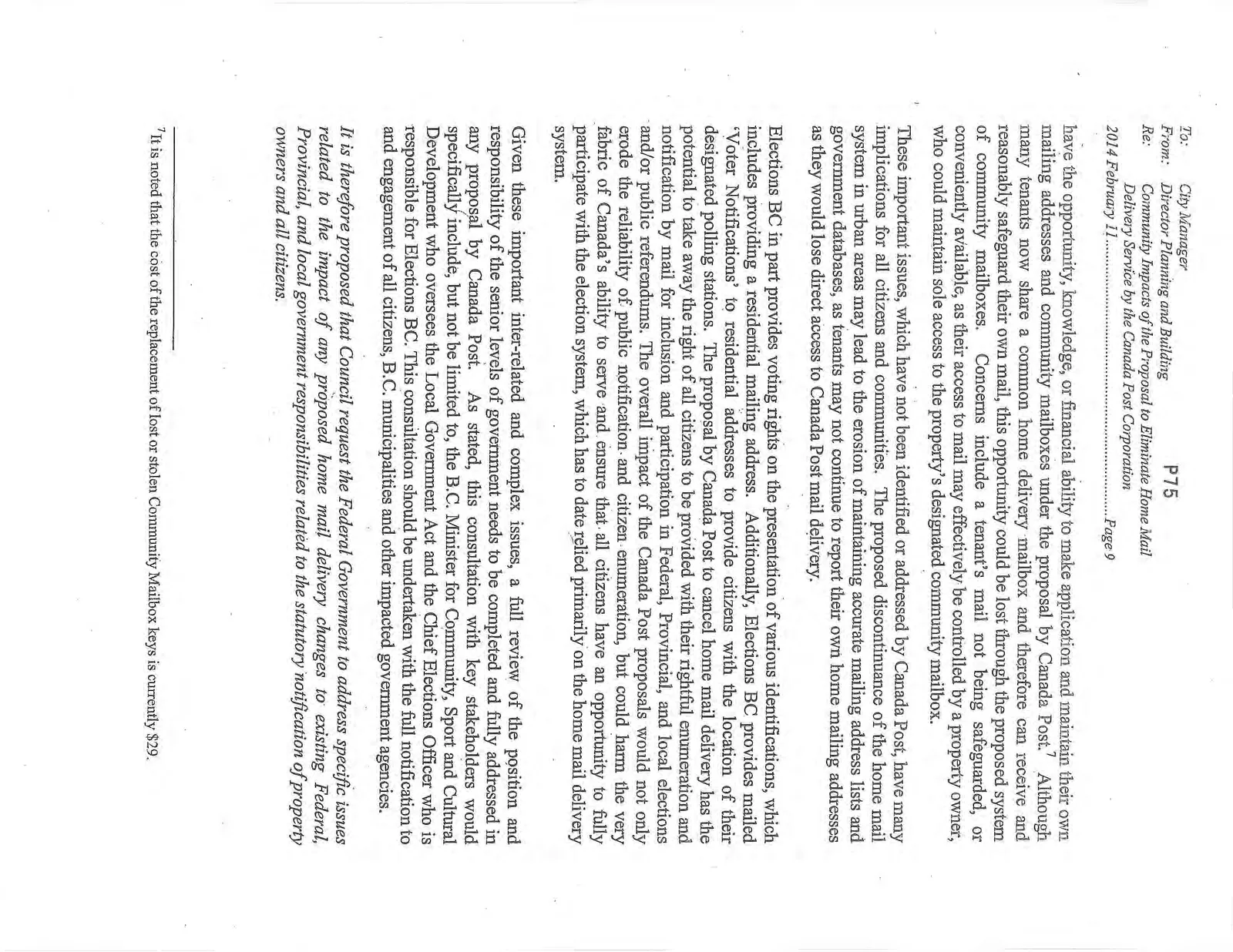
Canada Post has also not addressed how it will maintain mail service to hundreds of thousands of citizens that occupy legal and illegal secondary suites, located in single-family homes, duplexes and other building types, which are common in many of the country’s urban centres. A high percentage of these citizens may be new immigrants and/or have low incomes. Tenants of private properties, for a variety of reasons (lack of knowledge, language barriers, etc.), may not have the opportunity, knowledge, or financial ability to make application and maintain their own mailing addresses and community mailboxes under the proposal by Canada Post.⁷ Although many tenants now share a common home delivery mailbox and therefore can receive and reasonably safeguard their own mail, this opportunity could be lost through the proposed system of community mailboxes. Concerns include a tenant’s mail not being safeguarded, or conveniently available, as their access to mail may effectively be controlled by a property owner, who could maintain sole access to the property’s designated community mailbox.
These important issues, which have not been identified or addressed by Canada Post, have many implications for all citizens and communities. The proposed discontinuance of the home mail system in urban areas may lead to the erosion of maintaining accurate mailing address lists and government databases, as tenants may not continue to report their own home mailing addresses as they would lose direct access to Canada Post mail delivery.
Elections BC in part provides voting rights on the presentation of various identifications, which includes providing a residential mailing address. Additionally, Elections BC provides mailed ‘Voter Notifications’ to residential addresses to provide citizens with the location of their designated polling stations. The proposal by Canada Post to cancel home mail delivery has the potential to take away the right of all citizens to be provided with their rightful enumeration and notification by mail for inclusion and participation in Federal, Provincial, and local elections and/or public referendums. The overall impact of the Canada Post proposals would not only erode the reliability of public notification and citizen enumeration, but could harm the very fabric of Canada’s ability to serve and ensure that all citizens have an opportunity to fully participate with the election system, which has to date relied primarily on the home mail delivery system.
Given these important inter-related and complex issues, a full review of the position and responsibility of the senior levels of government needs to be completed and fully addressed in any proposal by Canada Post. As stated, this consultation with key stakeholders would specifically include, but not be limited to, the B.C. Minister for Community, Sport and Cultural Development who oversees the Local Government Act and the Chief Elections Officer who is responsible for Elections BC. This consultation should be undertaken with the full notification to and engagement of all citizens, B.C. municipalities and other impacted government agencies.
It is therefore proposed that Council request the Federal Government to address specific issues related to the impact of any proposed home mail delivery changes to existing Federal, Provincial, and local government responsibilities related to the statutory notification of property owners and all citizens.
⁷ It is noted that the cost of the replacement of lost or stolen Community Mailbox keys is currently $29.
3.5 Location of Community Mailboxes on City-owned property
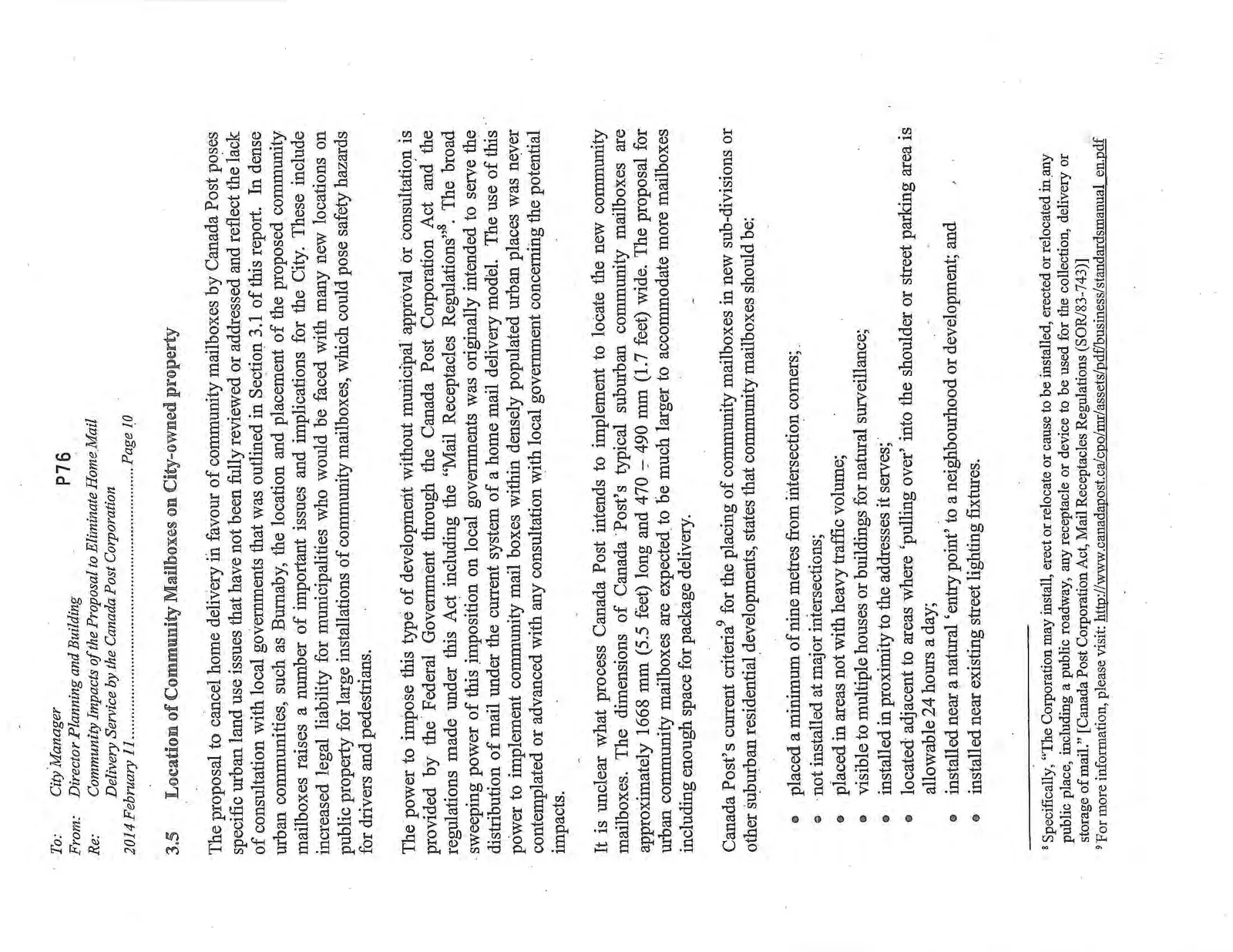
The proposal to cancel home delivery in favour of community mailboxes by Canada Post poses specific urban land use issues that have not been fully reviewed or addressed and reflect the lack of consultation with local governments that was outlined in Section 3.1 of this report. In dense urban communities, such as Burnaby, the location and placement of the proposed community mailboxes raises a number of important issues and implications for the City. These include increased legal liability for municipalities who would be faced with many new locations on public property for large installations of community mailboxes, which could pose safety hazards for drivers and pedestrians.
The power to impose this type of development without municipal approval or consultation is provided by the Federal Government through the Canada Post Corporation Act and the regulations made under this Act including the “Mail Receptacles Regulations”⁸. The broad sweeping power of this imposition on local governments was originally intended to serve the distribution of mail under the current system of a home mail delivery model. The use of this power to implement community mail boxes within densely populated urban places was never contemplated or advanced with any consultation with local government concerning the potential impacts.
It is unclear what process Canada Post intends to implement to locate the new community mailboxes. The dimensions of Canada Post’s typical suburban community mailboxes are approximately 1668 mm (5.5 feet) long and 470 – 490 mm (1.7 feet) wide. The proposal for urban community mailboxes are expected to be much larger to accommodate more mailboxes including enough space for package delivery.
Canada Post’s current criteria⁹ for the placing of community mailboxes in new sub-divisions or other suburban residential developments, states that community mailboxes should be:
- placed a minimum of nine metres from intersection corners;
- not installed at major intersections;
- placed in areas not with heavy traffic volume;
- visible to multiple houses or buildings for natural surveillance;
- installed in proximity to the addresses it serves;
- located adjacent to areas where ‘pulling over’ into the shoulder or street parking area is allowable 24 hours a day;
- installed near a natural ‘entry point’ to a neighbourhood or development; and
- installed near existing street lighting fixtures.
Specifically, “The Corporation may install, erect or relocate or cause to be installed, erected or relocated in any public place, including a public roadway, any receptacle or device to be used for the collection, delivery or storage of mail.” [Canada Post Corporation Act, Mail Receptacles Regulations (SOR/83-743)] ⁹ For more information, please visit: http://www.canadapost.ca/cpo/mr/assets/pdf/business/standardsmanual_en.pdf
Currently, Canada Post places its required infrastructure on the City of Burnaby lands without the approval or any consultation with city staff (for the small letter mailboxes or postal carrier mail pick-up boxes). As a result, the Engineering Department would be required to contact Canada Posted should any traffic or community issues be identified by staff or citizens. Canada Post currently is not obliged by law or any corporate policies to comply with community concerns regarding the location of its postal boxes. Canada Post has also developed no criteria that would provide guidelines for the implementation of Community mailboxes in dense urban areas, such as Burnaby. These guidelines would presumably also be reflected in an updated “Mail Receptacles Regulations” which would be amended by the Government of Canada.
There is some uncertainty if the proposal could be successfully integrated into some neighbourhoods given the lack of space within the streetscape to accommodate large installations of this type in multiple locations. This will pose difficult choices in locating community mail boxes and may be intrusive and of great inconvenience for many neighbourhoods and citizens. Additionally, it is unclear whether or not the “Mail Receptacles Regulations” provides the legal right for Canada Post to place community mailboxes on any municipal, school district or provincially-titled properties which may be included in the definition of the law’s use of the term “public place”. There are a host of concerns that have been identified related to Burnaby accommodating community mailboxes on City-owned lands which include:
- the availability and suitability of locations for mailboxes to serve all neighbourhoods;
- the ability to serve rapidly expanding residential areas effectively;
- the visual impact of community mailboxes in an urban environment;
- the impact on neighbouring properties and local land uses;
- the need for selective sidewalk and road improvements;
- the need and responsibility for community consultation;
- safety or access concerns (i.e. blocks traffic ‘sight lines’ or does not leave sufficient sidewalk space for a wheelchair to pass);
- any legal costs or liability from arising injuries or accidents;
- ability for location to accommodate the need for resident street parking;
- traffic volumes, movement and safety around community mailbox locations;
- security and lighting;
- snow and ice removal;
- vehicle access for Canada Post delivery staff;
- vandalism, graffiti and theft; and
- the need for provisions for litter clean-up and garbage removal.
All of these concerns carry with them a new level of municipal responsibility and costs that could become a significant financial burden for Burnaby’s taxpayers and other municipalities.
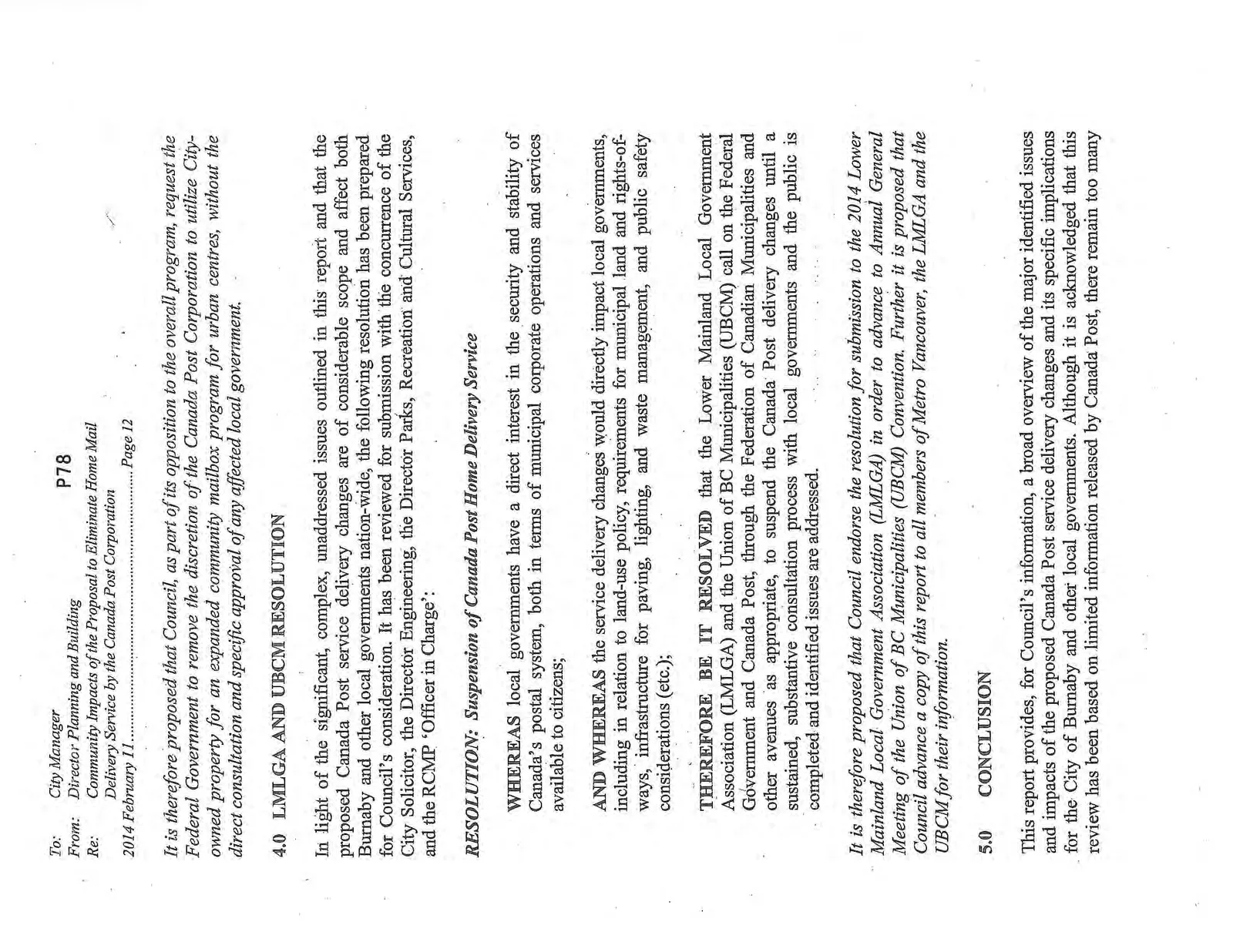
It is therefore proposed that Council, as part of its opposition to the overall program, request the Federal Government to remove the discretion of the Canada Post Corporation to utilize City-owned property for an expanded community mailbox program for urban centres, without the direct consultation and specific approval of any affected local government.
4.0 LMLGA AND UBCM RESOLUTION
In light of the significant, complex, unaddressed issues outlined in this report and that the proposed Canada Post service delivery changes are of considerable scope and affect both Burnaby and other local governments nation-wide, the following resolution has been prepared for Council’s consideration. It has been reviewed for submission with the concurrence of the City Solicitor, the Director Engineering, the Director Parks, Recreation and Cultural Services, and the RCMP ‘Officer in Charge’:
RESOLUTION: Suspension of Canada Post Home Delivery Service
WHEREAS local governments have a direct interest in the security and stability of Canada’s postal system, both in terms of municipal corporate operations and services available to citizens;
AND WHEREAS the service delivery changes would directly impact local governments, including in relation to land-use policy, requirements for municipal land and rights-of-ways, infrastructure for paving, lighting, and waste management, and public safety considerations (etc.);
THEREFORE BE IT RESOLVED that the Lower Mainland Local Government Association (LMLGA) and the Union of BC Municipalities (UBCM) call on the Federal Government and Canada Post, through the Federation of Canadian Municipalities and other avenues as appropriate, to suspend the Canada Post delivery changes until a sustained, substantive consultation process with local governments and the public is completed and identified issues are addressed.
It is therefore proposed that Council endorse the resolution for submission to the 2014 Lower Mainland Local Government Association (LMLGA) Annual General Meeting and Union of BC Municipalities (UBCM) Convention. Further it is proposed that Council advance a copy of this report to all members of Metro Vancouver, the LMLGA and the UBCM for their information.
5.0 CONCLUSION
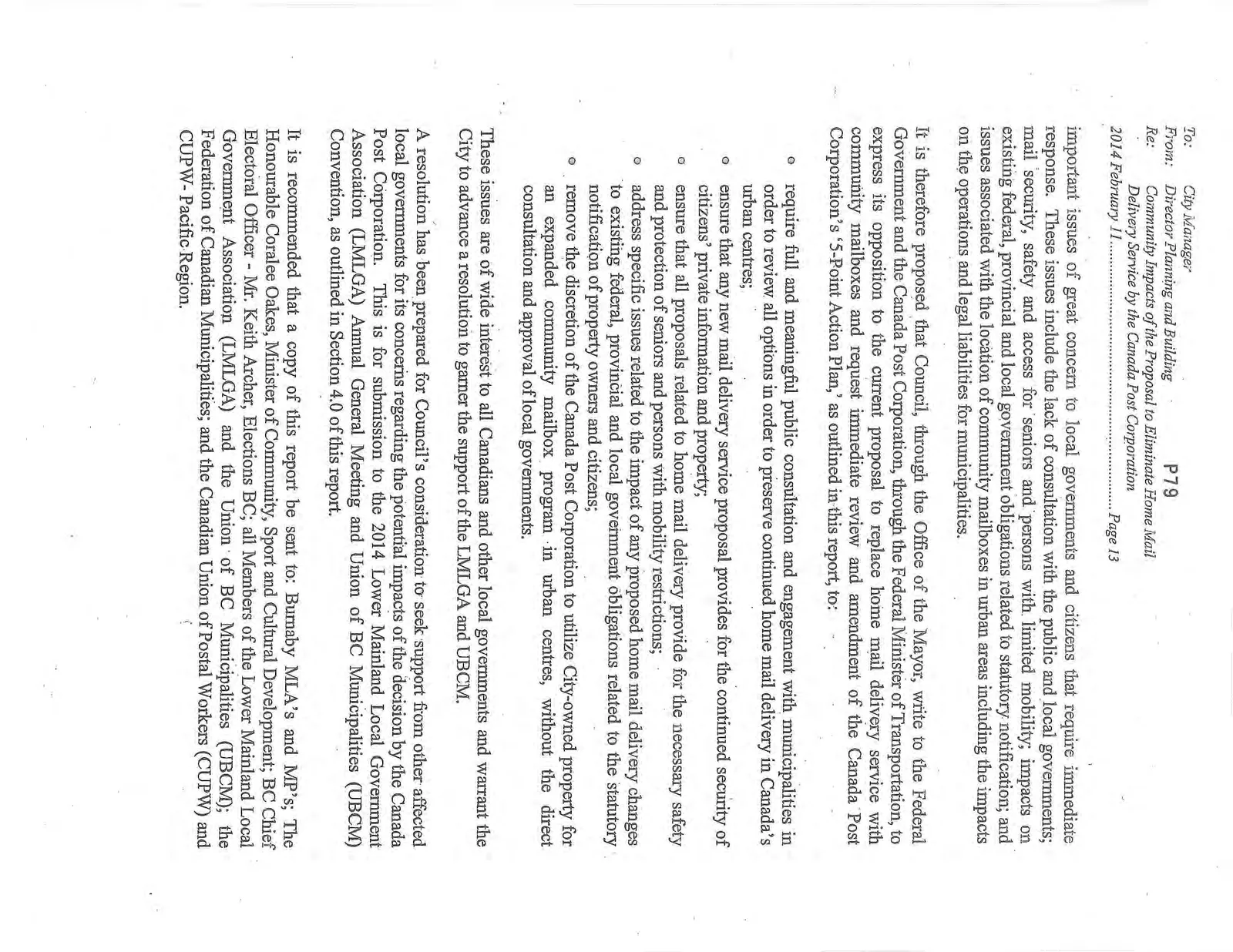
This report provides, for Council’s information, a broad overview of the major identified issues and impacts of the proposed Canada Post service delivery changes and its specific implications for the City of Burnaby and other local governments. Although it is acknowledged that this review has been based on limited information released by Canada Post, there remain too many important issues of great concern to local governments and citizens that require immediate response. These issues include the lack of consultation with the public and local governments; mail security, safety and access for seniors and persons with limited mobility; impacts on existing federal, provincial and local government obligations related to statutory notification; and issues associated with the location of community mailboxes in urban areas including the impacts on the operations and legal liabilities for municipalities.
It is therefore proposed that Council, through the Office of the Mayor, write to the Federal Government and the Canada Post Corporation, through the Federal Minister of Transportation, to express its opposition to the current proposal to replace home mail delivery service with community mailboxes and request immediate review and amendment of the Canada Post Corporation’s ‘5-Point Action Plan,’ as outlined in this report, to:
- require full and meaningful public consultation and engagement with municipalities in order to review all options in order to preserve continued home mail delivery in Canada’s urban centres;
- ensure that any new mail delivery service proposal provides for the continued security of citizens’ private information and property;
- ensure that all proposals related to home mail delivery provide for the necessary safety and protection of seniors and persons with mobility restrictions;
- address specific issues related to the impact of any proposed home mail delivery changes to existing federal, provincial and local government obligations related to the statutory notification of property owners and citizens;
- remove the discretion of the Canada Post Corporation to utilize City-owned property for an expanded community mailbox program in urban centres, without the direct consultation and approval of local governments.
These issues are of wide interest to all Canadians and other local governments and warrant the City to advance a resolution to garner the support of the LMLGA and UBCM.
A resolution has been prepared for Council’s consideration to seek support from other affected local governments for its concerns regarding the potential impacts of the decision by the Canada Post Corporation. This is for submission to the 2014 Lower Mainland Local Government Association (LMLGA) Annual General Meeting and Union of BC Municipalities (UBCM) Convention, as outlined in Section 4.0 of this report.
It is recommended that a copy of this report be sent to: Burnaby MLA’s and MP’s; The Honourable Coralee Oakes, Minister of Community, Sport and Cultural Development; BC Chief Electoral Officer - Mr. Keith Archer, Elections BC; all Members of the Lower Mainland Local Government Association (LMLGA) and the Union of BC Municipalities (UBCM); the Federation of Canadian Municipalities; and the Canadian Union of Postal Workers (CUPW) and CUPW- Pacific Region.
A copy of this report is proposed to be forwarded to the Social Issues Committee; Traffic Safety Committee; Environment Committee and the Mayor’s Task Force on Graffiti for information.
Lou Pelletier, Director PLANNING AND BUILDING
RM/JW:sa:sla
cc:
- Deputy City Managers
- Director Engineering
- Director Finance
- Director Parks, Recreation and Cultural Services
- OIC – RCMP
- Fire Chief
- Chief Building Inspector
- Chief Librarian
- City Solicitor
- Deputy City Clerk
Document Images
(14)