Transportation Governance Engagement Workbook - North Saanich
Completed questionnaire from the District of North Saanich providing feedback on regional transportation governance, including trade-offs and expectations.
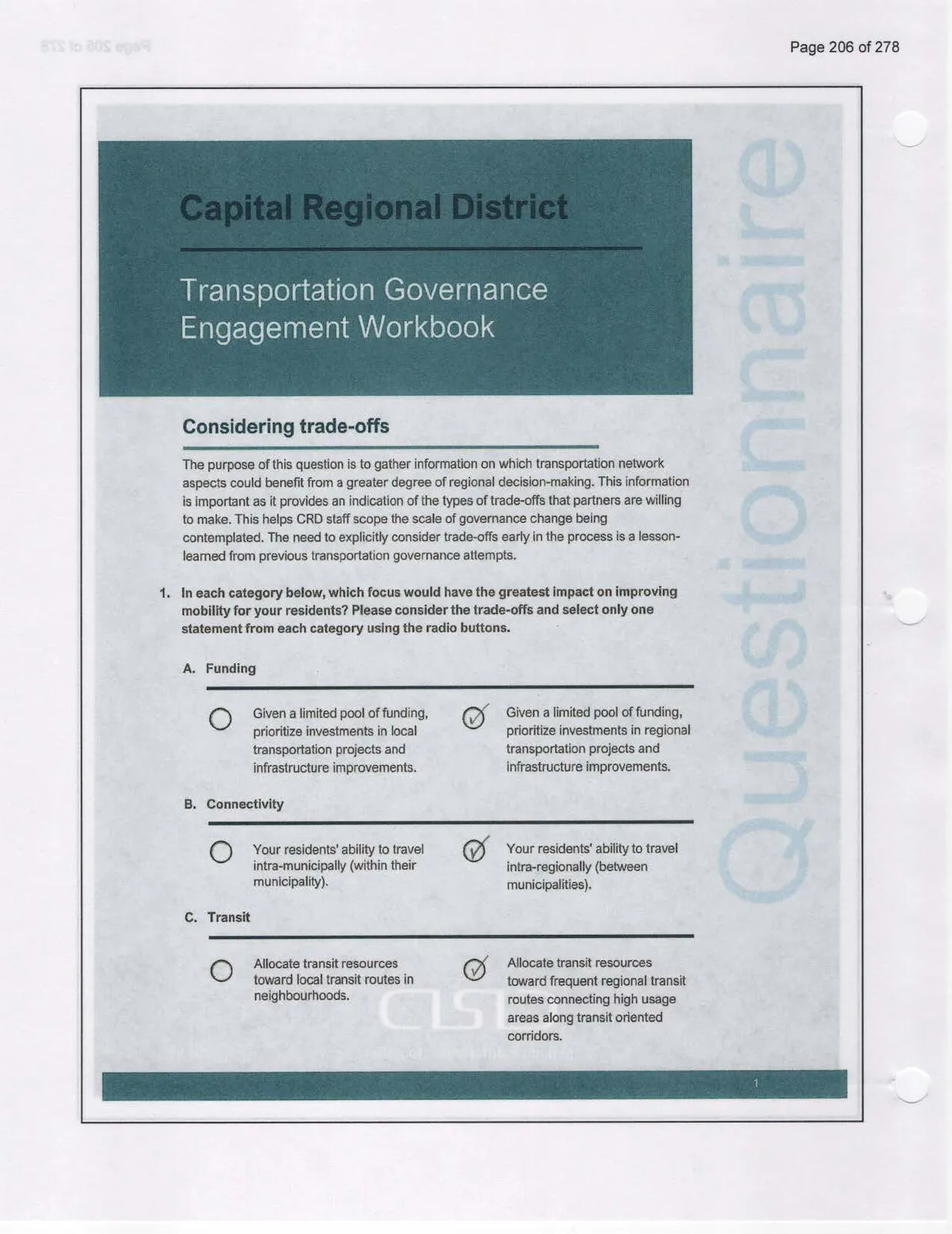
Capital Regional District
Transportation Governance Engagement Workbook
Considering trade-offs
The purpose of this question is to gather information on which transportation network aspects could benefit from a greater degree of regional decision-making. This information is important as it provides an indication of the types of trade-offs that partners are willing to make. This helps CRD staff scope the scale of governance change being contemplated. The need to explicitly consider trade-offs early in the process is a lesson learned from previous transportation governance attempts.
- In each category below, which focus would have the greatest impact on improving mobility for your residents? Please consider the trade-offs and select only one statement from each category using the radio buttons.
A. Funding
- Given a limited pool of funding, prioritize investments in local transportation projects and infrastructure improvements.
- Given a limited pool of funding, prioritize investments in regional transportation projects and infrastructure improvements.
B. Connectivity
- Your residents' ability to travel intra-municipally (within their municipality).
- Your residents' ability to travel intra-regionally (between municipalities).
C. Transit
- Allocate transit resources toward local transit routes in neighbourhoods.
- Allocate transit resources toward frequent regional transit routes connecting high usage areas along transit oriented corridors.
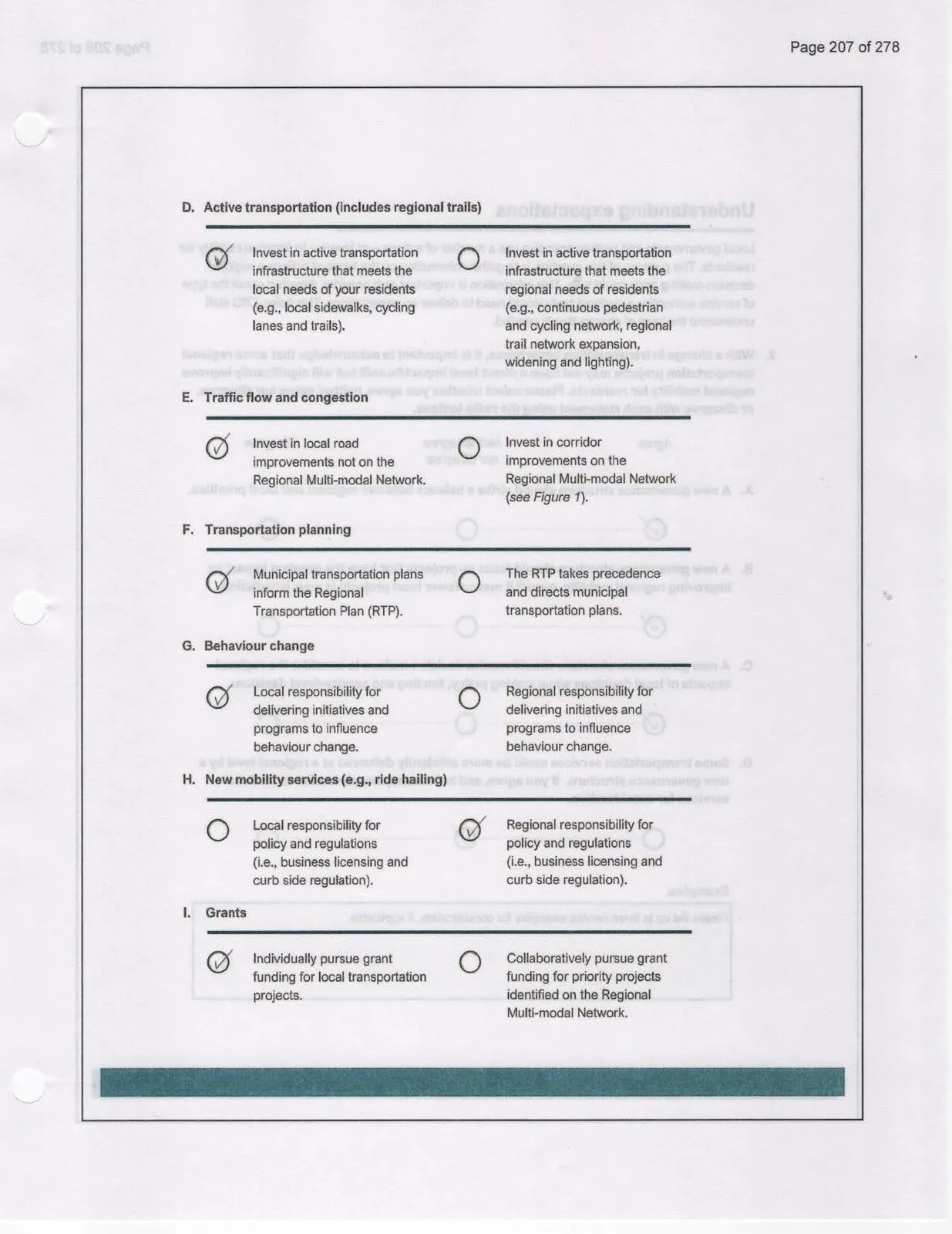
D. Active transportation (includes regional trails)
- Invest in active transportation infrastructure that meets the local needs of your residents (e.g., local sidewalks, cycling lanes and trails).
- Invest in active transportation infrastructure that meets the regional needs of residents (e.g., continuous pedestrian and cycling network, regional trail network expansion, widening and lighting).
E. Traffic flow and congestion
- Invest in local road improvements not on the Regional Multi-modal Network.
- Invest in corridor improvements on the Regional Multi-modal Network (see Figure 1).
F. Transportation planning
- Municipal transportation plans inform the Regional Transportation Plan (RTP).
- The RTP takes precedence and directs municipal transportation plans.
G. Behaviour change
- Local responsibility for delivering initiatives and programs to influence behaviour change.
- Regional responsibility for delivering initiatives and programs to influence behaviour change.
H. New mobility services (e.g., ride hailing)
- Local responsibility for policy and regulations (i.e., business licensing and curb side regulation).
- Regional responsibility for policy and regulations (i.e., business licensing and curb side regulation).
I. Grants
- Individually pursue grant funding for local transportation projects.
- Collaboratively pursue grant funding for priority projects identified on the Regional Multi-modal Network.
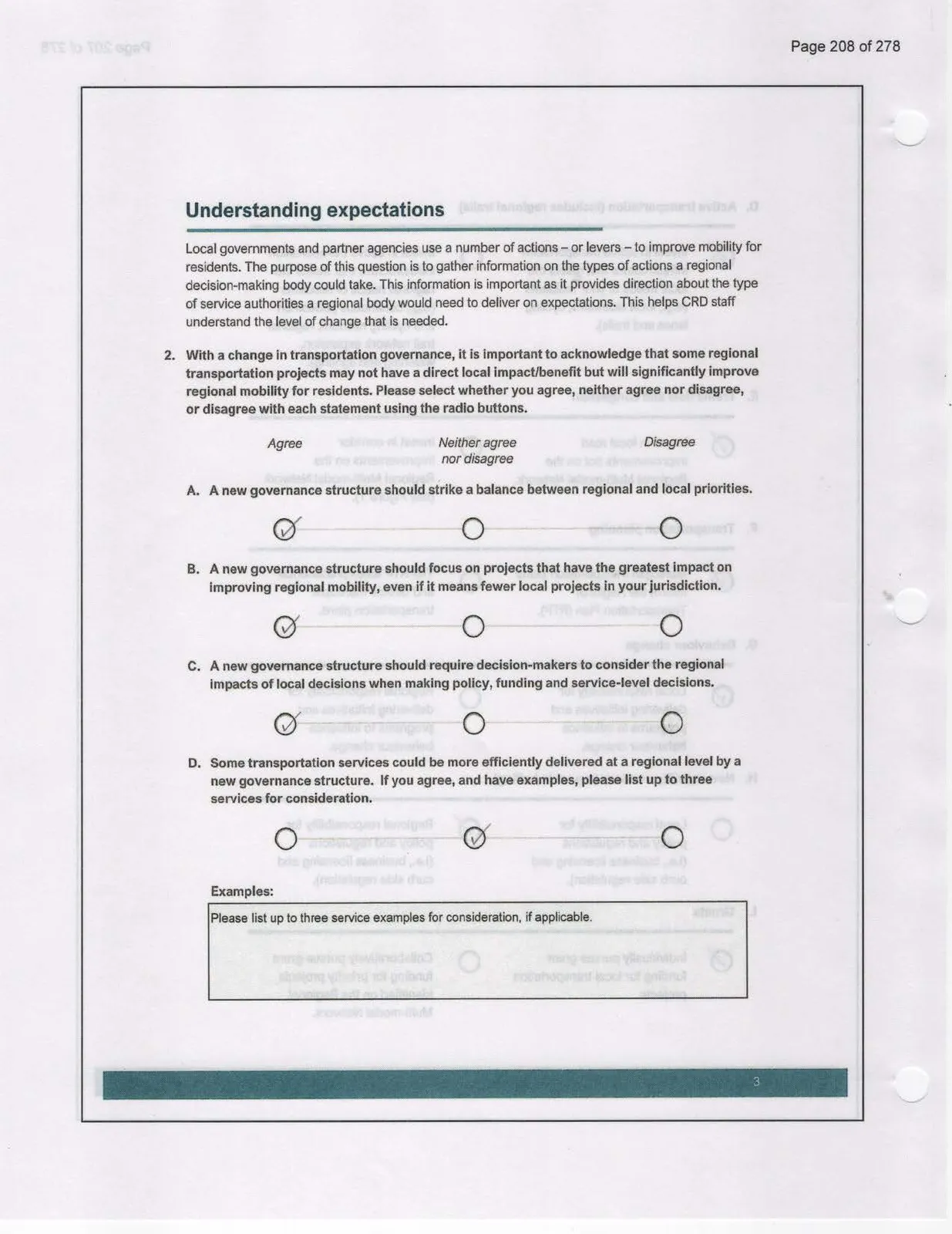
Understanding expectations
Local governments and partner agencies use a number of actions - or levers - to improve mobility for residents. The purpose of this question is to gather information on the types of actions a regional decision-making body could take. This information is important as it provides direction about the type of service authorities a regional body would need to deliver on expectations. This helps CRD staff understand the level of change that is needed.
- With a change in transportation governance, it is important to acknowledge that some regional transportation projects may not have a direct local impact/benefit but will significantly improve regional mobility for residents. Please select whether you agree, neither agree nor disagree, or disagree with each statement using the radio buttons.
| Statement | Agree | Neither agree nor disagree | Disagree |
|---|---|---|---|
| A. A new governance structure should strike a balance between regional and local priorities. | [x] | [ ] | [ ] |
| B. A new governance structure should focus on projects that have the greatest impact on improving regional mobility, even if it means fewer local projects in your jurisdiction. | [x] | [ ] | [ ] |
| C. A new governance structure should require decision-makers to consider the regional impacts of local decisions when making policy, funding and service-level decisions. | [x] | [ ] | [ ] |
| D. Some transportation services could be more efficiently delivered at a regional level by a new governance structure. If you agree, and have examples, please list up to three services for consideration. | [ ] | [x] | [ ] |
Examples: Please list up to three service examples for consideration, if applicable.
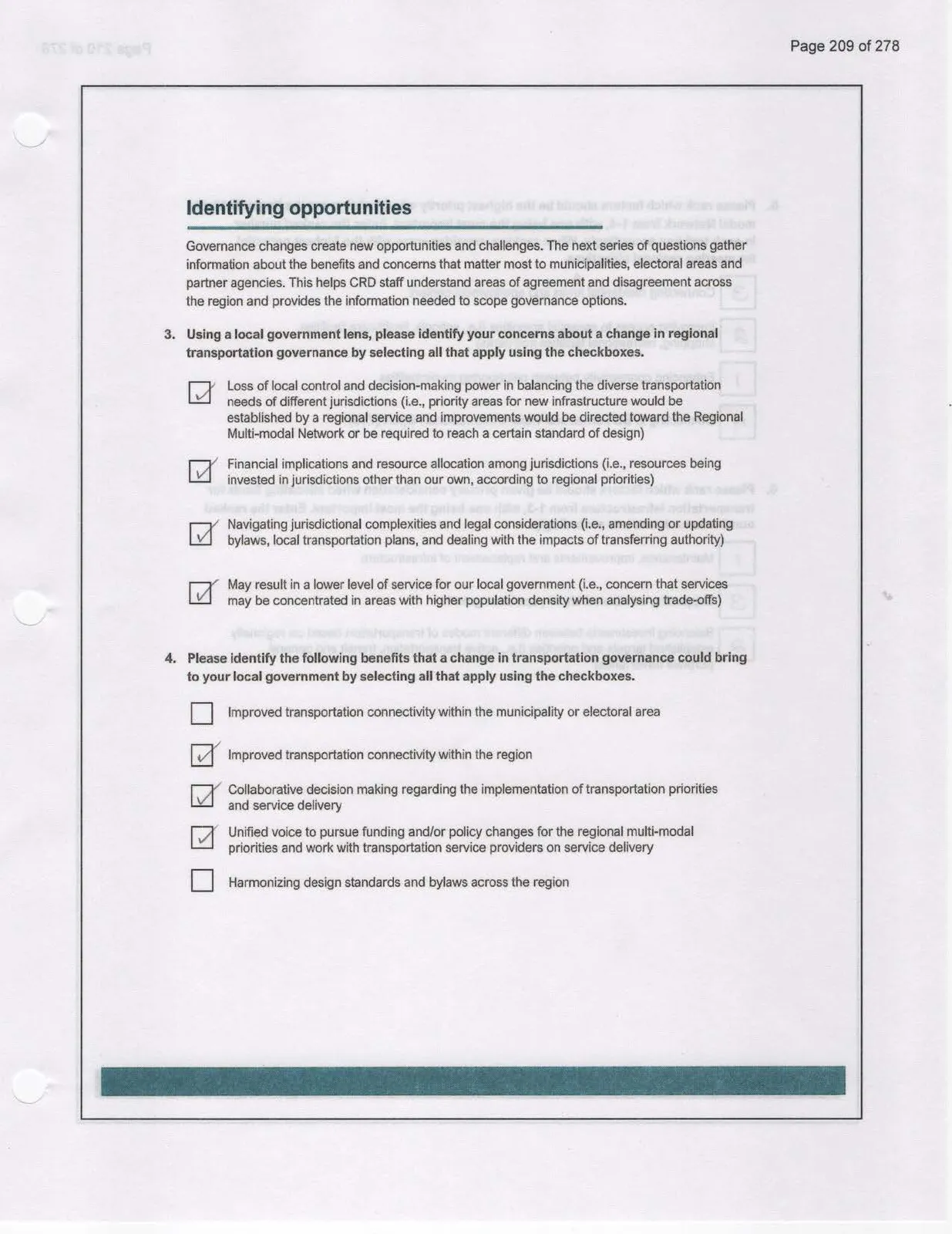
Identifying opportunities
Governance changes create new opportunities and challenges. The next series of questions gather information about the benefits and concerns that matter most to municipalities, electoral areas and partner agencies. This helps CRD staff understand areas of agreement and disagreement across the region and provides the information needed to scope governance options.
- Using a local government lens, please identify your concerns about a change in regional transportation governance by selecting all that apply using the checkboxes.
- Loss of local control and decision-making power in balancing the diverse transportation needs of different jurisdictions (i.e., priority areas for new infrastructure would be established by a regional service and improvements would be directed toward the Regional Multi-modal Network or be required to reach a certain standard of design)
- Financial implications and resource allocation among jurisdictions (i.e., resources being invested in jurisdictions other than our own, according to regional priorities)
- Navigating jurisdictional complexities and legal considerations (i.e., amending or updating bylaws, local transportation plans, and dealing with the impacts of transferring authority)
- May result in a lower level of service for our local government (i.e., concern that services may be concentrated in areas with higher population density when analysing trade-offs)
- Please identify the following benefits that a change in transportation governance could bring to your local government by selecting all that apply using the checkboxes.
- Improved transportation connectivity within the municipality or electoral area
- Improved transportation connectivity within the region
- Collaborative decision making regarding the implementation of transportation priorities and service delivery
- Unified voice to pursue funding and/or policy changes for the regional multi-modal priorities and work with transportation service providers on service delivery
- Harmonizing design standards and bylaws across the region
- Please rank which factors should be the highest priority when building out the Regional Multi-modal Network from 1-4, with one being the most important. Enter the ranked number in each text box accordingly. When ranking, consider areas with the highest potential for meeting regional objectives.
- [3] Connecting residential areas and employment centers
- [2] Improving access to essential amenities (i.e., schools, healthcare facilities, shopping, recreational facilities and parks)
- [1] Enhancing connectivity between neighboring municipalities
- [4] Connecting to BC Ferries and Victoria International Airport (YYJ)
- Please rank which factors should be given primary consideration when allocating funds for transportation infrastructure from 1-3, with one being the most important. Enter the ranked number in each text box accordingly.
- [1] Maintenance, improvements and replacement of infrastructure
- [3] Supporting anticipated future population growth
- [2] Balancing investments between different modes of transportation based on regionally established targets and priorities (i.e., active transportation, transit and general purpose travel lanes)
- Are there any additional comments or suggestions you would like to provide regarding the understanding of and support for a change in transportation governance in our region? Please provide comments or suggestions, if applicable.
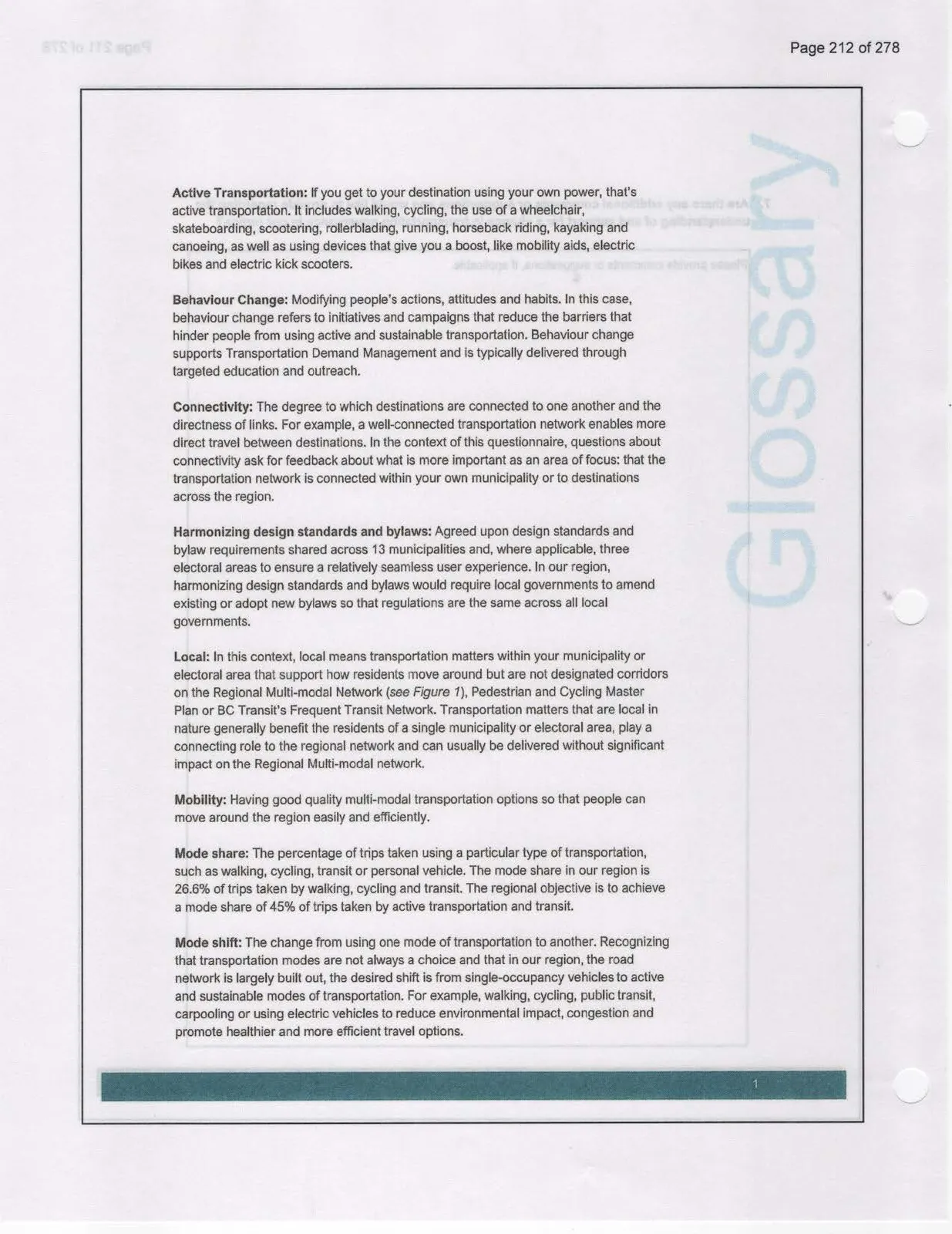
Glossary
Active Transportation: If you get to your destination using your own power, that's active transportation. It includes walking, cycling, the use of a wheelchair, skateboarding, scootering, rollerblading, running, horseback riding, kayaking and canoeing, as well as using devices that give you a boost, like mobility aids, electric bikes and electric kick scooters.
Behaviour Change: Modifying people's actions, attitudes and habits. In this case, behaviour change refers to initiatives and campaigns that reduce the barriers that hinder people from using active and sustainable transportation. Behaviour change supports Transportation Demand Management and is typically delivered through targeted education and outreach.
Connectivity: The degree to which destinations are connected to one another and the directness of links. For example, a well-connected transportation network enables more direct travel between destinations. In the context of this questionnaire, questions about connectivity ask for feedback about what is more important as an area of focus: that the transportation network is connected within your own municipality or to destinations across the region.
Harmonizing design standards and bylaws: Agreed upon design standards and bylaw requirements shared across 13 municipalities and, where applicable, three electoral areas to ensure a relatively seamless user experience. In our region, harmonizing design standards and bylaws would require local governments to amend existing or adopt new bylaws so that regulations are the same across all local governments.
Local: In this context, local means transportation matters within your municipality or electoral area that support how residents move around but are not designated corridors on the Regional Multi-modal Network (see Figure 1), Pedestrian and Cycling Master Plan or BC Transit's Frequent Transit Network. Transportation matters that are local in nature generally benefit the residents of a single municipality or electoral area, play a connecting role to the regional network and can usually be delivered without significant impact on the Regional Multi-modal network.
Mobility: Having good quality multi-modal transportation options so that people can move around the region easily and efficiently.
Mode share: The percentage of trips taken using a particular type of transportation, such as walking, cycling, transit or personal vehicle. The mode share in our region is 26.6% of trips taken by walking, cycling and transit. The regional objective is to achieve a mode share of 45% of trips taken by active transportation and transit.
Mode shift: The change from using one mode of transportation to another. Recognizing that transportation modes are not always a choice and that in our region, the road network is largely built out, the desired shift is from single-occupancy vehicles to active and sustainable modes of transportation. For example, walking, cycling, public transit, carpooling or using electric vehicles to reduce environmental impact, congestion and promote healthier and more efficient travel options.
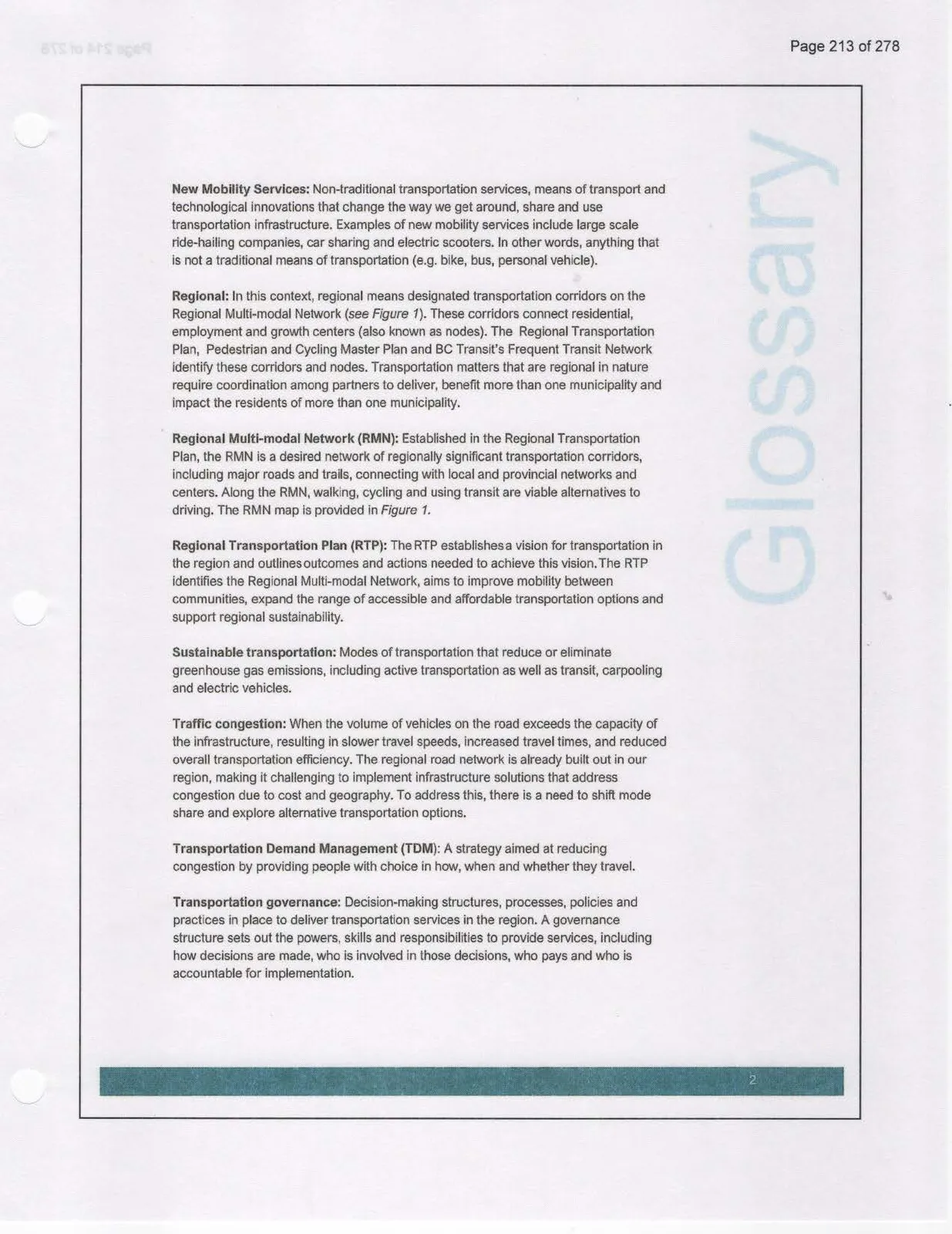
New Mobility Services: Non-traditional transportation services, means of transport and technological innovations that change the way we get around, share and use transportation infrastructure. Examples of new mobility services include large scale ride-hailing companies, car sharing and electric scooters. In other words, anything that is not a traditional means of transportation (e.g. bike, bus, personal vehicle).
Regional: In this context, regional means designated transportation corridors on the Regional Multi-modal Network (see Figure 1). These corridors connect residential, employment and growth centers (also known as nodes). The Regional Transportation Plan, Pedestrian and Cycling Master Plan and BC Transit's Frequent Transit Network identify these corridors and nodes. Transportation matters that are regional in nature require coordination among partners to deliver, benefit more than one municipality and impact the residents of more than one municipality.
Regional Multi-modal Network (RMN): Established in the Regional Transportation Plan, the RMN is a desired network of regionally significant transportation corridors, including major roads and trails, connecting with local and provincial networks and centers. Along the RMN, walking, cycling and using transit are viable alternatives to driving. The RMN map is provided in Figure 1.
Regional Transportation Plan (RTP): The RTP establishes a vision for transportation in the region and outlines outcomes and actions needed to achieve this vision. The RTP identifies the Regional Multi-modal Network, aims to improve mobility between communities, expand the range of accessible and affordable transportation options and support regional sustainability.
Sustainable transportation: Modes of transportation that reduce or eliminate greenhouse gas emissions, including active transportation as well as transit, carpooling and electric vehicles.
Traffic congestion: When the volume of vehicles on the road exceeds the capacity of the infrastructure, resulting in slower travel speeds, increased travel times, and reduced overall transportation efficiency. The regional road network is already built out in our region, making it challenging to implement infrastructure solutions that address congestion due to cost and geography. To address this, there is a need to shift mode share and explore alternative transportation options.
Transportation Demand Management (TDM): A strategy aimed at reducing congestion by providing people with choice in how, when and whether they travel.
Transportation governance: Decision-making structures, processes, policies and practices in place to deliver transportation services in the region. A governance structure sets out the powers, skills and responsibilities to provide services, including how decisions are made, who is involved in those decisions, who pays and who is accountable for implementation.
Document Images
(32)