Appendix: CRD Energy and Emissions Inventory Staff Report
Detailed report explaining that the Province has withheld on-road transportation data from the latest community emissions reports.
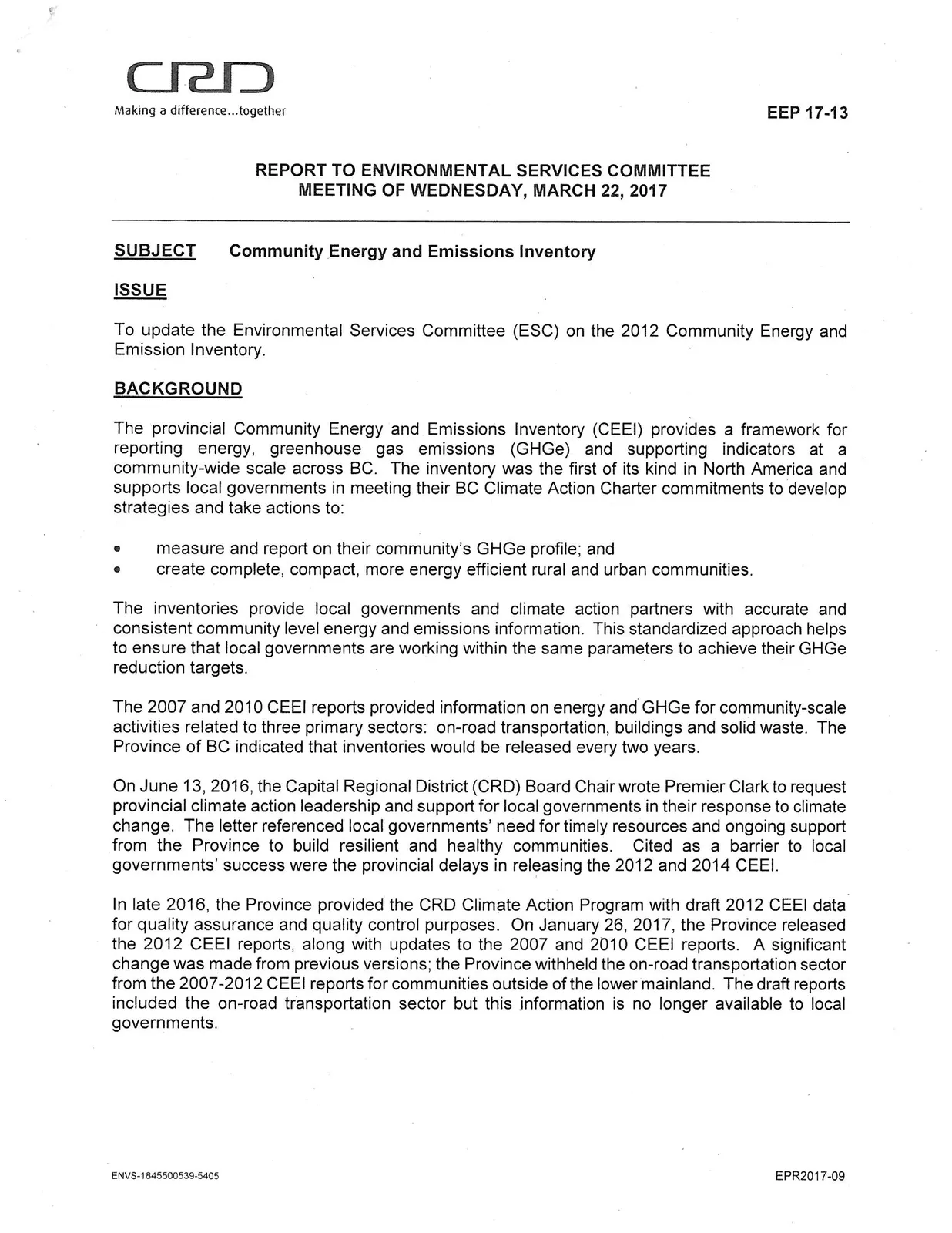
REPORT TO ENVIRONMENTAL SERVICES COMMITTEE
MEETING OF WEDNESDAY, MARCH 22, 2017
SUBJECT: Community Energy and Emissions Inventory
ISSUE
To update the Environmental Services Committee (ESC) on the 2012 Community Energy and Emission Inventory.
BACKGROUND
The provincial Community Energy and Emissions Inventory (CEEI) provides a framework for reporting energy, greenhouse gas emissions (GHGe) and supporting indicators at a community-wide scale across BC. The inventory was the first of its kind in North America and supports local governments in meeting their BC Climate Action Charter commitments to develop strategies and take actions to:
- measure and report on their community's GHGe profile; and
- create complete, compact, more energy efficient rural and urban communities.
The inventories provide local governments and climate action partners with accurate and consistent community level energy and emissions information. This standardized approach helps to ensure that local governments are working within the same parameters to achieve their GHGe reduction targets.
The 2007 and 2010 CEEI reports provided information on energy and GHGe for community-scale activities related to three primary sectors: on-road transportation, buildings and solid waste. The Province of BC indicated that inventories would be released every two years.
On June 13, 2016, the Capital Regional District (CRD) Board Chair wrote Premier Clark to request provincial climate action leadership and support for local governments in their response to climate change. The letter referenced local governments’ need for timely resources and ongoing support from the Province to build resilient and healthy communities. Cited as a barrier to local governments’ success were the provincial delays in releasing the 2012 and 2014 CEEI.
In late 2016, the Province provided the CRD Climate Action Program with draft 2012 CEEI data for quality assurance and quality control purposes. On January 26, 2017, the Province released the 2012 CEEI reports, along with updates to the 2007 and 2010 CEEI reports. A significant change was made from previous versions; the Province withheld the on-road transportation sector from the 2007-2012 CEEI reports for communities outside of the lower mainland. The draft reports included the on-road transportation sector but this information is no longer available to local governments.
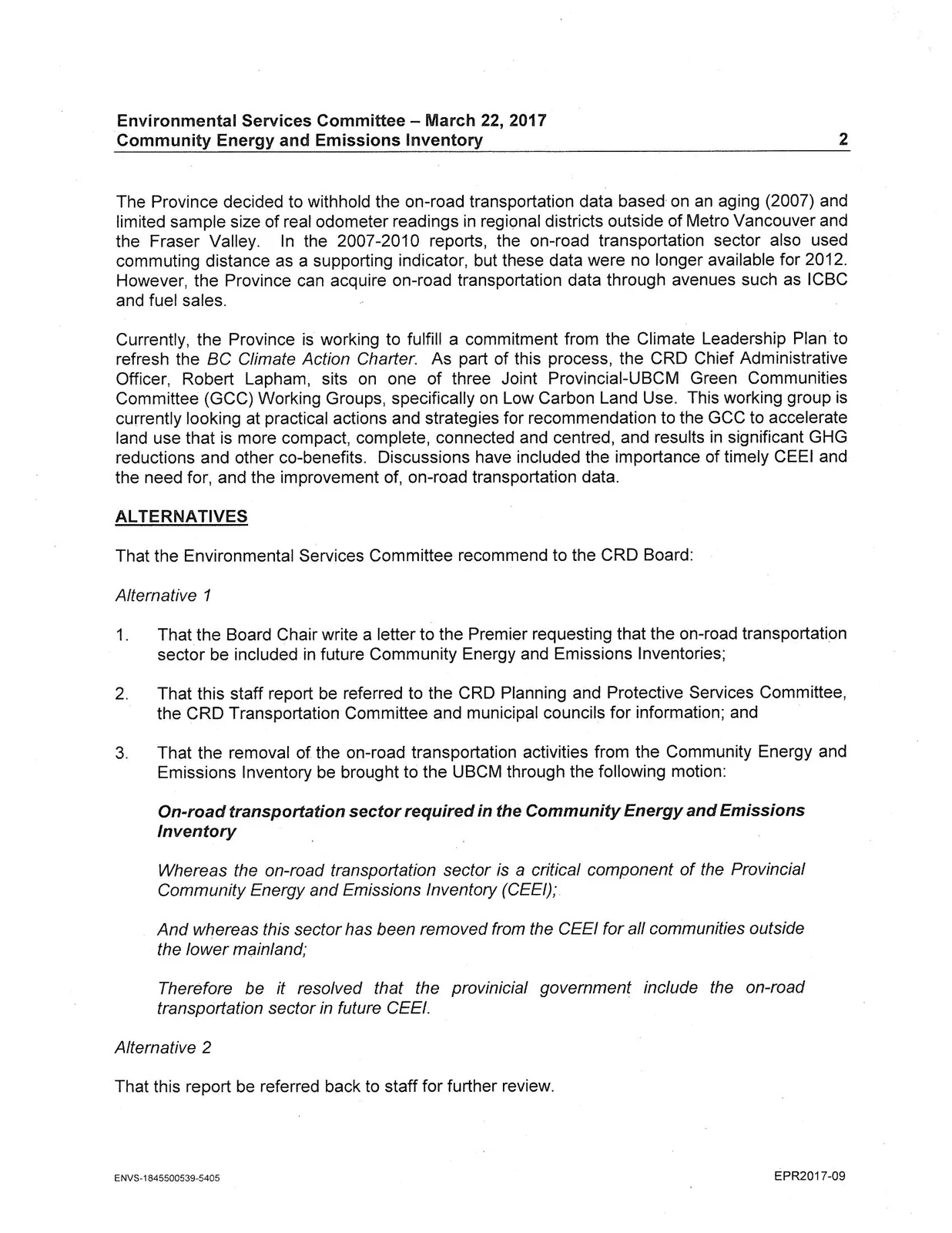
The Province decided to withhold the on-road transportation data based on an aging (2007) and limited sample size of real odometer readings in regional districts outside of Metro Vancouver and the Fraser Valley. In the 2007-2010 reports, the on-road transportation sector also used commuting distance as a supporting indicator, but these data were no longer available for 2012. However, the Province can acquire on-road transportation data through avenues such as ICBC and fuel sales.
Currently, the Province is working to fulfill a commitment from the Climate Leadership Plan to refresh the BC Climate Action Charter. As part of this process, the CRD Chief Administrative Officer, Robert Lapham, sits on one of three Joint Provincial-UBCM Green Communities Committee (GCC) Working Groups, specifically on Low Carbon Land Use. This working group is currently looking at practical actions and strategies for recommendation to the GCC to accelerate land use that is more compact, complete, connected and centred, and results in significant GHG reductions and other co-benefits. Discussions have included the importance of timely CEEI and the need for, and the improvement of, on-road transportation data.
ALTERNATIVES
That the Environmental Services Committee recommend to the CRD Board:
Alternative 1
- That the Board Chair write a letter to the Premier requesting that the on-road transportation sector be included in future Community Energy and Emissions Inventories;
- That this staff report be referred to the CRD Planning and Protective Services Committee, the CRD Transportation Committee and municipal councils for information; and
- That the removal of the on-road transportation activities from the Community Energy and Emissions Inventory be brought to the UBCM through the following motion:
On-road transportation sector required in the Community Energy and Emissions Inventory
Whereas the on-road transportation sector is a critical component of the Provincial Community Energy and Emissions Inventory (CEEI);
And whereas this sector has been removed from the CEEI for all communities outside the lower mainland;
Therefore be it resolved that the provinicial government include the on-road transportation sector in future CEEI.
Alternative 2
That this report be referred back to staff for further review.
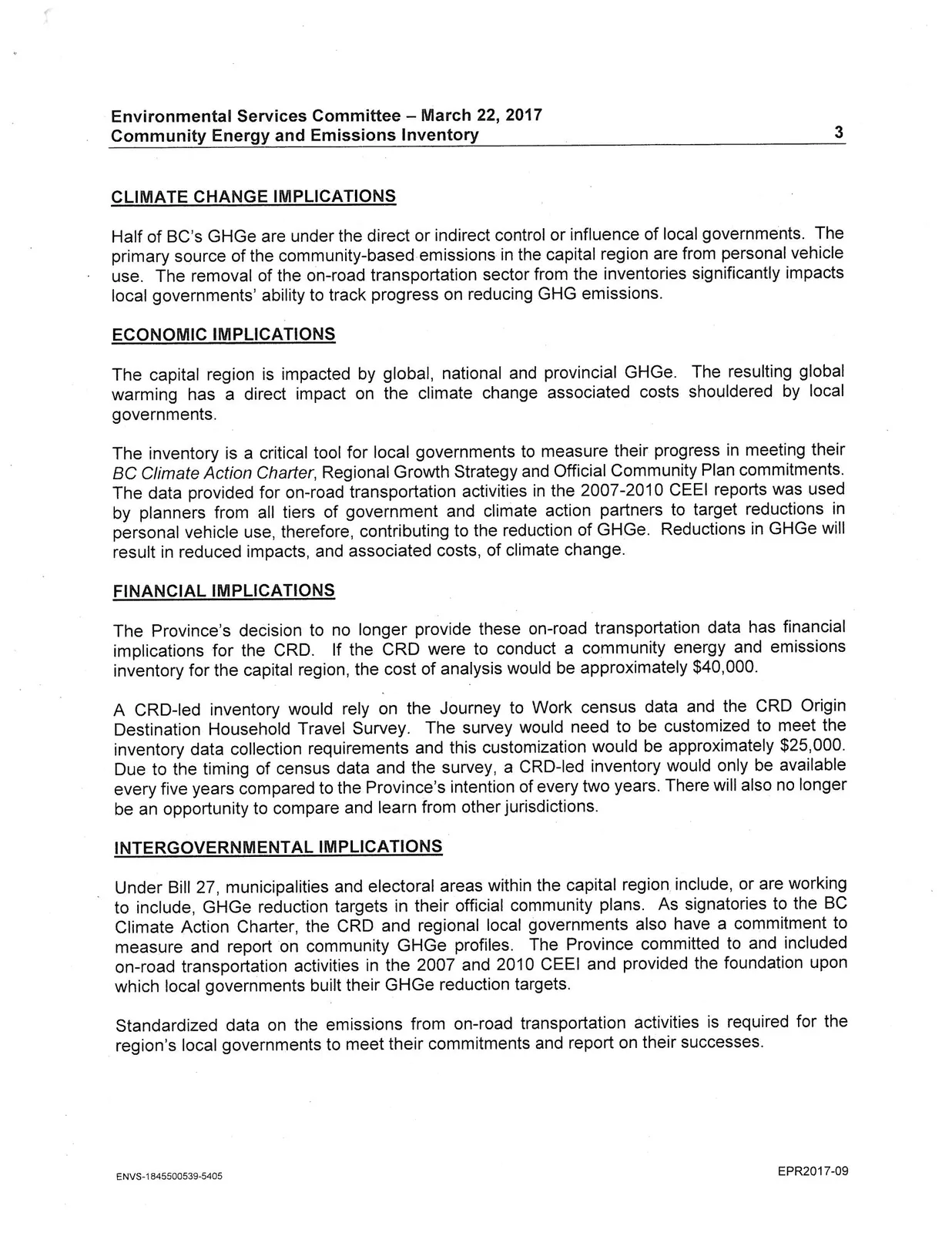
CLIMATE CHANGE IMPLICATIONS
Half of BC’s GHGe are under the direct or indirect control or influence of local governments. The primary source of the community-based emissions in the capital region are from personal vehicle use. The removal of the on-road transportation sector from the inventories significantly impacts local governments’ ability to track progress on reducing GHG emissions.
ECONOMIC IMPLICATIONS
The capital region is impacted by global, national and provincial GHGe. The resulting global warming has a direct impact on the climate change associated costs shouldered by local governments.
The inventory is a critical tool for local governments to measure their progress in meeting their BC Climate Action Charter, Regional Growth Strategy and Official Community Plan commitments. The data provided for on-road transportation activities in the 2007-2010 CEEI reports was used by planners from all tiers of government and climate action partners to target reductions in personal vehicle use, therefore, contributing to the reduction of GHGe. Reductions in GHGe will result in reduced impacts, and associated costs, of climate change.
FINANCIAL IMPLICATIONS
The Province’s decision to no longer provide these on-road transportation data has financial implications for the CRD. If the CRD were to conduct a community energy and emissions inventory for the capital region, the cost of analysis would be approximately $40,000.
A CRD-led inventory would rely on the Journey to Work census data and the CRD Origin Destination Household Travel Survey. The survey would need to be customized to meet the inventory data collection requirements and this customization would be approximately $25,000. Due to the timing of census data and the survey, a CRD-led inventory would only be available every five years compared to the Province’s intention of every two years. There will also no longer be an opportunity to compare and learn from other jurisdictions.
INTERGOVERNMENTAL IMPLICATIONS
Under Bill 27, municipalities and electoral areas within the capital region include, or are working to include, GHGe reduction targets in their official community plans. As signatories to the BC Climate Action Charter, the CRD and regional local governments also have a commitment to measure and report on community GHGe profiles. The Province committed to and included on-road transportation activities in the 2007 and 2010 CEEI and provided the foundation upon which local governments built their GHGe reduction targets.
Standardized data on the emissions from on-road transportation activities is required for the region’s local governments to meet their commitments and report on their successes.
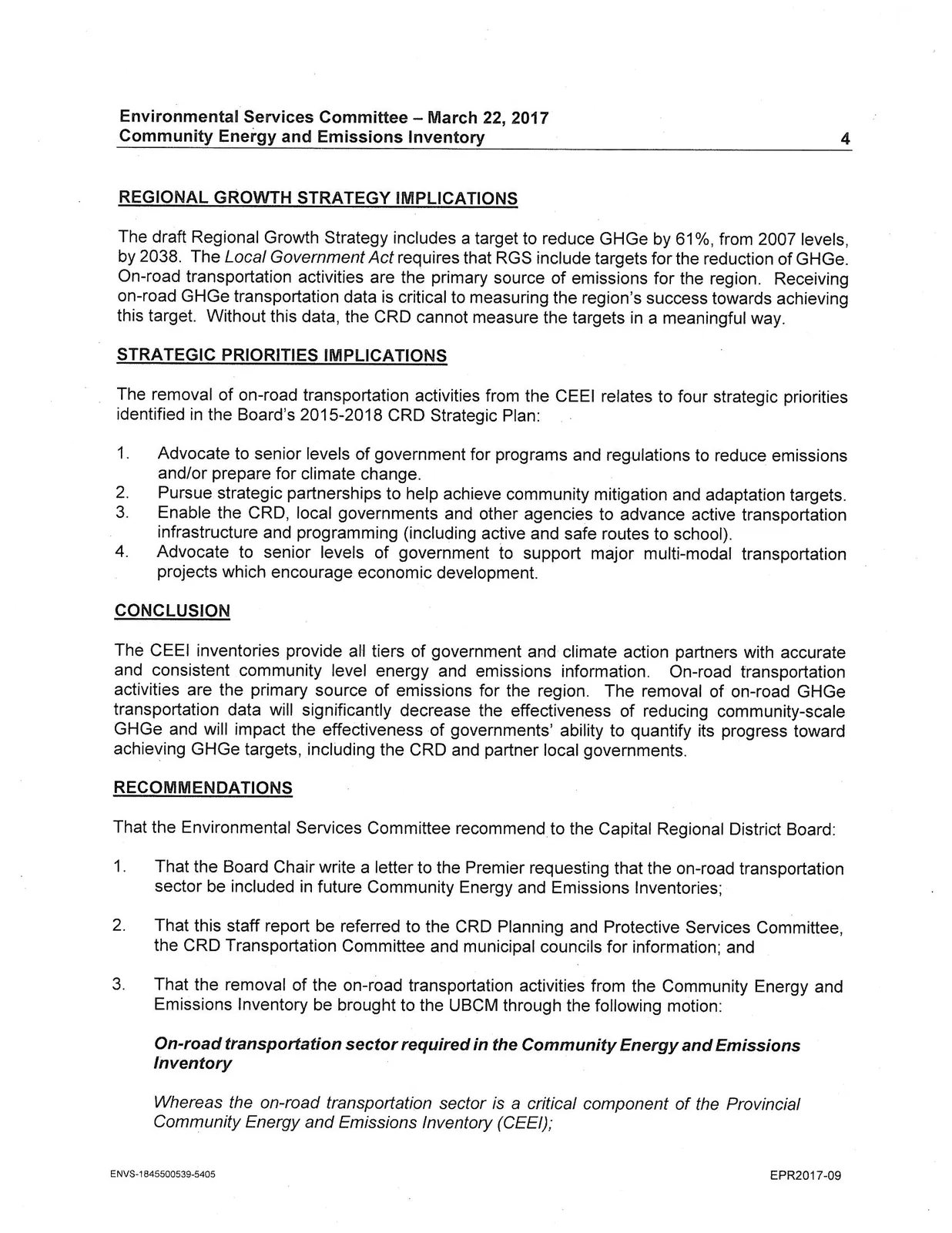
REGIONAL GROWTH STRATEGY IMPLICATIONS
The draft Regional Growth Strategy includes a target to reduce GHGe by 61%, from 2007 levels, by 2038. The Local Government Act requires that RGS include targets for the reduction of GHGe. On-road transportation activities are the primary source of emissions for the region. Receiving on-road GHGe transportation data is critical to measuring the region’s success towards achieving this target. Without this data, the CRD cannot measure the targets in a meaningful way.
STRATEGIC PRIORITIES IMPLICATIONS
The removal of on-road transportation activities from the CEEI relates to four strategic priorities identified in the Board’s 2015-2018 CRD Strategic Plan:
- Advocate to senior levels of government for programs and regulations to reduce emissions and/or prepare for climate change.
- Pursue strategic partnerships to help achieve community mitigation and adaptation targets.
- Enable the CRD, local governments and other agencies to advance active transportation infrastructure and programming (including active and safe routes to school).
- Advocate to senior levels of government to support major multi-modal transportation projects which encourage economic development.
CONCLUSION
The CEEI inventories provide all tiers of government and climate action partners with accurate and consistent community level energy and emissions information. On-road transportation activities are the primary source of emissions for the region. The removal of on-road GHGe transportation data will significantly decrease the effectiveness of reducing community-scale GHGe and will impact the effectiveness of governments’ ability to quantify its progress toward achieving GHGe targets, including the CRD and partner local governments.
RECOMMENDATIONS
That the Environmental Services Committee recommend to the Capital Regional District Board:
- That the Board Chair write a letter to the Premier requesting that the on-road transportation sector be included in future Community Energy and Emissions Inventories;
- That this staff report be referred to the CRD Planning and Protective Services Committee, the CRD Transportation Committee and municipal councils for information; and
- That the removal of the on-road transportation activities from the Community Energy and Emissions Inventory be brought to the UBCM through the following motion:
On-road transportation sector required in the Community Energy and Emissions Inventory
Whereas the on-road transportation sector is a critical component of the Provincial Community Energy and Emissions Inventory (CEEI);
And whereas this sector has been removed from the CEEI for all communities outside the lower mainland;
Therefore be it resolved that the provinicial government include the on-road transportation sector in future CEEI.
| Submitted by: | Glenn Harris, Ph.D., R.P.Bio., Senior Manager, Environmental Protection |
| Concurrence: | Larisa Hutcheson, P.Eng., General Manager, Parks & Environmental Services |
| Concurrence: | Robert Lapham, MCIP, RPP, Chief Administrative Officer |
AB:cam
Document Images
(5)