Esquimalt Harbour – Small Project Environmental Screening Report
A completed environmental screening report for the Department of National Defence regarding the dock project at 335 Stewart Avenue.
Esquimalt Harbour – Small Project Environmental Screening Report
EIA Tracking #: 2021-21-102863 (after the draft document is provided to DND this number is generated and provided by DND, it is added to the final document prior to sign-off)
1. SITE ADDRESS / LOCATION:
# 335 Stewart Avenue, Victoria, BC, V9B 1R6
2. PROJECT TITLE:
Dock Pile Replacement, Dock Pile Installation and Ramp Replacement - 335 Stewart Avenue
3. CONTACT INFORMATION:
| Name: | Lee Critchley CHLTimberworks |
|---|---|
| Address: | 3093 Volmer Road, Victoria, BC V9B 2H7 |
| Telephone No.: | 250-508-7712 |
| Fax No.: | N/A |
| Email: | Chl.Timberworks@gmail.com |
4. PROJECT DESCRIPTION:
Describe the project in sufficient detail for the public or other third party to understand what undertaking(s) is/are being proposed and the related infrastructure change(s) that is/are required. This description should describe the full life cycle of the project from construction through operation to decommissioning. Note that the proponent is responsible for ensuring that all proposed activities comply with municipal bylaws, codes of practise, best management practises and guidelines that may be applicable to the proposed work.
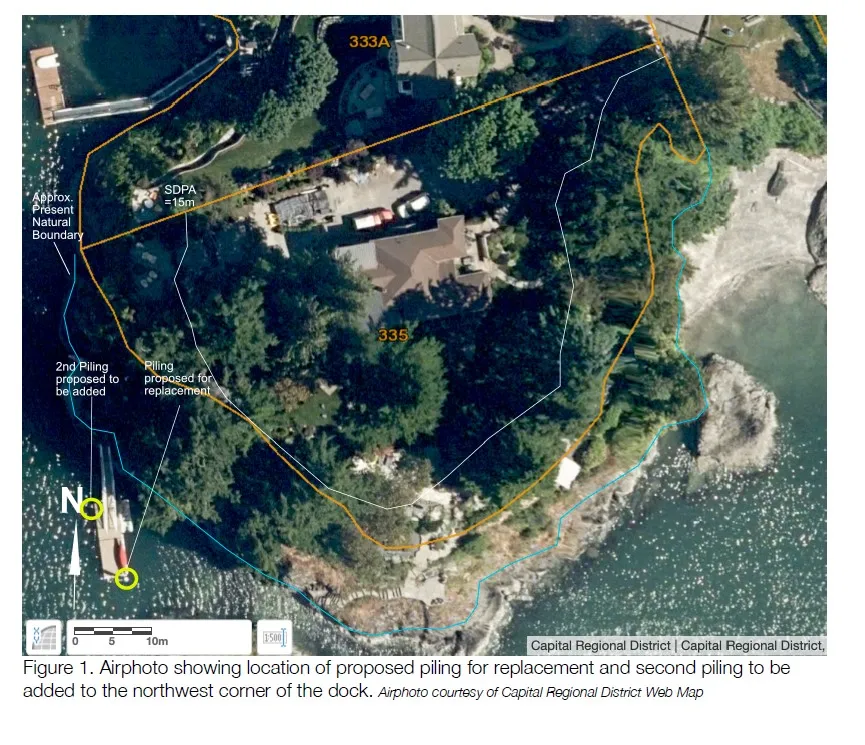
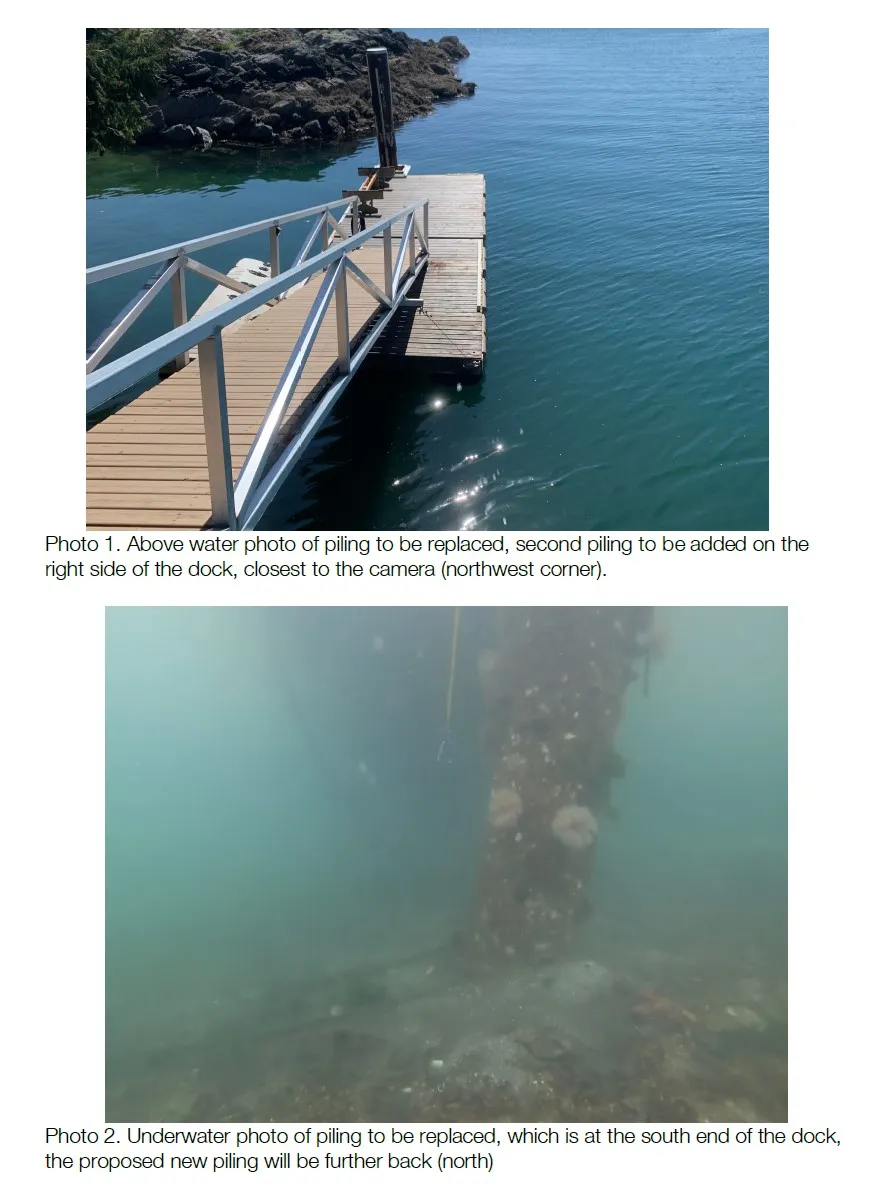
Proposed activities associated with this project include the following, as per Figure 1, Photo 1 and Photo 2:
- Replacement of one existing creosote piling with a 12" steel piling on the SE corner of the existing private dock;
- Installation of one new 12" steel piling on the NW corner of the existing private dock;
- Replacement of existing ramp with a new higher gauge aluminum ramp. New ramp is the exact same dimension and will result in no change to existing shading.
Piling removal/replacement/installation and ramp removal/replacement will be conducted using a barge mounted crane/pile driver. Piles will be installed using a vibratory hammer.
5. PROJECT SCHEDULE:
Estimated start and completion dates.
Owner proposes to complete the work during one of the following BC Marine/Estuarine Timing Windows for the Protection of Fish and Fish Habitat for Area 19 (Victoria):
Summer Window: 01 July - 01 October Winter Window: 01 December – 15 February
6. PROPOSED ACTIVITIES: (Please check all applicable activities)
Construction Activities:
- Pile removal
- Pile driving / deck building
Operational Activities:
- Vessel movement
- Noise generation
Storage and Maintenance: (None selected)
Cleaning / Disposal: (None selected)
Other Activities: (describe any other activities that are not provided in the above list) Project will involve the use of a barge mounted crane/pile driver.
7. PHYSICAL DESCRIPTION OF PROJECT LOCATION:
(Please check all applicable boxes that describe features in and around your project site, provide a further description of these features and potential impacts)
Terrestrial Vegetation:
Description: (please provide a brief description of each item checked) N/A
Project Impact: (explain how your project might impact these features and how impacts will be mitigated) N/A
Aquatic Vegetation:
[x] Emergent aquatic vegetation
Description: (please provide a brief description of each item checked) On 28 May and 1 October 2020, Lehna Malmkvist, MSc, RPBio. of Swell Environmental Consulting Ltd. (Swell) visited the site at 335 Stewart Avenue, Victoria, BC to evaluate the existing condition of the property in reference to a proposed dock piling replacement within the Town of View Royal’s Natural Watercourse and Shoreline Areas Development Permit Area, additionally, Dr. Joachim Carosfeld, Executive Director, World Fisheries Trust reviewed video of the site to assess the existing condition and potential environmental impact of the proposed works (Annex A). The location is at the mouth of Limekiln Bay, part of the Esquimalt Harbour, an area characterized in the CRD Harbours Atlas (Fig. 3). In general, this is a bedrock and boulder shoreline, with pocket beaches, leading to a shallow soft bottom. The site evaluation confirmed this general character – a bedrock and boulder-rich steep shoreline extends approximately 2 m (horizontally) from the highest High tide line, reaching a sandy mud bottom at a depth of 1.1-1.8 m. The mud bottom extends at a low slope into the harbor, in this assessment to a depth of 4.2 m., with scattered debris, rocks, and patches of gravel.
The subtidal boulder region is dominated by sea lettuce (Ulva lactuca) in shallow water, progressing to large leafy kelp (Laminaria groenlandica). This kelp is also abundant on the dock and, as large plants, in one of the transects with more debris and rocks on the mud bottom, extending to the end of survey. A similar fringed kelp, Agarum fimbriatum, is likely mixed in with this, particularly in deeper water. Otherwise, the sandy mud bottom has a thick diatom biofilm, pock-marked by active clam and worm burrows, with Laminaria kelp and plumose anenomes (Metridium spp.) attached to debris. Some clumps of Gracilaria filamentous red algae and drift sea lettuce (Ulva) are present, Dungeness crabs are common (Cancer magister), and a mottled seastar (Evasterias troschelli) was observed. Judging from the excavation marks in the sand, the crabs (including the similar Cancer gracilis – graceful rock crab) and different species of clamdigging seastars are likely present in transient fashion. A school of juvenile herring was observed, but no other fish. Small fish and shrimp are nevertheless likely present in the Laminaria kelp bed. No eelgrass is reported for the head of Limekiln Bay, but was considered of patchy occurance in Esquimalt Harbour (AMR, 2004). None was observed at this site, likely because it is too deep. The existing pilings are also covered with diatom film and barnacles, with scattered plumose anenomes and colonial tunicates.
No eelgrass was observed in the project area.
Project Impact: (explain how your project might impact these features and how impacts will be mitigated) Potential impacts include the following:
- Accidental spills from equipment, machinery and vehicles (including barge) used during construction activities could result in a release of hydrocarbons into the marine environment, impacting aquatic vegetation and aquatic species in the area;
- Disturbance of the marine substrate from pile driving, as well as increased vessel traffic during construction activities (e.g. barge). Barge stabilizing spuds and anchoring of vessels may also increase sediment disturbance. Disturbed marine substrate may increase Total Suspended Solids (TSS) which may smother aquatic vegetation and algae; and
Mitigation measures to minimize any significant effects from these activities are detailed in Section 8. Swell identifies that in summary, the proposed work will not disturb any rare or endangered species or ecosystems and provided the measures described are followed, the effects of the project on the marine environment and shoreline conditions are minimal.
Surface Terrain:
Description: (please provide a brief description of each item checked) N/A
Project Impact: (explain how your project might impact these features and how impacts will be mitigated) N/A
Storm Outfalls:
Yes [ ] No [x]
Description: (please provide a brief description of each item checked) N/A
Project Impact: (explain how your project might impact these features and how impacts will be mitigated) N/A
Wildlife:
[x] Aquatic Birds [x] Fish [x] Invertebrates [x] Other (Marine Mammals)
Description: (please provide a brief description of each item checked) Swell Environmental Consulting (Swell) conducted an evaluation of the subtidal area adjacent to 335 Stewart Avenue on 28 May and 01 Oct 2020 (Annex A). They identified the following fish/invertebrates during their site visits:
Dungeness crabs are common (Cancer magister), and a mottled seastar (Evasterias troschelli) was observed. Judging from the excavation marks in the sand, the crabs (including the similar Cancer gracilis – graceful rock crab) and different species of clamdigging seastars are likely present in transient fashion. A school of juvenile herring was observed, but no other fish. Small fish and shrimp are nevertheless likely present in the Laminaria kelp bed. No Species At Risk were observed.
Swell did not make specific note of any aquatic birds and/or marine mammals during the evaluation, however the DFO Aquatic Species At Risk Map (http://www.dfo-mpo.gc.ca/species-especes/sara-lep/map-carte/index-eng.html) was consulted to determine the potential distribution of aquatic species at risk and the presence of their critical habitat within the general Esquimalt Harbour area. There was no critical habitat identified within the project area. The project area is located adjacent to critical habitat for the northeast Pacific southern resident killer whale population. The boundary for this habitat is located at the mouth of Esquimalt Harbour, outside of the project area.
The following SAR were identified as being found, or having the potential to be found, within the project area, although none of these species were observed by Swell during their project evaluation:
- Humpback whale
- Harbour porpoise
- Leatherback sea turtle
- Killer whale
- Stellar sea lion
- Northern abalone
- Yelloweye rockfish
- Green sturgeon
Esquimalt Harbour may provide intermittent habitat for marine mammal SAR such as sea lions and porpoises. While humpback and killer whales have been observed at times in the proximate area, it is unlikely that the immediate project area would provide habitat for whales, including killer whales, due to the high levels of industrial activities present within the harbour.
River otters and harbour seals are species commonly observed throughout Esquimalt Harbour, although Swell did not make note of observing either species during their project evaluation.
In 2021, Dillon Environmental Consulting Ltd completed an update to the Physical and Biological Features of Esquimalt Harbour. They noted the following bird SAR that have the potential to be found within Esquimalt Harbour based on a SARA registry and BC Conservation Data Centre screening: Ancient Murrelet, Band-tailed Pigeon, Barn Swallow, Black Scoter, Black Swift, Brandt’s Cormorant, Brant, California Gull, Canada Goose, occidentalis subspecies, Caspian Tern, Cassin's Auklet, Common Murre, Common Nighthawk, Double-crested Cormorant, Great Blue Heron fannini subspecies, Green Heron, Horned Grebe (western population), Marbled Murrelet, Olive-sided Flycatcher, Peregrine Falcon, anatum subspecies, Peregrine Falcon pealei subspecies, Pink-footed Shearwater, Purple Martin, Red Knot roselaari type, Red-necked Phalarope, Rough-legged Hawk, Rusty Blackbird, Short-billed Dowitcher, Surf Scoter, Tundra Swan, Western Grebe. Swell did not make note of any of these species during their project evaluation.
Project Impact: (explain how your project might impact these features and how impacts will be mitigated) The potential effect on the marine environment from sedimentation is the deposition of suspended sediments resulting in smothering of marine vegetation and algae. Impacts of sedimentation on species such as mussels, barnacles and benthic infaunal communities are likely minimal as those species can adapt to fluctuating turbidity levels and re-colonize naturally and rapidly. Sediment can be carried away from the property to impact other areas due to tidal and waves action.
Mobile species such as crabs may be temporarily displaced during construction activities. Benthic infaunal species may be injured or displaced by the installation of pilings in the muddy bottom. These invertebrate species are considered to have moderately high resilience due to their ability to naturally and rapidly recolonize.
Nearshore fish habitat and juvenile fish occupying the nearshore habitat may be disturbed during construction activities. Fish may be temporarily displaced by construction activity, although due to the short-term nature of the project, most species will have moderate resiliency.
Underwater sounds propagate well in the ocean environment relative to sound propagation in air. Noise generated by piling installation may travel underwater affecting fish a distance from the property. Little is known about the effects of anthropogenic sound on fish and invertebrates, although it is generally acknowledged that marine mammals and fish, particularly fish with swim bladders, are more sensitive to noise effects than invertebrate species. Fish use sounds in a wide variety of behaviours including aggression, territory protection, defense, and reproduction. Anthropogenic noise may mask acoustic communication by fish, disrupt of behaviour, or cause physiological stress or physical injury. The short duration and use of vibration installation of the pilings, may result in temporary displacement of fish, to which most species will have moderate resiliency.
Underwater sounds during the installation of the pilings have the potential to cause sensory disturbance, and potential displacement of marine mammals. Sound levels, however, are not expected to be high enough to result in avoidance behavior over a large distance, nor are they anticipated to exceed thresholds considered to possibly harm or injure marine mammals.
Noise and activity during construction of the proposed Project will potentially cause sensory disturbance and displacement of nearshore marine birds. Displacement of birds from habitats/foraging grounds may result in the use of less suitable habitats, and potentially, nest abandonment. Nest abandonment increases the mortality risk for eggs and chicks.
Mitigation measures to minimize any significant effects from these activities are detailed in Section 8. Swell identifies that in summary, the proposed work will not disturb any rare or endangered species or ecosystems and provided the measures described are followed, the effects of the project on the marine environment and shoreline conditions are minimal.
Upland / Foreshore / Waterlot Use at Project Location:
[x] Residential
Description: (please provide a brief description of each item checked) Privately owned residence
Adjacent Upland / Foreshore / Waterlot Use:
[x] Residential
Description: (please provide a brief description of each item checked) Neighbour is 333A Stewart Ave – privately owned residence
Historical Upland / Foreshore / Waterlot Use:
[x] Residential
Description: (please provide a brief description of each item checked) Privately owned residence
8. DESCRIPTION OF PROPOSED ACTIVITIES:
In column 1 list activities identified in Section 6 “Proposed Activities”. In column 2 provide further details for the activity such as details regarding construction steps, and how the site will be used once constructed. In column 3 identify best management practices or mitigation measures for each activity that will be employed to minimize any environmental impacts.
| Column 1 | Column 2 | Column 3 |
|---|---|---|
| Activity | Details of Activity | Environmental Mitigation and Best Management Practices to be used |
| ALL | ALL ACTIVITIES SHALL COMPLY WITH MUNICIPAL BYLAWS, CODES OF PRACTISE, BEST MANAGEMENT PRACTISES, AND/OR GUIDELINES THAT MAY BE APPLICABLE TO THE PROPOSED WORK. | |
| All | Remove 1 old creosote treated timber piling; Install 2 new steel pilings using a barge mounted pile driver and vibratory drilling; Replace existing ramp with new ramp; and Vessel movement (barge). |
All activities will comply with the current version of the Esquimalt Harbour Practices and Procedures. This includes requirements for contractor vessels, entry, movement and departure clearances, and marine spill response requirements. All activities will comply with the Best Management Practices detailed in the Natural Watercourse and Shoreline Development Permit Area Review for a Dock Piling Replacement at 335 Stewart Ave, Victoria, BC, Town of View Royal (Swell Environmental Consulting, 20 November 2020) (Annex A). All activities will comply with the measures detailed in the DFO Review Letter (20-HPAC-01227, Annex B), and personal correspondence between DFO and proponent regarding project amendment (10 May 2021) which include the following: - Conduct all pile driving works during the relevant least risk timing window(s) for your area (Winter: December 1-February 15 and Summer: July 1-October 1) - Minimize the duration of in-water works to the extent possible. - Conduct works during favourable weather conditions. - Ensure appropriate contingency materials (e.g., bubble curtain, silt curtain) are readily available onsite in sufficient quantities for local conditions and will be employed if required. - Water-based equipment should not ground upon the seabed except for the use of anchors or spuds needed to keep the water-based equipment in position. - Minimize movements/repositioning of barge and subsequent spudding to minimize physical disturbance to the seabed. - Avoid spudding down or anchoring in sensitive fish habitats such as eelgrass beds or kelp beds or estuarine marsh. - Conduct works during suitable tides to avoid grounding out and propeller scour from vessel and barge movements. - The following mitigation measure should be applied to protect marine mammals: o Vessels must maintain a minimum distance of 200m from killer whales, except in the area between Campbell River and just north of Ucluelet including Barkley and Howe Sound where the minimum distance is 400m, and 100m from all other whales, dolphins and porpoises (2021 management measures to protect Southern Resident Killer Whales) o If there is a risk of harm to a marine mammal from direct contact, temporarily suspend construction until the individual has left the exclusion zone or has not been sighted for 30 minutes. - An appropriate sediment control plan should be developed and implemented to minimize sedimentation of the aquatic environment during all phases of the work, undertaking or activity. - The direct or indirect release of sediment or sediment-laden water into the aquatic environment or the induced sedimentation of foreshore or nearshore areas or the induced turbidity of water in the aquatic environment is to be minimized during the works. - A debris management plan (containment and removal) should be developed and implemented for piling installation and removal activities to prevent construction materials and debris (treated wood fragments, sawdust, cuttings, lead/zinc based marine paint etc.) from entering or being deposited onto aquatic habitats. - Piles should not be dragged on the seabed following removal but rather lifted clear by an excavator/ machine. - All works must be undertaken and completed in such a manner so as to prevent the release of substances deleterious to fish and other aquatic life pursuant to Section 36 of the Fisheries Act, which specifically prohibits the deposit of deleterious substances into fish bearing waters. Due diligence is required at all times to prevent such deposits, and adherence to the measures in this letter does not of itself relieve the proponent of this ongoing obligation. - An appropriate spill prevention, containment, and clean up contingency plan for hydrocarbon products (e.g., fuel, oil, hydraulic fluid, etc.), and other substances deleterious to aquatic life should be put in place prior to work commencing, and appropriate spill containment and cleanup supplies should be kept available onsite. Onsite personnel should also be trained in spill prevention, containment and cleanup procedures. - Notify DFO at least 10 days before starting Project. A copy of the DFO review letter should be kept on site while work is in progress. |
9. PROVINCIAL AND MUNICIPAL GOVERNMENT INVOLVEMENT
Identify all other provincial and/or municipal government departments that provided guidance/advice/approvals pertaining to this project. Summarize the engagement details and the responses received. Note – as detailed in Section 8, the proponent is required to comply with all municipal bylaws, codes of practise, best management practises, and guidelines as applicable to the proposed project.
Proponent is responsible for ensuring that all activities comply with municipal (Town of View Royal) bylaws, codes of practise, best management practises, and/or guidelines that may be applicable to the proposed work.
10. OTHER FEDERAL DEPARTMENTS
Identify all other federal departments (e.g. DFO, Transport Canada) that provided guidance/advice/approvals pertaining to this project. Summarize the engagement details and the responses received. Include all correspondence with other federal departments as an Annex to this report. Note that if another federal department must issue an authorization or permit under any other federal Act of Parliament (e.g. Fisheries Act, Canadian Navigable Waters Act), they will be required to make their own S.82 Determination under the Impact Assessment Act (IAA).
DFO: Proponent submitted a Request for Review to the Fish and Fish Habitat Protection Program (the Program) of Fisheries and Oceans Canada (DFO) on 26 November 2020.
Provided that the Proponent incorporates the measures detailed in the letter of advice (Annex B), the Program is of the view that the proposal is not likely to result in the contravention of the above mentioned prohibitions and requirements.
Proponent submitted a project amendment to DFO (addition of a second pile) on 06 May 2021 via email. DFO (Vanessa Smith) responded 10 May 2021 and identified the Letter of Advice remains valid, with the incorporation of the following additional mitigation measure:
- Vessels must maintain a minimum distance of 200m from killer whales, except in the area between Campbell River and just north of Ucluelet including Barkley and Howe Sound where the minimum distance is 400m, and 100m from all other whales, dolphins and porpoises (2021 management measures to protect Southern Resident Killer Whales).
This email correspondence is included in Annex B.
TRANSPORT CANADA: Proponent discussed the project with Transport Canada and it was concluded that it meets the assessment criteria of the Minor Works Order for Docks and Boathouses (Common Project Search File No. 2021-505097, Navigation Protection Program Registry No. 4201). Therefore, a Canadian Navigable Waters Act Approval is not required. A Public Notice was posted at the Esquimalt Anglers Association, 1101 Munro St, Victoria BC V9A 5P2.
11. INDIGENOUS ENGAGEMENT
To be completed by DND, upon review of the proposed project.
Indigenous Community Engagement is not planned as it is unlikely that the Project will impact Indigenous health and socio-economic conditions, physical and cultural heritage, the current use of lands and resources for traditional purposes, or any structure, site or thing that is of historical, archaeological, paleontological or architectural significance.
12. DEPARTMENT OF NATIONAL DEFENCE ENVIRONMENTAL REVIEW:
Activities meet the definition of a Project under Section 81 of the IAA as it is to be carried out on federal lands or outside Canada and is in relation to a physical work. However, the proposed Project is included as one of the classes of projects set out in the Designated Classes of Projects Order (Schedule 1 Part 1 Section 1: Operation, maintenance or repair of a physical work) and all stipulated conditions can be met. Therefore, the proposed Project does not trigger posting on the CIAR.
DND has reviewed the project to be undertaken as presented in this report. On the basis of this report, it has been determined that the proposed project is not likely to cause significant adverse environmental effects. Therefore the project can proceed with application of the mitigation measures specified in Section 8 of this report. If the proponent chooses to not implement the mitigation measures as described in this report, or if the scope of the project changes in any way, the project, as reviewed by DND will be considered different from this review under Section 82 of the IAA, and the determination related to this project will not longer be valid and will need to be re-evaluated.
S.82 Determination under the IAA
On the basis of this DND EED Report, it has been determined that the impact of this project on the environment is as follows:
[x] Project is not likely to cause significant adverse environmental effects. The Project can proceed with application of the mitigation measures specified in the interaction tables in this report.
[ ] The Project is likely to cause significant adverse environmental effects that cannot be mitigated. The project cannot proceed in its current state.
12. SIGNATURES
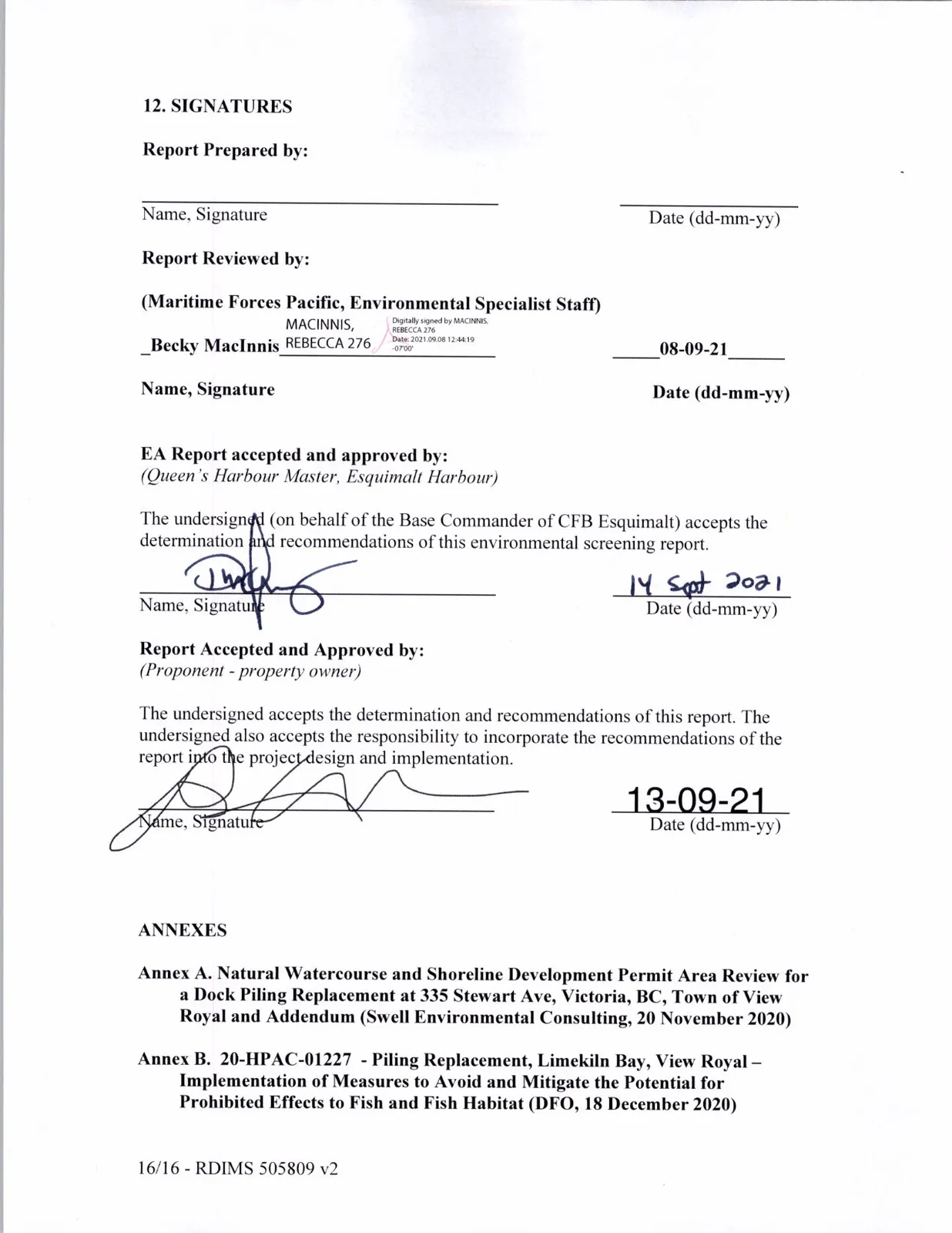
Report Prepared by: Lee Critchley 18-08-21
Report Reviewed by: Becky MacInnis (Maritime Forces Pacific, Environmental Specialist Staff) 08-09-21
EA Report accepted and approved by: (Queen’s Harbour Master, Esquimalt Harbour) 14 Sept 2021
Report Accepted and Approved by: (Proponent - property owner) 13-09-21
ANNEXES
Annex A. Natural Watercourse and Shoreline Development Permit Area Review for a Dock Piling Replacement at 335 Stewart Ave, Victoria, BC, Town of View Royal and Addendum (Swell Environmental Consulting, 20 November 2020)
Annex B. 20-HPAC-01227 - Piling Replacement, Limekiln Bay, View Royal – Implementation of Measures to Avoid and Mitigate the Potential for Prohibited Effects to Fish and Fish Habitat (DFO, 18 December 2020)