TOWN OF VIEW ROYAL BYLAW NO. 1060
A bylaw to amend the Official Community Plan with respect to the Neighbourhood Centre land use designation and the property at 298 Island Highway.
TOWN OF VIEW ROYAL
BYLAW NO. 1060
A BYLAW TO AMEND THE TOWN OF VIEW ROYAL OFFICIAL COMMUNITY PLAN WITH RESPECT TO THE NEIGHBOURHOOD CENTRE LAND USE DESIGNATION, THE NEIGHOURHOOD MIXED USE DEVELOPMENT PERMIT AREA, AND THE LAND USE DESIGNATION OF 298 ISLAND HIGHWAY
The Council of the Town of View Royal, in open meeting assembled, enacts as follows:
This Bylaw may be cited as "Official Community Plan No. 811, 2011, Amendment Bylaw No. 1060, 2020”.
Official Community Plan Bylaw No. 811, 2011 is amended by deleting Part 4 “Development Permit Area: Neighbourhood Mixed Use” in its entirety and replacing it with the following:
“Development Permit Area: Neighbourhood Mixed Use
Areas marked Neighbourhood Mixed Use or Neighbourhood Centre on Schedule P of the OCP are designated Development Permit Areas as per the Local Government Act Section 919.1(1) (f) and (g) for the establishment of objectives and the provision of guidelines for the form and character of multi-unit residential and commercial development in the Town of View Royal.
Justification
Neighbourhood mixed use areas will provide a central focus for neighbourhoods in View Royal. Offering a mix of residential accommodations and neighbourhood-serving commercial services, these areas will become compact, walkable and cycling –friendly local activity hubs.
Objectives
The objectives of requiring a Development Permit in the areas identified as Neighbourhood Mixed Use or Neighbourhood Centre are to:
- Facilitate the orderly development of Neighbourhood Mixed Use areas and Neighbourhood Centre areas and encourage compatibility in the scale and design character of buildings;
- Establish distinct neighbourhood centres offering a mix of retail services, employment opportunities, and a variety of housing types;
- Ensure neighbourhood centres are pedestrian-oriented and cyclist-friendly; and
- Achieve a high standard of design.
Exemptions
In all areas designated Neighbourhood Mixed Residential Use or Neighbourhood Centre, the following development is exempt from obtaining a Development Permit:
- Subdivision of land where a rezoning was not required.
- Internal alterations to a building.
- Building additions, external building or site alterations, not exceeding an estimated construction value of $30,000 which are so similar in their effect on the form and character of development as to not warrant an application in the opinion of the Director of Development Services.
GUIDELINES – DESIGN CHARACTER, ALL DEVELOPMENTS
i. Buildings should address the public realm and contribute to a safe and comfortable pedestrian-friendly streetscape. ii. Materials should be of durable, high quality material and should reflect the natural surroundings of View Royal and a “West Coast” design character; bringing in elements of wood, stone and a natural colour palette. Natural materials are preferred. iii. Building design should promote “eyes on the street” for natural surveillance of the public realm through the provision of entrances, windows, patios, porches and decks facing public streets and spaces. iv. Main entrances should be clearly identified in the streetscape. Entrances may be emphasized with lighting, architectural detailing, colour, special paving, landscaping or other defining features. Weather protection should be incorporated into the entrances of multi-unit buildings. v. Long blank walls should be avoided. Public frontages should present a consistent and visually appealing design through use of materials, windows, articulation and roof treatments. vi. Unsightly roof elements, including mechanical equipment and vents, should be enclosed by roof parapets or other forms of solid screening. vii. Signage should be consistent with the overall design of buildings and should be oriented to pedestrians and cyclists, rather than motorists. viii. Design details such as street lighting standards and street furniture should be of a consistent design and contribute to an attractive streetscape. ix. Containers for garbage and recycling should be stored in a safe and convenient location and screened from view.
GUIDELINES – DESIGN CHARACTER, COMMERCIAL/RESIDENTIAL MIXED-USE
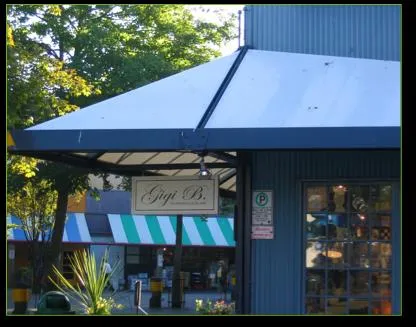
i. Incorporate weather protection along public sidewalks with awnings, canopies or other features.
GUIDELINES – DESIGN CHARACTER, RESIDENTIAL
i. Ground floor units in townhouses and low-rise apartments should have individual front doors that are directly accessible and visible from the street. Ground floor units may be raised up to 0.6 metres (two feet) above grade to provide privacy for dwelling units. ii. Direct access to private outdoor space, some of it covered, should be provided to as many units as possible.
GUIDELINES – SITING, HEIGHT AND MASSING, ALL DEVELOPMENTS
i. New developments should respect the scale and general development pattern of the adjacent use. ii. Create visual interest by providing variations in height, rooflines and massing. iii. Buildings over two-storeys should utilize setbacks and/or terracing above the second level to reduce massing impacts on the street and surrounding neighbours, preserve view corridors and provide visual interest. iv. Residential units and balconies should not protrude further than the commercial façade below. v. Buildings should be located to maximize sunlight exposure to residential units, balconies and on-site common areas or outdoor seating areas. vi. Building siting and placement of balconies, decks and windows should limit overlook and shadowing impact on neighbours.
GUIDELINES – SITING, HEIGHT AND MASSING, COMMERCIAL AND RESIDENTIAL MIXED USE
i. Buildings should be clustered on key roads and intersections to create a hub of residential density and services that is pedestrian-oriented and in keeping with the scale of the neighbourhood. ii. Buildings should be built to the front property line, articulated with generous areas of clear glass windows and doorway entrances set back into retail units.
GUIDELINES – LANDSCAPING, ALL DEVELOPMENTS
i. Retain mature trees, vegetation and natural features wherever possible. ii. Landscaping should contribute to a pedestrian-friendly streetscape and may include street trees, planters, decorative paving, seating, and use of other materials or furniture to add interest and define the pedestrian realm. iii. Utilize native species wherever possible in site landscaping. Plants should be chosen for seasonal interest and compatibility with the local climate. iv. Drought-tolerant plant species are encouraged. v. Landscaping should incorporate an automatic irrigation system. vi. A combination of hard and soft landscaping elements should be used to define the transition between public and private space. vii. Parking areas visible from streets and adjacent residential buildings should be screened with substantial landscaping. Surface parking areas should incorporate trees in planting islands to increase permeability, provide shade and improve the visual appearance of parking areas. viii. Landscape design strategies should be incorporated that minimize stormwater runoff, and promotes the natural infiltration and cleaning of runoff. ix. All landscaping work and plant material shall conform to the most recent edition of the British Columbia Landscape Standard published by the British Columbia Society of Landscape Architects.
GUIDELINES – PARKING, ACCESS AND CIRCULATION, ALL DEVELOPMENTS
i. Provide strong and safe linkages to surrounding parks, trails, schools and other neighbourhood destinations. ii. Pedestrian and cycling access routes should be designed to provide easy and convenient access to transit services, cycling routes, trails and sidewalks. iii. Sidewalks should be provided on public streets. iv. Access and circulation should be safe and convenient for pedestrians and vehicles. v. Parking should be accommodated underground wherever possible. vi. Surface parking should be limited to short term commercial or residential visitor parking and should be suitably landscaped to screen parking areas from public roads and pedestrian routes. vii. Sheltered bicycle parking for visitors should be provided at an accessible location near the primary entrance and located so as to ensure passive surveillance.
GUIDELINES – PARKING, ACCESS AND CIRCULATION, COMMERCIAL AND RESIDENTIAL/COMMERCIAL MIXED-USE
i. If not accommodated underground, commercial parking should be located behind buildings, wherever possible. ii. Servicing and loading areas should be located in a manner that does not negatively impact the pedestrian realm.
GUIDELINES – LIGHTING, ALL DEVELOPMENTS
i. Building and site lighting should be sufficient to ensure pedestrian and vehicle safety. ii. Outdoor lighting should be regulated to control the quantity, quality and direction of night lighting. Lighting fixtures that are “dark skies” friendly to limit light pollution at night are encouraged. iii. Light fixtures should be consistent with the general design character of the building. iv. Street lighting standards should be pedestrian scale, while providing sufficient light for automobile traffic. v. Street light standards should be consistent with street furniture and garbage/recycling receptacles. vi. Outdoor electrical outlets should be provided at regular intervals to facilitate the installation of seasonal/decorative outdoor lighting. vii. Where pole mounted lighting is necessary, light standard luminaries should be no more than 40,000 lumens and mounted on poles no more than 5 metres high.
GUIDELINES – SAFETY
i. All developments should be designed for safety and security by incorporating Crime Prevention Through Environmental Design principles and guidelines with particular attention to passive surveillance, good site lines, appropriate lighting, clear definition of private, semi-private and public space, and appropriate access control measures.
GUIDELINES – OTHER
i. Implementation of “adaptable design standards” in residential development is encouraged to accommodate individuals with mobility challenges, and to facilitate “aging in place”. ii. Incorporation of Green Building strategies such as Leadership in Energy and Environmental Design (LEED®) and Built Green standards in the design and construction all buildings is highly encouraged. iii. Incorporation of resource and energy efficiency into the siting, design, construction and maintenance of buildings and structures is highly encouraged.
Variances
i. Variances to building setbacks, building height, parking and landscape requirements may be considered where it can be shown that the variance does not impact substantial compliance with the intent of the guidelines. ii. Variances for parking standards may be considered where the request for such variances are supported by a satisfactory study prepared for the Town of View Royal by a qualified professional.”
3. Official Community Plan Bylaw No. 811, 2011 is amended by deleting Part 1 Section 1 “Policy LU1.5 Land Use Designations” in its entirety including the accompanying photographic and replacing it with the following:
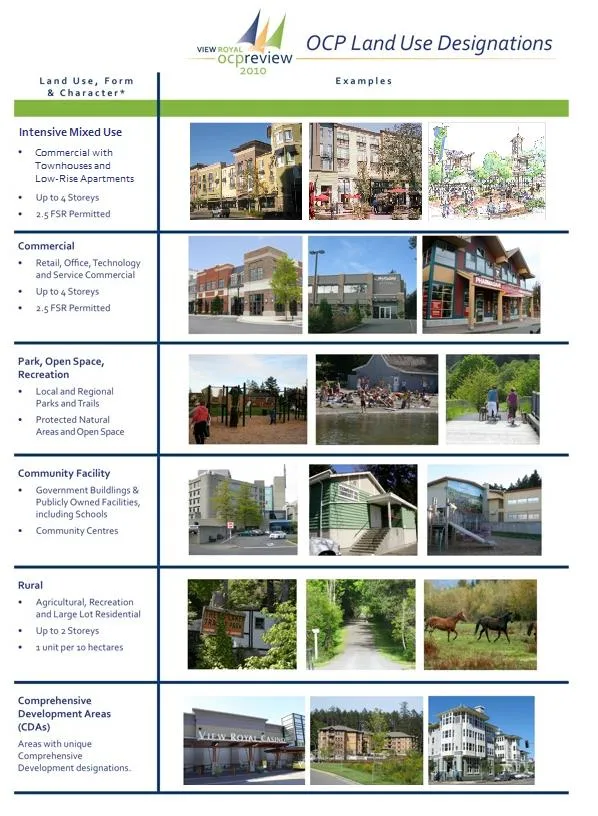
OCP Land Use Designations
| Land Use, Form & Character* | Examples |
|---|---|
| Large Lot Residential • Detached Homes • Large Lots and Yards • Up to 2.5 Storeys |
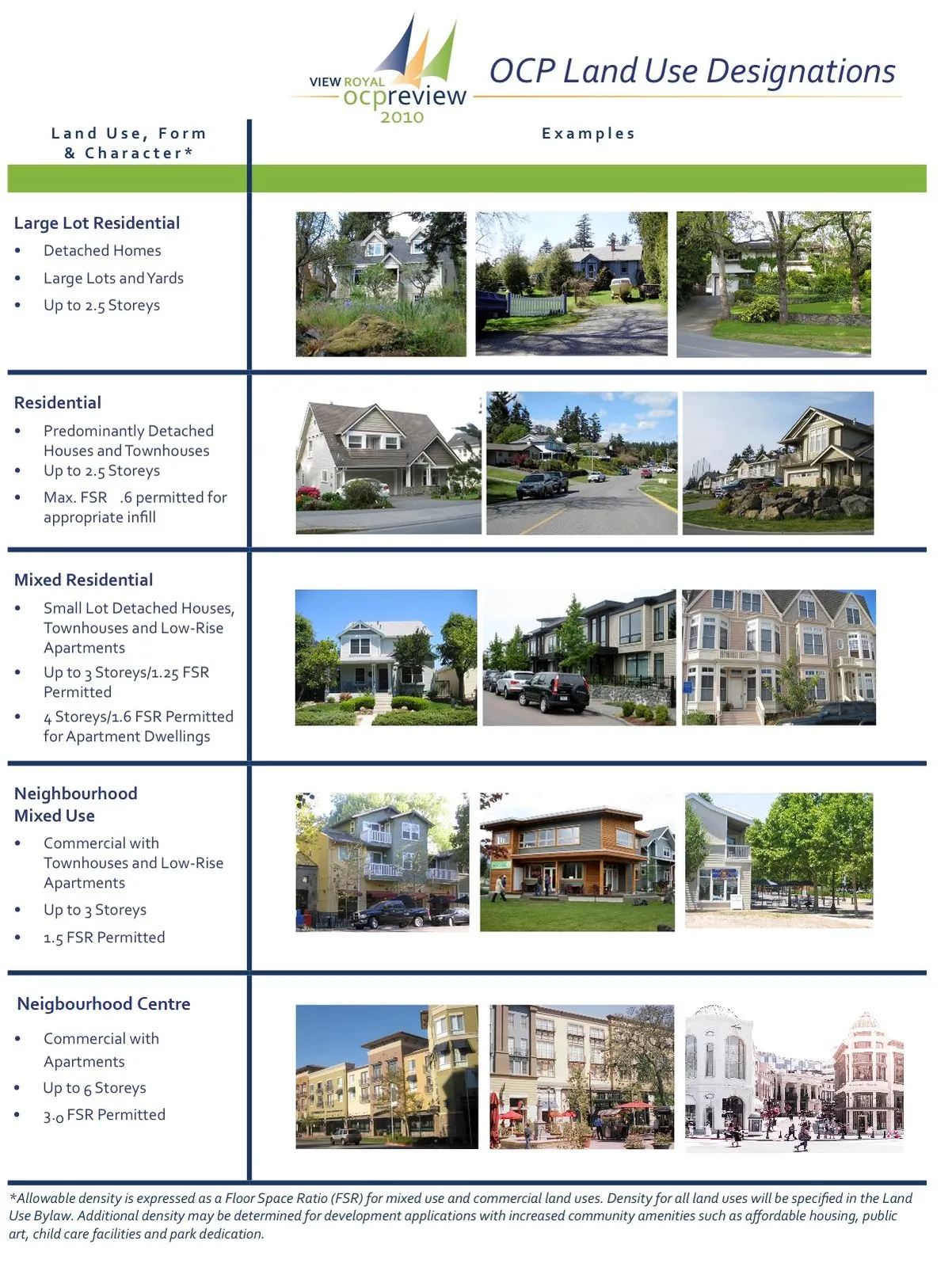  |
| Residential • Predominantly Detached Houses and Townhouses • Up to 2.5 Storeys • Max. FSR .6 permitted for appropriate infill |
, , |
| Mixed Residential • Small Lot Detached Houses, Townhouses and Low-Rise Apartments • Up to 3 Storeys/1.25 FSR Permitted • 4 Storeys/1.6 FSR Permitted for Apartment Dwellings |
, , |
| Neighbourhood Mixed Use • Commercial with Townhouses and Low-Rise Apartments • Up to 3 Storeys • 1.5 FSR Permitted |
, , |
| Neighbourhood Centre • Commercial with Apartments • Up to 6 Storeys • 3.0 FSR Permitted |
, , |
| Intensive Mixed Use • Commercial with Townhouses and Low-Rise Apartments • Up to 4 Storeys • 2.5 FSR Permitted |
, , |
| Commercial • Retail, Office, Technology and Service Commercial • Up to 4 Storeys • 2.5 FSR Permitted |
, , |
| Park, Open Space, Recreation • Local and Regional Parks and Trails • Protected Natural Areas and Open Space |
, , |
| Community Facility • Government Buildings & Publicly Owned Facilities, including Schools • Community Centres |
, , |
| Rural • Agricultural, Recreation and Large Lot Residential • Up to 2 Storeys • 1 unit per 10 hectares |
, , |
| Comprehensive Development Areas (CDAs) Areas with unique Comprehensive Development designations. |
, , |
*Allowable density is expressed as a Floor Space Ratio (FSR) for mixed use and commercial land uses. Density for all land uses will be specified in the Land Use Bylaw. Additional density may be determined for development applications with increased community amenities such as affordable housing, public art, child care facilities and park dedication.
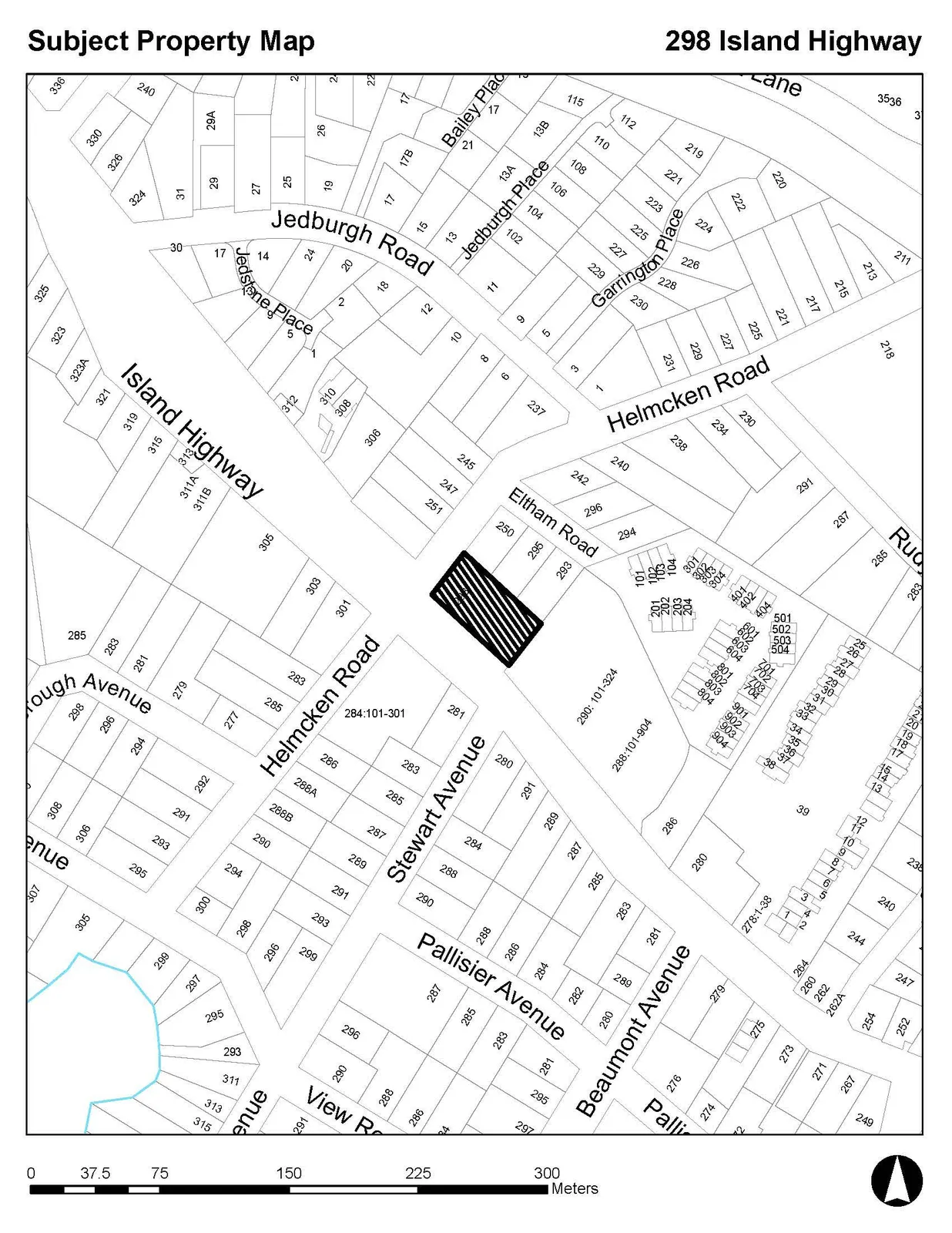
4. Schedule "L" Land Use Designations of Official Community Plan Bylaw No. 811, 2011 is amended by changing the land use designation for the lands addressed as 298 Island Highway and legally described and legally described as
Lot 1, Section 8, Esquimalt District, Plan 35505
and shown outlined on the sketch plan in Schedule “1” forming part of this Bylaw from “Neighbourhood Mixed Use” to “Neighbourhood Centre”.
READ A FIRST TIME THIS ___ th DAY OF _________.
READ A SECOND TIME THIS ___ th DAY OF _________.
PUBLIC HEARING HELD THIS ___ th DAY OF _________.
READ A THIRD TIME THIS THIS ___ th DAY OF _________.
ADOPTED BY COUNCIL, SIGNED BY THE MAYOR AND THE CLERK AND SEALED WITH THE SEAL OF THE TOWN OF VIEW ROYAL THIS ___th DAY OF _________.
_________________________________________ _________________________________________ MAYOR CORPORATE OFFICER
SCHEDULE 1.
Subject Property Map: 298 Island Highway
Document Images
(1)