Annex A: Environmental Overview Report - Natural Watercourse and Shoreline Development Permit Area Review
An environmental assessment by Swell Environmental Consulting regarding the dock piling replacement at 333A Stewart Avenue.
Gary Mathies 333A Stewart Ave. Victoria, BC V9B 1R6
May 7, 2021
RE: Environmental Overview Report - Natural Watercourse and Shoreline Development Permit Area Review for a Dock Piling Additions at 333A Stewart Ave, Victoria, BC, Town of View Royal
Swell Environmental Consulting Ltd. (Swell) consulting has been requested to evaluate the existing condition of the 333A Stewart Ave in reference to a proposed dock piling replacement within the Town of View Royal’s Natural Watercourse and Shoreline Areas Development Permit Area (Figure 1). Dr. Joachim Carosfeld, Executive Director, World Fisheries Trust reviewed video of the site to assess the existing condition and potential environmental impact of the proposed works (see report in Appendix 1). The underwater video was filmed by Lee Critchley, CHL Timberworks on January 31, 2021 (https://gopro.com/v/dM07Kzyo0JrOz).
As per View Royal’s Schedule Q of the Official Community Plan (2011) Bylaw No. 811, the site was assessed for sensitive ecosystems, red and blue listed species, and all environmentally sensitive areas within the site. This Environmental Overview Report summarizes our assessment of the environmental conditions at the property and potential impacts from the proposed dock piling replacement construction work zone.
Natural Watercourse and Shoreline Areas Development Permit Area, Bylaw No. 811
The View Royal Official Community Plan (OCP 2011) Bylaw No. 811, identifies the following Guidelines from the Natural Watercourse and Shoreline Areas DPA that apply to this project:
- Docks and wharves should be sited to avoid impacts on sensitive ecosystems such as eelgrass beds, fish habitat, and natural processes such as currents and littoral drift.
- Piers and pilings and floating docks are preferred over solid-core piers.
- Docks should be constructed of stable materials that will not degrade over time. The use of unenclosed plastic foam or the use of creosote treated pilings is strongly discouraged.
Proposed Works
The owner is proposing to install two 12” steel pilings (Figure 1 and Photo 1). There are two options for the proposed piling locaitons, Option A (yellow circles, preferred location) or Option B (pink circles, if substrate does not permit installation for Option A). No concrete work is proposed.
The owner has stated that they are communicating with Department of National Defense for the work in Limekiln Bay, part of Esquimalt Harbour, and a DFO Project Review will be submitted.
The proposed work will follow the Environmental Protection Measures described later in this report to minimize the risk and prevent impacts to marine fish and their habitat, as well as any advice provided by Fisheries & Oceans Canada in their response to the Project Review which will be submitted to them, concurrent with the Development Permit application to View Royal.
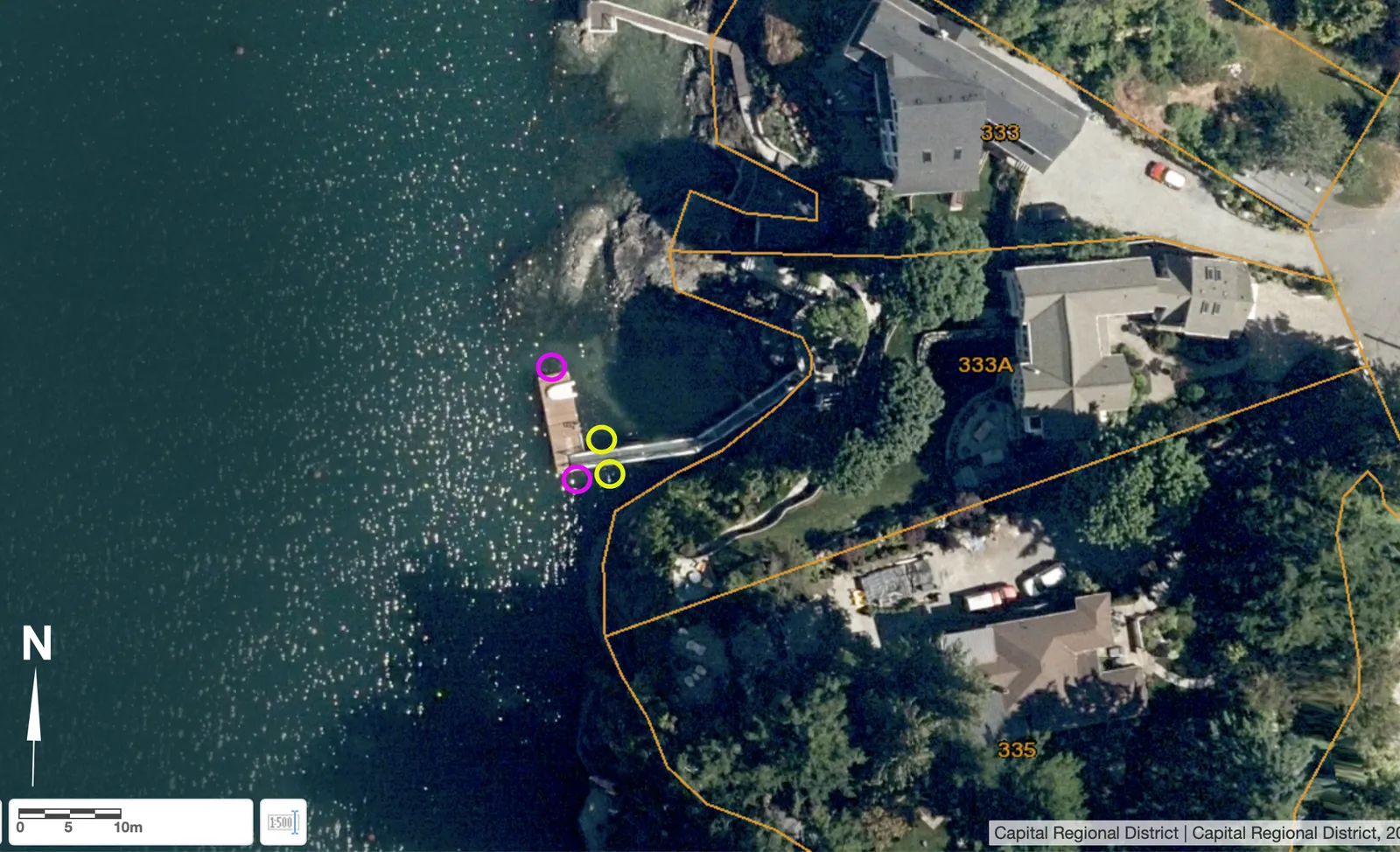
Figure 1. Airphoto showing location of proposed pilings. Option A (yellow circles, preferred location); Option B (pink circles, if substrate does not permit installation for Option A) Airphoto courtesy of Capital Regional District Web Map
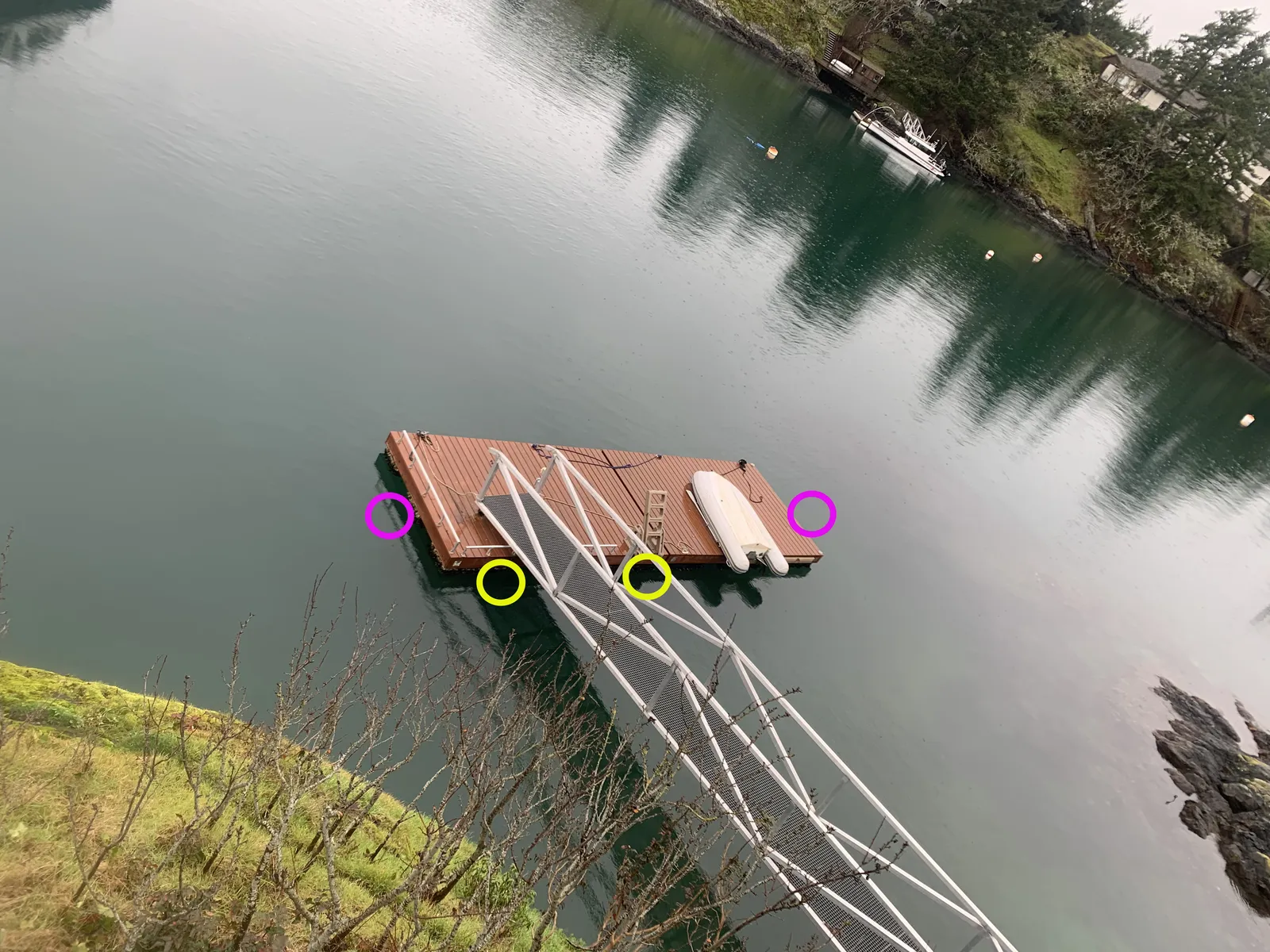
Photo 1. Proposed location for installation of two pilings. Option A (yellow circles, preferred location); Option B (pink circles, if substrate does not permit installation for Option A)
Site Conditions
The site of the proposed work is in the subtidal area adjacent to 333A Stewart Ave, in the vicinity of the existing dock. Dr. Joachim Carosfeld, Executive Director, World Fisheries Trust reviewed video of the site to assess the existing condition and potential environmental impact of the proposed works (see photos and report in Appendix 1). The underwater video was filmed by Lee Critchley, CHL Timberworks.
The work will take place approximately 15m from the shoreline, in approximately 4 metres water depth.
Dr. Carosfeld, described the site as follows:
The location is at the mouth of Limekiln Bay, part of the Esquimalt Harbour, an area characterized in the CRD Harbours Atlas (Fig. 3). In general, this is a bedrock and boulder shoreline, with pocket beaches, leading to a shallow soft bottom.
The site evaluation confirmed this general character – a bedrock and boulder-rich steep shoreline drops to a sandy mud bottom at a depth of about 2 m. The soft bottom extends at a low slope into the harbor, with scattered debris and rocks.
Biological assessment:
At the time of the survey (January, 2021), the mud bottom in the area of the proposed pilings was devoid of large algae or eelgrass, with some wireweed Sargassum and bladed kelp Laminaria on larger rocks. More algae are present on the rock shore, including a variety of bladed red algae, and may be more prevalent later in the year. Otherwise, the sandy mud bottom has a thick diatom biofilm, pock-marked by active clam and worm burrows (Fig. 4), with numerous plumose anenomes (Metridium spp.) attached to debris. The pink starfish Pisaster brevispinus was observed, likely responsible for numerous clam excavation pits. Red rock crabs were also seen (Fig. 6).
Impact of Proposed Development
Following completion of the site assessment, Dr. Carosfeld, determined (Appendix 1):
No eelgrass was observed in the project area. The sandy mud bottom, with rich clam resources and Laminaria kelp bed, are typical of this region and widespread. Piling placement should not affect any sensitive habitats.
Recommendations and Environmental Protection Measures
A dock is existing at 333A Stewart Avenue and the proposed addition of two dock pilings will have a minimal effect on the ecological conditions of the subtidal area in the vicinity of the work, provided the following environmental protection measures are implemented during the piling installation:
- Submit a Project Review to DFO concurrently with the Development Permit Application and implement any additional recommendations provided.
- Marine construction activities are restricted to the following Reduced Risk Timing Windows in order to ensure that significant harm does not occur to fish or fish habitat, as per Fisheries and Oceans Canada under the federal Fisheries Act:
- Summer Window: July 1 – August 1
- Winter Window: December 1 – February 15
- Minimize the duration of in-water works to the extent possible.
- Conduct works during favourable weather conditions.
- Pipe piles must be capped or otherwise treated to prevent birds from being trapped inside the piles.
- Ensure appropriate contingency materials (e.g., bubble curtain, silt curtain) are readily available onsite in sufficient quantities for local conditions and will be employed if required by the Environmental Monitor
- Water-based equipment should not ground upon the seabed except for the use of anchors or spuds needed to keep the water-based equipment in position.
- Minimize movements/repositioning of barge and subsequent spudding to minimize physical disturbance to the seabed.
- Avoid spudding down or anchoring in sensitive fish habitats such as eelgrass beds or kelp beds or estuarine marsh.
- Conduct works during suitable tides to avoid grounding out and propeller scour from vessel and barge movements.
- The following mitigation measure should be applied to protect marine mammals:
- Vessels must maintain a minimum distance of 100 m from whales with the exception of populations of killer whales where the minimum distance is 200 m.
- If there is a risk of harm to a marine mammal from direct contact, temporarily suspend construction until the individual has left the exclusion zone or has not been sighted for 30 minutes.
- If a vibrohammer is not used, and impact pile driving is required, the Contractor must engage hydroacoustic monitor during pile installation.
- Contractor must have access to bubble curtain, if needed, to mitigate the pressure in excess of the levels described below.
- Establish separate fish and marine mammal exclusion zones prior to impact pile driving and monitor the zones for the presence of fish for at least 10 minutes and for marine mammals for at least 30 minutes prior to the start of impact pile driving.
- Conduct pile driving during daylight hours and when weather conditions permit visual assessments for marine mammals in the exclusion zones.
- If fish and marine mammals are not observed in the respective exclusion zones during the pre-start period, a soft start procedure is recommended where the energy is gradually increased over a 10 minute period. The soft start procedure is also recommended anytime after there is a break of 30 minutes or more during impact pile driving.
- If a marine mammal enters the marine mammal exclusion zone, temporarily suspend impact pile driving until the individual has left the exclusion zone or has not been sighted for 30 minutes.
- The recommended sound thresholds are 206 dB re: 1 μPa and a SELcum of 186 dB re: 1 μPa2s at the boundary of the fish exclusion zone and 160 dBRMS re: 1 μPa at the boundary of the marine mammal exclusion zone.
- If hydroacoustic monitoring indicates that these thresholds are being exceeded, impact pile driving should cease and only resume after additional mitigation measures (e.g., bubble curtain) are implemented to effectively reduce sound levels below the thresholds.
- An appropriate sediment control plan should be developed and implemented to minimize sedimentation of the aquatic environment during all phases of the work, undertaking or activity.
- The direct or indirect release of sediment or sediment-laden water into the aquatic environment or the induced sedimentation of foreshore or nearshore areas or the induced turbidity of water in the aquatic environment is to be minimized during the works.
- The following criteria must be complied with:
- Total Suspended Solids (TSS):
- TSS should not exceed 25 mg/L
- Turbidity:
- Turbidity should not exceed 2 nephelometric units (NTU) when background is less than 8 NTU.
- Turbidity should not exceed 8 NTU when background is between 8 and 80 NTU.
- Turbidity should not exceed background by more than 10% when background is greater than or equal to 80 NTU.
- “Background” is defined as the level at an appropriate adjacent reference site, that is satisfactory to DFO, and is affected neither by works or activities associated with the project or the works site, nor by sediment-laden water, induced suspended sediments, or induced turbidity resulting from works or activities associated with the project or the work site.
- Should the project result in TSS or NTU levels in excess of the criteria outlined above, then those works and activities that might be contributing to these conditions must be halted until measures that will ensure compliance with the criteria outlined above are put in place.
- Where the suspended solids and turbidity criteria outlined above cannot be practicably achieved, work areas and those works and activities that might be contributing to these conditions must be contained and isolated from tidal and flowing waters such that fish are prevented from accessing the work areas, and sediments, sediment-laden water, and turbid water are contained and prevented from leaving the work areas.
- Total Suspended Solids (TSS):
- The following criteria must be complied with:
- A debris management plan (containment and removal) should be developed and implemented for piling installation and removal activities to prevent construction materials and debris (treated wood fragments, sawdust, cuttings, lead/zinc based marine paint etc.) from entering or being deposited onto aquatic habitats.
- Piles or other materials should not be dragged on the seabed but rather lifted clear by an excavator/ machine.
- All works must be undertaken and completed in such a manner so as to prevent the release of substances deleterious to fish and other aquatic life pursuant to Section 36 of the Fisheries Act, which specifically prohibits the deposit of deleterious substances into fish bearing waters. Due diligence is required at all times to prevent such deposits, and adherence to the measures in this letter does not of itself relieve the proponent of this ongoing obligation.
- An appropriate spill prevention, containment, and clean up contingency plan for hydrocarbon products (e.g., fuel, oil, hydraulic fluid, etc.), and other substances deleterious to aquatic life should be put in place prior to work commencing.
- All equipment will be maintained in good proper running order to prevent leaking or spilling of potentially hazardous or toxic products. This includes, but is not limited to, hydraulic fluid, diesel, gasoline and other petroleum products.
- Equipment will be inspected for leaks prior to beginning work.
- All hydrocarbon products (fuel, oil, hydraulic fuel, lubricants), fueling equipment, and deleterious substances must be stored and handled in accordance with all applicable legislation, guidelines and BMP’s. An appropriate spill prevention, containment and cleanup contingency plan for hydrocarbon products and any other deleterious substances that may be used or transported to the project site, must be in place prior to work commencing on the project to ensure that spills are contained and prevented from entering the marine environment.
- Contractors will have emergency spill equipment available whenever working near or on the water. The emergency spill equipment should be appropriate for the specific operation and environmental conditions and equipment operators should be trained in their deployment and use.
- Appropriate spill containment and cleanup supplies should be kept available onsite.
- Onsite personnel should also be trained in spill prevention, containment and cleanup procedures.
Environmental Monitoring
- Owner must notify the Qualified Environmental Professional (QEP) a minimum of 2 weeks prior to the initiation of the works.
- A QEP will monitor the piling installation, including a pre-construction meeting with the contractor, and monitoring for sediment releases, spills, water quality,
- If impact pile driving is used, the Contractor must also engage a hydroacoustic monitor to monitor pressure within the marine environment.
- The QEP must be on site at all times during the course of the project whenever there is the potential for adverse effects or fish or fish habitat.
- Upon completion of the project, the QEP will provide DFO with a monitoring report summarizing the project and describing any environmental issues that arose during the project. Monitoring results should be forwarded to the appropriate contact at DFO’s Oceans, Habitat and Enhancement Branch.
- Any adverse effects will be reported to DFO.
- If contractors are working and a herring (or other fish) spawning occurs or if there are any negative impacts to fish or fish habitat, the work will be suspended until the appropriate DFO contact has been notified and has provided direction.
Provided the Best Management Practices above are followed, the applicable guidelines for the Development Permit Area are expected to be met, and we do not expect the proposed construction activities to have any negative impacts to the current ecosystems of the 15-m DPA setback or subtidal marine environment.
In summary, the proposed work will not disturb any rare or endangered species or ecosystems and provided the measures described in this review are followed, the effects of the project on the marine environment and shoreline conditions are expected to be minimal.
Please do not hesitate to contact us with any questions you may have.
Sincerely,
Lehna Malmkvist, MSc, RPBio (#1613)
APPENDIX 1. Piling Replacement Proposal, 333A Stewart Ave., View Royal, BC, Subtidal Habitat Assessment. Dr. Joachim Carosfeld, Executive Director, World Fisheries Trust
Document Images
(1)